

This article is incomplete
Some sections are missing or need additional details. Help improve it by contributing.
Cinder City is built as an open-world MMO tactical shooter, and its multiplayer structure stretches from quiet solo runs through tight squad dungeons up to large shared fields packed with other players. The core promise is flexibility: you can take on the world alone at your own pace, or team up with a squad and tackle tougher content together. The game is online-only and leans heavily toward cooperative play against the environment rather than player-versus-player competition, so most of the structure described here is about working with other people, not against them.
Solo and Squad Play
At the smallest scale, the narrative campaigns are designed so a player can run them entirely solo. Each playable hero has their own 5 to 6 hour single-player campaign that serves as a tutorial leading into the shared open world; the overall “epic” main story is estimated at 10 to 15 hours, and combining all heroes' campaigns plus side stories totals around 100 hours of story-driven content. When players want more firepower or simply company, they can group into a co-op squad. A coordinated squad opens the door to harder objectives that would be difficult or impractical to clear alone, and it lets players combine different hero strengths, as covered on the Heroes and Classes page.
Instanced Dungeons
Beyond open exploration, the game features instanced group dungeons. Most dungeons are designed around four-player parties, with some content extending up to six players. These dungeons take place in spaces like underground passages and subway tunnels, and are matchmade or pre-formed before entry. Importantly, dungeons are not stratified into hard difficulty tiers: bosses inside instanced dungeons are not necessarily stronger than world bosses outside. The difference is in the patterns, gimmicks, and characteristics of each fight rather than raw stat scaling.
Shared Open World
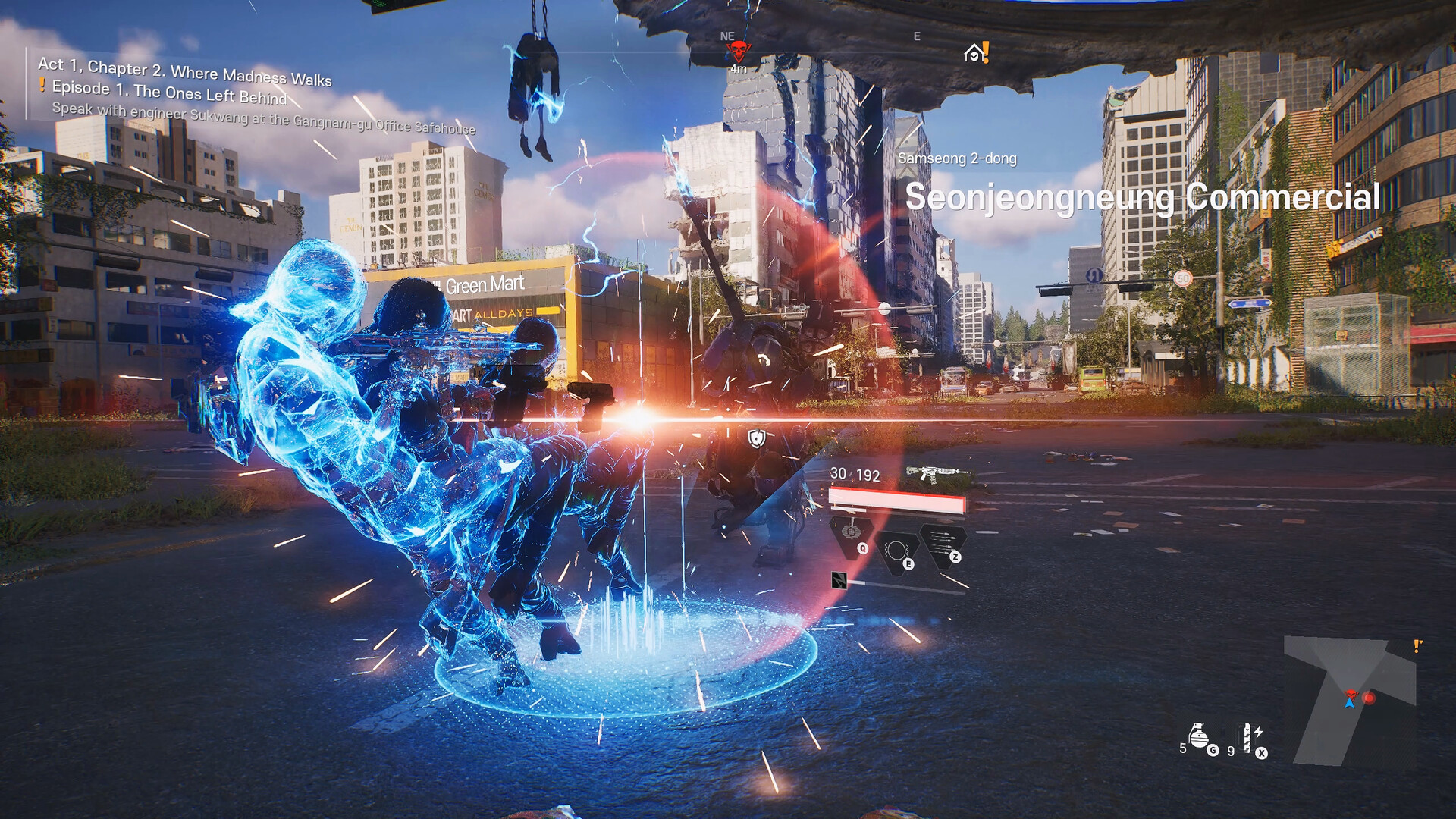
The largest layer is the shared open-world field itself. The world is being engineered for “hundreds” of players in the same space, and the studio is still tuning the exact number through closed testing. Recent demos and dev interviews have cited a working range that starts around 200 players demonstrated in playtest, rises to 300 to 500 promised for launch, and could climb toward 1000 as an upper bound depending on Closed Beta Test feedback. All of these counts are approximate and not yet final. The setting for these shared spaces is detailed on the Seoul Open World page.
World Bosses and Dynamic Events
The open world hosts large-scale world bosses, the marquee example being the Godzilla-sized mech shown in the Opening Night Live trailer with tens of players surrounding it. Alongside set-piece bosses, the world surfaces dynamic events that trigger when players reach specific points on the map. Bae has signaled the studio is still balancing how dense to make these events relative to scripted side quests, with players seeming to favor large-scale combat over many small side stories.
Approximate Group Sizes
The table below summarizes the player counts shown so far. Every value is approximate and subject to change before release.
Activity | Approx. Players |
|---|---|
Solo campaign | 1 |
Instanced dungeon party | 4 (some up to 6) |
Open-world world boss | Tens of players around a single boss |
Shared open-world field | Hundreds (range cited: 200 demonstrated, 300 to 500 promised, 1000 floated) |
PvE Focus
Cinder City is heavily PvE-focused, meaning the bulk of its content pits players against the world and its enemies rather than each other. Cooperation is the throughline across every scale of play, from a lone run to a full field of operatives. PvP is not part of the launch core mode; Bae has confirmed the team is exploring the idea of dedicated PvP zones, but the form of any future PvP has not been decided and the feature remains at the idea stage as of early July 2026.
Endgame Structure
Endgame in Cinder City revolves around PvE content. The studio frames endgame threats across three scales: field bosses roaming the open world, instanced dungeons (typically in underground or subway areas) that require a party to matchmake or pre-form before entering, and massive world raids that pull large numbers of players together against a single target. Bosses are differentiated by patterns, gimmicks, and characteristics rather than by escalating difficulty tiers, and the studio plans the regular MMO cadence of post-launch content updates that add new dungeons and new heroes.
Closed Beta and Launch
A global Closed Beta Test is planned ahead of launch. Bae described the window in September 2025 as falling between the start and middle of 2026, and NC America CEO Jeonghee “JJ” Jin reaffirmed at GDC 2026 that the CBT is coming “in the near future” and that the launch window remains second half of 2026, with no specific date yet narrowed down. The CBT is positioned as the key moment that will inform the final launch timing. Official pre-launch screenshots corroborate the four-player party size: one shows a stacked party list of three named teammates alongside the local player, each with their own health bar and status icon, with floating nameplates tracking them in the world. Before it, a first Pre-Alpha Playtest was held from August 14 to 16, 2026 with sign-ups opened on July 30; that test was United States only, restricted to players aged 16 or older, and covered by a non-disclosure agreement that bars participants from recording, streaming, or posting anything from the build, so it is not expected to produce public footage of the cooperative modes. The studio has said further playtests with other regions will follow. For how these activities tie into the broader loop, see the Gameplay Overview. As the studio shares more, these counts and modes will be confirmed and updated here.