

Combat and Gunplay
Combat is central to Cinder City, and the game builds its action around realistic gunplay backed by a range of distinct encounter types. The studio has emphasized firearm combat that authentically replicates firearm operations, giving the shooting a grounded, deliberate feel.
On This Page
Combat is central to Cinder City, and the game builds its action around realistic gunplay backed by a range of distinct encounter types. The studio has emphasized firearm combat that authentically replicates firearm operations, giving the shooting a grounded, deliberate feel. Beyond standard firefights, players face giant mechs, mutated Creatures in confined spaces, and open-world battles across the city. This page covers the main pillars of combat as they have been shown so far across the Gamescom 2025 and G-STAR 2025 demo builds.
Realistic Gunplay
The foundation of combat is realistic gunplay. Firearms are designed to authentically replicate firearm operations, with first-shot accuracy maximized and recoil patterns shaped by the attachments a player bolts onto a gun. Vertical grips, stocks, and other parts each change a weapon's characteristics, so players can dial in a shooting style that fits their hero and loadout. The grounded approach shapes the rhythm of every fight, rewarding careful aim and positioning over arcade-style abstraction.
Third-Person and First-Person Toggle
Cinder City is primarily a third-person shooter, but players can switch to first-person view when aiming down sights for tighter precision shots. The view toggle is free at any time, giving fights a flexible feel between cinematic third-person traversal and focused first-person aim. Players can also lean out from behind cover and fire blind by extending only the gun, without committing to a full third-person aim.
Movement and Stamina
The suit Knights wear functions as both armor and movement system. Sprinting, jumping, and dashing all consume the suit's energy reserve, which doubles as a stamina pool. Dodging sideways out of incoming fire and chaining short dashes between cover points are the primary defensive tools, and the energy cost forces players to pace their evasions.
Cover and Tactical Freedom
The Gamescom 2025 demo built combat around cover-based shooting, but the team explicitly stepped away from that approach for the G-STAR 2025 build. CEO Bae described the change as a deliberate experiment: the cover-first design was limiting free movement such as parkour and jumping, so the studio scaled cover back and redefined the loop around tactical freedom and unrestricted movement. Cover has not been completely abandoned, but it is no longer the primary spatial language of a fight.
Tactical Skills
Each hero brings a set of tactical skills tied to the gear they have equipped. Skills shown in demos include a personal energy shield, a salvo of homing missiles, a barrier-style shield dome, a projectile-hijack that redirects incoming fire back at attackers, and a supply call that drops ammo and grenades. Tactical gear also includes utility tools such as combat drones and stealth systems. In the G-STAR build skills are structured as consumable charges rather than recurring cooldowns: once a player picks up or acquires a skill they have a finite number of uses before they need to find or earn more, rather than waiting for a timer.
Localized Damage and Dismemberment
Hits are tracked by body part. Executive Producer Hwang Sung-jin has confirmed that dismemberment is part of the design and that future enemies will continue to act after losing pieces of themselves: some may keep attacking even without a head, while others will change their behavior after losing an arm or a leg. The system pushes players toward thinking about where they hit an enemy, not just how many shots they land.
Takedown Options
Downed enemies can be finished in several ways. A clean headshot before they fall ends a fight outright; an enemy that survives the initial barrage drops into a critically injured state from which a player can finish them with another bullet, walk up and kick them out, or simply walk past and leave them. The choice is part of the game's brutal-choices framing rather than purely tactical.
Enemy AI
Enemies use a 3D space-aware AI that tracks both the player's position and the geometry around it. NPCs flank around walls, take cover behind objects, throw smoke grenades to break line of sight, and reposition based on what they see. Bae has cited the AI as one of the reasons development has taken so long: the team did not want the game to feel like a wave shooter against stationary targets.
Confirmed Enemies
Several distinct enemy types have been showcased in the public demos.
Enemy | Role | Notes |
|---|---|---|
Iron Smasher | G-STAR Part 1 boss | A large mechanical enemy with a flying hammer attack pattern. Best countered with an RPG to interrupt the swing. |
Ulgoras | G-STAR Part 2 boss (Chamber 17) | Found inside a dark hospital sequence. Only takes damage from specific weak points, demanding precise aim and target identification. |
Creature | Standard indoor enemy | Mutated humans that inhabit lightless indoor spaces. Vulnerable to fire; Molotov cocktails are a fast counter early game. |
Armed Rebels | Standard outdoor enemy | Human factions armed with smuggled mega-corp weapons. Some wear armor that forces aim at weak points; some self-destruct on approach. |
Hyde group | Hostile criminal faction | A named criminal organization active in the ruined city, cast as one of the principal human threats alongside the armed rebels. |
Mech bosses | Open-world world boss | Giant mechs that demand many players to bring down. Showcased in the Gamescom 2025 Opening Night Live trailer with tens of players surrounding a single mech. |
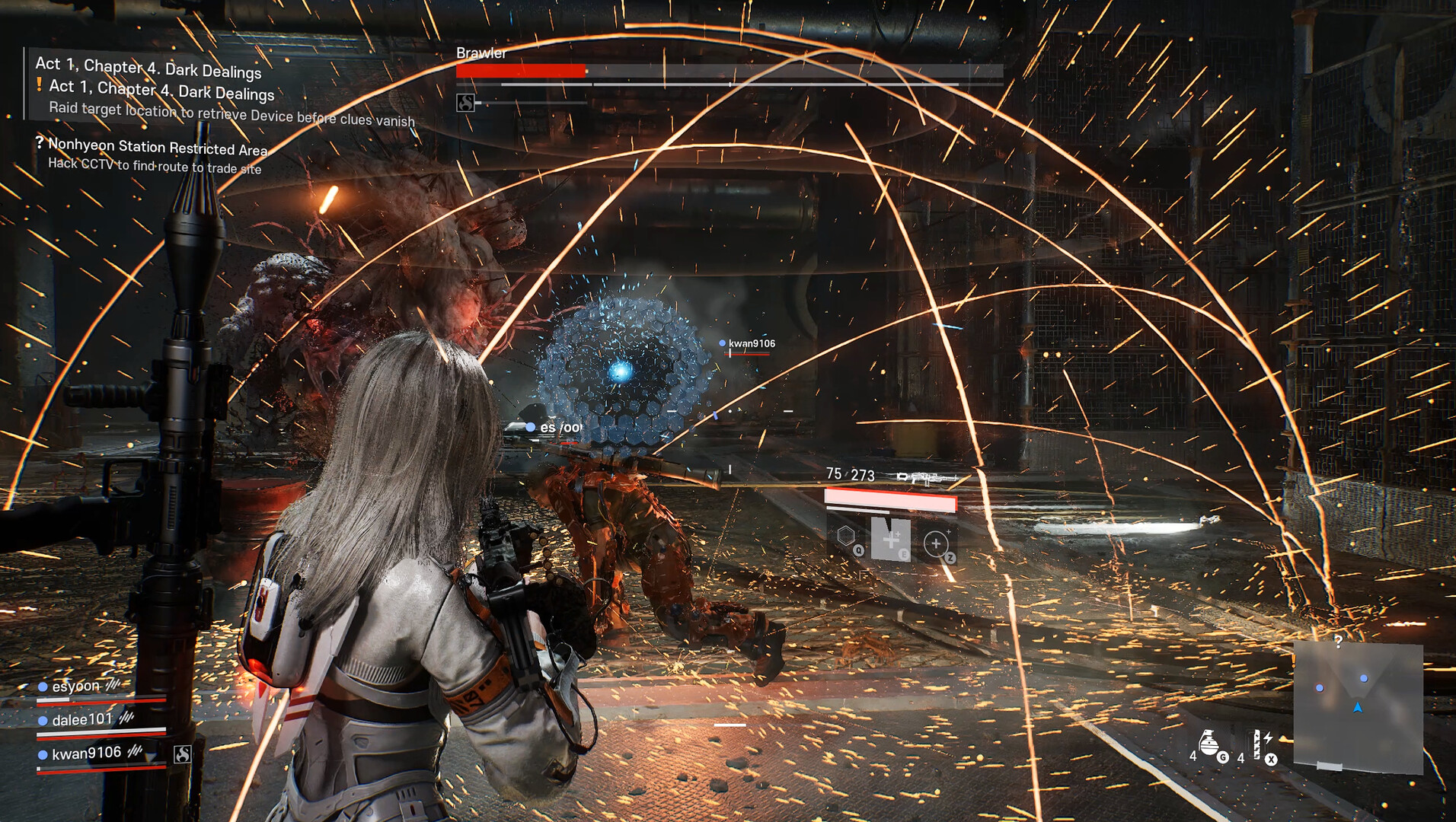
Brawler | Named enemy in official screenshots | A large enemy fought indoors with a boss-style named health bar plus a second segmented bar beneath it, suggesting a separate armour or shield layer that must be stripped before health damage applies. |
Heads-Up Display
The interface shown in official pre-launch screenshots is compact and sits mostly around the screen edges. A compass ribbon runs along the top with cardinal markers and objective pips, and the mission tracker occupies the upper left. The lower right carries a minimap, a throwable count, and a battery-style charge indicator. Ammunition appears as a magazine-over-reserve readout, with values such as 30 over 192 and 75 over 273 visible in different shots, indicating reserve pools far larger than a single magazine.
Ability slots are bound to the Q, E, and Z keys on the keyboard layout shown, sitting in a row beside the weapon and ammunition readout, with contextual prompts for aiming and for deploying tactical gear. Enemy health appears as a floating bar with a numeric value above ordinary enemies, while named targets get a wider bar anchored to the top of the screen. Teammates appear both as a stacked party list in the lower left and as floating nameplates over their characters in the world. These details come from official pre-launch screenshots, so naming, structure, and interface elements may change before release.
Vehicles in Combat
Vehicles surface in both demos and dev interviews as part of the combat loop. Motorbikes give Knights a fast traversal option between contested zones, and the open-world build extends that to cars, helicopters, “technical” gun-trucks, and power loader mechs. Mechs themselves are not just enemies: Bae has confirmed players will be able to hijack and pilot mechs to turn them against other threats.
Combat Pillars at a Glance
Combat Type | Description |
|---|---|
Realistic gunplay | Firearm combat with first-shot accuracy and recoil shaped by attachments. |
Giant mech battles | Large-scale set-piece fights against towering mechs in the open world. |
Corridor Creature fights | Confined indoor encounters against mutated humans that are weak to fire. |
Open-world shooting | Firefights against armed rebels across the streets and structures of the city. |
Tactical-skill plays | Single-use skill charges layered on top of gunfire (shields, missiles, projectile hijack). |
Related Systems
Build progression in Cinder City centers on weapon upgrades, with character growth treated as secondary. How combat connects to the broader role system is covered on the Heroes and Classes page. For how these combat pillars fit into the wider gameplay loop, see Gameplay Overview, and for the larger encounters and the multiplayer side of the loop see Co-Op and Multiplayer.