

Seoul Open World
The open world of Cinder City is a reimagined version of Seoul, built in Unreal Engine 5 as a seamless space for players to explore. Set in a post-apocalyptic, alternate-history timeline, the world blends real geography with science-fiction elements, giving players a recognizable city transformed by apocalypse and advanced technology.
On This Page
This article is incomplete
Some sections are missing or need additional details. Help improve it by contributing.
The open world of Cinder City is a reimagined version of Seoul, built in Unreal Engine 5 as a seamless space for players to explore. Set in a post-apocalyptic, alternate-history timeline, the world blends real geography with science-fiction elements, giving players a recognizable city transformed by apocalypse and advanced technology. This page covers the structure of the open world, the real districts it draws on, its approximate scale, and how players share the field.
A Reimagined Seoul
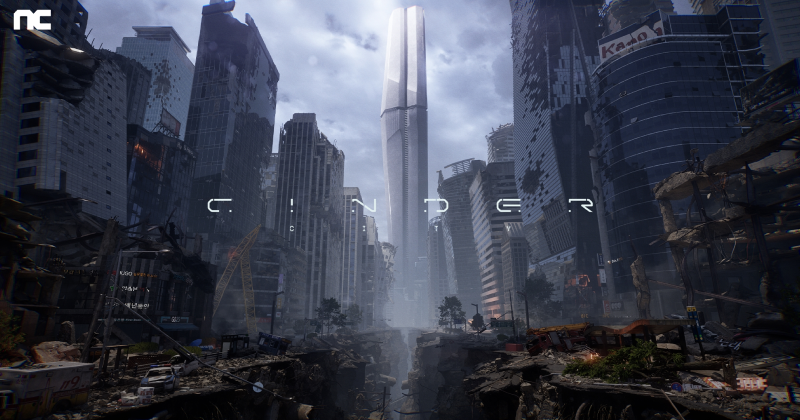
The setting is an alternate-history Seoul where 23rd-century technology has spread through a 21st-century city. Rather than a generic future metropolis, the world is rooted in a real place, which gives exploration a sense of authenticity. The Unreal Engine 5 foundation supports a seamless open world, letting players move through the city and its encounters without hard breaks. For the broader lore and story behind this world, see the Setting and Story page.
Real Districts and Cameos
The world draws on real Seoul districts and landmarks to ground its science-fiction premise. NCSOFT has officially called out Samseong-dong and Nonhyeon-dong as the primary inspiration; the team built much of the playable area from real-world urban data captured in the Samseong Station area three to four years before the public demos. Builds shown at G-STAR 2025 also surface cameos of recognizable Seoul landmarks like the Bongeunsa temple complex and the COEX convention center, reinterpreted as alternate-history ruins. Visual touches reinforce the same grounding: “safety first” signs and signage for stations such as Seolleung Station appear in the demo environments. Building the open world around recognizable districts reinforces the alternate-history framing, so the futuristic and post-apocalyptic elements play out across streets and locations rooted in the real Seoul.
Official screenshots of the pre-launch build show how those districts surface during play. On-screen location banners name Samseong 2-dong and a Seonjeongneung Commercial area within it, while mission text points players to a Gangnam-gu Office safehouse and to a Nonhyeon Station Restricted Area. That places named administrative buildings and subway stations inside the playable space rather than leaving the districts as backdrop, and it lines up with Samseong-dong and Nonhyeon-dong being the two areas the studio has named as primary inspiration. Street-level dressing continues the same grounding, with ordinary mart and convenience-store frontage still standing along ruined commercial strips. These details come from official pre-launch screenshots, so naming, structure, and interface elements may change before release.
World Scale
The open world is large but bounded. CEO Bae has described the playable space as approximately 8 kilometers in diameter, framing it as larger than the playable area of GTA V. A separate dev framing describes the world as roughly 7 by 7 kilometers wide, organized into two launch locations of about 7 square kilometers each. Both framings describe a dense, focused world rather than an unbounded sprawl, suited to the game's mix of street-level firefights, larger mech battles, and confined Creature encounters. The G-STAR 2025 demo temporarily removed the open-world layer to ensure the build's overall polish; the open-world content will return as development progresses, with more near-future visual elements being layered onto the current “intentionally incomplete” look.
Aspect | Early Indication |
|---|---|
World size (Bae quote) | Approximately 8 km in diameter; framed as larger than GTA V |
Alternative framing | Roughly 7 by 7 km wide, two launch locations of about 7 sq km each |
Players per field | Hundreds (range: 200 demonstrated, 300 to 500 promised, 1000 floated upper bound) |
Engine | Unreal Engine 5 |
Reference geography | Samseong-dong, Nonhyeon-dong (primary); Bongeunsa, COEX (cameo) |
Vehicles in the Open World
Traversal is not limited to walking and sprinting. The open world supports a variety of vehicles: motorbikes for fast solo movement, cars and “technical” gun-trucks for groups, helicopters for vertical traversal and aerial firefights, and power loader mechs and other mechs that players can hijack from the battlefield and pilot themselves. The bike vehicle was confirmed in the Gamescom 2025 hands-on; the wider lineup was confirmed by Bae in interviews around the same period.
A Shared Field
As an MMO, the world is shared among many players at once. The studio has consistently described the design target as “hundreds” of players in the same field, with specific cited numbers ranging from around 200 players demonstrated in playtest, up to 300 to 500 promised at Gamescom 2025, and a potential 1000 floated as an upper bound. The exact figure will be tuned through the Closed Beta Test. Even at the lower end, the scale is meant to make populated areas feel alive with other operatives moving through the same space rather than serving as an empty wilderness. How players group up within this field is covered on the Co-Op and Multiplayer page.
Dynamic Events
The open world is designed to feel active, with dynamic events surfacing as players explore. These trigger when a player reaches a specific point on the map rather than along a fixed quest path, and they keep the city alive between scripted missions. Combined with the variety of combat encounters and the surface-versus-underground split (the surface leans toward shooter combat; underground areas lean toward horror and Creature fights), the events help the world feel responsive. For how exploration ties into the wider gameplay loop, see Gameplay Overview, and for the encounters waiting in the world see Combat and Gunplay.