
Loading...
Loading...
Resources and Economy
September 11, 2026 at 10:43 PM
Removed repeated body wikilinks, keeping the first occurrence of each target
The economy of ZeroSpace runs on two main resources, supported by a supply system and by control of key points on the map. Managing these is the foundation of every mode, from the Campaign to Skirmish.
Two of those systems decide more than income. Hexite fixes where you are allowed to build, and experience decides how fast your faction and your hero scale, so the economy doubles as the map control layer.
Resource | Role | How You Get It |
|---|---|---|
Hexite | Primary resource for most units and structures | Mined from hexite patches by extractors that raise themselves, and dropped by neutral creep units |
Flux | Secondary resource for advanced units, structures, and upgrades | Grows on the map as purple crystal and falls at marked impact sites on a countdown timer; carried home by a harvester unit |
Supply | Caps how large your army can grow | Raised by building supply structures for your faction, at 12 supply each |
Experience | Raises your faction level, and each level buys a talent | Generated continuously by XP towers you have captured |
Power | Pays for the abilities on your top bar | Accumulates slowly on its own, and refills when your own units die |
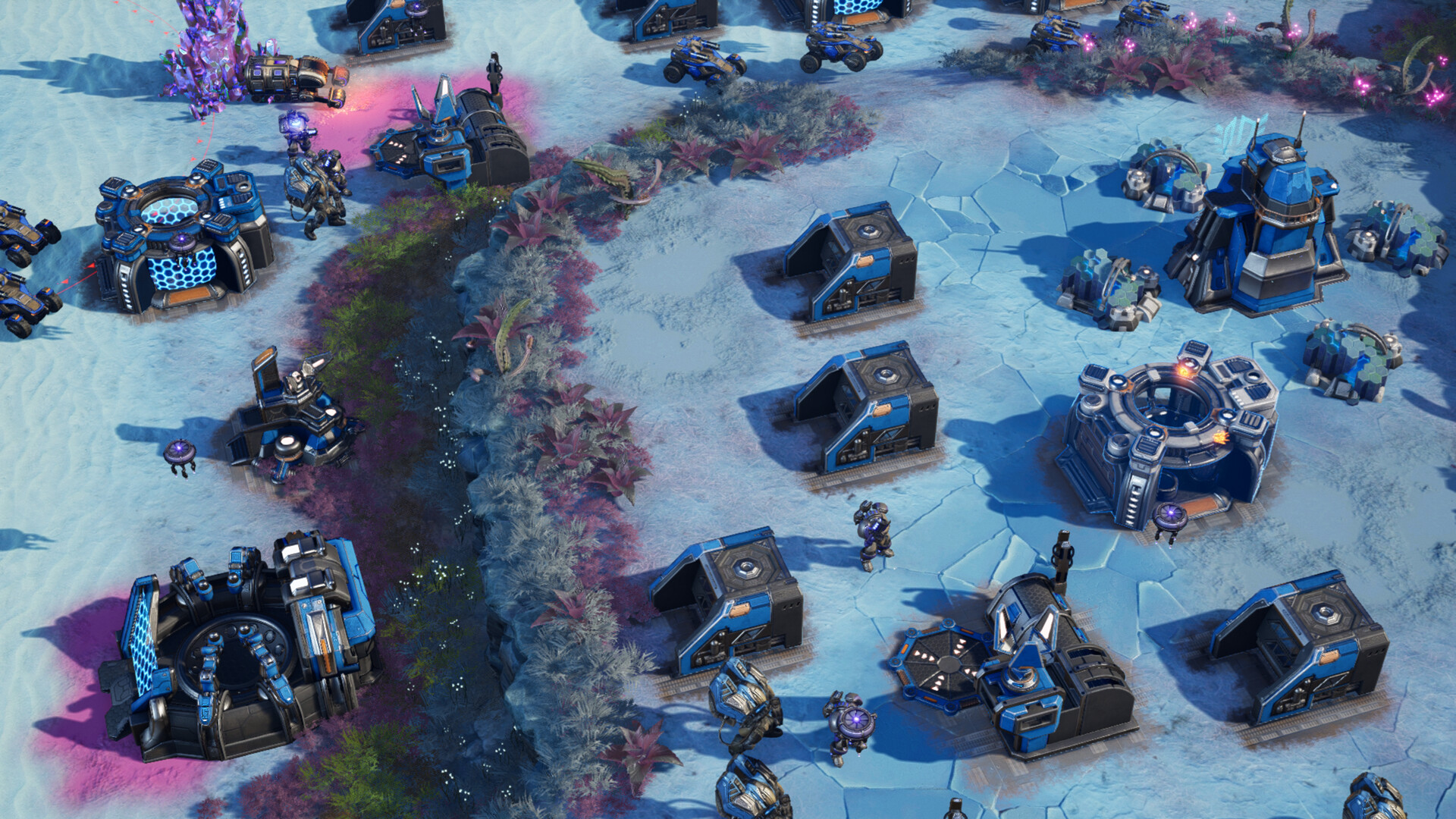
Because flux is scarcer and arrives at specific points, contesting those impact sites is a recurring source of conflict. Spending flux wisely matters a great deal; fully upgrading heroes and elite units can demand a heavy flux investment.
Hexite is not only income. Every base has to sit on a hexite patch, which fixes where an expansion can go and turns scouting into a search for the next patch you can hold. Community documentation of the current build records a starting location ringed by six patches and each expansion by four.
You do not build the extractors. Three go up instantly at the starting location and one at each expansion, and the remainder are raised on their own, one at a time. The initial base keeps its six patches whatever later happens to your main base.
Rates are shared. Every faction pulls 1.4 hexite per second from a live patch. Patches never disappear outright: once run down they drop to 0.35 per second and keep paying at that rate indefinitely, which is why an old expansion is still worth defending. Three factions call the structure an Extractor. The Grell grow a Feeder Vine that does the same job.
The placement rule is a redesign rather than the original system. In an update on October 4, 2025 the studio introduced Hexite Pits and rebuilt Operating Towers around them, saying that players could not tell where their expansions were meant to go and that a pit would remove the ambiguity. Extractors were redesigned in the same pass. That was a pre-launch build, roughly nine months before Early Access opened.
The Campaign runs its own variant of the rules. A balance change on August 6, 2026 raised the exhausted mining rate on campaign Gold Hexite from 40 percent to 50 percent.
Flux is a purple crystal that grows out on the map rather than inside your base, so gathering it means going and getting it. Each faction sends a different unit to do that, and each faction works its hexite through a different structure.
Faction | Flux Harvester | Hexite Structure |
|---|---|---|
Prospector | Extractor | |
Gatherer | Feeder Vine | |
Labourer | Extractor | |
Xol Harvester | Extractor |
Rich flux deposits appear periodically during a match and yield double a standard one, with no cap on how many harvesters can work a single field, which makes them worth expanding toward. Where community measurement exists, a Grell Gatherer brings in about 1 flux per minute from a standard deposit and 2 from a rich one with a cap of ten gatherers, while a Legion Labourer runs slower at 0.7 and 1.4 but the Legion may field fifteen of them.
Each faction expands its supply with the right structures. The Protectorate, for example, uses upgradeable supply platforms that can double as turrets.
The numbers are the same across the roster. A Protectorate Supply Platform, a Grell Nourishing Pod and a Legion Idal Conduit each cost 75 hexite and provide 12 supply; the Xol Power Core provides the same 12 for 50. A Protectorate platform takes one attachment: a Sensor Platform for 50 hexite that grants wide vision including over high ground, or a Turret Platform for 75 that bolts on a missile launcher. An older name for the Protectorate structure, Supply Depot, still turns up in community documentation, but the shipped name is Supply Platform.
Supply is charged to army units only, not to harvesters or build drones, so the figure on your bar tracks fighting strength rather than headcount. Your hero is the single largest early draw on it: most heroes take 10 supply on their own.
Layered on top of the two resources is faction experience. Securing XP towers early raises your faction level, which strengthens your Heroes and Commanders and your wider force.
XP towers are neutral structures placed on every competitive map, listed in the community entity database under the name Remnant Pillar. Each begins under guard by a single creep, an Elder Arkanid, with 75 health and a slow melee attack for 4 damage. Clear the guard, then be the only player with units inside the tower radius for a set duration and the tower is yours; the marking on the ground shows the capture zone. An opponent can take it back the same way. Once captured, a tower produces experience continuously and keeps producing it after your units walk away, which is what makes the opening fight over them worth having. Per map tower counts are listed in Maps.
Experience buys faction levels, and community documentation puts the threshold at 100 experience per level. Each level makes you choose a talent, and there are seven of them:
Faction Level | What You Are Offered |
|---|---|
1 | Two main faction talents, pick one |
2 | One main faction talent and one mercenary talent, pick one |
3 | Two main faction talents, pick one |
4 | One main faction talent and one mercenary talent, pick one |
5 | Two main faction talents, pick one |
6 | One main faction talent and one mercenary talent, pick one |
7 | A single choice between Resource Control and Power Control |
One pick per level means seven picks across a full match, and a pick is permanent for that game. The mercenary talents offered at levels 2, 4 and 6 come from whichever mercenary group you hired, which is a reason to weigh a mercenary choice on more than the units it sells. No first party page describes the talent track, so treat the level by level detail as community documentation of the current build rather than a published specification.
Two upgrades that feed this system, Resource Warfare and The Stars in Our Reach, used to apply only to experience earned from towers. An update on August 19, 2026 widened both so they work on every experience source.
A fourth pool sits along the top bar and pays for faction wide abilities. It fills slowly on its own, and it fills again when your own units die, returning roughly a quarter of the supply you lost as energy. That is deliberate: the worse an engagement goes, the more top bar you have to stabilise with. The three conversion mechanics are paid out of the same pool, and every unit carries a separate price for each, which is why a unit stat block lists an infuse, a reanimate and a replicate cost side by side. See Units for what those three do.
Different Factions reskin these systems in their own language and mechanics, but the underlying loop of gathering hexite, securing flux, expanding supply, and leveling up is shared. A solid grasp of it is the first thing covered in Getting Started.
The dated record of the balance changes above is in Update History.
