Loading...
Loading...
Cooking Recipes
April 17, 2026 at 11:53 AM
Add Image column to 2 table(s) with 6 matched icons
Cooking in Windrose is a core survival mechanic that replaces the traditional hunger and thirst systems found in most survival games. Instead of draining over time, food provides temporary buffs to health, stamina, and combat stats. This design philosophy is similar to Valheim, where eating is a reward rather than a penalty. Players can stack up to two food buffs and one drink buff simultaneously, making meal planning an important part of preparation for dungeons and boss fights.
To cook food, you need to build a Cooking Fire. Unlike many crafting stations in Windrose, the Cooking Fire is portable and can be placed anywhere without needing to be within Bonfire range or under a roof. This makes it possible to cook meals in the field before entering a dungeon or tackling a difficult encounter. The Cooking Fire requires basic resources to construct: a small amount of wood and stone.
New recipes are unlocked automatically when you pick up a new ingredient for the first time. This discovery-based system encourages exploration across islands, since each biome contains different plants, animals, and harvestable goods.

Each food item provides a specific stat bonus that lasts for a set duration. Basic raw foods like coconuts or cooked dodo meat provide short buffs lasting around 7 minutes. Advanced cooked recipes provide stronger buffs lasting up to 30 minutes. When a buff expires, the stat bonus is removed and you need to eat again to restore it.
You can have two food buffs active at the same time, plus one drink buff. This means you can stack, for example, a Strength food, a Vitality food, and a stamina drink for a combined stat boost before entering combat. Choosing the right combination of foods is part of the game's tactical layer.
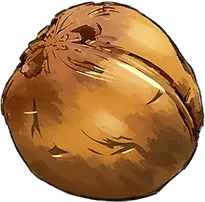
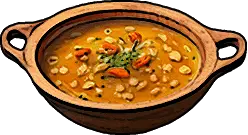
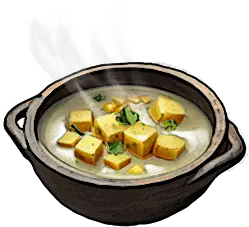
The earliest food sources are found on the starting island. Coconuts are scattered on the ground near beaches and can be eaten raw for a small stamina buff. Coastal Dodos drop meat that can be cooked into Dodo Broth at any Cooking Fire. These two items form the backbone of early survival before more complex recipes become available.
Image | Food Item | Source | Effect |
|---|---|---|---|
| Coconut | Found on beaches | Small max stamina increase |
Cooked Dodo Meat | Cook raw Dodo meat | Health increase, short duration | |
| Dodo Broth | Dodo meat + water at Cooking Fire | Health regeneration buff |
Cooked Boar Meat | Cook raw Boar meat | Moderate health increase |

As you explore the second and third islands, you gain access to ingredients like peppers, potatoes, bananas, eggs, and various herbs. These unlock more powerful recipes with longer-lasting attribute buffs. Advanced recipes require combining multiple ingredients at the Cooking Fire.
Image | Recipe | Ingredients | Effect | Duration |
|---|---|---|---|---|
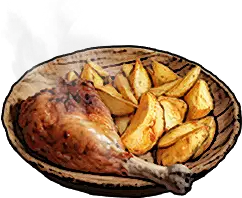
| Spicy Chicken with Sweet Potato | Chicken, Sweet Potato, Pepper | +10 VIT | 30 min |
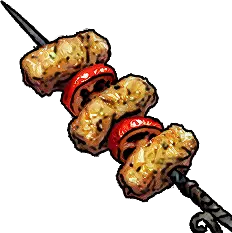
| Spicy Breaded Kebab | Meat, Bread, Pepper | +10 STR | 30 min |
| Hearty Egg Broth | Egg, Herbs, Water | +10 AGI | 30 min |
| Coconut Milk with Bananas | Coconut, Banana | Max stamina increase | 30 min |
The +10 stat buffs from advanced recipes are significant. A +10 VIT buff noticeably increases your maximum health, while +10 STR raises melee damage output. Combined with the right equipment and talents, food buffs can make the difference between defeating a boss or getting knocked out.
Ingredients are found throughout the archipelago. Each island has its own selection of harvestable plants and animals. Some ingredients are plentiful, while others are rare and found only in specific locations.
Ingredient | Location | Notes |
|---|---|---|
Coconut | Beaches on most islands | Abundant, often found on the ground |
Dodo Meat | Starting island, coastal areas | Dropped by Coastal Dodos |
Boar Meat | Forested areas | Dropped by Boars and Savage Boars |
Pepper | Second and third islands | Found growing on bushes |
Sweet Potato | Second and third islands | Harvested from patches near ruins |
Banana | Tropical areas | Found on trees or on the ground |
Egg | Near Dodo nesting areas | Also found in some camps |
Healing Herbs | All islands | Used in both cooking and alchemy |

Food buffs and alchemy potions serve different roles. Food provides sustained stat buffs over time, while potions offer instant effects like burst healing. You can have food buffs and potion effects active simultaneously. For boss fights, the ideal setup is to eat two strong foods before the encounter and keep healing potions ready for emergencies.
In co-op play, one player can specialize in cooking for the group. Since food buffs affect only the player who eats, each party member needs their own supply. Coordinating who brings which ingredients to a shared base can streamline preparation. The Cooking Fire can be used by any player, so a single fire placed at a dungeon entrance works for the entire group.
Always carry coconuts as a backup food source. They are everywhere and provide a small but useful stamina buff.
Cook in bulk before heading to a new island. Bring enough food to last through exploration and any boss encounters.
Prioritize recipes that match your build. STR food for melee builds, AGI food for agility-focused playstyles.
The Cooking Fire is cheap to craft. Place them at dungeon entrances so you can rebuff between attempts.
Keep different food types in separate storage baskets at your base for easy inventory management.
Early Access launched with a broader recipe list than the tutorial hints at. Several dishes are easy to miss because their ingredients come from different islands and the cooking fire does not surface new recipes until the player picks up each ingredient once. The recipes below are confirmed at launch and provide the most impact relative to ingredient difficulty.
A mid-tier max HP buff with a short ingredient list. Crab meat drops from the crabs that patrol starting-island and early coastal beaches (not the bigger coastal dodos, but the sideways-walking crabs near the water line). A single crab meat produces one Boiled Crab at the cooking fire. The 15-minute +Max HP duration matches Bacon and Eggs, so most players alternate between the two depending on which ingredient is more abundant at the time. Boiled Crab is a reliable replacement whenever dodo eggs are scarce.
The default early-game recipe for any build. The ingredients are 1x Boar Meat (or generic meat) and 1x Dodo Egg, cooked at a cooking fire. The buff provides both a max HP increase and a small Vitality boost, which stacks with the Vitality attribute for a noticeably larger HP bar in the first few hours of play. Dodo eggs come from the nests near dodo spawn clusters on the starting island, and boar meat drops from any boar hunt engagement. This is the first recipe most guides recommend cooking in bulk.
A 15-minute drink buff that raises max HP and grants +5 Endurance. Bananas are harvested from banana trees on the second and third islands, and coconut milk is crafted from coconut meat. The +5 Endurance bonus is meaningful for any build since it directly expands the stamina pool, but it is particularly valuable for dodge-heavy Agility builds. It occupies the drink slot alongside two food buffs, so it does not conflict with any of the stat-focused meats.
A 30-minute Vitality buff that adds roughly 10 points of Vitality on top of any existing max HP. The ingredient list is chicken meat (from the fowl on the second and third islands), sweet potato (harvested from cultivated plots near jungle ruins), and cayenne pepper (found on bushes in the same biome). The Vitality bonus is the single highest max HP boost available from a cooked food, which is why it is the recommended pre-boss Vitality slot.
The Strength counterpart to Spicy Chicken. A 30-minute buff granting a meaningful Strength bonus (scales directly with club, mace, and Hellbart damage). Ingredients include meat, bread (crafted from flour and salt), and pepper. Players using two-handed strength-scaling weapons should always slot a Spicy Breaded Kebab before engaging a tough target, since the damage increase compounds with the weapon's base scaling.
An alchemy elixir rather than a cooked food, but worth mentioning here because it completes the pre-boss buff stack. The 30-minute +15% damage buff is the most impactful single consumable for high-difficulty encounters. It uses alchemy ingredients (not cooking fire ingredients) and is prepared at the alchemy table rather than the cooking fire.
A ranged-specific elixir providing +13% ranged damage. Prepared at the alchemy table from alchemy components. Most impactful on builds that rely on gunpowder weapons like blunderbusses and muskets. Stacks with Precision attribute points and with Dead Eye Grog when resources allow.
Ingredient | Primary Source | Notes |
|---|---|---|
Coconut | Palm trees, all islands | Press E on ripe palms; respawns quickly |
Banana | Second and third islands | Harvested from banana trees and wild clusters |
Dodo Egg | Dodo nest clusters, starting island | Gathered from nests near dodo spawns |
Boar Meat | Boar kills | Drops from regular and Savage Boars |
Crab Meat | Coastal crab kills | Walk the beach line for spawn patrols |
Chicken Meat | Fowl on second and third islands | Bird Hunt challenge also uses this |
Sweet Potato | Second and third islands | Found on cultivated plots near ruins |
Cayenne Pepper | Second and third island bushes | Stacks with Spicy recipes |
Healing Herbs | Drowned dungeons and ancient ruins | Respawn after POI clear; shared with potions |
Misty Orchid | Islands 2 and 3, glowing blue flowers | Keystone ingredient for alchemy |
The cooking fire is cheap and portable, so a common tactic is to place one near the boss arena or dungeon entrance and cook in bulk on arrival. This avoids the problem of food buffs expiring during the sail across the archipelago. A stack of 5-10 of each planned food is enough to re-buff several times after death attempts, which matters for boss encounters where the first two or three runs are usually scouting attempts rather than clears. Pair this with a fast travel bell at the dungeon entrance for a clean loop of cook, fight, respawn, re-buff, re-engage.
Related pages: food and potions for buff stacking and the Hungry debuff; alchemy for elixir preparation; health and healing for how max HP buffs scale with rally healing.