
Loading...
Combat
August 18, 2026 at 06:30 AM
Added a section on what the first public build settled about difficulty, defence, puzzles and the control scheme
Combat in Tides of Annihilation is a stylish action system built around Gwendolyn fighting alongside summoned Spectral Knights. Rather than treating allies as disposable, the game makes the knights central to both offense and traversal, and lets the player blend their abilities with Gwendolyn's own attacks in real time. The studio describes the combat as "Neo-Medieval": Gwendolyn commands an Order of more than ten legendary knights, each with their own skills, and the focus of the first public hands-on event is letting players try this knight-led combat firsthand.
Gwendolyn channels a mysterious gray fog to summon spectral Knights of the Round Table. The full roster includes more than ten legendary knights, and the player builds a personal Order from them. Up to four knights can be set into the active loadout at once, arranged as two interchangeable sets that can be swapped during a fight.
The Dual Frontline Battle System is the core combat framework. Knights can be summoned mid-combo, and the two knight sets can be swapped on the fly to chain different abilities together. In certain encounters the system also lets the player control Gwendolyn and a knight at the same time across mirrored dimensions, most clearly shown in the Mirror Space Folded Realm.
Each knight carries an elemental identity that can be imbued into Gwendolyn's active weapon, changing the damage type and adding effects. Confirmed examples include Sir Lamorak with a lightning affinity and Palamedes with fire; an ice-affinity knight has also appeared in earlier footage. Some elements interact with the environment as well as with enemies, for example using fire to break through certain obstacles.
When Gwendolyn and a knight combine, they enter a Partnered State, a merged form that reshapes her moveset and grants enhanced attacks and mobility tied to that specific knight. The merged silhouette changes per knight so the pairing reads at a glance.
Gwendolyn fights with a set of weapons that can be swapped to suit an encounter. In interviews the developers have referred to four weapons; their full details have not been shown. See Weapon Types for more.
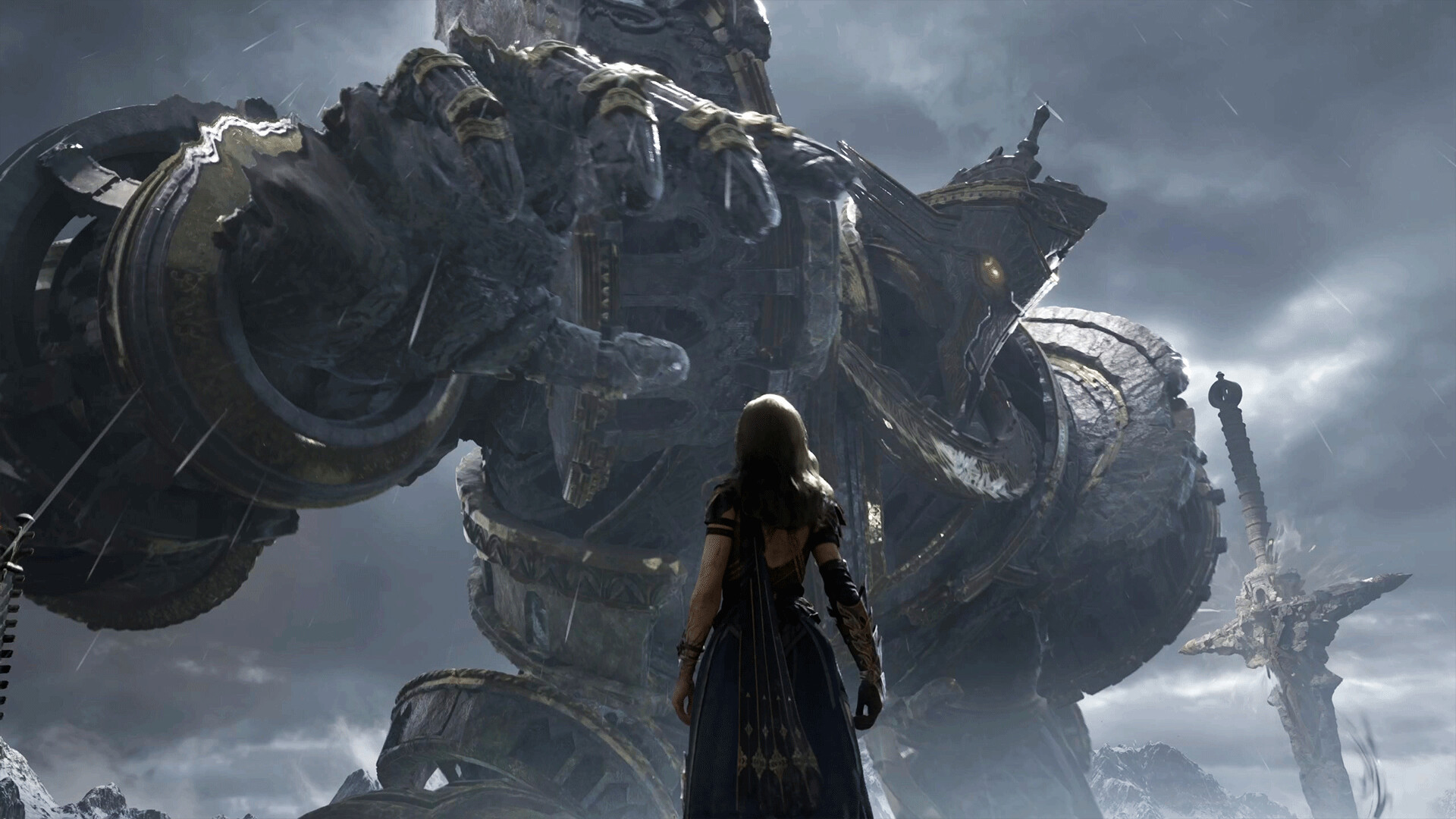
Combat is punctuated by large set-piece fights. The developers have described more than thirty bosses, ranging from human-scale foes such as the shape-shifting witch Tyronoe to the towering Colossal Knights that the player can scale and fight across their own bodies.
Combat options expand through light RPG systems, including leveling and skill trees, plus customization of the knight loadout, weapons, equipment, and accessories. See Skill Tree and Progression for details.
The first offline hands-on, held in Chengdu on 15 and 16 August 2026, put the combat in players’ hands for the first time and settled several open questions about it. The build shipped with selectable difficulty options rather than one fixed setting. Gwendolyn has both a dodge and a block, so defence is not limited to evasion. Fights are separated by environmental puzzle sections instead of running back to back. Players described the control scheme as demanding, built on layered directional and button combinations rather than short single button strings, which fits the knight swapping and mid combo summoning the system is designed around.
When the studio put out its recruitment video for the first hands-on event, it explained the combat through the culture of Chengdu, where the team is based, rather than through systems language. The action was compared to the choreography of Sichuan opera, where each movement is drilled to be worth watching. The demo's two routes, one exploration-led and one boss-led, were compared to the clear and spicy sides of a divided hotpot. And the business of building combos and choosing when to spend them was compared to a hand of mahjong, where the value is in how pieces combine rather than in any one tile.
The comparisons line up with what the studio has said elsewhere about the build: the demo splits into branching paths, and the two boss fights at the ends of them are against Mordred and Geraint. The framing also matches the design goal it has repeated since the reveal, that the knights are collaborators to be arranged rather than cooldowns to be spent.