

Combat in Tides of Annihilation is a stylish action system built around Gwendolyn fighting alongside summoned Spectral Knights. Rather than treating allies as disposable, the game makes the knights central to both offense and traversal, and lets the player blend their abilities with Gwendolyn's own attacks in real time. The studio describes the combat as "Neo-Medieval": Gwendolyn commands an Order of more than ten legendary knights, each with their own skills, and the first public hands-on event was built around letting players try this knight-led combat firsthand. Getting Started covers the same ground at a beginner level, and Chengdu Playtest records the first build the public was able to play.
Summoning Knights
Gwendolyn channels a mysterious gray fog to summon spectral Knights of the Round Table. The full roster includes more than ten legendary knights, and the player builds a personal Order from them. Up to four knights can be set into the active loadout at once, arranged as two interchangeable sets that can be swapped during a fight.
The August 2026 build put concrete numbers on that arrangement. Five knights sat in the demo pool. Four could be equipped at once, split into two primary slots and two secondary slots, and the player could switch between the two pairs at any point in a fight, including in the middle of a combo. A primary knight carries a dozen or more attack moves of its own; a secondary carries two. Spectral Knights lists the five and what each one did.
Dual Frontline Battle System
The Dual Frontline Battle System is the core combat framework. Knights can be summoned mid-combo, and the two knight sets can be swapped on the fly to chain different abilities together. In certain encounters the system also lets the player control Gwendolyn and a knight at the same time across mirrored dimensions, most clearly shown in the Mirror Space Folded Realm. The knights are not confined to fights either: outside combat their abilities are the traversal and puzzle toolkit, opening ziplines across gaps, breaking walls, and lifting heavy objects into place.
Elemental Affinities
Each knight carries an elemental identity that can be imbued into Gwendolyn's active weapon, changing the damage type and adding effects. Confirmed examples include Sir Lamorak with a lightning affinity and Palamedes with fire; an ice-affinity knight has also appeared in earlier footage. Some elements interact with the environment as well as with enemies, for example using fire to break through certain obstacles.
Partnered State
When Gwendolyn and a knight combine, they enter a Partnered State, a merged form that reshapes her moveset and grants enhanced attacks and mobility tied to that specific knight. The merged silhouette changes per knight so the pairing reads at a glance.
Weapons
Developers have said in interviews that there are four weapon types, three of them named. Only the sword has actually been demonstrated: in the August 2026 build Gwendolyn carried swords alone, in several equippable variants with different abilities, and the arrows seen in demo footage belong to a knight rather than to her loadout. See Weapon Types for the split between what has been reported and what has been shown.
Bosses
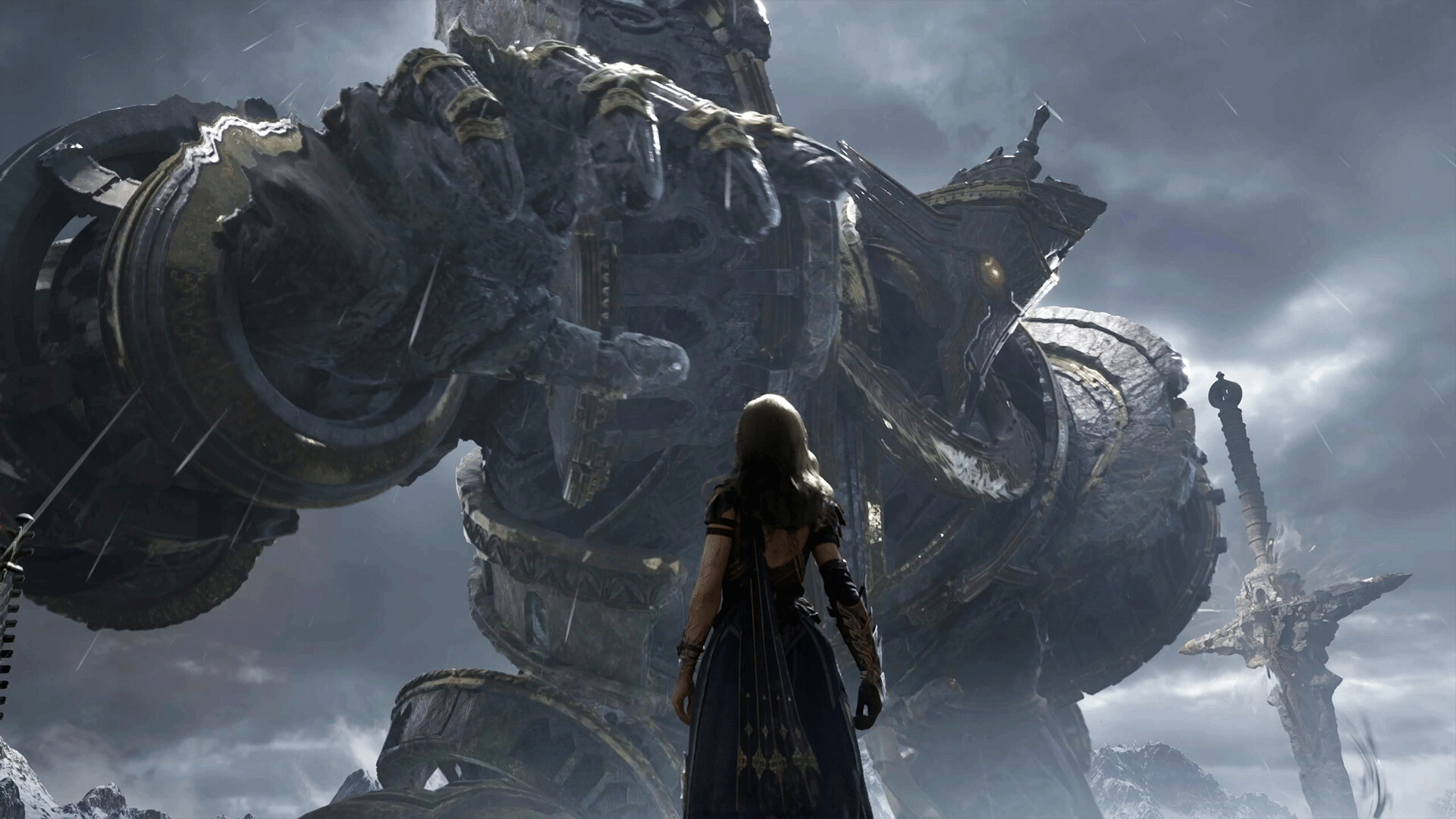
Combat is punctuated by large set-piece fights. In a 2024 interview the developers described more than thirty bosses, ranging from human-scale foes such as the shape-shifting witch Tyronoe to the towering Colossal Knights that the player can scale and fight across their own bodies.
That figure has not been restated since. Asked in September 2026 how many bosses the finished game would hold, the studio said it could not give an exact number because bosses were still in development. The 2024 answer was already hedged as subject to change when it was given, and the later refusal does not withdraw it, so it stands here with its date attached rather than as a current count.
The same conversation did settle how the fights are sorted. The Anubis encounter in the demo is a main-line boss, and there are side bosses as well, pitched at a higher difficulty than the main line. That split matches what the studio has said about tuning: the critical path is built around heavy reward and light punishment, and the sterner tests sit in optional content for players who go looking for them.
Progression
Combat options expand through light RPG systems, including leveling and skill trees, plus customization of the knight loadout, weapons, equipment, and accessories. See Skill Tree and Progression for details.
What the Public Build Showed
The first offline hands-on, held in Chengdu on 15 and 16 August 2026, put the combat in players’ hands for the first time and settled several open questions about it. The build shipped with selectable difficulty options rather than one fixed setting. Defence is not limited to evasion, though the block is a knight effect rather than part of Gwendolyn's base kit: hands-on accounts list a complete block among the things a summoned knight can grant. Fights are separated by environmental puzzle sections instead of running back to back. Players described the control scheme as demanding, built on layered directional and button combinations rather than short single button strings, which fits the knight swapping and mid combo summoning the system is designed around.
Defence runs on colour-coded telegraphs. A red flash marks an attack that has to be parried rather than absorbed; a yellow flash marks one that has to be jumped or dodged, and several wide ground attacks can only be cleared by leaving the floor. Players described both the parry window and the invincibility on a dodge as generous, and a single bad hit does not empty the health bar.
Offence is metered by an enemy stagger gauge. Wearing that gauge down opens an execution, and the build carried a spread of execution animations rather than one canned finisher. There is no stamina bar, so a string is bounded by positioning and recovery frames rather than by a resource.
Evasion is deliberately limited. A third consecutive dodge carries a long recovery, and neither dodging nor parrying is available while airborne, which pushes players to space their evades instead of chaining them. Bosses were also seen dropping health items when a fight was going badly, which lines up with the studio's stated preference for pushing a player forward over walling a run.
Cue | Response | Detail |
|---|---|---|
Red flash | Parry | Marks an attack that cannot simply be blocked out of the base moveset |
Yellow flash | Jump or dodge | Wide ground attacks in particular have to be jumped rather than rolled through |
Stagger gauge emptied | Execution | Opens a finisher; the build carried a range of execution animations |
Third dodge in a row | Recovery penalty | A long recovery follows, so evades have to be spaced out |
Airborne | Neither dodge nor parry | Defensive options are grounded only |
Rest points sit through the level and work the way a bonfire does elsewhere in the genre: they refill healing flasks, respawn defeated enemies, allow equipment and knight changes, and act as fast travel. Hands-on accounts render the name of these checkpoints differently, so this article records what they do rather than what they are called.
Creators covering the build gave the knight swap a name of its own, Swap Cancel, for the way a swap interrupts Gwendolyn's recovery and keeps a string alive. The cancel is visible in the footage; the label is community shorthand and has not been confirmed as an in-game term.
How the Studio Describes It
When the studio put out its recruitment video for the first hands-on event, it explained the combat through the culture of Chengdu, where the team is based, rather than through systems language. The action was compared to the choreography of Sichuan opera, where each movement is drilled to be worth watching. The demo's two routes, one exploration-led and one boss-led, were compared to the clear and spicy sides of a divided hotpot. And the business of building combos and choosing when to spend them was compared to a hand of mahjong, where the value is in how pieces combine rather than in any one tile.
The comparisons line up with what the studio has said elsewhere about the build. Its own description of the package was one standalone level together with two strong-enemy challenges, and public attendees picked one of the two routes for their hour. The bosses reached inside it were Anubis at the end of the museum's Egyptian wing, Mordred closing out the level, and Geraint as an optional sub-quest fight. The framing also matches the design goal the studio has repeated since the reveal, that the knights are collaborators to be arranged rather than cooldowns to be spent.
What the Studio Added After the Public Builds
A developer question-and-answer session in September 2026, published after the game had been played at two public events, filled in several gaps that hands-on accounts could not reach.
Topic | What the Studio Said |
|---|---|
World structure | The finished game holds semi-open areas for players to explore, alongside the main line and the side content. The first playable slice was a single hand-built level, so nobody has seen one yet. |
Boss structure | Anubis in the demo is a main-line boss. Side bosses also exist and are harder. No total was given. |
Gear | Equipment and badges were added on top of the knights themselves, and the studio describes the combinations of knights, equipment and rewards as directly shaping how a fight feels. |
Puzzles | The demo puzzles lean on observation and reasoning. The finished game is to introduce new puzzle content at different stages, with more complex setups than the demo carried. |
Genre | Asked whether respawning enemies at checkpoints made it Soulslike, the studio said the game has been an action adventure since the design stage and that the combat is deliberately fast, drawing on Devil May Cry and God of War. |
One piece of development history came out of a separate interview at the same show. An earlier version of the game contained no puzzles and nothing like the current emphasis on exploration, and the adventure layer was added afterwards because the team believed it made the whole experience richer. That is the clearest explanation available for why the combat reads as further along than the material between fights.