
Loading...
Loading...
Ganymede
September 21, 2026 at 02:25 AM
Dated the tone statement to its publication, qualified the tone section, corrected the forged-paperwork detail and the order of the escape, hedged three source-material claims, and neutralised the title-card alt text
Ganymede is Jupiter's largest moon and the largest natural satellite in the entire solar system. In The Expanse universe, it is the agricultural heart of the outer planets, earning the title "breadbasket of the Belt." Its vast domed greenhouses, fed by a network of orbital mirrors, produce the majority of the food that sustains the populations of the Belt and the Jovian system. With a population numbering in the millions and a unique natural magnetosphere that shields its surface from Jupiter's radiation, Ganymede became one of the first permanent human settlements beyond the inner planets and one of the safest places in the Jovian system to live and raise children.
In The Expanse: Osiris Reborn, Ganymede is a confirmed visitable location where players can explore the famous gardens, navigate political tensions between Earth and Mars military forces, and uncover connections to the protomolecule conspiracy. The game's official social media has described the location: "Ganymede is one of Jupiter's largest moons. Its domes bloom under giant orbital mirrors. With stable gravity and magnetic field, it became home to millions of people."
Detail | Information |
|---|---|
Type | Natural satellite (Jupiter's moon) |
Parent Body | Jupiter (seventh satellite) |
Classification | Galilean moon |
Primary Function | Agricultural production (breadbasket of the outer planets) |
Population | Millions of permanent residents |
Key Feature | Domed agricultural greenhouses with orbital mirror system |
Unique Trait | Only moon in the solar system with a magnetosphere |
Governing Authority | Jointly administered by UNN and MCRN (pre-incident) |
Significance | Site of the Ganymede incident; connected to Project Caliban |
In-Game Status | Visitable location in The Expanse: Osiris Reborn |
Ganymede is the seventh satellite of Jupiter and one of the four Galilean moons, originally discovered by Galileo Galilei. It is the largest moon in the solar system, slightly larger than the planet Mercury, though its density is roughly half that of Mars. This lower density translates to surface gravity weaker than that of Earth's Moon, making Ganymede a low-gravity environment for its inhabitants.
The moon's surface is predominantly ice-covered, with a mix of older, heavily cratered dark regions and younger, lighter terrain marked by grooves and ridges. What makes Ganymede exceptional among Jupiter's moons is its natural magnetosphere, the only one of its kind among all moons in the solar system. This magnetic field deflects charged ionizing radiation from Jupiter's intense radiation belts, creating conditions where dome-grown crops can survive and where human exposure to harmful radiation remains far lower than on neighboring moons like Europa. Only Callisto, which orbits farther from Jupiter outside the worst of the radiation belts, offers comparable safety.
The magnetosphere's protective effect extends beyond agriculture. Ganymede earned a reputation as the location with the lowest rate of birth defects and stillbirths in the Jovian system, making it a destination for expectant parents from other colonies who traveled there specifically to deliver their children in safer conditions.
Ganymede Station was one of the first permanent human settlements in the outer planets, established as a long-term colony rather than a temporary mining outpost. Its primary purpose was food production. The station features large domed agricultural complexes on the moon's surface, commonly referred to as the "gardens of Ganymede." These greenhouses are among the most important pieces of infrastructure in the outer solar system.
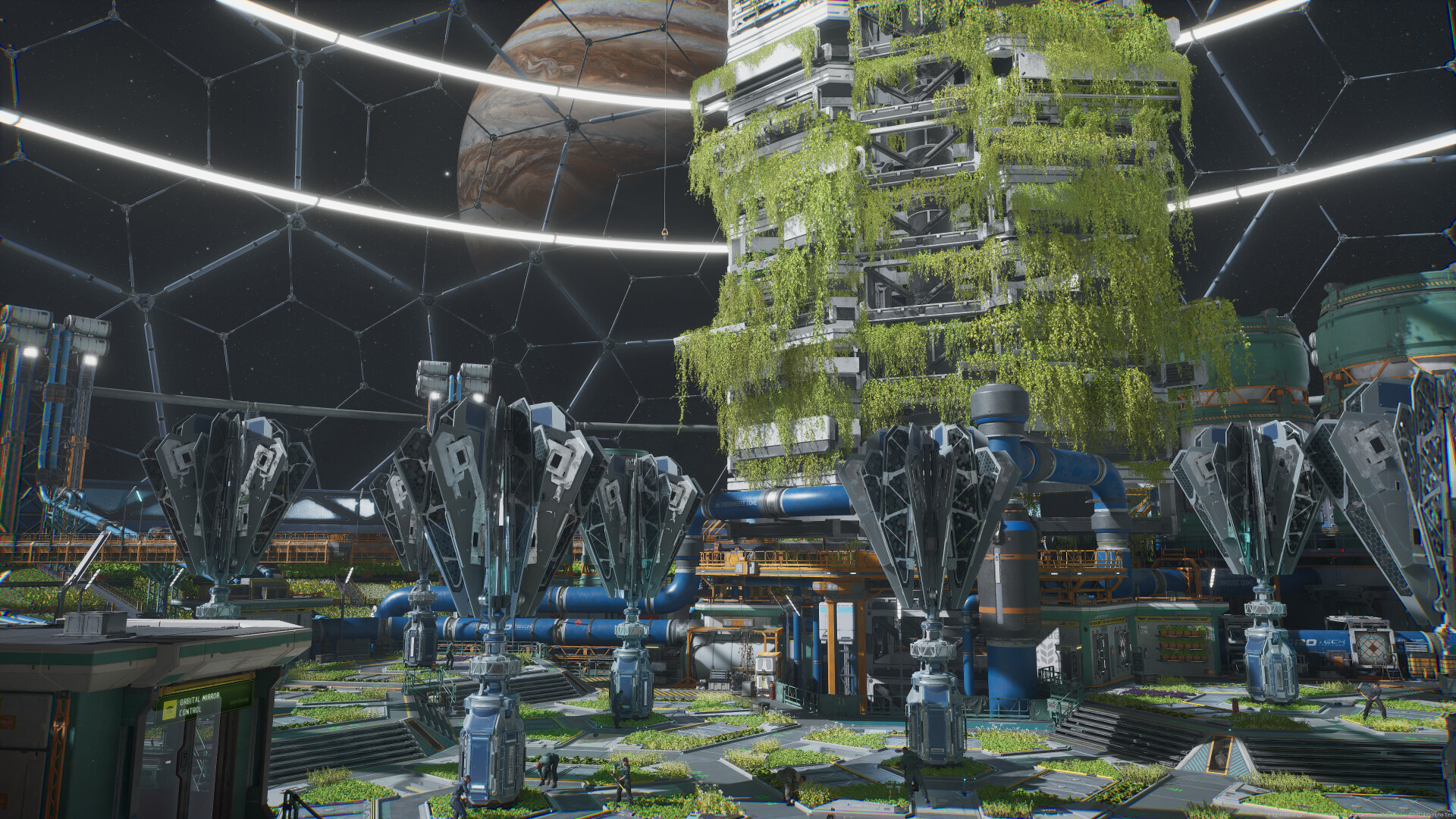
The gardens rely on an intricate system of orbital mirror stations positioned around Ganymede. These mirrors capture and concentrate sunlight, then direct it down onto the dome greenhouses below. Given Jupiter's distance from the Sun (roughly 5.2 astronomical units), natural sunlight reaching Ganymede is about 25 times weaker than what reaches Earth. The mirror network compensates for this by focusing and amplifying the available light, making large-scale agriculture possible in a region of space where it would otherwise be impractical.
The dome greenhouses produce vegetables, fruits, and even some livestock products for those who can afford them. Ganymede's output feeds not just its own population but is the primary food source for the entire outer planets, including Belt stations like Ceres. This economic role gave Ganymede enormous strategic importance: any disruption to its agricultural output would trigger food shortages and potential starvation across the Belt. The fragility of this supply chain is a recurring theme in The Expanse, and it becomes a critical plot point when the Ganymede incident devastates the moon's infrastructure.
In The Expanse: Osiris Reborn, the gardens are highlighted as one of the most visually striking environments in the game. The Gamescom 2025 environments trailer showcased Ganymede's "fragile ecosystems" and "lush gardens," emphasizing the contrast between the green, sunlit agricultural domes and the metallic, industrial aesthetic found in other locations. Creative Director Alexander Mishulin described the studio's approach: "Every place in The Expanse tells a story. When we recreate locations like Ganymede or Ceres, It covers making them look authentic and capturing the struggles and hopes of the people who live there."
Beneath the surface domes, Ganymede's infrastructure is more typical of Belt construction. The underground sections house residential areas, medical facilities, markets, docking bays, and maintenance corridors. These areas feature narrow corridors and utilitarian design. This reflects the practical engineering priorities of outer-planet settlements where resources are always scarce and every cubic meter of pressurized space is valuable.
The contrast between the lush, open garden domes above and the cramped, industrial corridors below is one of Ganymede's defining visual characteristics. In the game, players will encounter both environments as they explore the location, moving between the above-ground dome environments and the station's underground facilities.
Ganymede's role as the breadbasket of the outer planets made it one of the most politically contested locations in the solar system. Prior to the Ganymede incident, the moon was jointly administered by Earth and Mars, with both the United Nations Navy (UNN) and the Martian Congressional Republic Navy (MCRN) maintaining significant military forces in orbit and on the surface. A strict border divided the moon's territory between the two superpowers.
This arrangement reflected the broader power dynamics of The Expanse's solar system. Earth and Mars, the two inner-planet powers, both recognized that controlling Ganymede meant controlling the food supply of the outer planets. For the OPA (Outer Planets Alliance) and Belters more broadly, Ganymede's political status was a constant source of resentment. The fact that inner-planet military forces occupied the moon that fed the Belt underscored the colonial dynamics that define much of the conflict in The Expanse universe.
In the source material both Earth and Mars keep military forces on Ganymede; the game has not yet shown a UNN presence on the moon, and the 2026 demo centred on a Protogen base and an unnamed attacking force. Depending on the player's origin and faction affiliations, interactions with military personnel and local civilians may vary significantly, similar to how the Ceres Station experience changes based on the player's background.
The Ganymede incident is described in the source material as one of the most devastating events of that timeframe. Owlcat has placed the game's timeline alongside the events covered by the first two books of the source material; whether Osiris Reborn directly revisits the source material's Ganymede incident on screen has not been confirmed for The Expanse: Osiris Reborn.
The incident began when a human-protomolecule hybrid, created as part of Project Caliban, was secretly unleashed on the moon's surface. The hybrid attacked United Nations Marines, who in turn drew the creature toward nearby Martian Marine Corps forces. Simultaneously, communications signals to the surface were jammed, preventing either side from understanding what was actually happening.
The hybrid killed all military personnel it encountered except for one survivor: Gunnery Sergeant Roberta "Bobbie" Draper of the MCRN. With surface communications blacked out, the UNN and MCRN naval forces in orbit each believed the other side had launched an unprovoked attack. This misunderstanding escalated into a full-scale battle above and on Ganymede.
The battle claimed nearly three thousand military and civilian lives and caused over five billion MCR dollars in infrastructure damage. Debris from the fighting, including fragments of the orbital mirror network, fell onto the station below, destroying agricultural domes and killing civilians who had taken shelter inside. The damage to the mirror system meant that even the domes that survived the initial battle could no longer receive adequate sunlight to sustain crops.
The destruction of Ganymede's agricultural infrastructure triggered a cascading crisis across the outer planets. With the breadbasket of the Belt severely damaged, food supplies to stations throughout the Jovian system and the asteroid belt were disrupted. The result was a slow-motion humanitarian disaster: widespread food shortages, price spikes, and starvation on stations that depended on Ganymede's output.
Ganymede Station itself entered a long, grinding collapse. The damage to the domes and mirror system meant the station could no longer sustain its own population, let alone export food. Evacuation efforts were hampered by logistical challenges, and many refugees spent months aboard ships with nowhere to dock. The human cost of the Ganymede incident extended far beyond the initial casualties, as the ripple effects of losing the outer planets' primary food source reshaped politics and daily life across the Belt.
One of the key figures caught up in the aftermath was Praxideke "Prax" Meng, a botanist who worked on Ganymede's soybean farms. During the chaos of the incident, his daughter Mei was abducted by her pediatrician, Dr. Lawrence Strickland, who was secretly working with Project Caliban. Mei and other children with rare genetic conditions were taken to Io for protomolecule experimentation. Prax's desperate search for his daughter became a central storyline in Caliban's War.
Project Caliban was a secret program run by Protogen (a subsidiary of Mao-Kwikowski Mercantile) in collaboration with elements of both the UN and Martian governments. The project's goal was to weaponize the protomolecule by infecting human subjects to create hybrid supersoldiers. Research and development took place at Prospero Station on Io, but Ganymede served as the field testing ground.
The hybrid unleashed during the Ganymede incident was a deliberate test of the protomolecule weapon program. The attack on military personnel from both sides, combined with the communications jamming, was designed to create chaos while the hybrid's combat capabilities were evaluated under real conditions. The fact that the test killed nearly three thousand people and destroyed the outer planets' food supply was, from the perspective of Project Caliban's architects, an acceptable cost.
Jules-Pierre Mao, the head of Mao-Kwikowski Mercantile, was the primary financier and driving force behind Project Caliban. Dr. Lawrence Strickland handled the medical experimentation on Io, using kidnapped children with specific genetic conditions as test subjects. The connection between Ganymede and Io is central to that storyline in the source material; whether the game revisits it has not been confirmed.
Ganymede is one of the confirmed visitable locations in The Expanse: Osiris Reborn. After the opening sequence on Eros Station and the escape aboard the Gemini, the game opens into a non-linear structure where players choose their destinations from the ship's navigation console. Ganymede is among the locations available alongside Ceres Station, Mars, Luna, Io, and Pinkwater Station.
The developers have emphasized Ganymede's visual distinctiveness. The Gamescom 2025 environments show highlighted the contrast between the "industrial sprawl" of Pinkwater Station and the lush "agricultural gardens" of Ganymede. The domed greenhouses, with their green plant life and artificial sunlight filtering through orbital mirrors, are intended to stand out from the darker, more confined environments found on most Belt stations.
In terms of gameplay, Ganymede has a mix of above-ground dome environments and underground facilities. The location includes a social hub with NPCs, shops, and quest givers, consistent with the game's approach to major locations. A military presence on the moon, if the game includes one, would add a layer of political tension, and the location's connections to Project Caliban tie it directly into the game's main storyline.
People familiar with the source material will recognize Ganymede as a significant location of the in-universe period. Since Owlcat has placed the game's timeline alongside the in-universe period of the first two source-material novels, source-material events on Ganymede may form part of the story's backdrop. Through the end of Caliban's War, the Ganymede incident and its aftermath are expected to feature prominently in the story. How the player's choices intersect with these events remains to be seen, but the developers have confirmed that player decisions shape the narrative in meaningful ways throughout the game.
On August 26, 2026 the developer showed a mid-game Ganymede mission publicly for the first time, debuting two videos during the Find Your Next Game Show at gamescom. A four-minute gameplay video of the same mission followed on August 28, 2026, and its official title gives the mission its name: Beetle in the Anthill. The footage moves the moon out of the category of a named future destination and into demonstrated gameplay.
In the mission, the Captain and their sibling J infiltrate a secret Protogen base to recover data stolen from them on Pinkwater station. The rest of the crew takes part remotely rather than joining the ground team, supplying technical help and moral support while the twins work inside.
The sequence opens as a social infiltration. The pair move through the base undercover, meet Protogen employees, and try to talk their way into the storage area holding the stolen data. That approach does not hold. An unexpected third party arrives partway through and a bioengineered menace is released inside the base, forcing the siblings to improvise and fight their way back out.
The developer's description of the August 28 video adds the specifics the trailer left out. The twins go in disguised as members of "the mysterious Osiris branch of Protogen", the video follows a female Martian protagonist with J as her sister, and once the plan collapses the pair are chased by what the description calls an unknown monster while they try to reunite with the crew. Owlcat's press release for the trailer is more specific about the creature, describing "a treacherous encounter with a hybrid", and hands-on accounts of the demo identify it as a protomolecule hybrid held in the base.

Hour-long press hands-on sessions with the mission at gamescom 2026 in Cologne filled in more of the route. Before the alarm, the twins pull documents from a terminal so that the crew aboard the Gemini can forge the paperwork they need to get at the cargo. After the base goes to red alert the pair flee and run into Michael, whom one account places among the force that broke into the base; the three reach an accord in the heat of the moment and escape together through Ganymede's original colony, an underground warren built before the domes. The demo ends in an agricultural dome full of farmers, with a plan to turn the dome's solar array against the creature and a choice over whether to send a companion to shepherd the civilians to safety or keep the squad together. Every account ends before the fight itself. This is preview-build content and may change before release.
Mission Beat | What the Footage Establishes |
|---|---|
Objective | Recover data stolen from the twins on Pinkwater station, held in a storage area inside a secret Protogen base. |
Ground team | The Captain and J. The remaining crew assist from off-site with tech support rather than deploying. |
Opening approach | Undercover movement through the base, conversation with Protogen employees, and a talk-your-way-in attempt on the storage area. |
Turn | An unexpected third party breaks into the base and a bioengineered menace is loosed inside it. The press release calls the creature a hybrid. |
Resolution shown | The siblings improvise and fight a route out. |
Systems showcased | Cinematic storytelling, action combat, exploration, and the dialogue system. |
The mission also ties Ganymede directly to the opening chapter. The data the twins are chasing was taken from them on Pinkwater station, which makes this stop a continuation of the Pinkwater Security thread rather than a self-contained side trip.
Character | Role | Connection to Ganymede |
|---|---|---|
Roberta "Bobbie" Draper | MCRN Gunnery Sergeant | Sole survivor of the hybrid attack during the Ganymede incident |
Praxideke "Prax" Meng | Botanist | Ganymede soybean farmer whose daughter was kidnapped during the incident |
Mei Meng | Child (Prax's daughter) | Abducted from Ganymede by Dr. Strickland for protomolecule experiments on Io |
Dr. Lawrence Strickland | Pediatrician / Researcher | Kidnapped children from Ganymede for Project Caliban experiments |
Jules-Pierre Mao | Corporate executive | Financed Project Caliban and authorized the Ganymede field test |
Ganymede's political environment is shaped by the presence of inner-planet military forces on a moon that feeds the Belt. Players should pay attention to how NPCs from different factions react to the player's origin and past decisions. As with Ceres Station, the player's background may open or close certain dialogue options and side content.
The location's connections to Project Caliban and the protomolecule conspiracy make it a key stop for players pursuing the main storyline. Exploring both the surface domes and underground facilities thoroughly may reveal important information and side quests related to the broader narrative.
For players unfamiliar with the books or show, the in-game depiction of Ganymede provides important context for understanding why the protomolecule conflict matters beyond just the immediate threat. In the source material, the destruction of the outer planets' food supply has consequences that ripple through every faction and every station in the game, affecting prices, NPC attitudes, and available missions.
The closed beta does not visit Ganymede. The entire beta slice is confined to Pinkwater Four Station and its EVA corridors, a single story mission that typically runs between one and two and a half hours. Ganymede exists in the current build only as a named future destination, not as a walkable space. Beta players interacting with the Gemini's navigation console, companions, or station NPCs will hear Ganymede referenced among the planned waypoints of the larger journey, but the moon itself is not playable until the full release.
Ganymede has been explicitly named by the developer as one of the places the player will travel to in the full game. The confirmed destination list, drawn straight from the developer's own framing of the expanded post-beta map, includes Ceres Station, Ganymede, Mars, Luna, and a number of bunker complexes hidden in the asteroid belt. Ganymede sits inside that list as Jupiter's representative stop, matching its narrative weight in the wider setting.
Destination | Role in the Full Game |
|---|---|
The cultural heart of Belter life and the largest station in the asteroid belt. Confirmed as a full-game destination the player can travel to from the Gemini. | |
Ganymede | Agricultural and political-fulcrum moon in Jupiter's space. Confirmed as a full-game destination the player can travel to from the Gemini. |
Homeworld of the Martian Congressional Republic. Confirmed as a full-game destination alongside Ganymede. | |
Earth's Moon and administrative seat of Earth-aligned politics. Confirmed as a full-game destination alongside Ganymede. | |
Asteroid-Belt Bunker Complexes | Smaller bunker-style sites scattered across the Belt, named alongside Ganymede in the developer's list of full-game destinations. No individual bunker names have been confirmed yet. |
Travel between destinations runs through the Gemini, the player's ship and the twins' shared call sign. Rather than choosing destinations from a world map, the player walks to the Gemini's navigation console and selects from a list of named systems and stations. Ganymede will be one of those entries once the full game opens its wider route network.
The moon's inclusion among the earliest confirmed destinations is a function of its role in the wider Expanse universe: it is a key agricultural site and a political fulcrum in Jupiter's space, historically contested between Inner and Belter interests. Pinkwater Four itself, the beta's only hub, is framed in the main menu art within clear view of Jupiter, so a jump to Ganymede is a short logical step for the Gemini once the twins leave Pinkwater's immediate orbit. Ganymede's history as a contested breadbasket fits the political register the setting is built on, and the mission shown in 2026 pairs that with the grounded danger of a base going into lockdown. On tone more broadly, the studio said in an interview published in September 2026 that the crew's story is pitched slightly more heroic and light-hearted than the books and the series, which it described as dark and gloomy, and that beta feedback on the tone and quippy dialogue led to changes in the mission's narrative.
The closed beta itself never leaves Pinkwater Four Station, so the points below are inference from the beta's systems rather than things shown on Ganymede. They sit alongside the gamescom mission described above, which is demonstrated footage:
Ganymede's placement in Jupiter's space connects it to the Gemini's likely route from Pinkwater Four outward toward the rest of the full-game map. The main-menu composition, which sits Pinkwater in view of Jupiter, reinforces that proximity.
Companion-driven reactivity carries forward from Pinkwater Security's hub. Decisions made on Pinkwater Four, including whether Oscar O'Connell and the station survive, how the spacewalk airlock choice is resolved, and whether side interactions like Larry's painting errand are honored, are expected to echo in how the player is received at later stops. Ganymede, as a named later stop, sits inside that ripple. See Choices and Consequences for how the reactivity web is framed.
Squad composition will likely shape the Ganymede visit the same way it shapes every other location. Because social skill checks pool the scores of the player and any companions on the ground team, which pair the player brings off the Gemini is expected to open or close dialogue and exploration branches on Ganymede just as it does on Pinkwater Four.
The gamescom mission answered several questions that were open before it aired. The following details remain unconfirmed for Osiris Reborn specifically and should not be treated as facts:
The developer has not named any individual Ganymede NPC. The gamescom footage shows Protogen employees inside the base without identifying them; a single hands-on account mentions a Doctor Simic in charge of one section of the base, which no official source has confirmed.
The infiltration mission is titled Beetle in the Anthill in the developer's August 28, 2026 video. No other quest title set on Ganymede has been given.
No skill check on Ganymede has been shown resolving on screen. The undercover conversation implies the dialogue systems are in play, but no specific check and threshold has been demonstrated.
The demo route passes through the original underground colony beneath the domes, but how much of the moon is traversable outside the mission, and whether players move between the surface domes and the underground levels freely, has not been shown.
Hands-on accounts of the demo end inside an agricultural dome with farmers present, so at least one garden dome is walkable mission space. Whether the gardens can be visited outside the mission has not been shown.
Ganymede's inclusion as one of the first-named full-game destinations is consistent with the studio's stated pitch: an original story and setting that keeps the novels' grounded-sci-fi texture, even though the studio has said its crew's story is pitched slightly more heroic than the books and the series. Every destination on the confirmed list sits on a real political fault line in the solar system, and Ganymede's standing as a contested agricultural hub places it on exactly that kind of fault line. The moon is therefore likely to function less as a scenic stopover and more as a pressure point where the player's alignment, prior choices, and companion roster all matter to how the visit unfolds.
