

Character Creation and Progression
Character creation in The Expanse: Osiris Reborn begins with a choice that goes beyond cosmetics. Players pick one of three origins, each rooted in the lore and physics of The Expanse universe. From there, progression follows an open, classless system that lets players build their character however they see fit. Creative Director Alexander Mishulin has compared the build philosophy to Dark Souls: find the weapon and playstyle that feels right for you and build around it, rather than picking a class and following its predetermined path.
Origins
The three available origins correspond to the three major human populations in The Expanse setting. Each origin affects the player character's physical appearance, starting stats, and how factions react to them throughout the game. Dialogue options, NPC attitudes, and certain quest branches shift depending on where the player character was born and raised.

Origin | Physiology | Background |
|---|---|---|
Earther | Average height, medium build. Adapted to full Earth gravity (1g). | Born on Earth under the authority of the United Nations. Earthers tend to be physically compact and well-muscled from living their entire lives under full gravity. They carry the political baggage of being part of the dominant inner-planet power. |
Martian | Taller than Earthers, bulkier build. Adapted to Martian gravity (0.38g). | Raised on Mars under the Martian Congressional Republic. Martians grow up in roughly a third of Earth's gravity, resulting in taller, broader frames. Mars is a military-industrial society obsessed with its terraforming project, and Martians tend to carry a sense of discipline and purpose. |
Belter | Extremely tall, very thin frame. Adapted to very low gravity and micro-gravity. | Born and raised in the asteroid belt or outer stations. Generations of living in low to zero gravity have made Belters distinctly different from inner-planet populations. They struggle physically in high-gravity environments and face widespread discrimination and economic exploitation. |
The physiological differences between origins are not just cosmetic. They are a fundamental part of The Expanse's worldbuilding. A Belter who grew up in micro-gravity has bones and muscles that literally cannot handle full Earth gravity for extended periods. The game reflects these differences both mechanically and narratively.
Belter Cultural Details
The game prioritizes book canon over the TV show when depicting Belter culture. Belter NPCs speak Creole (a distinct language that evolved in the Belt from a mix of Earth languages) and use unique gestures that developed in low-gravity living. These gestures include hand signals and body language that replace or supplement spoken communication in environments where sound does not carry well (vacuum, noisy stations, across distances in large open spaces). Players who choose the Belter origin will have dialogue options in Creole and will understand these gestures natively.
Origin and Faction Reception
Origin affects how every major faction treats the player. An Earther or Martian arriving on Ceres Station will encounter hostility from the local Belter population. Prices may be higher, certain NPCs will refuse to speak openly, and some side quests only trigger if the player is a Belter. Conversely, a Belter origin opens more side quests and dialogue options on Belt stations but closes doors in inner-planet territories where Belters are treated as second-class citizens. The Belter origin is described as having the most additional side quest content. This reflects the richness of Belt culture and politics in the source material.
The 2026 origin breakdown sharpened how this plays out on Ceres Station. Early in the story, Mars is accused of destroying the ice hauler Canterbury, which had been carrying ice to Ceres. With the station left short of water, the Belter population turns hostile toward inners, and especially toward Martians. A Belter protagonist can fall back on shared language and customs to move through the station easily, while an inner feels like an outsider. Establishing and strengthening these origin-specific faction ties becomes a larger factor later in the game, and after the player secures the help they need, the story leaves open whether they keep supporting that faction.
No Class System
Osiris Reborn does not use a traditional class system. There are no rigid archetypes like "Soldier," "Engineer," or "Medic" that lock players into a specific playstyle. Instead, the progression system is fully open. As the player levels up through combat and quest completion, they earn points that can be invested in any combination of skills, abilities, and passive upgrades.
Mishulin's Dark Souls comparison is instructive. In Dark Souls, every player starts with the same basic framework and can develop in any direction: heavy armor and great swords, light armor and daggers, pyromancy, miracles, sorcery, or any hybrid. Osiris Reborn applies a similar philosophy where the early game is about experimentation and the mid-to-late game is about committing to the build that feels natural. The developers want players to try different weapons and abilities in the early hours, then gradually invest more deeply in the combinations that suit their playstyle.
Example Builds
While there are no classes, the progression system naturally supports several distinct playstyle archetypes. The following examples illustrate the kinds of builds players can create.
Build Archetype | Focus | Playstyle |
|---|---|---|
Gunslinger | Gunplay and weapon mastery | Prioritizes weapon damage, accuracy, reload speed, and secondary fire mode effectiveness. Spends most of its time behind cover, landing precise shots and swapping between fire modes. |
Ability-Heavy (ME Adept style) | Skills and tech abilities | Invests heavily in ability cooldown reduction, device power, and area-of-effect upgrades. Uses grenades with thrusters, energy shields, shoulder cannons, and other tech as the primary damage source. Similar to playing a Mass Effect Adept who relies on powers rather than weapons. |
Commander | Companion effectiveness | Focuses on upgrades that boost companion damage, durability, and ability frequency. Turns the player into a force multiplier who issues commands and keeps companions alive while they do the heavy lifting. |
Device Specialist | Drone and gadget mastery | Combines protective drones, deployable turrets, and trap-style devices to control the battlefield. Excels at locking down chokepoints and creating safe zones during defensive encounters. |
Sniper | Long-range precision | Centers around sniper rifles with armor-piercing rounds and the Tactical Visor for target acquisition through walls. Prefers to engage from maximum distance and uses companions as a frontline screen. |
Hacker / Engineer | Skill checks and tech synergy | Invests in Hacking and Science skill checks to unlock alternative mission paths, then supplements with tech abilities that disable or redirect enemy equipment. |
Tactical Visor Build | Information and precision | Centers around the Tactical Visor ability combined with AP ammo to shoot through walls at highlighted targets. Uses information advantage to set up ambushes and coordinate companion flanking. |
These archetypes are not mutually exclusive. A player could invest primarily in gunplay while picking up a few drone abilities for defensive situations, or focus on companion effectiveness but still unlock the Tactical Visor for better battlefield awareness. The system rewards experimentation and hybrid approaches.
Skill Checks
Three skill categories govern non-combat interactions: Persuasion, Science, and Hacking. Each has multiple proficiency levels. Skill checks are flat pass/fail based on the player's current proficiency. There is no random element. If you meet the threshold, you pass. If you do not, you fail. Failed checks never block the main story but can close off optional dialogue branches, bonus rewards, and alternative approaches to objectives.
Leveling and Equipment
Experience is earned through combat encounters, quest completion, and exploration milestones. Each level grants points to distribute across the skill tree, which branches into abilities, upgrades, and passive stat bonuses. Equipment (weapons, armor, and tech devices) can be found in the world, purchased from vendors at social hubs, or built through the crafting system. Better gear provides raw stat increases and unlocks new tactical options; a higher-tier grenade launcher might add a homing feature, while an upgraded drone might gain the ability to revive downed companions.
Replayability
The combination of three origins and an open progression system gives players a strong reason to replay the game. An Earther gunslinger will have a very different experience from a Belter ability specialist, both in terms of combat feel and narrative content. Faction reactions, dialogue options, and even certain quest outcomes change based on origin, meaning a second playthrough can reveal story threads that were invisible the first time around. The companion permadeath system adds another variable: different choices lead to different crew compositions by the endgame.
Closed Beta Character Creation
The closed beta does not include the full character creation tool. Full appearance, gender, and background selection are reserved for the full game. Instead, players choose between four pre-made presets that mix two backgrounds with two combat flavors.
The presets are not classes. They simply seed the starting gadgets and a few pre-allocated skill tree points, and you are free to branch out into any tree from level one. Belter presets default to a female character model and Earther presets default to male. The twin sibling, J (also referred to as Jay), always matches the player's gender, so a female player's J is female and a male player's J is male. The twins also have complementary facial features rather than being an exact copy.
Preset | Background | Focus | Default Gender | Starting Gadgets |
|---|---|---|---|---|
Earther Officer | Earther | Assault, direct gunplay | Male | Frag grenade, incendiary rounds, tactical scanner |
Earther Hacker | Earther | Gadget support, crowd control | Male | Pandemic algorithm, gremlin drone swarm, tactical scanner |
Belter Officer | Belter | Assault, direct gunplay | Female | Frag grenade, incendiary rounds, tactical scanner |
Belter Hacker | Belter | Gadget support, crowd control | Female | Pandemic algorithm, gremlin drone swarm, tactical scanner |
A typical beta playthrough runs about one to two and a half hours. A full character creation pass, including the third Martian background, arrives with the full game. See Getting Started for a broader beta walkthrough and companions for how the crew system grows beyond J.
Backgrounds and Personal Passives
The full game offers three backgrounds: Earther, Belter, and Martian. Each background gives the player a single personal passive that adds one point to a social skill. That small head start compounds because most exploration checks stack the player's skill with the accompanying companions' scores, so a well chosen passive can tip borderline checks from failure into success.
Background | Personal Passive | Visual Trait | Beta Availability |
|---|---|---|---|
Earther | +1 Athletics (social skill) | Standard human build | Playable in the closed beta |
Belter | +1 Engineering (social skill) | Visibly taller and more elongated than Earthers, a direct consequence of growing up in low gravity | Playable in the closed beta |
Martian | +1 to a social skill (specific skill not revealed in the closed-beta materials) | Intermediate build relative to Earthers and Belters | Full game only, not in the closed beta |
The Belter visual trait is worth calling out separately. Belter player characters stand noticeably taller and more elongated than Earthers, which is immediately obvious the first time the Belter protagonist speaks with Zafar at the station. It matches the source novels' portrayal of Belters as a population shaped by generations of low gravity. The beta only exposes the Earther and Belter passives; Martian is confirmed as a third option but its specific social skill boost has not been shown.
Named Origin Perks
Each origin grants a single named passive perk at character creation that the character keeps for the whole game. The closed beta confirmed the Earther and Belter perks by name; the Martian perk exists in the full game but its specific bonus was not shown in beta materials.
Origin | Perk Name | Effect |
|---|---|---|
Earther | Gravity's Gift | +1 to Athletics checks |
Belter | Tekimang | +1 to all Engineering checks |
Martian | Not yet revealed | A bonus to a social skill, with the exact skill unconfirmed; Martian is a full-game option only |
Origins go well beyond starting numbers. Each origin carries a dedicated quest chain of origin-specific missions, where the player tracks down representatives of their own faction and earns that faction's trust and aid. The major factions of the solar system react differently depending on where the player was born. Martian-born players are the only ones allowed to land on Mars early in the game, Earthers keep important contacts on Luna, and a Belter who grew up on Ceres Station still has a loyal local friend there. The same character is a complete stranger to an Earther arriving on Ceres, opening a different side of that personality. Owlcat frames origins as a way to make the player a co-author of their own story, with characters later acknowledging the player's past choices and reacting to them.
The Twin and Crew-Level XP
The player always has a twin sibling, J, whose gender mirrors the player's own and who is the only fully playable squadmate during the closed beta mission. The shared call sign for the pair is Gemini, which is also the name of their ship.
Experience is pooled at the crew level rather than per character. The whole crew shares one level, and each level-up awards skill points to the player and simultaneously to each companion for their own trees. In practice this means you do not have to babysit a lagging squadmate. If the player hits a milestone, J and every other crew member hit it at the same time. The same logic is intended to extend to every other companion introduced during the full game.
Combat Skill Trees
Each character has their own set of combat trees. The player has four trees, and each companion has three. Points spent in one character's trees never affect another character, so a dedicated leader build still rewards investing in J's own shooter and gadget nodes so J can carry their own weight.
Starting Specializations
The full game opens with a specialization pick that seeds your captain's starting skills and gear. A cyber warfare specialist begins with solid gadget expertise and a rotation that leans on abilities more than firearms. A firearms specialist begins with stronger shooting and leadership skills, splitting their contribution between personal aim and orders issued to companions in combat.
Specializations are starting points rather than locked roles. Nothing stops a cyber warfare specialist from investing in weapon skills on the way up and finishing as a hybrid of both. All four combat trees stay open no matter which specialization you choose, so the pick decides where you begin, not where you can end up.
The two specializations are renamed versions of the two combat presets used in the closed beta. What the beta labelled a hacker is now the cyber warfare specialist, and what it labelled an officer is now the firearms specialist.
Specialization | Closed Beta Name | Starting Emphasis |
|---|---|---|
Cyber warfare specialist | Hacker | Gadget expertise; abilities used more than firearms |
Firearms specialist | Officer | Shooting and leadership; personal aim plus companion orders |
Player Trees
Tree | Role | Representative Node Effects |
|---|---|---|
Marksmanship | Weapon damage specialist | Rate of fire, weapon damage, magazine size, and additional weapon damage while an ability is active. |
Gadgets | Ability caster | Ability cooldown reduction, damage against controlled or exposed targets, armor granted by defensive abilities, and duration of ability effects. |
Survivalist | Tank and melee | Armor, armor regeneration, health, melee damage, and damage dealt while your armor is at zero. The first point in this tree grants roughly a 15% armor bonus, so investments are meaningful rather than incremental. |
Leader | Squad commander | Companion damage, companion armor, damage reduction for companions, and cooldown reduction on the Engage command. Heavy investment can reduce Engage cooldown enough to make it a centerpiece of the rotation. |
Companion Trees
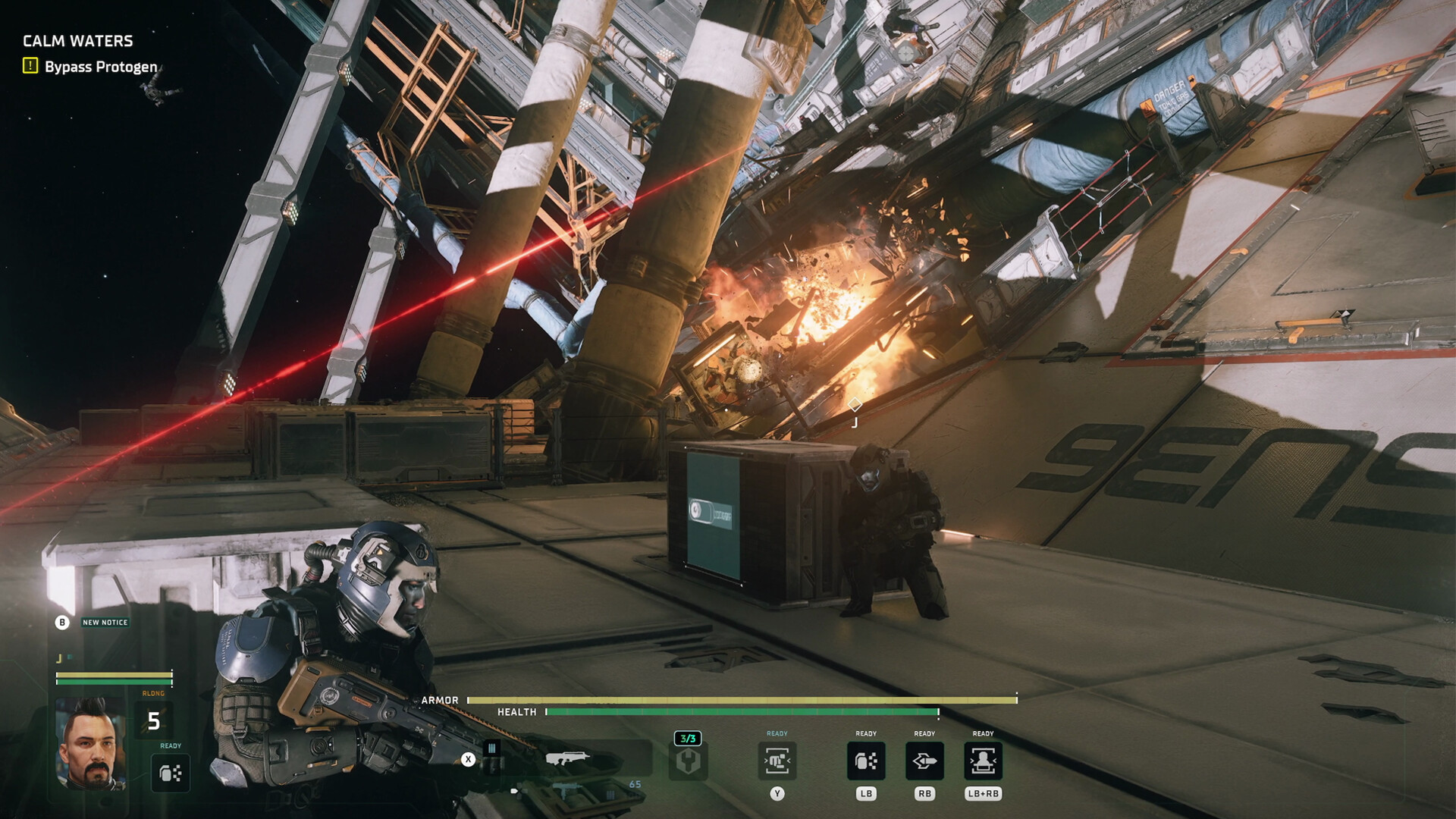
Every companion has the Marksmanship, Gadgets, and Survivalist trees, but no Leader tree because the player is the crew leader. The node names match the player's trees, but the effects inside each node are different. For example, J's Gadget tree contains a node that switches J's default environmental exploit from Precision to Malfunction, a capability the player character cannot take. See The Exploit System for the full list of exploit types and how they interact with the battlefield.
Social and Exploration Skills
Social skills and exploration skills are the same set of six stats, referenced by either name depending on the context. Every character, player and companion alike, has two of them. The six are:
Persuasion. Unlocks extra dialogue branches, gossip, and occasionally bonus XP for leaning on an NPC until they open up.
Athletics. Moves heavy obstacles, boosts melee, and speeds up general traversal. Earther's passive adds a point here.
Cyber Sabotage. The hacking skill. Triggers the number-alignment mini-game to open locked doors and consoles under a fifteen second timer.
Perception. Opens a reticle-fill mini-check where the player must hold their gaze on a target; looking away interrupts the fill and restarts the check.
Analysis. A hacker-leaning skill used to read environmental data and evidence. Not directly demonstrated during the beta but confirmed as one of the six.
Engineering. Opens broken doors, traces conduits, and repairs machinery. Belter's passive adds a point here. Investment can also reduce damage to nearby cover and grants extra low-tier crafting materials when looting the world.
Social skill trees are laid out as simple linear paths from top to bottom. Because each character only has two social skills, picking which companion to bring on a mission is a real choice. A lock you cannot open on one run can be walked straight through on the next by swapping squad composition.
Skill-Check Stacking and Focus Drugs
When a skill check fires in the world, the player's score in that skill is added to every accompanying companion's score in the same skill. If the check requires a score of four in Athletics, the player has two, and J has two, the check passes. This makes social skills a genuine party-level resource rather than a per-character trait, and it directly rewards bringing the right pair of companions for the mission ahead.
Consumable focus drugs add a temporary +1 to a non-combat skill for a single check. They are the intended bridge when stacking still falls short. Spending one in the shared party tally can carry an otherwise failing check across the threshold, but they are limited consumables, so they are best saved for checks that clearly gate meaningful loot, dialogue, or route choices.
Companion Signature Passives
Each companion carries one personal passive tied to their character design, separate from the per-background passive the player receives. J's passive is Twin Bond, which raises the player's lowest social skill score by one point whenever a check is rolled. In the Athletics-two, Perception-three example above, J's presence on the squad pushes the player's Athletics to three while the roll resolves, which can unlock options that would otherwise need a focus drug or a different squadmate entirely. Other companions carry their own named passives with equally distinct effects, and they stack with the player's background passive rather than replacing it.
Leveling Flow in Practice
On each level-up you allocate two separate kinds of points. Combat points go into the player's four combat trees and each companion's three. Social points go into two social skills for each character. Hitting milestones in combat trees unlocks deeper nodes; hitting milestones in social skills unlocks new dialogue options and exploration mini-checks that were previously out of reach. Because social trees are linear, the decision is usually which of your two skills to push first, not whether to branch.
Gear and consumables feed back into this system. Subsystems offer flat passive bonuses to armor, reload speed, ability damage, and cooldowns, so they effectively act as extra points you can rearrange without respeccing a tree. See Weapons and Equipment for the full subsystem and modification detail, and Combat and Gameplay for how these trees interact with cover, tactical pause, and the Engage command during a fight.
For narrative context on why backgrounds carry the weight they do, see The Expanse Universe.
Respeccing
Changing your mind is possible but deliberately costly. Combat points can be reallocated aboard the Gemini for a fee, and that fee rises with every respec you buy. Because the option lives on the ship rather than in the field, you cannot rebuild in the middle of an encounter, so a real change of direction is a planned trip home rather than a reaction to one bad fight.
Beta Specialization Pick Rate
Owlcat's May 2026 beta statistics report disclosed how the two specialization choices were distributed across the more than 21,000 beta participants. The split underscores the studio's framing that combat-focused builds and stealth/hacking builds are both viable in the closed beta mission, but the larger share of players defaulted to the more direct combat archetype.
Specialization | Beta Pick Rate |
|---|---|
Officer | More than 60% of players |
Hacker | Remainder (less than 40%) |
Owlcat did not break down the male-versus-female protagonist split or the Earther versus Belter origin distribution. Pick-rate data for individual weapon categories, exploits, and companions was also not published in the studio's recap.