

Overview
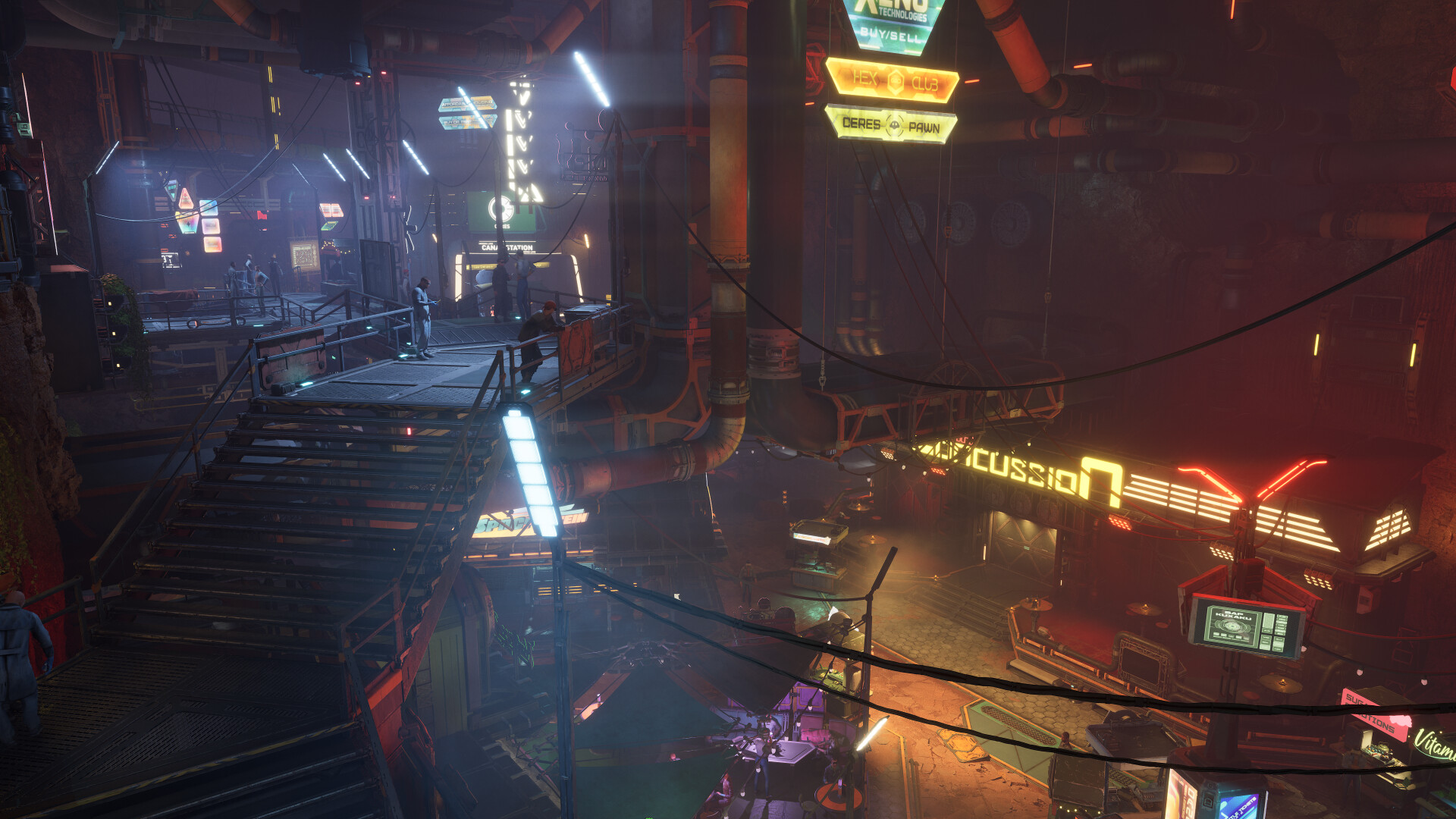
Ceres Station is one of the major social hubs players can visit in The Expanse: Osiris Reborn. The game's official account confirmed that "in The Expanse: Osiris Reborn, you will visit big social hubs between missions. Ceres, one of the biggest colonies in the Belt, will be one of such places." Between missions, players can explore the station, talk to locals, shop for equipment, uncover side content, and navigate the complex social dynamics of Belter culture.
The Steam store description refers to Ceres as part of "the teeming slums" that players will visit alongside locations like the gardens of Ganymede and the political bastions of Mars and Luna. Ceres is presented as a seedier, grittier location compared to the other social hubs, home to the Belt's largest port and a population deeply connected to the Outer Planets Alliance.
Physical Description
In The Expanse universe, Ceres is a dwarf planet that was hollowed out and spun up to provide gravity through centrifugal force. It is the largest station in the Asteroid Belt and one of the most heavily populated locations outside of Earth and Mars. The station has a tiered social structure reflected in its physical layout: wealthy and employed residents live near the top levels in apartments with faux sunlight, while the rest of the population lives deeper inside the rock, walking on dirt-strewn ground in corridors lit by neon and sputtering lamps.
Gravity weakens the deeper you go into the station. In the poorest sections, a pronounced Coriolis effect makes itself felt. Poured liquids curve in the air, and newcomers experience dizziness and nausea. Water is rationed across the station, carefully monitored and allocated in decreasing amounts as you move further from the outer levels.
Population
Ceres supports a permanent population of approximately six million residents, with an additional one million people transiting through at any given time. Between 800 and 1,000 ships dock on Ceres every day. This makes it by far the most populated and busiest station in the Belt, and one of the most densely packed human settlements in the solar system.
Security and Governance
During the game's timeframe, Ceres Station's security is handled by Star Helix Security, a private firm staffed mostly by Earthers alongside Belters willing to work with the system. Star Helix serves a similar function to Pinkwater Security on other stations: a private contractor maintaining law and order under contract. The station was governed by the United Nations during the early part of The Expanse timeline, but the Outer Planets Alliance (OPA) has a strong presence and eventually takes control.
Belter Culture and Creole
Ceres is the cultural heart of the Belt. The OPA has a major presence on the station, and Belter identity runs deep in the population. The developers have confirmed that some characters on Ceres will use Belter Creole, the distinct language that developed among Belt-born people, which the studio refers to by its in-universe name, Lang Belta. In a developer interview, the team explained how language varies by character: some companions do not use much Creole because they work in spaces where Earthers and Martians mix. But on Ceres itself, players will encounter characters who speak heavy Creole. This reflects the station's Belter identity.
The OPA presence means Ceres is politically charged. Earther or Martian players may face hostility based on their origin. The game's faction alignment system tracks how the player interacts with the Belt's population, and decisions made on Ceres can shift the player's standing with the OPA and the broader Belter community.
Economy and Black Markets
Ceres runs on commerce. The station's port handles massive volumes of cargo and passenger traffic daily. Berth fees are structured to keep ships moving: longer stays cost more, discouraging ships from lingering. The station hosts legitimate shops where players can purchase equipment and crafting materials, but Ceres is also known in the lore for its thriving black and grey markets, reinforced by dozens of ships crisscrossing the Belt carrying unofficial cargo.
For the player, Ceres is a place to resupply, upgrade gear, and gather information between missions. NPCs in bars and corridors offer side content, rumors, and contacts that can open up new mission opportunities or provide intel on the unfolding protomolecule conspiracy.
Companion Content
Ceres has personal significance for at least one of the game's companions, providing the basis for companion-specific side content tied to the station. These companion quests are part of the game's broader system where crew members have their own backgrounds and personal stakes in specific locations, giving the player reasons to engage with social hubs beyond just buying gear.
Atmosphere in the Game
The developers and press previews describe Ceres as a dark, gritty, densely packed environment. Between the sheer number of bars and OPA presence, there is a lot to see and contend with. The station's corridors are visually distinct from the other locations in the game: where Pinkwater Station has a clean, military feel and the gardens of Ganymede show orbital agriculture, Ceres is all neon-lit alleys, crowded docks, and the sounds of a working-class population living on the edge.
Key Facts
Detail | Information |
|---|---|
Type | Dwarf planet, hollowed and spun for artificial gravity |
Permanent population | ~6 million |
Transiting population | ~1 million at any given time |
Daily ship traffic | 800-1,000 ships |
Security | Star Helix Security (private contractor) |
Governance | United Nations (transitioning to OPA control) |
Language | Standard English and Belter Creole |
Economy | Major port, legitimate and black market commerce |
Game role | Social hub for shopping, NPCs, companion quests, and side content |
Ceres in the Full Campaign Map
Ceres Station is one of the destinations the developers have publicly committed to visiting in the full version of The Expanse: Osiris Reborn. Alongside Ganymede, Mars, Luna, and the asteroid-belt bunker complexes named in the reveal material, Ceres sits in the wider network of human-occupied destinations the campaign intends to carry the player through between missions. In the developer framing, it is one of the biggest Belt colonies the crew of the Gemini is expected to visit as the story moves outward from the Eros incident. The broader locations list places Ceres alongside the other major social hubs rather than as a gated endgame destination.
Players of the closed beta do not visit Ceres in that build. The beta's playable window is confined to Pinkwater Four Station and the EVA corridors immediately around it, plus a spacewalk sequence bridging the two. Ceres is present in the beta only as background context: a direction the Gemini is implicitly going to travel in, a cultural reference point for the Belter crewmates around the player, and a name that surfaces when news broadcasts and station gossip talk about the state of the Belt. Anything the beta does not directly show about Ceres is left deliberately unstated here.
Ceres as a Belt Hub
Inside the fiction, Ceres is the largest station in the Belt and the cultural, economic, and political center of Belter life. That framing matches the Steam store material and the developer overview: Ceres is positioned as the busy, politically charged counterweight to Earth-facing destinations like Luna and the MCR-controlled surface of Mars. The game's other confirmed factions all have a reason to keep eyes on Ceres, which in turn means the player will have reasons to be pulled into its affairs once the campaign opens the station up.
The tone the developers have set for the game, political intrigue layered over grounded science fiction tension, suits Ceres naturally. The station is described as a dense port, a migration bottleneck, a black-market hub, and a place where Belter identity is at its loudest. Every one of those traits reads as an invitation to the kind of choice-driven, faction-aware play The Expanse: Osiris Reborn builds its story and setting around.
The Belter Origin and a Ceres-Focused Playthrough
The character creation and progression system in the beta already exposes the first tool a Ceres-focused playthrough will lean on. Two of the game's three player backgrounds are selectable in the beta: Earther and Belter. The third, Martian, is present in the reveal material but not in the closed-beta preset pool. Each background grants a personal passive: Earther picks up a bonus in the Athletics social skill, Belter picks up a bonus in Engineering, and the Martian passive is described as a social-skill boost whose exact target has not been announced. For a run built around the Belt, the Belter origin is the most thematically fitting choice, and the Engineering passive sets the player up for the infrastructure-focused skill checks that the preview builds scatter around station environments.
Belter presets in the beta are also visibly distinct at the modeling level. Belter characters stand noticeably taller and appear more elongated than Earther characters, a visual marker the game treats as a defining trait of Belt-born people. The developers have stated the intent to carry that trait through Belt-native locations, which means a Ceres sequence in the full game should sit comfortably in that visual register, with the player character blending in rather than standing out. The beta pairs the Belter presets with female models and the Earther presets with male models for its four locked slots, but the reveal material makes clear that background, gender, and appearance will be independently customizable in the final release.
Whichever origin the player chooses, the larger point is that the game's character creation and progression systems are not locked by background. Presets seed a starting loadout and a handful of skill points, not a class. That means the player can equip a Belter character for Ceres-style dockside work, a diplomat-leaning build, or a hacker operating inside Belt black-market systems. None of those builds are gated off by origin; the passive is the only hard tie between background and playstyle.
Foreshadowing on Pinkwater Four Station
Even though the beta never takes the player to Ceres, the build threads Belt-adjacent references through its one playable mission. Large newscast screens mounted in public spaces on Pinkwater Four Station run stories keyed to the wider the Expanse universe, and NPCs stop to watch them. Crewmates argue about the veracity of the coverage. Visiting residents trade rumors about figures active elsewhere in the Belt. None of it names Ceres explicitly in the clips the beta surfaces, but all of it establishes that the solar system beyond Pinkwater Four is in motion, and Ceres is the loudest Belt voice in that solar system by default.
The station's weapons and goods vendor, Luciana, pushes the same motif further in her persuasion-gated gossip. Her chain of rumors rewards the player for leaning into the Persuasion social skill, and some of what she volunteers touches on MCR-adjacent contacts, including implied political ties between a Pinkwater Security captain and figures at the top of the Martian Congressional Republic. That thread explicitly folds factions outside Pinkwater into the player's awareness before the campaign's map ever opens up. The same design pattern, informational rewards paid out through rumor vendors, is a natural fit for Ceres given the station's role as a Belt gossip hub in the fiction.
Possible Mission Flavor
Nothing the beta surfaces confirms specific Ceres missions, NPCs, or quest lines. What the beta does confirm is the shape of how Osiris Reborn handles a mercenary-contract mission, and Ceres, as a mercenary-friendly port, is a natural fit for more of the same. Pinkwater Four demonstrates the template: the player docks the Gemini at a station, debriefs with a local contact, explores a compact social hub that doubles as a tutorial zone for skill checks and dialogue trees, then pivots into a combat mission shaped by earlier choices. Ceres, as a bigger and denser hub, is a logical venue for another pass of that structure at larger scale.
The player's reception on any future Ceres visit is also likely to be colored by the decisions they made earlier. Persuasion paths, airlock choices, and how the player handled the choices and consequences offered at Pinkwater Four all feed into the crew's reputation as the campaign progresses. Whether the player convinced Pinkwater to resist Protogen or to stand down, whether Pinkwater Four survived the encounter at all, and how Zafar and the rest of the crew read the player's priorities on that mission are all carried forward. The game's per-companion approval tracking is the delivery mechanism for that carryover, and Zafar's long-term relationship in particular is explicitly shaped by choices such as whether the player waited for his airlock recommendation or forced entry through a nearer airlock against his advice. All of that feeds the social posture the player will arrive at Ceres with.
The 2026 origin breakdown filled in why that reception is so sharp. Early in the story, Mars is accused of destroying the ice hauler Canterbury, which had been carrying ice to Ceres. Left short of water, the station's Belter population turns hostile toward inners, and especially toward Martians. A Belter who grew up on Ceres can lean on shared language and customs and still has a loyal local friend to call on, while that same friend is a complete stranger to an Earther arriving for the first time. An inner-born captain moves through the station as an outsider, which makes origin one of the strongest levers on how a Ceres visit unfolds.
What the Beta Does Not yet Confirm
A careful reading of the available material also draws hard limits around what Ceres will and will not contain in the full release. The closed-beta build does not confirm named Ceres NPCs, specific Ceres missions, or any particular enemy-faction presence tied to Ceres operations. It does not confirm that any Ceres content is skill-gated in a specific way, or that any of the beta's characters (beyond the Gemini's crew) will reappear there. Existing beta companions like Zafar and J travel with the player by default; beyond that, the beta is silent on who the player will meet at Ceres or what they will be asked to do.
Where the existing fiction describes Ceres in concrete terms, the overview above (population, port traffic, governance, Belter Creole usage, economic character) is the source. Where the game has not yet spoken, this article stops. Treat any specific quest names, named Ceres-side antagonists, or purported romance options that circulate before release as unverified until the developers confirm them through an official channel.
Between Pinkwater Four, the Gemini, and Ceres
A useful way to hold the current picture together is to think of the Gemini as the through-line and Ceres as one of the stops. The Gemini is the mobile base. Pinkwater Four is the place where the player has a first home-base encounter, receives a brief, and makes the first serious choices of the campaign. Ceres is the biggest Belt port on the map the developers have sketched out, and the place where the game's Belter themes, political intrigue, and mercenary-economy pressures are most likely to converge. Events at Eros Station sit upstream of all of it, and their ripples reach Ceres through the same news channels the player watched in the beta's opening hours.
Nothing in that picture demands a particular Ceres build from the player. A Belter Engineer and an Earther Hacker will both land at Ceres as Pinkwater survivors with a ship they took from Protogen and a crew bound to them by shared history. The social and faction reactivity the beta demonstrates is what makes the two arrivals feel different, not a hard class lock. That is exactly the sort of branching story and setting the campaign is built around, and Ceres is the setting most obviously primed to show it.