
How it Works
After the prologue, Coen has 30 days and 30 nights to rescue his family from Brencis and his inner circle. This is the central structural mechanic of The Blood of Dawnwalker, and it shapes every decision the player makes.
The clock does not tick in real time. Walking around the world, exploring, fighting, and looting do not advance the day counter. Only specific narrative actions (completing quests, making dialogue choices) move the calendar forward. Every action that costs time is marked with an hourglass icon showing exactly how many days or nights it will consume. You always know the price before you commit.
Day/Night Segment Structure
Inside each 24-hour cycle, time is broken into discrete segments. There are eight daytime segments and eight nighttime segments per day. Every quest, dialogue choice, or scripted action that advances the clock spends a whole number of these segments, never a fractional amount. The hourglass icon on a choice tells you exactly how many daytime or nighttime segments you are paying. Across the 30-day rescue window that adds up to 240 daytime segments and 240 nighttime segments to spend on whatever Coen pursues.
The split matters because Hex Magic is locked to daytime segments and vampiric powers are locked to nighttime segments. Spending a full night on an infiltration leaves Coen with fewer night segments left for vampire-only encounters elsewhere on the map, and the same logic applies in reverse during the day. The 8+8 split is the underlying budget that the day/night ability divide draws from.
Perks carry the same divide on their face. Coverage of the shipped game reports that each one is labelled for daytime, for night-time, or for either, so a build is partly a decision about which half of the clock a player expects to spend most of.
Reading the Clock
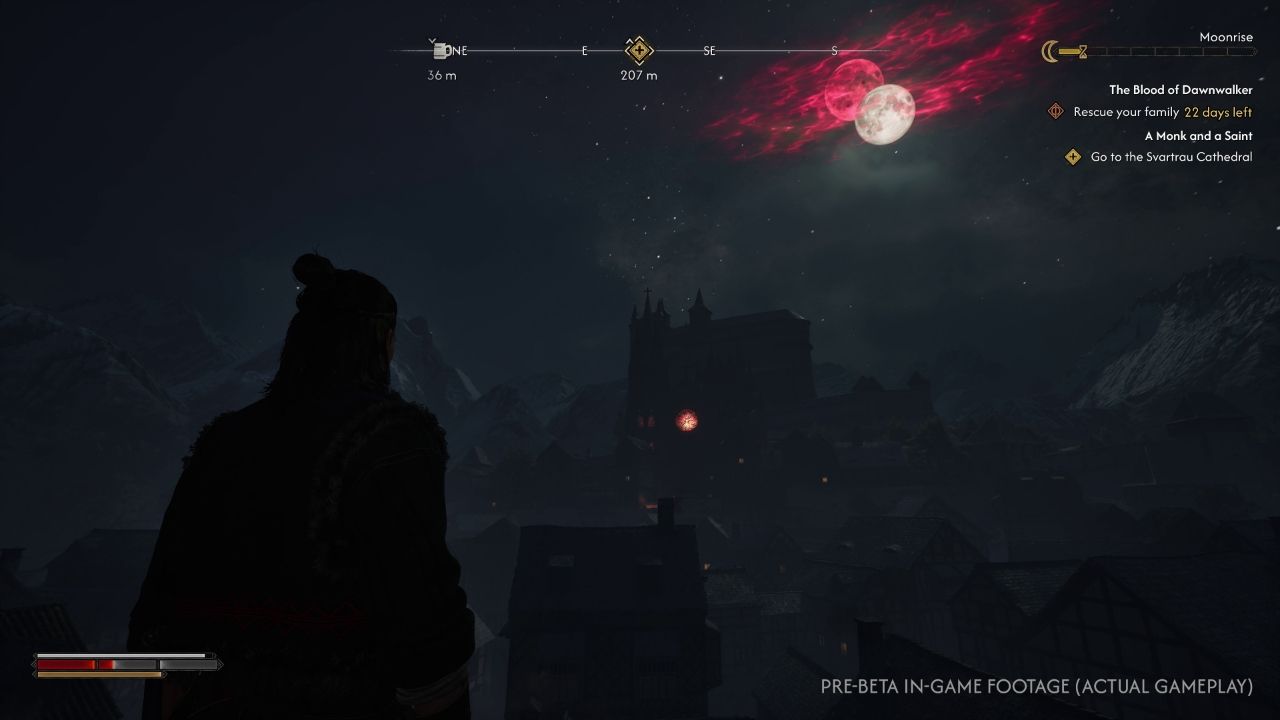
A bar in the top right of the screen tracks progress through the current phase, filling section by section. The quest journal prints the time cost of an entry before it is accepted, and a lapse can arrive part way through a quest, in several instalments, rather than all at once at the end.
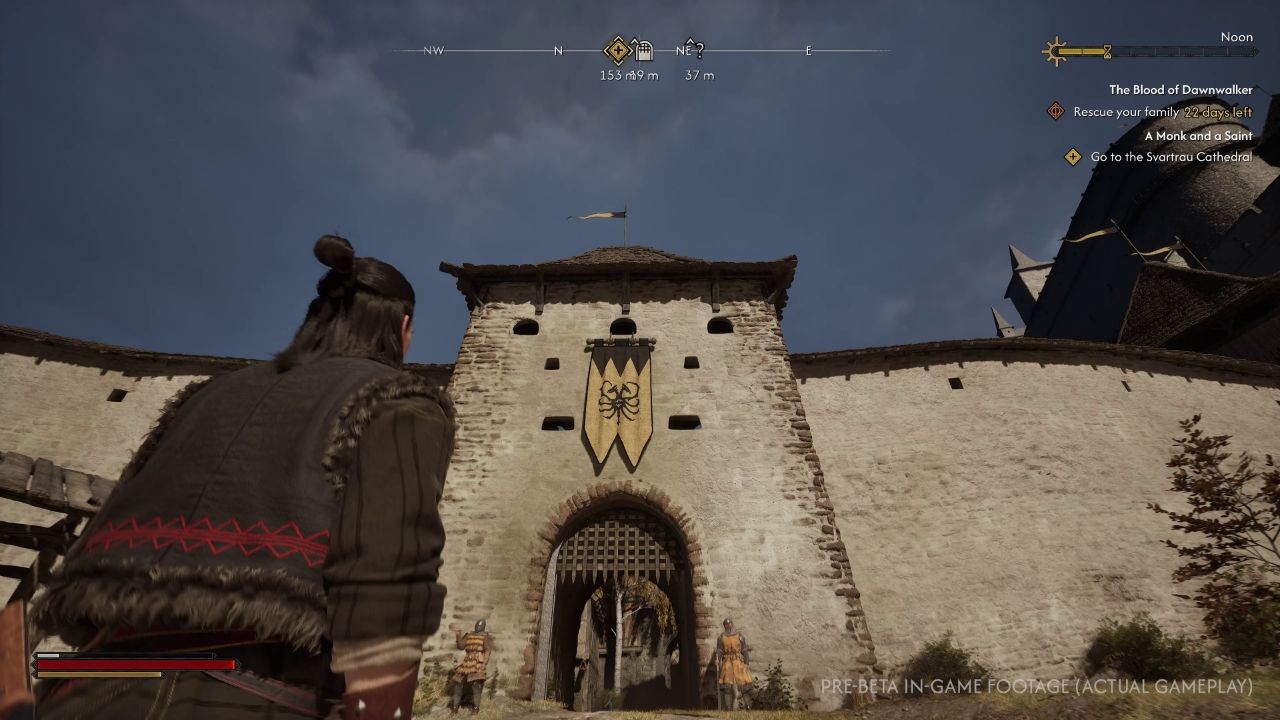
Three signals warn that a segment is about to be spent. An hourglass with an arrow pointing to a sun or a moon means the action will flip the phase outright. Approaching a place or a person that will trigger a jump produces a ticking sound and greys out a section of the on-screen clock. A blue clock icon on a journal entry marks a quest that will expire if it is left too long, and a sun or moon icon marks one that can only be started in that half of the cycle.
There is no option to switch the time system off, soften it, or convert it to real time. It is the frame the whole game is built in rather than a difficulty setting.
What Else Spends Segments
Quests are the largest draw on the clock but not the only one. Three other confirmed sinks all take segments without any story progress to show for it, which is what gives the budget its bite.
Action | Cost |
|---|---|
Training a perk | Spending points at a Shrine costs in-game time on top of the point price. Building Coen stronger is itself a draw against the deadline. |
Getting arrested | Attacking or killing a protected villager and being caught costs 16 segments in a cell, which is a whole day and night gone. |
Advancing time deliberately | Time can be pushed forward manually at a shrine, which is how a player reaches night-gated content during the day. The segments still come out of the same budget. |
Working the other direction, the Sanzhana are the one confirmed exception. These winged traders buy teeth harvested from the dead, and the line of encounters they appear in pays back time rather than coin. Two independent accounts of the shipped game report that finishing all five of those encounters returns a full day to the clock, which is the only documented way to claw segments back. Individual trades pay in money, and no rate for them has been published.
Time as a Currency
Game director Konrad Tomaszkiewicz has described time as "a currency which players are in control of fully." If a quest costs two days, you see that upfront. If you choose to spend those two days helping a village, that's two days you don't have for something else. The system creates constant trade-offs. You cannot do everything in 30 days, and the game knows this.
Roughly 80% of the game's content is accessible in a single playthrough. The remaining 20% is locked behind branching decisions and time constraints that make it impossible to see everything at once. This is intentional. Replayability comes from making different choices with the same time budget.
No Main Quest
The developers have been explicit about this: there is no main quest in the traditional sense. There is one goal (save your family) and everything else is optional. You decide which leads to follow, which factions to support, and which parts of the valley to explore. The game does not distinguish between main quests and side quests. There are just quests, and you choose which ones matter to you.
Tomaszkiewicz has cited Fallout 1 and Fallout 2 as direct design inspirations for this structure. Both Fallout games gave the player a clear objective and a time limit, then let them pursue it however they wanted. The Blood of Dawnwalker follows the same principle: "It's more similar to the old Fallout, where you have a clear goal and everything is optional, you decide."
What Happens After 30 Days
The game does not end when the deadline passes. If you fail to rescue the family within 30 days, the story continues, but with consequences. What those consequences are depends on what you did or didn't do during the 30 days. The family's fate changes based on your actions.
Walkthroughs of the shipped game describe what that looks like. Once more than thirty in-game days have passed since the prologue, a cutscene shows the family dying in Brencis's castle. Play carries on without the clock, Brencis can still be confronted, and the epilogue records the loss. No achievement is attached to that outcome, while finishing any ending inside the deadline adds one, In the Nick of Time.
Players can also attempt the rescue before the 30 days are up. Going early is possible but increases the difficulty, since you've had less time to prepare, build alliances, and gather information. The system rewards thorough preparation while punishing both rushing and procrastination.
The budget is looser than it looks for a player who sticks to the story. One walkthrough reports that concentrating on the court activities that draw out Brencis's three lords can bring the story to its end in seven to ten in-game days, which leaves most of the month for side content.
Consequences of Inaction
Doing nothing is itself a choice the world recognizes. If a village asks for help and you move on, something happens to that village. If a faction has an alliance and you never follow up, they proceed without you (and they remember. The developers have said that "even inaction is a choice) one the world around Coen will recognize and respond to."
Multiple Endings
The ending system forms what creative director Mateusz Tomaszkiewicz described as "a very complicated web of connections." There are multiple endings not just for the overall story but for individual characters. Some choices may branch into potential sequels. The designer responsible for tracking all the branching paths has been compared to "the Charlie Day meme with red tape."
Two of those endings can fire far earlier than the 30-day clock suggests. The prologue closes with a fight against Brencis that the game expects the player to lose, since that defeat is what sets up the rescue. The fight is winnable. Walkthroughs of the shipped game document that beating Brencis there kills him, removes the antagonist, and ends the game at once, and describe it as extremely hard to pull off in practice.
The second early exit needs no combat at all. Once the prologue is over and the walled starting area opens up, a player can simply leave Vale Sangora instead of attempting the rescue, abandoning the family and closing out the story that way.
Two independent accounts of the released game describe that route in the same terms: a broken bridge in the north-west of the swamp region, crossed with a fully upgraded Shadowstep, opening onto a road and a pass that is still clear. One of those accounts puts the requirements at a corruption level of eleven and the second rank of the perk that extends Shadowstep's range, while a later walkthrough reports that climbing the canyon wall at night with Planeshift and Shadowstep reaches the same road straight after the prologue. The game is usually counted as having seven endings: four full endings, two early endings (leaving the valley, and a dream ending inside the Home Sweet Home quest), and a failure ending if the thirty days run out. One account adds winning the prologue fight as an eighth. See Greifberg for the castle assault most of the full endings begin with.
Game Length
Completion times measured at launch spread very wide. A direct route through the story can finish in roughly eighteen hours, a fuller run lands somewhere past thirty-five, and near-exhaustive play has run past eighty. Post-launch coverage has not narrowed it much. One guide puts the likely range at anywhere between twenty and fifty hours and expects most players to land between thirty and forty, a figure it ties to seeing the major questlines and some side content; the creative director has separately been quoted at around fifty hours on average; and the studio estimated fifty to seventy before release. The spread is the point rather than a failure to agree, because how long a run takes is partly a decision the player makes with the clock. The main story can also be finished well before the deadline, and play continues afterwards. The game was originally scoped to be roughly the size of The Witcher 3's Blood and Wine expansion, but it grew during development. Given that each playthrough involves different choices and missed content, the total playtime across multiple runs is substantially higher.