

Base building in Subnautica 2 has received a major overhaul, described by the development team as "Underwater Base Building 2.0." The developers stated they are "making base building better with more customization than ever before" with "shapes and ways they've always wanted." Dev Vlog 1 (April 23, 2025) showed the updated system in action, and Design Lead Anthony Gallegos framed it as a central pillar of the Early Access offering. The team noted: "We've taken everything that we've learned from our experience on the previous games, and we've poured it into Subnautica 2."
How the New System Works
Subnautica 2 uses a flexible, modular base-building system on Proteus. Bases consist of pressure-sealed rooms connected by corridors and observation modules, with each piece carrying many attachment points for greater placement freedom.
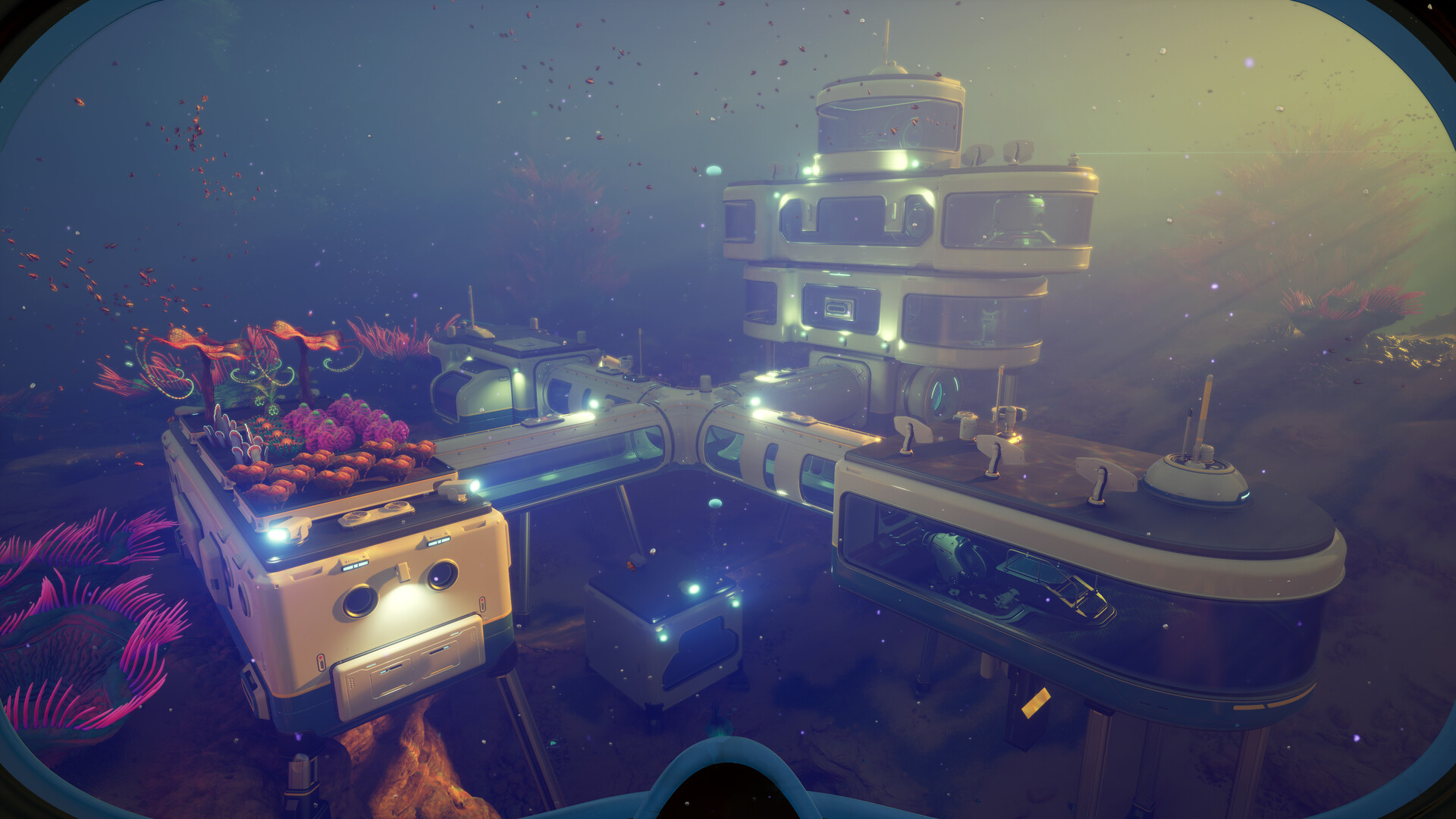
Subnautica 2 reworks this system with three key changes:
Change | Description |
|---|---|
More connection points | Each building piece has significantly more attachment spots, allowing greater variety in how structures connect. |
Greater placement freedom | Builders face fewer restrictions on where individual pieces can be positioned relative to one another. The rigid cardinal-direction-only attachment system has been loosened. |
More building pieces | The total number of buildable components is larger, with some pieces designed for specific aesthetic or structural roles. |
The system has been described as enabling players to "snap pressure chambers together like sci-fi Lego." While it retains a modular snap-point attachment logic (pieces lock to other pieces at defined points), the expanded connection options mean bases can have significantly more complex and distinctive layouts than was possible in previous games.
New Structural Elements
Dev Vlog 1 footage revealed several new construction components:
Piece | Description |
|---|---|
Support pillars | Structural columns that reinforce bases and create more architecturally varied constructions. Enables greater vertical complexity. |
Superconducting foundations | A new foundation type, likely related to power distribution throughout larger bases. |
Half-Round Room | A named new room type shown in development footage. |
Nook | A smaller, specialized compartment shown in development footage. Suggests more granular room sizing. |
Dev Vlog 1 also showed bases with noticeably more complex silhouettes and ornate layouts, suggesting additional piece types beyond those specifically named above.
Power Management
Every base on Proteus runs on power. Without it the habitat cannot produce oxygen, and an unpowered base switches its life support off, so a reliable supply is the first priority after laying down a hatch and a corridor. The panel shown when you step inside reports production against consumption, so you can see at a glance whether your generators are keeping up, with a blue reading for what you make and a red reading for what the base draws.
The launch build offers four power sources. The figures below are steady output per second under good conditions:
Source | Output | Placement and Notes |
|---|---|---|
Solar Panel | Up to 8 in direct daylight, falling to about 1 at night or at depth | Mounted on the base exterior, usually the roof. Cheap and ideal for a shallow starter base, but unreliable on its own once the sun goes down. Pair it with a power storage unit to bank daytime energy for the night. |
Hydroelectric Turbine | A steady 12, day and night | Placed inside the flowing current tunnels found in some biomes. Output never fluctuates, but the tunnels are not everywhere, so the base has to sit reasonably close. Power is carried back to the base with a chain of transmitters. |
Thermal Plant | Up to 16, scaling with ambient heat | Placed on or beside thermal vents and inside geothermally hot biomes. The single highest output when sited well, and effectively free to run, but only practical if you live near heat. |
Bioreactor | A steady 10, or 20 when overcharged | Built indoors and fed organic matter such as plants and fish. It works in every location, which makes it the universal backup. Overcharging it with concentrated biofuel doubles output but burns through fuel far faster. |
Solar and hydroelectric are the usual pairing for most bases, with thermal reserved for hot biomes and a bioreactor kept as a portable backup that runs anywhere. Power storage units, unlocked separately, hold surplus daytime energy so a solar base does not go dark overnight.
Co-op base building
In multiplayer sessions (up to four players), bases are shared between all players. Several co-op-specific mechanics have been confirmed:
Feature | Details |
|---|---|
Shared power management. | Power is pooled across the base. Life support must stay active for all four divers simultaneously. If the base runs out of power, everyone suffers. This creates natural coordination around resource gathering and power infrastructure. |
Individual oxygen. | While power is shared, oxygen management remains individual to each player. |
Shared blueprints. | Blueprints are bound to the save file. New blueprints discovered by any player become available to the entire team. This means a group can divide exploration duties to unlock recipes faster. |
Simultaneous building. | Players can build independently within the same world at the same time. One player can gather resources while another expands the base. |
Save conversion. | A single-player save can be converted to a multiplayer session, allowing players to invite friends to see and expand an existing base. |
Resource Changes
Dev Vlog 1 showed a completely reworked resource system that directly affects base building. Resources on Proteus use resource-specific nodes on the seafloor that can be identified visually and collected by hand. This replaces the breakable limestone, sandstone, and shale outcrops from previous games that dropped randomized materials. Players can now target the exact resources they need for construction rather than relying on chance drops.
Resources are stored as fractional quantities using a decimal-based inventory system (for example, "0.71 titanium" rather than whole units). This granular tracking changes how players plan material gathering for base construction, since building pieces may require precise fractional amounts rather than whole-number stacks.
Dev Vlog 6: Building Bases
On March 12, 2026, Unknown Worlds released Dev Vlog 6, dedicated entirely to the reworked base-building system. The vlog featured Kiel McDonald (Base Design Lead), Carolyn Lu (Senior Engineer), Milan Singh (Senior Gameplay Engineer), and Ben Henry (Lead Hard Surface Artist). The team walked through the new procedural approach to base design: rather than snapping fixed pieces together, players start from a basic room shape and reshape it freely, widening walls, carving alcoves, and customizing surfaces. Attachments shown in the vlog include customizable windows, lighting, decorative panels, doors, moonpools, and stacked growbeds for underwater farming.
Building Mechanics
Bases are assembled with the habitat builder. Right-click opens the piece menu, the scroll wheel rotates the selected piece, and a ghost preview shows where it will attach along with the support pillars that will hold it up. You only need one unit of one material to drop a ghost, so you can lay out a whole base in outline and fill the pieces in later. Because the auto-generated support pillars can get in the way of later additions, it helps to build from the bottom up.
Rooms are reshaped rather than fixed in size. With a piece selected you can use the scroll wheel to grow a wall outward, and the same works from the inside to push a wall out or pull it back in. To shrink a piece, enter deconstruction mode and use the shrink control, then adjust it the same way. There is no grid or measurement readout, so the reliable trick for an even room is to lay corridors flush against each side as a ruler, size the room to match, then remove the spare corridors.
The current build has no dedicated vertical connectors. To go up or down you stack one room on top of another to form a shaft and place a ladder inside it. Ladders only link full rooms, not half-rooms or corridors, and they can be fiddly to seat. Other modules round out a layout: nooks are larger compartments that jut out from a room and suit a desk or a modification station, while half-round rooms are the main option for a curved profile.
Windows are the most customizable element. They come in three sizes set with the scroll wheel and can be grown or shrunk like other pieces. Single panes make portholes, panes can be combined into vertical or horizontal slit windows, and the corners of a larger window can be switched from rounded to straight to change its shape.
Moonpool and Vehicle Docking
A moonpool lets you dive straight into the water from inside the base and is where the Tadpole docks. The dock locks the vehicle in place, recharges its power cell, and lets you swap its chassis or modules. The catch is space: the docking arm hangs well below the moonpool, so a standard room rarely gives it enough clearance on the first try and the placement preview turns red over shallow seabed, rock, or another part of the base. Build the moonpool high off the floor, expand it after placing, and set the dock off-center because it will not line up cleanly with corridor steps.
Interior and Decoration
Interiors can be dressed with wall panels, posters, beds, chairs, and a dining table that other objects can be set on top of. Wall racks act as hard points, the same as the ones on the Tadpole, and hold deployable storage, oxygen generators, work lights, and beacons, which makes them handy as an emergency kit beside a moonpool. Sitting in a chair or lying in a bed pauses food and water drain, so they are useful for reading through logs or going idle during a co-op session. Lighting brightens a base but draws extra power and can cost performance, so heavy lighting is best treated as an endgame luxury.
Choosing a Base Location
A good site balances three things: easy access to whichever power source you intend to run, a short trip to the resources and objectives you visit most, and a manageable danger level nearby. A base tucked under the starting Lifepod is safe and convenient at first, but it sits far from the later biomes to the east, so the commute grows long as you progress. Many of the best-placed spots already hold a wrecked base you cannot occupy, though you can usually build around it. Cave sites work where a thermal vent is close enough to power them, and a few cliff-edge spots let a base extend slightly toward the open Void for the view. Late in the game, a small forward base near your current objectives saves a great deal of travel time.
Early Access 1.1 Changes (Adaptive Measures)
The Adaptive Measures update (Early Access 1.1, July 8, 2026) added several base-building refinements. A new storage buildable holds items without contributing to nearby crafting systems, so cached materials can be excluded from recipe auto-completion, and the World Tree Relic decoration seen in the trailer became a buildable item. The Vehicle Dock and Fabricator received placement improvements: the dock platform and rails were made smaller to fit tighter rooms, both snap more clearly to hatches and other base elements, and added feedback clarifies when a Moonpool needs enlarging for docking or fabrication. Placement ghosts read more clearly behind objects or at the water surface, blockage VFX for construction and deconstruction are now visible through walls, and the maximum deconstruct size of a base was increased. Players can also now sprint inside a base and on the surface.
Answered Since Launch, and What Is Left
Most of the pre-launch questions about base building have been settled by the shipped build:
Several pre-launch questions have since been answered: the power sources, the moonpool, and interior decoration all shipped, and structural integrity, base flooding, and base attacks are not part of the current Early Access build. A few details remain undocumented:
How base building interacts with Blight-affected zones
The exact crafting cost of every building piece, since the full recipe list has not been published and some community figures disagree
October base and power fixes
Buddy System Hotfix 2 on October 6, 2026 corrects Thermal and Hydroelectric Generators losing or displaying the wrong power after streaming out and back into the world, as well as incorrect Hydroelectric Turbine output after streaming. It also fixes moved Biobeds showing the wrong mesh after a reload and tools on Carryable Racks appearing visually duplicated while the rack is moved. Tadpole docking orientations that were incorrectly blocked by vehicle geometry are corrected.