

Survival Mechanics
Survival mechanics in Subnautica 2 build on the franchise's foundation of underwater survival while introducing significant new systems. In the current Early Access build the player manages four survival stats while exploring the oceans of Proteus, gathering materials, and building. The sequel retains the core loop from previous games but adds permanent genetic modification, a decimal-based inventory, a radically different opening sequence, and co-op survival dynamics.
The Four Survival Stats
Subnautica 2 tracks four survival stats in the current Early Access build: Oxygen, Health, Hunger, and Thirst. These are the only always-on meters. Temperature is handled separately as an environmental hazard rather than a fifth meter, covered in its own section below.
Stat | Description | Notes |
|---|---|---|
Oxygen | Limited air supply that depletes underwater. Running out is one of the most common causes of death. | Carrying a spare oxygen tank and switching to it mid-dive extends time underwater; empty tanks refill at underwater oxygen plants. The Tadpole has exterior oxygen ports for co-op passengers. |
Health | Depletes from creature attacks, environmental hazards, heat exposure, drowning, and falling. | The no-weapons policy means damage is designed to be received, not dealt. Players cannot kill hostile creatures, so managing Health means avoiding harm rather than winning fights. |
Hunger | Drains over time and must be refilled by eating. Previous games used cooked fish and harvested plants. | Eating local fish and plants safely requires the Digestion Adaptation first. Cooked fish is the simplest meal, while growbeds and higher-tier recipes cover food on longer expeditions. |
Thirst | Drains over time and must be refilled by drinking. Previous games fabricated water from a single source fish or from salt and coral. | Waterslugs provide an early source of drinkable water through the Fabricator, alongside crops and other recipes. The Water Retention BioMod doubles what each drink restores, which stretches a scarce early resource. |
Temperature as an Environmental Hazard
Temperature is not a standing survival meter in Subnautica 2. Instead, heat is treated as an environmental hazard that only matters inside hot zones. In those areas, roughly 30 to 80 degrees Celsius, escalating heat deals damage to Health the hotter the water becomes, so the danger scales with how deep into a hot biome the player pushes.
At the top of that range sits the heat barrier, an 80 degree Celsius wall that blocks progress entirely until the player gains the Heat Tolerance Adaptation. Heat Tolerance is what allows the player to pass that barrier and survive the hottest areas, which gate later content. Because the effect is tied to specific zones rather than a global meter, the player only needs to think about temperature when approaching geothermal or superheated water, not during ordinary diving in temperate biomes.
Game Modes
The current Early Access build ships two game modes. The mode chosen at the start of a save determines whether the four survival stats are active at all.
Mode | How Survival Works |
|---|---|
Survival | The default mode. Oxygen, Hunger, and Thirst are all active, and the player must manage them throughout the game. |
Creative | Removes the survival meters, unlocks all blueprints, and provides infinite power and item durability, so the focus shifts entirely to building and exploration. |
A Hardcore or permadeath mode is not confirmed for this game's Early Access build. A mode of that kind existed in prior franchise games, but it should not be assumed to be present here until it is confirmed. For a fuller breakdown of what each mode enables and disables, see the dedicated Game Modes page.
Death and Respawn
When the player dies in Survival mode, they respawn at the assigned Biobed rather than reloading a save. Death is not the end of a run: the world and any built bases persist, and the player simply restarts from a habitat.
Dying does carry a cost. On death the player drops the items they were carrying, so recovering a lost inventory means swimming back to where they died, which can be dangerous if the death happened in a hostile or deep area. In co-op, a teammate can revive a downed player before they reprint: the revived player keeps their equipment and regains a small amount of oxygen. A downed player who would rather not wait can reprint immediately and respawn at their assigned Biobed. Revives arrived in the Buddy System update on August 19, 2026. See the Early Access and Development Roadmap for the planned co-op additions.
Food, Water, and Farming
Hunger and Thirst work much as food and water did in earlier games, but with one early gate. Before the player can eat the moon's fish and plants without taking damage, they must gain the Digestion Adaptation from an Angel Comb a short way from the start. Until then, eating hurts rather than heals. Once digestion is unlocked, cooked fish is the simplest food, Threemoon Temaki (one each of Halfmoon, Harvestmoon, and Bluemoon plus a Fibrous Pulp) is an efficient meal for long trips, and Pavlova is a top-tier recipe that restores about 80 food, 70 water, and 10 health at once.
Waterslugs can be processed into drinkable water at the Fabricator, while crops and other recipes provide additional supplies, and the Water Retention BioMod doubles the value of every drink, which is the most reliable way to manage thirst in the current build.
Farming closes the loop. Growbeds let the player grow compatible plants on a renewable cycle, on land or underwater, and they can be stacked to save space. Harvested plants yield Fibrous Pulp, which is refined into Fiber for first aid kits, alongside the ingredients for food and water recipes. Because crops regrow quickly, a small garden beside the base can cover food, water, and healing for the rest of a playthrough.
The Deep-Start Opening
Subnautica 2's opening sequence is a deliberate inversion of the original game's pacing.
The pioneer's ship crashes directly into Proteus's deep ocean. Trapped in the flooding vessel at extreme depth, the Noetic Advisor directs the player to use an experimental gene-altering machine aboard the ship to survive the crushing pressure. This moment introduces the permanent DNA Adaptation system as a narrative necessity rather than an optional upgrade.
After the genetic modification, the player is propelled back toward the surface, getting a terrifying glimpse of deep-sea creatures (including leviathan-class organisms) as they rise. The player then begins the main gameplay loop from shallower waters, working back down toward the horrors they already glimpsed.
This design front-loads the dread. Players know what lurks in the deep from their very first minutes, and the entire progression arc becomes a journey back toward that terror rather than a gradual discovery of it.
No-Weapons Philosophy
Subnautica 2 has no weapons of any kind, a deliberate design choice covered in full on the no-weapons philosophy page. The survival knife from previous games has been replaced by a cutting tool classified as a collection item. Leviathan-class organisms are mechanically invincible and cannot be killed, so survival depends on evasion rather than combat.
Confirmed evasion methods include flares (which can distract the Collector Leviathan), quiet swimming in dark water (the Collector's behavior reacts to light, sound, and movement), and using terrain and biome features as cover.
Decimal Inventory and Resource Nodes
Subnautica 2 replaces whole-number item stacks with a fractional, decimal resource system. Official gameplay footage showed the player carrying a partial amount of titanium, for example a reading below one full unit, in their inventory. Resources are tracked as continuous quantities rather than discrete whole-number items.
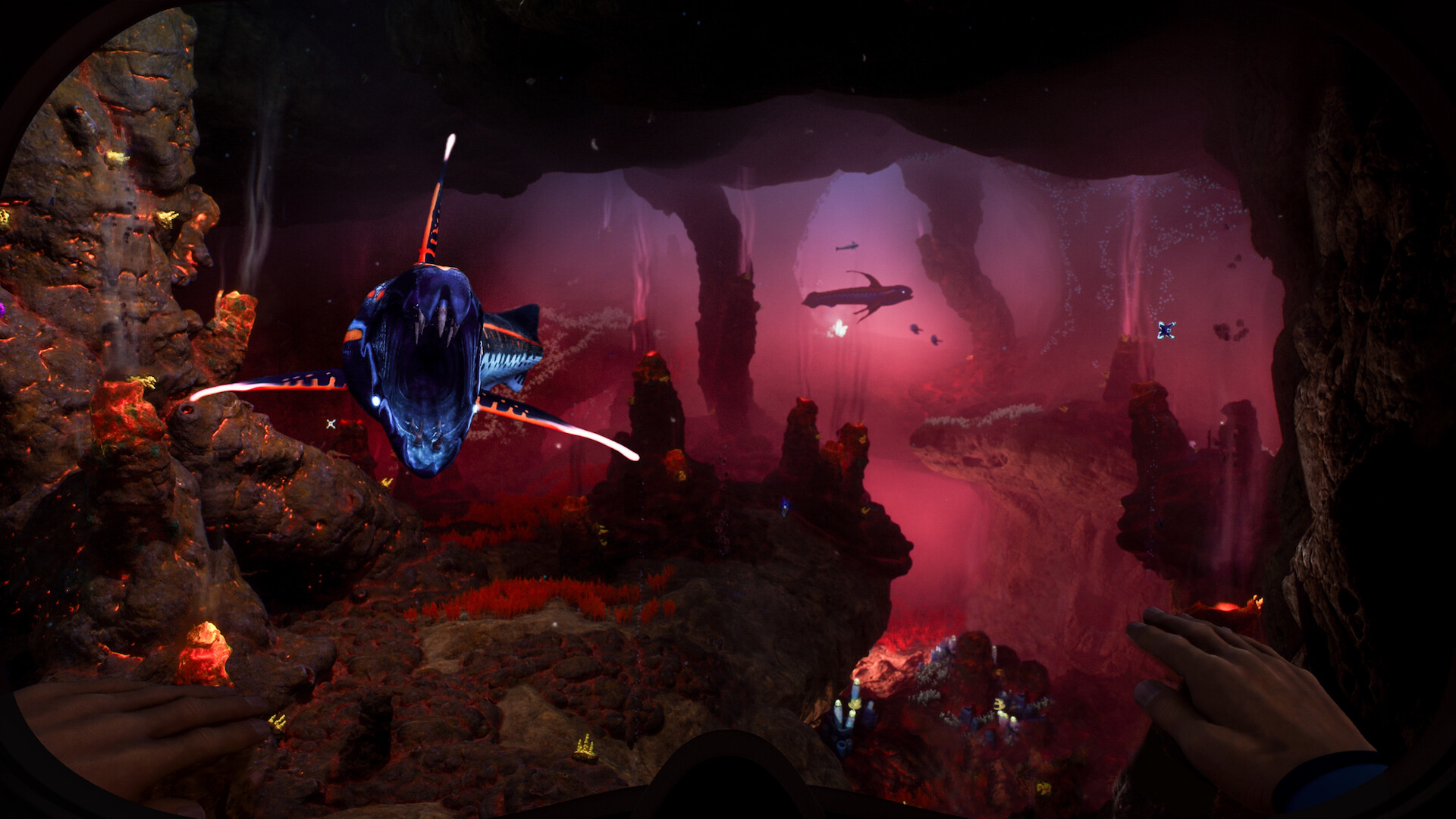
Alongside this, the game replaces breakable outcrops with resource-specific nodes on the ocean floor. Each node type yields a known, specific resource when collected by hand. This reduces the randomness of resource gathering from previous games: players can visually identify and target the exact materials they need.
The Scanner has been upgraded with radar capabilities to help locate resource nodes and scannable objects in the surrounding area, reducing time spent searching in Proteus's larger map. Together, the resource-specific nodes, decimal tracking, and radar-equipped Scanner make resource gathering more deliberate and predictable than in previous games.
Two Progression Paths
Subnautica 2 separates body modification into two distinct systems, and both feed survival. Adaptations are permanent DNA upgrades drawn from Angel Comb growths that gate major progression, such as Pressure Tolerance for deeper diving and Heat Tolerance for passing the heat barrier. BioMods are temporary, reversible perks managed at a Bio Lab that do not enter the player's genome and can be swapped freely. The two systems are described in detail on their own pages.
System | How It Works |
|---|---|
Technology path | Scan fragments of objects and wrecks to unlock blueprints for vehicles and equipment with higher depth ratings, extending where the player can go. See Blueprints and Scanning. |
Biology path | Collect DNA with the Biosampler and gain permanent Adaptations from Angel Comb bulbs, allowing the player's body to survive conditions that would otherwise require mechanical protection. |
Co-Op Survival
The addition of co-op multiplayer for up to four players introduces shared survival dynamics. Confirmed co-op survival features include:
Shared bases require collective power management to keep life support active for all divers. Running out of power affects everyone.
The Dive Elevator enables coordinated resource runs, with teams descending together and hauling materials back to the surface.
Players can ride the exterior of the Tadpole with oxygen ports preventing drowning.
Shared blueprint unlocks mean the team can divide exploration duties to discover recipes faster.
Single-player saves can be converted to multiplayer sessions, and co-op is optional rather than required.
The Blight
The Blight is a mysterious bacterium spreading across Proteus, disrupting the ecological balance of the ocean world. It is a central narrative threat. Blight-affected zones contain creatures that behave more aggressively and environments that become increasingly hazardous. How the Blight affects specific survival stats has not been fully detailed, so its exact mechanical impact remains open in the current build.
Narrative Integration
The survival experience is woven into the story. The Noetic Advisor guides the player through the adaptation process and insists on continuing the mission despite the dangers. The gene-altering machine in the opening sequence establishes genetic modification as a planned component of the expedition, raising questions about the true nature of the mission. The PDA tracks both survival stats and active genetic adaptations, connecting the gameplay systems directly to the narrative.