

This article is incomplete
Some sections are missing or need additional details. Help improve it by contributing.
Persona 4 Revival is a turn-based role-playing game. The information below reflects the publisher's official description and the producer's commentary; system specifics beyond what is summarized have not yet been confirmed by Atlus. For the project overview see Persona 4 Revival.

The publisher lists the game's genre tags as adventure and role-playing, with turn-based combat, story-rich, party-based RPG, detective, multiple endings, time-management, and exploration as defining elements.
Turn-Based Combat
Battles in Persona 4 Revival play out in turns. Exploiting an enemy's elemental weakness is a central tactic: landing a hit on a weakness knocks the enemy down. When all enemies are knocked down in this way, the party can perform an All-Out Attack, a coordinated assault that deals significant damage. This weakness-and-knockdown loop is a key part of combat strategy.
Multiple Personas
The official description states that the protagonist can equip multiple Personas, each offering different skills and fighting styles. Swapping between Personas allows adaptation to different enemy types and situations. The specifics of how Personas are obtained, fused, or managed in Revival have not been announced.
Social Links
A Social Links system allows the protagonist to deepen bonds with the residents of Inaba. The publisher's official description uses the term Social Links. How Social Links affect gameplay in Revival, which characters are involved, and whether new bonds are added has not been detailed in pre-release materials.
Time Management and Daily Life
Outside of combat, the game is structured around managing time across the school year. Players balance school attendance, extracurricular activities, part-time work, and other aspects of daily life in Inaba. How the player spends their time has consequences for relationships and character growth, though the precise calendar mechanics have not been elaborated on in official announcements.
Revamped Graphics
The world of Inaba is rebuilt with revamped, modern graphics. The teaser trailer shown at the June 2025 Xbox Games Showcase presented early-development footage of several locations, indicating the visual overhaul is underway. Character models have been rebuilt with more proportionate proportions. No further technical or visual details have been officially confirmed.
Design Philosophy
Producer Kazuhisa Wada has described the team's design goal as creating an experience enjoyable in a new and different way, rather than simply adding content on top of the original. He has acknowledged that the project is a tough challenge because of the volume of content in the original release, but characterized the work as shaping up nicely.
June 2026 Gameplay Trailer
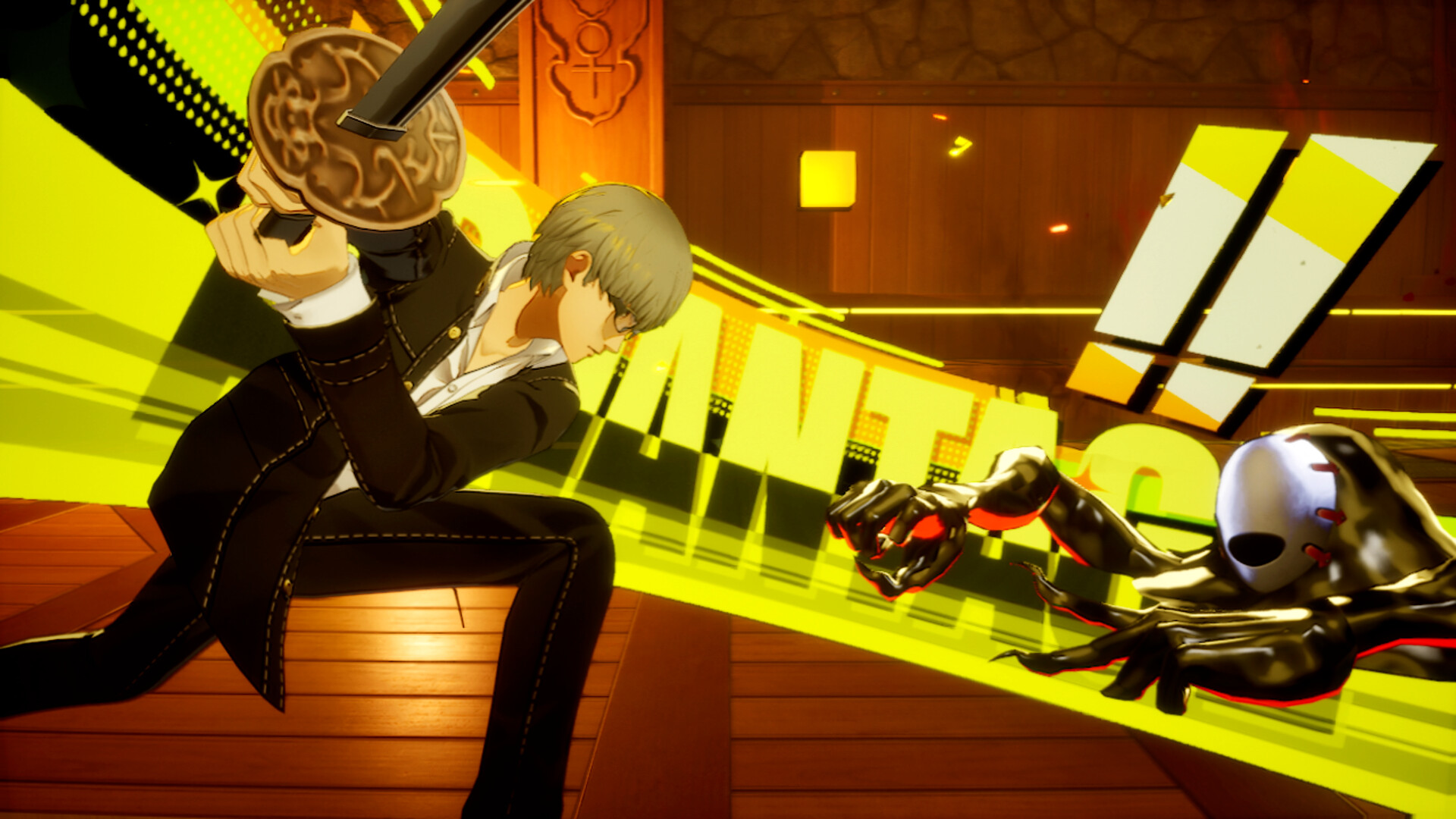
A new trailer shown during a June 2026 Xbox Games Showcase gave Persona 4 Revival its first proper combat showcase, moving beyond the 2025 teaser to present the remake's battles in motion with modernized, current-generation presentation and quality-of-life updates. The same showcase confirmed the February 18, 2027 release date; the announcement history is covered under Development and Announcement.
The showcase was followed by a deeper gameplay reveal detailing the remake's battle system. Combat keeps the series' 1 More structure, where striking an enemy's weakness or landing a critical hit grants an extra turn, and knocking down every enemy still opens up an All-Out Attack. On top of that foundation, the remake adds several new mechanics that modernize battles in line with Atlus's recent releases.
Atlus sets the battle loop out in four published steps:
Step | What happens |
|---|---|
Attack Weaknesses | Hitting an enemy's elemental weakness knocks it down. |
1 More Chance to Act | A knockdown or a critical hit grants the acting character an extra turn. |
Unleash All-Out Attacks | With every enemy knocked down, the party attacks together for heavy damage. |
Acquire Personas | Finishing a fight this way can yield new Personas afterwards. |
New Battle Mechanics
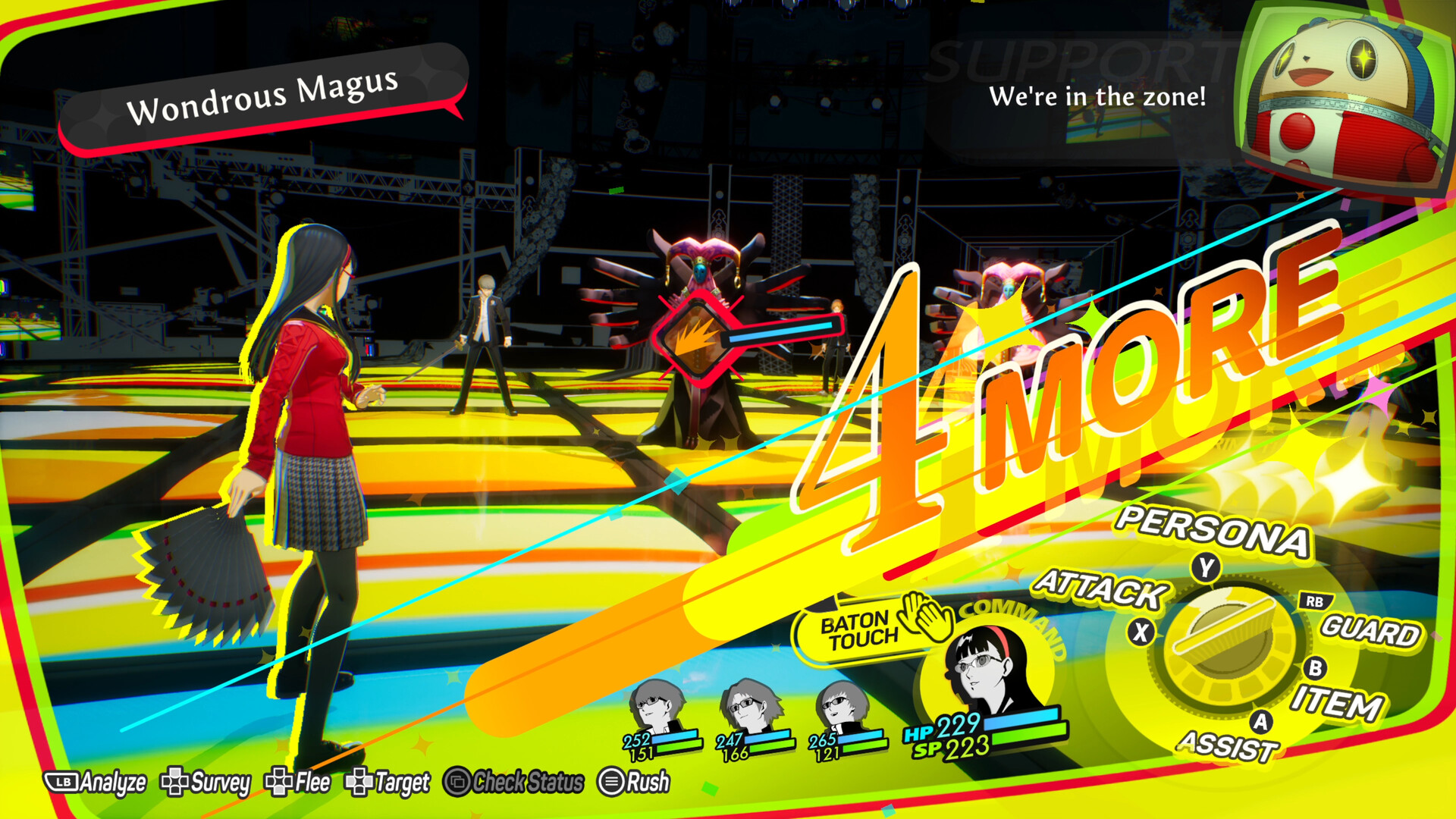
1 More and Baton Pass: Hitting a weakness or scoring a critical knocks an enemy down and grants a 1 More extra turn. During a 1 More, the acting character can use Baton Pass to hand that extra attack to another party member, which lets the team chain weakness hits and build toward an All-Out Attack. The in-battle prompt for the hand-off reads Baton Touch.
Approaching Shadows: Atlus states that while exploring, the party can land the first strike on a Shadow or avoid the fight altogether. How the party approaches a Shadow in the corridor is therefore part of the encounter rather than a preamble to it. Atlus has not published names or figures for the resulting battle-start advantages.
Sending Enemies Flying: Landing a normal attack on a Shadow that is suffering a status ailment can send it crashing into another Shadow, dealing damage and spreading the same ailment to the second enemy. Used well, it knocks down several enemies in a row. The in-battle label for a successful hit reads NICE SHOT!
Prime Time: Filling a dedicated gauge in battle activates Prime Time, a powered-up state that lets a character take consecutive actions, removes all skill costs, ignores enemy resistances, and allows free Baton Passes. It is capped off by a flashy Series Finale that deals significant damage. Atlus presents Prime Time as the remake's signature offensive burst.
All-Out Attack: The series staple returns. When every enemy on the field is knocked down, the party can unleash a coordinated All-Out Attack for heavy damage across all targets, and a finishing All-Out Attack can also yield new Personas after the battle ends.
Guarding: The remake lets the party guard against a Shadow's attack while moving through a dungeon. Blocking successfully staggers the enemy, which opens it up to a follow-up strike that starts the fight at an advantage, or lets the party slip past and skip the encounter entirely. Atlus lists guarding under the remake's new features rather than as a carry-over.
Support Skills
Not every party member fights directly. Atlus has detailed Rise Kujikawa as a support character who stays back from the front line and works on the party's behalf through what the game calls support skills. These fire on a chance basis rather than every time, and cover reconnaissance as well as protection.
Support Skill | Effect |
|---|---|
Analyze Open | Reveals a random selection of the enemies' elemental affinities as the battle begins. |
Psycho Pop | Inflicts a random status ailment on every enemy as the battle begins. |
Safeguard | Gives a chance to nullify an incoming enemy attack outright. |
Support skills are picked up in two ways: by levelling up, and by spending time with Rise and raising her Social Link rank. That makes the daily-life half of the game a direct route to combat strength rather than a separate track, and the same principle is stated more generally for bonds across Inaba.
A Stress-Free Direction
Atlus has framed the remake's system changes around a more approachable, "stress-free" experience with modern design sensibilities. General producer Kazuhisa Wada has described the project as following a different "color" from the original while keeping its identity intact. In practice this covers the quality-of-life additions confirmed so far: an in-town minimap that surfaces shops, job boards, and restaurants in Inaba, and the ability to begin a Social Link conversation through the protagonist's phone rather than only by tracking the person down. Wada has applied the same goal to the dungeons, describing the aim as making dungeon play a great deal less stressful. Two of the measures have been named: a goal guide that points the party toward its objective, and health and magic recovery from breaking objects found while exploring. For the people these bonds involve and the new voice work behind them, see Voice Cast and Story and Setting.
Confirmed Daily-Life Systems
Atlus has published more of the non-combat layer than it had at the reveal. Five personal stats return and are raised through study, club activities and part-time work:
Stat | Raised By |
|---|---|
Knowledge | Study, classes and exams. |
Courage | Daily activities that push the protagonist out of his comfort zone. |
Diligence | Sustained effort, including part-time work. |
Understanding | Time spent with the people of Inaba. |
Expression | Activities that build how the protagonist communicates. |
Raising these far enough opens options that were previously closed off. Time advances with each action taken, so a day holds only a limited number of them, and which events are available depends on the date, the time of day and the weather. Later in the story the party is able to travel outside the town. Strengthening bonds is stated to improve Persona ability and to unlock combat skills, tying the two halves of the game together.
The remake also adds new events, both seasonal ones tied to the calendar and scenes that spend more time with individual characters. For how those scenes are presented and voiced, see Development and Announcement and Story and Setting.
Confirmed Removals
Remakes cut as well as add, and Wada has named three things from the earlier version that are not in Persona 4 Revival: the motorbike the protagonist could ride, the tag-team combination attacks, and the television-listing mini-games. He has not said what, if anything, takes their place, and no new mechanic has been presented as a replacement for any of them.
This list is what Atlus has confirmed as removed, not a complete account of the differences. Anything else from the earlier releases stays unconfirmed in either direction until Atlus addresses it.
What Has Not Been Confirmed
Persona fusion returns in the Velvet Room, and Atlus has confirmed that a fused Persona can inherit skills from the Personas that made it, so a build can be shaped around a chosen moveset. What has not been published is the finer structure: fusion recipes, the size and contents of the Persona roster, and how the Velvet Room itself is presented. The dungeons inside the TV world are likewise undetailed beyond the confirmation that each area has its own look and is wrapped in fog, though the September 2026 demo announcement does confirm that dungeon exploration and a boss fight are both playable in the current build. Atlus has not spelled out damage numbers, the full skill list, or the day-by-day shape of the calendar, and has not said whether the ending structure changes. Where this wiki describes elements that are still undetailed, it marks them as unconfirmed rather than presenting them as shipped Revival content.