Loading...
Loading...
Storytellers and Story Cards
May 26, 2026 at 09:38 PM
Em-dash sweep: replaced em-dashes with commas/periods per writing style rules
Paralives lets players shape the tone and difficulty of a save through two related narrative tools shown in the launch gameplay reveal: the Storyteller chosen when a household begins, and the Story Cards presented at the end of each in-game day. Both are single-player features that steer where a Parafolk story goes rather than scripting it outright. They sit alongside a set of menu sliders that tune how the simulation behaves. This article covers what the developer has confirmed for the Early Access launch on May 25, 2026; where the reveal left exact effects unstated, that is noted rather than guessed.
For the broader launch picture see Early Access. For the day-to-day simulation these tools influence see Live Mode, and for the separate social-interaction card choice see Together Cards.
A Storyteller is selected at the start of a new save, during the opening sequence as the household arrives in the town of Melino. Each Storyteller frames the kind of experience the player wants, shifting the overall tone and difficulty of the run. The launch reveal introduced named Storytellers but did not publish their precise numerical effects, so the descriptions below reflect each one's stated intent rather than exact modifiers.
Three Storytellers ship at Early Access launch: Maxence (balanced), Ricardo Castello III (more challenging), and Stella (Doggo) (gentler). The launch reveal introduced these by name but did not publish their precise numerical effects, so the descriptions below reflect each Storyteller's stated intent rather than exact modifiers.
Storyteller | Stated Intent |
|---|---|
Maxence | Leans toward a calmer, steadier run; described as wanting to bring balance to your stories. Sits in the middle of the difficulty curve. |
Ricardo Castello III | Leans toward a more eventful, dramatic run; described as adding some spice to a Para's life and bringing more challenges to your Parafolk' daily lives. The higher-difficulty option. |
Stella (Doggo) | Leans toward a gentler run; described as protecting your Parafolk from life's lowest lows for a less challenging gameplay experience. The lower-difficulty option. |
The choice of Storyteller is a framing decision made before play begins. It pairs with the finer-grained narrative settings below, so a player can pick an overall mood and then adjust individual values to taste.
Story Cards are an end-of-day choice. When a Parafolk goes to sleep, the player is shown three Story Cards and picks one. The selected card triggers a narrative outcome or consequence that plays into the following day, nudging the household's story in a particular direction. Because the choice happens once per day at bedtime, it acts as a steady drip of small narrative turns rather than a constant interruption.
The reveal confirmed the three-cards-at-bedtime mechanic and that outcomes vary by card, but it did not publish a full catalog of individual cards or their exact results. Specific card lists are therefore left for confirmation in the shipped build.
Paralives uses two different card systems, and they are easy to confuse. They operate at different moments and serve different purposes.
System | When It Appears | What It Does |
|---|---|---|
At the end of each day, when a Para sleeps | Choose one of three cards to set a narrative outcome for the next day | |
During a social interaction, after roughly twenty minutes | Choose one of three cards to steer where the ongoing conversation leads |
In short, Story Cards shape the arc of a household across days, while Together Cards shape the direction of a single conversation between Parafolk in the moment.
Beyond the Storyteller and Story Cards, Paralives exposes a set of menu options that let players tune how the simulation runs. These settings make the sandbox more forgiving or more demanding depending on the player's preference. The launch reveal called out the following adjustable values.
Setting | Effect |
|---|---|
Real-time pregnancy rate | Adjusts how quickly a Pregnancy and Birth progresses, from a quick turnaround to a longer, slower term. |
Labor duration | Sets how long the labor stage lasts before a baby arrives. |
Career strike threshold | Controls how much leeway a Para has at work before consequences hit; ties into the Careers system. |
Autonomous needs at work | Toggles whether Paras automatically handle Needs System actions such as eating or using the restroom while on the job, instead of waiting for player input. |
Lifestage duration | Adjusts how long a Parafolk spends in each Lifestage, from a fast turnover to long, slow-aging saves. |
Real-life-seconds to in-game-minutes ratio | Controls how quickly time passes in Live Mode; shorter ratios accelerate day-night cycles, longer ratios stretch each day. |
Multiple-birth chance | Adjusts the probability that a Pregnancy and Birth produces twins or higher multiples. |
Career performance difficulty | Tunes how demanding Careers are at meeting daily performance targets, independent of the strike threshold. |
Together with the Storyteller choice, these settings let a player decide how hands-on a save feels: a relaxed, low-stakes town on one end, or a busier, higher-pressure one on the other. They sit in the game's menu and can be set up front when starting out.
All of these tools are single-player. Paralives runs without an internet connection and has no multiplayer or co-op mode, so the Storyteller, Story Cards, and narrative settings exist purely to give one player more control over their own town's pace and mood. See Frequently Asked Questions for more on the single-player scope and the launch feature set.
Each Storyteller's preset configures a default mix of difficulty toggles and starting funds; players can override any of the underlying narrative settings after picking a Storyteller. The Storyteller chosen at save creation also biases which Story Cards appear at the end of each in-game day.
Storyteller | Tone | Confirmed effect |
|---|---|---|
Maxence | Balanced (default difficulty) | Provides a fair and balanced gameplay experience; recommended first pick. Standard starting funds, standard need depletion, standard career strike threshold. |
Ricardo Castello III | Higher challenge | Brings more challenges in daily life. Lower multiple-birth odds, harsher overall household experience, deliberately suited to drama saves, failure-driven storytelling, and legacy attempts. |
Stella (Doggo) | Gentler (lower difficulty) | Protects Parafolks from life's lowest lows. 35,000 Paradime starting funds, automatic eating and toilet use at work enabled by default, softened need depletion, lower career strike risk. |
Independent of the Storyteller preset, the narrative settings menu exposes individual sliders and toggles for each household. Storyteller choice supplies sensible defaults; the menu lets players tune each axis.
Real-time pregnancy rate (how quickly pregnancy progresses).
Labor duration.
Chances for multiple births.
Lifestage duration (per-stage in-game days).
Minutes-per-real-life-second ratio (how fast in-game time advances).
Career strike thresholds (how many missed shifts cause dismissal).
Job performance difficulty.
Autonomous needs at work, whether Parafolks automatically eat and use the restroom during the work-day rabbit hole.
At the end of each in-game day, when a Parafolk goes to sleep, the player picks one of three Story Cards. The selected card triggers a narrative outcome or consequence that plays out across the following day, nudging the household's story in a particular direction (financial windfall, illness, surprise visitor, family-tension flashpoint, opportunity, and so on).
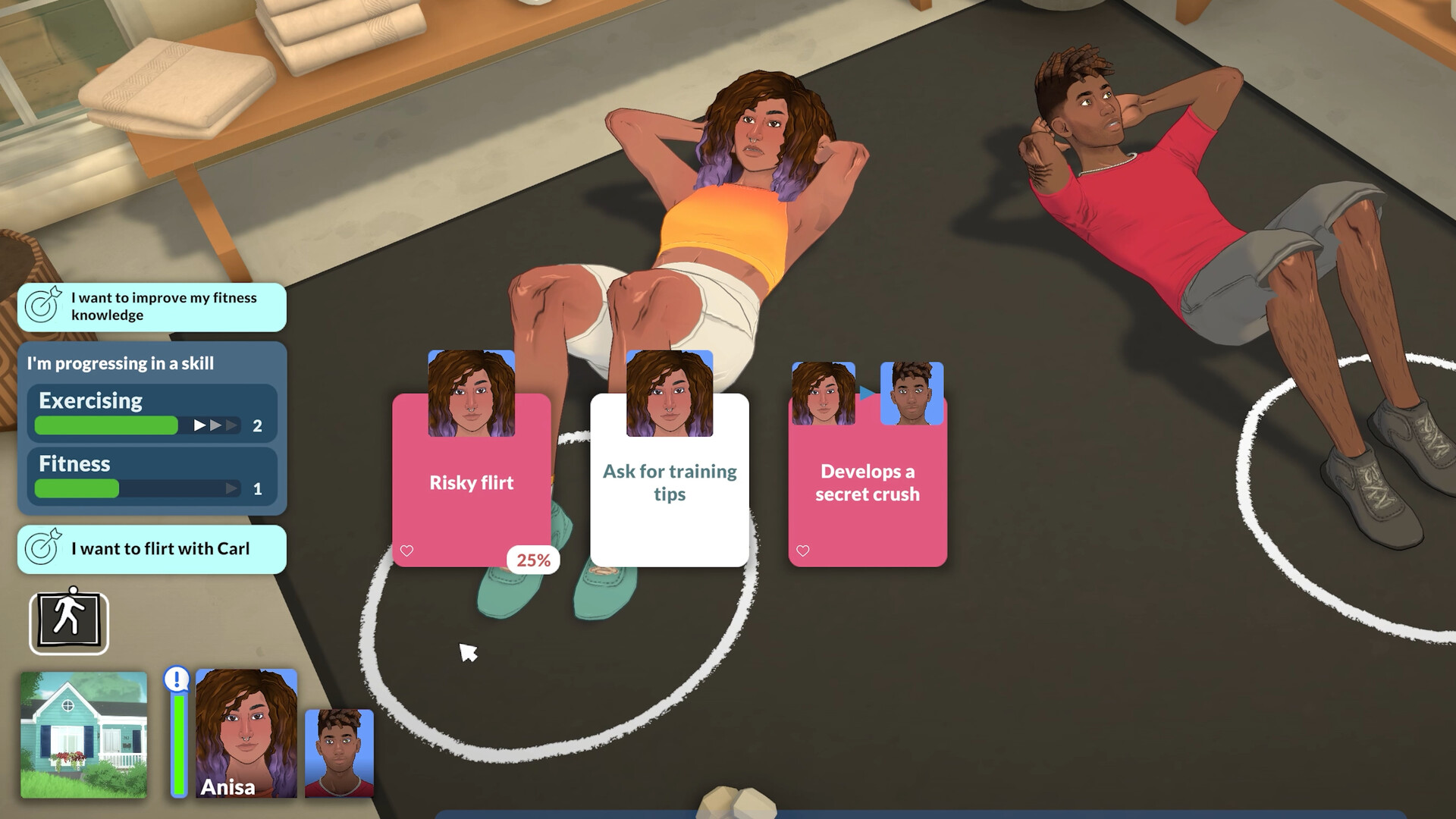
Story Cards are distinct from Together Cards. Together Cards fire during one-on-one conversations after roughly twenty minutes of dialogue and can unlock new relationship labels and social interactions. Story Cards are once-per-day, household-level, and reshape the next day rather than the current conversation.
[object Object],[object Object],[object Object]