

Overview
Procedural animation is one of the core technical pillars of Paralives. Because the game allows players to freely resize furniture, create custom-height characters using the Paramaker height slider, and build homes with no grid constraints in Build Mode, the animation system cannot rely on a fixed set of pre-made animations designed for standard-sized objects. Instead, Paralives uses procedural animation techniques that automatically adapt character movements to whatever environment and objects they encounter.
Lead developer Alex Masse and the Paralives Studio team have documented the development of this system extensively through developer diaries, providing insight into the technical challenges and solutions involved.
What is Procedural Animation?
Procedural animation is a technique where character movements are generated or modified in real time by algorithms rather than being played back from a pre-recorded animation file. In traditional game animation, an animator creates a specific animation for each action (sitting in a chair, waving hello, picking up an object), and the game plays that exact animation every time. This works well when the environment is predictable, but it breaks down when objects can be any size and characters can be any height.
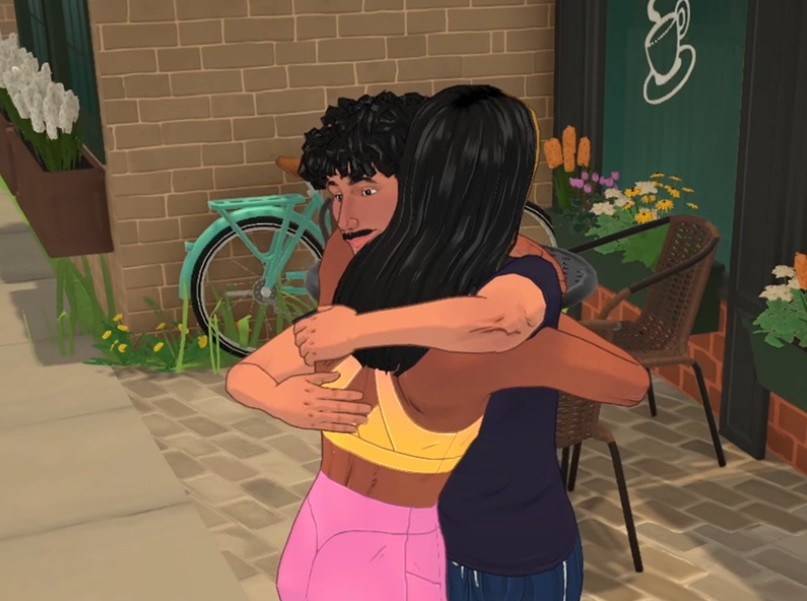
In Paralives, procedural animation involves creating a base set of hand-crafted animations and then using mathematical techniques to adjust them in real time. The result is that a Parafolk can sit naturally on a chair of any height, shake hands with a character of any stature, or reach for an item on a shelf at any elevation, all without requiring a separate animation for each scenario.
Inverse Kinematics
The primary technique Paralives uses for procedural animation is called inverse kinematics (IK). In a character's skeletal hierarchy, body parts are connected in a chain: the shoulder connects to the upper arm, which connects to the forearm, which connects to the hand. Forward kinematics moves each joint in sequence from the root, but inverse kinematics works in reverse. It sets a target position (for example, "the hand should be at this doorknob") and then calculates how all the joints in the chain need to rotate to reach that target with a credible, natural-looking movement.
Paralives applies IK targets to multiple body parts:
Body Part | IK Application |
|---|---|
Hands | Reach for objects, handshakes, high-fives, and other hand-target interactions |
Feet | Stay planted on the ground during sitting animations and adapt to terrain elevation |
Hips | Adjust height when sitting on furniture of varying heights |
Arms | Full arm chains adapt when reaching for targets at different positions |
The Sitting Problem
One of the most significant challenges the team faced was getting Parafolk to sit naturally on furniture of any height. Because furniture in Paralives can be freely resized, a chair might be at floor level, at standard dining height, or elevated to bar stool height. A single pre-made sitting animation cannot handle all of these cases.
Hip Adaptation
The first approach the team tested involved taking procedural control over the character's hips. In a character skeleton, the hips are the root of the hierarchy, meaning every other body part moves along with them. By raising or lowering the hips to match the seat height, the character's body would adjust accordingly. However, this introduced a new problem: because the feet are children of the hips in the skeletal hierarchy, moving the hips also moved the feet, causing them to clip through the floor or float above it.
Foot Planting
To solve the foot clipping issue, the team added IK targets to the feet. These targets keep the feet planted on the ground during sitting animations, regardless of where the hips are positioned. The IK system calculates the correct leg bend to bridge the gap between the grounded feet and the elevated (or lowered) hips, producing a natural-looking seated posture.
Base Animation Tiers
Rather than trying to handle every possible seat height with a single animation plus procedural adjustments, the team created a minimal set of base sitting animations:
Sitting on the floor (lowest tier)
Sitting on a medium-height chair or platform (standard tier)
Sitting on a higher platform or bar stool (elevated tier)
The procedural system selects the closest base animation and then applies IK adjustments to fine-tune the posture for the exact height of the furniture. This approach provides a better starting point for the IK system than a single universal animation, resulting in more natural-looking results across the full range of possible furniture heights.
Character Height Interactions
The Paramaker allows players to set their characters to a wide range of heights, from very short children to very tall adults. This creates interesting challenges for social animations, particularly interactions where two characters need to make physical contact.
Handshakes and High-Fives
When two Parafolk of different heights interact, their hands need to meet at a plausible point between them. The IK system calculates a meeting point based on both characters' heights and adjusts each character's arm chain to reach that point. For extreme height differences (such as a very small child trying to high-five a very tall adult), the team explored additional behavioral responses, like having the taller character crouch down or the shorter character jump, requiring new base animation states that could be reused for other child-to-adult interactions.
Conversations
During conversations in Live Mode, Parafolk of different heights need to face each other naturally. The procedural system adjusts head and torso orientation so that characters appear to be making eye contact regardless of the height difference, avoiding awkward situations where a tall character stares over a shorter one's head.
Benefits for Development
Procedural animation provides substantial benefits for the development team's workflow:
Reduced animation workload: Instead of creating separate animations for every possible object size, the team creates a small number of base animations and lets the procedural system handle variations.
Scalability: As new furniture and objects are added to the game (including community mods), they automatically work with existing animations through the IK system.
Consistency: The procedural system ensures that interactions look natural across the full range of customization options, maintaining visual quality even in edge cases.
Modding support: Community-created furniture of unusual sizes will be compatible with Parafolk animations without requiring modders to create custom animations.
Emotion and Personality Animations
Beyond object interaction, procedural techniques also influence how Parafolk express themselves. The animation system blends base locomotion and idle animations with personality-driven variations based on a Para's Vibe. An energetic Para might have a bouncier walk cycle, while a gloomy Para might shuffle and slouch. These variations are layered on top of the base animations procedurally, allowing the same walk cycle to feel distinct for different characters.
Emotions also feed into the animation system. A Para who is overjoyed might gesture more broadly during conversations, while an anxious Para might fidget or avoid eye contact. These subtle adjustments are generated by the procedural system rather than requiring dedicated animation clips for every emotion-action combination.
Technical Foundation
Paralives is built in the Unity engine, which provides built-in support for inverse kinematics through its animation system. The Paralives Studio team has extended Unity's default IK capabilities with custom solutions tailored to the game's unique requirements. The combination of Unity's animation tools with the team's procedural extensions allows the small indie studio (14 people in 2025) to achieve animation quality that would typically require a much larger team producing hundreds of individual animation clips.
Personality-Driven Walking (April 2026)
On April 23, 2026 Paralives Studio publicly confirmed that walking animations in the Early Access build are procedurally adjusted based on three inputs the system reads from each Para:
Input | Effect on Walk Animation |
|---|---|
Vibe | Overjoyed, Gloomy, Energetic, Serious, Jester, etc. change posture, stride, and arm swing. |
Emotion | Short-lived emotional states (nervous, smug, sad, etc.) layer on top of the vibe baseline. |
Lifestage | Toddlers, children, young adults, adults, and elders all have lifestage-specific walking baselines. |
The result is that two Paras with the same outfit but different vibes, emotional states, or lifestages will visibly move through the open-world town in distinguishable ways without requiring a per-character animation override. The studio also previewed this behaviour inside the April 14, 2026 animation show (see Animations), where "NPC Leisure Walk" was called out as having variation styles.