

Fighting in Mistfall Hunter is fast, close, and deliberate. It mixes heavy steel with arcane magic in fluid third-person action, and the whole system is built around stringing together combos while reading the enemy in front of you. The classes that put these tools to use are listed on Classes.
Third-person action
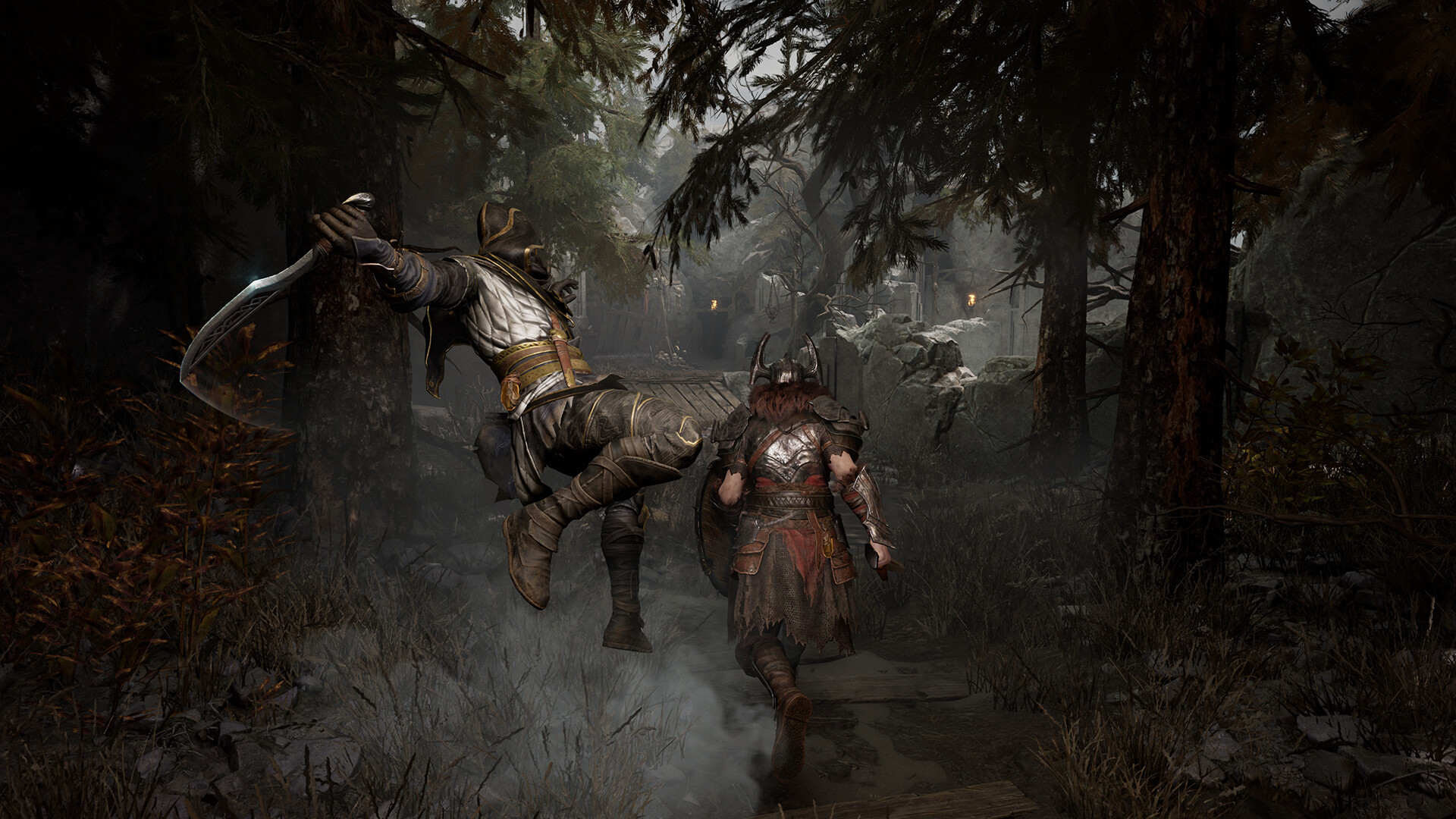
Combat plays out in third person with an emphasis on momentum and combo strings. A precision free-aim targeting system lets you aim at enemy weak points rather than just locking on, so positioning and aim both matter. Alongside the weapons, hunters carry a range of tactical items they can throw or deploy in a fight.
Magic and steel together
Rather than splitting characters cleanly into fighters and casters, Mistfall Hunter leans on a blend of melee weapons and arcane arts. A hunter might open with a blade and follow up with a magical effect, depending on their class and loadout. This is most obvious in classes like the Sorcerer and the Seer, who fold magic directly into their attack patterns.
Two stances, swapped mid-battle
The signature of the combat system is the two-weapon stance setup. Each of the six classes masters two distinct weapon categories, and you can swap between them in the middle of a fight. That means a single character can shift from one fighting style to another without leaving the action, opening up combos that chain across both weapons.
Each class expresses this differently. Here is the high-level shape of how the confirmed classes use their two stances:
Class | Weapon stances | Style in brief |
|---|---|---|
Sword and Shield, plus Hammer | Offense and parry up close, or heavy stun blows | |
Bow (Javelin confirmed for Season 2) | Charged shots or debuff arrows at range | |
Staff (second weapon not yet detailed) | Elemental reactions or stardust magic | |
Daggers, plus Dual Blades | Stealth bursts or stacking wound damage | |
Catalyst, plus Mace | Light and wind offense, or heal and shield support | |
Greatsword, plus Polearm and Shield | Withering sigils and detonations, or reach and guard-breaking with the polearm |
That picture changed close to launch. The Withered Knight gets its second stance, the Polearm and Shield, as part of the first season, so its greatsword is no longer the whole kit. The Blackarrow second weapon slipped out of the launch window and has since been confirmed as a Javelin arriving in Season 2, while the Sorcerer second stance has still not been detailed. Until those land, each of those three classes fights with one weapon category.
The energy and dodge overhaul
The developers reworked how stamina-style resources function. The older Exhaustion penalty was removed entirely, and dodging became an independent, charge-based mechanic that no longer drains Energy. In practice this decouples offense from defense, so spending Energy on attacks does not leave you unable to evade. The change was paired with a Special Recovery system. These are systems the team adjusted across betas, so exact values are build-dependent.
Stagger, blocking, and counterplay
The developers frame combat as a tactical mind game rather than a button race. Starting an attack commits you to its recovery frames, and landing the hit is what opens a combo, so aggression always carries risk. A stagger cannot be shrugged off at will: the only way to cancel out of one is a mechanic called Breakaway.
Shields do not make blocking a free defense. Negating every point of incoming damage would reward passive play, so a raised shield never mitigates everything, but builds can push blocking toward a high damage-reduction rate. The Hammer sits at the other end of the scale, kept deliberately slow in exchange for devastating power.
Holy weapons
Above the ordinary loot tiers sits a weapon class the developers kept hidden until shortly before release. Holy weapons carry exclusive gameplay affixes rather than plain stat lines, and they are meant to widen what a build can do rather than simply hitting harder. They drop from map bosses, and each boss has its own unique Holy weapon, so chasing a specific one means hunting a specific fight. The exact bonuses have deliberately not been published. The bosses that hold them are listed on Enemies and Bosses, and where they sit among the gear tiers is covered on Progression, Skills, and Talents.
Balance at launch
A round of tuning followed the June test. The Withered Knight came out of it as the most-played class, and its greatsword was adjusted rather than reined in: Parry unlocks at a lower level, its counter window is longer, Thorn Guide no longer fails on terrain collisions, and the second stage of Breakthrough Charge lost the knockback that used to push ranged targets out of reach. The Shadowstrix lost some of its chain crowd control, with Crow Storm no longer stacking on an already-stunned target and dealing slightly less damage. The Seer mace saw its Shapeshift escape shortened and slowed, keeping the skill useful for short chases without making the class impossible to pin down.
Post-launch systemic tuning
Two changes in the August 12, 2026 update altered how damage and interrupts behave across every class rather than inside one kit. Damage over time now ticks less frequently while dealing the same total damage, which changes how quickly a bleed or burn pressures a target without changing how much it is worth over its full duration. Separately, the high-tier anti-interrupt effect carried by one gem affix had its cooldown raised from 10 seconds to 15, making uninterruptible windows scarcer in a drawn-out fight. The same patch cut the PvP damage multipliers of the Blackarrow and the Sorcerer in solo mode specifically, leaving their PvE damage untouched, an early sign that the developers intend to tune solo and squad play against different targets. The running record is on Updates and Patch Notes.
The August 19 update corrected three systemic faults rather than tuning numbers. Gyldening damage had been calculating abnormally under specific circumstances, the Unyielding gem affix stopped working when its level was upgraded, and Super Armor Clash failed to resolve properly when two Blasphemers fought each other while under the Zeal state. Controller users also gained smoother handling when refining Star Silver, a Favorite function, and distinct vibration feedback on fall damage.
The developers set out their balancing philosophy the following day. The stated goal is that practising a class should feel rewarding and that tactical outplay should stay available, which they framed as a tension: the skill ceiling for veterans should not be flattened, while newcomers should not have to grind through punishing practice loops to access a playstyle at all, and no build should be pushed so far that it becomes niche. Three archetypes were named as sitting at a very high skill ceiling and therefore first in line for that work: the Sword and Shield Mercenary's shield build, the Blackarrow, and the Sorcerer.
That work began on August 28, 2026 with the largest class pass since launch, covered on each class page, and continued on September 3 and 15. Beneath the class entries a few systemic changes ran through the same three patches. Tactical items were retuned twice: on August 28 the Revealing Bulb series gained automatic target-seeking and a stronger speed boost, the Potent Revealing Bulb drained more dodge energy, and the Fetid Jar's hit radius and downed duration both grew; on September 15 the series lost its dodge-energy reduction altogether and the Exposed status it applies can no longer be stacked onto the same target. Three gem affixes were named in the same window: Creation, which could stack abnormally until August 28; Fervor, whose damage boost was trimmed on September 15; and Smiting, which the Withered Knight's Execute no longer triggers while the Blackarrow's Blood Infection explosions now do. Gyldening damage was corrected again on September 3 after it was found spiking abnormally and landing before Gyldening progress had accumulated.
The rest of the systemic work was about making movement trustworthy. August 28 added a protective constraint system across every class to stop hunters launching into the sky after high-speed movement and reduced server-side rubberbanding when a branch skill follows a dodge; September 3 smoothed rapid direction changes during displacement skills such as Bloody Blade Dance; and September 15 stopped Breakaway and ground-slam recovery animations desyncing under continuous hits, added network fault tolerance to post-dodge branch attacks, and improved how a dodge's direction is synchronised to other players. Two matchmaking changes bear on how fights happen at all: Brandrgarde gained a Solo queue on September 3, and from September 9 every mode can start a match under a dynamic player cap, so lobbies can be smaller than before.
Ranked combat
Fighting well is tracked separately from fighting at all. Path of Glory is the opt-in ranked ladder that scores extractions, kills, tasks, and the assets you carry out, and only penalises you for failing to extract.