

Power in Mistfall Hunter comes from a mix of talents, skills, and gear rather than a single track. Each of the six Classes builds toward its own style of fight, and the systems below are how you shape that. Several of these details come from development notes published before release, so treat exact numbers as build-dependent.
Talents and skills
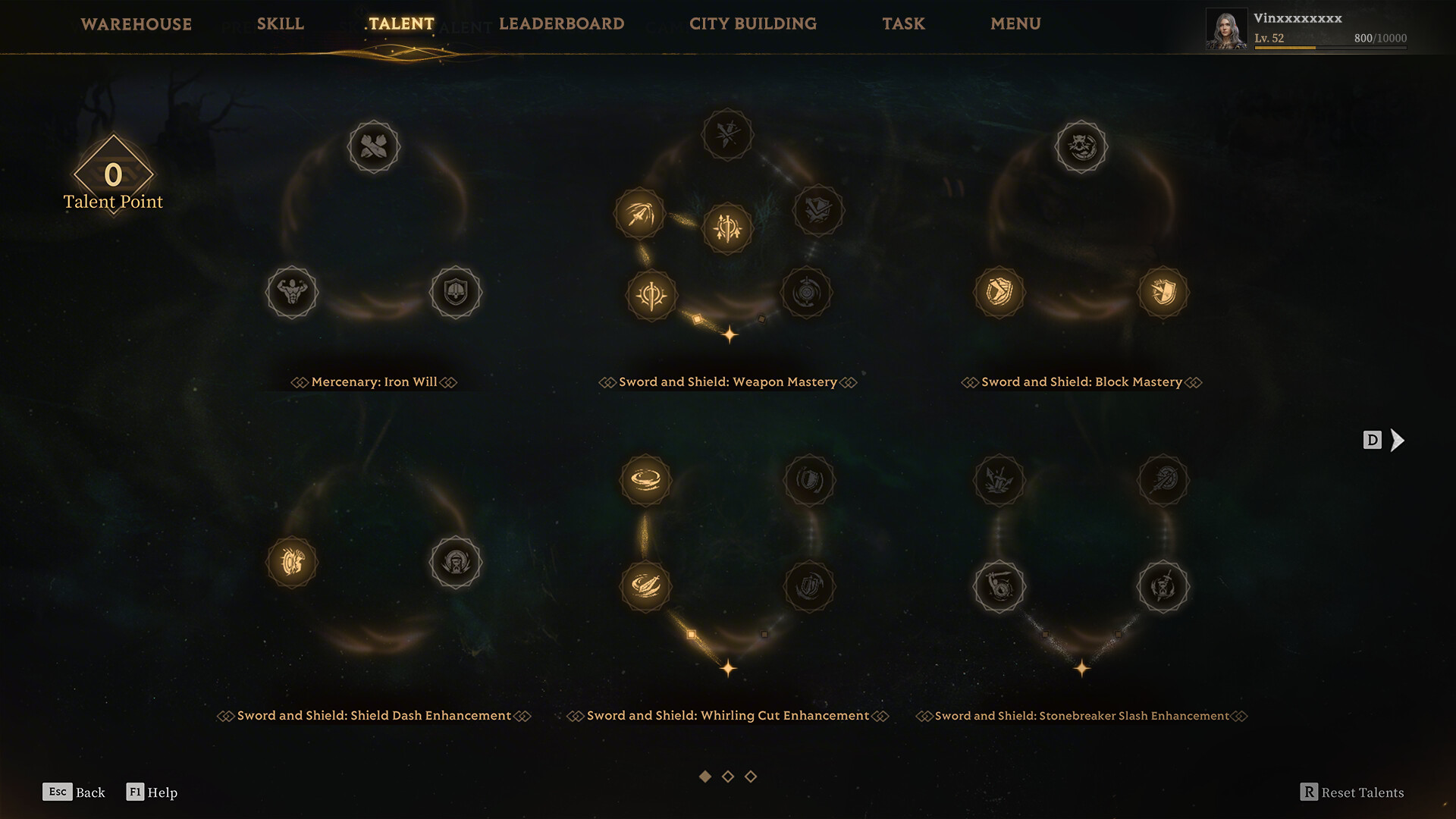
Builds draw on expansive talent trees alongside active skills. The developers frame this as a way to break free from rigid class restraints, letting a hunter lean into roles like assault, mobility, crowd control, or defense rather than being locked into one. Combined with the two-weapon stances from Combat and Weapons, the goal is broad build variety inside each class. Talents are allocated from the talent screen in the hub, and resets are free, so respeccing between runs costs nothing.
Gem socketing
Gear customization runs on a gem socketing system that replaced an older random-affix approach. Affix Gems slot into equipment to grant their bonuses, with rules around gem type and level, and one wildcard socket that accepts a wider range. This shifts power-building toward deliberate gem choices instead of rerolling random rolls.
Gear rarities
Equipment comes in tiers of rarity. The confirmed tiers are listed below, topped by class-specific Legendary sets. Some of these high-end sets are described as Holy Relics or Holy Weapons and are tied to specific bosses or lore figures, such as the relic Absolution connected to the Blasphemer Yorol, covered on The World and Lore. The developers noted that several Legendary set names were tentative and subject to change.
Rarity | Notes |
|---|---|
Common | Base-tier equipment |
Refined | Improved over Common |
Excellent | Higher-grade gear |
Epic | Obtained via Equipment Vouchers |
Legendary | Class Holy Relic and Holy Weapon sets, some boss-linked |
The Holy weapon tier was detailed shortly before launch. These carry exclusive gameplay affixes rather than ordinary stat lines, and they drop from map bosses, with each boss holding its own unique Holy weapon. The developers withheld the actual bonuses on purpose. The fights that hold them are listed on Enemies and Bosses.
Forging with the Spirit Blacksmith
Crafting and upgrading run through an NPC called the Spirit Blacksmith. Forging is time-based and happens using real-world time rather than costing Gyldenblood, and its speed is influenced by your camp building level. The Spirit Blacksmith also handles socketing and unsocketing gems.
Loadouts and Share Codes
A Loadout System lets you equip a full set of gear and gems with one click and save loadout profiles to swap between. Builds can be exported and imported through a Share Code, so players can pass complete setups to one another.
The camp and Scavenger Squad
Each player works out of the hub settlement of Windrest, which has upgradable buildings and its own NPCs, and which the developers plan to expand across seasons. One camp feature is the Scavenger Squad, an idle, non-combat way to deploy units and gather resources, tied to your camp building levels. The camp is where your forging, storage, and other out-of-match systems live.
Named facilities in Windrest include Cazarro's shop for supplies, the Workshop for forging, repairs and gem socketing, the Training Grounds, the warehouse and its Gyldjar upgrades, the Collection Pedestal, the Tent wardrobe, Pip's Auction House, and the Goddess Statue with its Springhorn. Dew handles class changes. The full breakdown is on Windrest.
Since August 19, 2026 the Scavenger Squad refreshes its material requirements once a task is completed and its rewards are claimed, and the reroll applies across every mode. Before that change an unwanted set of requirements could stall the deployment until it was cleared some other way.
The task systems that feed camp progression were eased on August 28, 2026. Season Tasks ask for fewer monster kills and no longer demand the harder difficulty modes, tasks against Gyldhunters count defeats rather than executions and need fewer of them, equipment-value conditions became rarity conditions, and objectives a team can progress together are now marked. Contract tasks had most counts reduced, every container-search task removed, and tactical-item tasks opened to any tactical item, while the reward for a single Daily Task rose from 30 to 40 Contract Sigils. The September 3 update let the Collection Pedestal accept upgrade materials in phased submissions rather than all at once, and the September 15 update stopped stackable items in Pip's Pouch from occupying extra inventory slots when the same item is acquired repeatedly.
The player economy
Mistfall Hunter includes a player-driven Auction House where hunters buy and sell, with equipment and gems listed separately. Alongside the standard shared storage, the premium Pip's Pocket offers secure stash space. Together these let players trade the spoils they extract and bank rare finds between runs.
Seasons and resets
The game is built around seasons that the developers expect to run about three to four months each. A season ends with a reset: most progress is wiped so everyone starts the next season on even footing, though certain long-term progression carries over rather than being lost outright. A fresh roadmap is laid out toward the end of each season.
The player economy shifts at launch as well. The developers plan to add more Auction House slots and to remove the automatic restocking used during testing, so the market reflects what hunters actually list instead of refilling on its own.
Those boundaries were made specific on August 20, 2026. Character levels, warehouse supplies, and select camp buildings reset at a season rollover. Long-term progression systems, the Collection Pedestal among them, are explicitly excluded from the wipe. A portion of your seasonal assets returns as compensation and can be exchanged for key resources, and separate honorary rewards scale to the net asset worth you finished the previous season with. The developers described this as a framework locked in early in development, chosen over a full carry-over because carrying everything forward would force them to tighten drop rates and slow late-game resource acquisition to hold the economy stable. The precise trade-in ratios and the full wipe specification are still to be published; the rollover rules as they stand are covered on Season 1: Soul Hunt.
Changes at launch
Several systems were reworked for release. Buying on the Auction House was the weakest of them during testing, so the first season focuses on One-Click Buy and Quick Purchase at the Loadout Station, cutting the failed purchases that used to happen when market prices moved between selecting an item and paying for it.
The key system grew as well. Locked treasure chambers and matching chests were added inside the maps, along with several new types of rare, high-tier keys. That gives exploration more to find and gives the player market something more to trade, since keys are themselves goods.
System | What launch adds |
|---|---|
Auction House | One-Click Buy and Quick Purchase at the Loadout Station; more listing slots and no automatic restocking |
Keys | Locked treasure chambers and chests, plus new rare high-tier key types |
Ladder and tier rewards | The Path of Glory ranked ladder, with milestone rewards at each of its seven tiers |
Collection Pedestal | A display in your camp for the loot you have brought home |
Battle pass | A seasonal pass, free for everyone in the first season |
What the seasonal layer wraps around all of this is described on Season 1: Soul Hunt.
Ranked progression
Separate from gear and talents, competitive standing runs on Path of Glory, which unlocks at character Level 6 and climbs through seven tiers from Duskborn to Zenith. It is opt-in per match and per player, and only failing to extract costs you points.