
Loading...
Loading...
Setting and Lore
August 17, 2026 at 02:58 PM
Added Enceladus, Tethys, and the Saturn sector to the named locations table, noted the moon's colony, extraction site, and shipyard, recorded the De Broglie basis of the De Vaar drive, and replaced a placeholder image description
Falling Frontier takes place in a future where humanity has spread across the solar system, forming distinct colonial lineages on planets and moons including Earth, Titan, Mars, and Venus, among others. These factions share deep historical ties to Earth but have grown into rival powers with conflicting interests.
The game's calendar is shown on screen during play, and official material set in the campaign's opening reads January 2545, placing the setting several centuries after the colonisation of the solar system that the lore describes. Time runs continuously and can be paused or accelerated.
Titan's warships carry a TDF prefix ahead of the vessel name, as with the Pinnacle and the York, while the vessels shown in the Hano destroyer reveal used a TFV prefix. Ship names themselves follow a naval convention drawn from real-world usage, which matches the wider presentation of fleets as small groups of individually named vessels rather than interchangeable units.
The game takes place in a procedurally generated Frontier system beyond the Sol system, orbiting a recently discovered star named Damarat. All nine factions are competing to establish a foothold and secure access to the Frontier's abundant resources. The layout of each star system, including its planets, moons, asteroid fields, and nebulae, is generated at the start of each game or campaign.
The game's primary campaign, Titan Rising, follows Titan's continued struggle for independence. Act 1 and Act 2 of the campaign take place in the Sol system, beginning in Saturn's planetary system. Act 3 moves the story into a procedurally generated Frontier system.
In the campaign's narrative, the player leads Titan's forces against attempts by Mars to dominate the moon. The campaign is planned to run for approximately thirty hours across all three acts, with Act 1 shipping at Early Access launch and subsequent acts added during the Early Access period.
Faster-than-light travel in the setting relies on the De Vaar jump drive, a matter-wavelength drive roughly based on the De Broglie hypothesis, which masks a ship's matter signature as pure energy so it can pass through a temporary wormhole known as a jump conduit. Crews describe the falling sensation of leaving faster-than-light travel as making the fall. Early prototypes of the drive were unstable until the discovery of a material designated Ti-82 allowed ships to survive the stresses of the jump.
The jump drive is affected by gravity, creating an exclusion zone around planets, moons, and other celestial bodies. A ship must first clear this zone on its standard fusion drives before it can safely jump. Jump fuel takes the form of He3, which ties directly into the game's logistics network: long-range fleets depend on refueling infrastructure, and refueling can become a high-risk moment in battle, because damage during a transfer can ignite the He3 and destroy nearby vessels.
A handful of specific places in the setting have been named in official material. Most of the Frontier system itself is generated fresh for each game, so named locations tend to belong to the Sol system chapters of Titan Rising rather than to the procedural map.
Location | Where | Notes |
|---|---|---|
Gulliver Base | Phobos, in orbit of Mars | The system-wide Martian naval headquarters and the primary low-gravity shipyard in the sector. |
The Forge | Asteroid cluster | An asteroid cluster shown in the first reveal of campaign gameplay. |
Moon of Saturn | Home of the faction the player commands in the campaign, and the starting region of Act 1. |
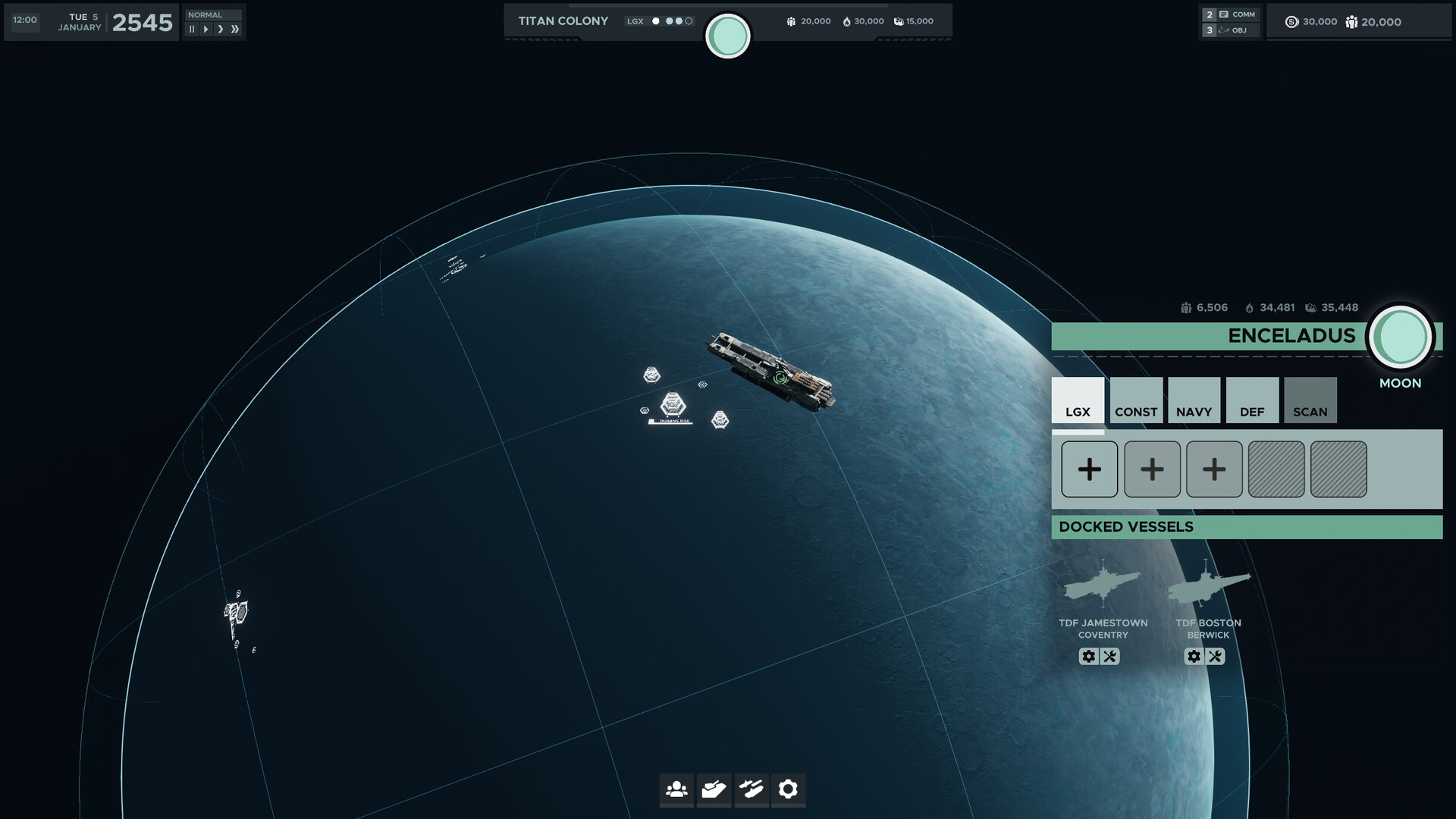
Saturn's own moons appear as distinct, named bodies in the campaign's opening chapters rather than as generic map features. Enceladus carries a colony that can be managed in its own right, with an extraction site worked nearby and a shipyard named for the moon, and Tethys is labelled in the same view.
Location | Where | Notes |
|---|---|---|
Enceladus | Moon of Saturn | A colonised moon with its own management panel, docked warships, a nearby extraction site, and the Enceladus Shipyards. |
Tethys | Moon of Saturn | A named moon shown in the same region of Saturn's system. |
Saturn sector | Sol system | Objectives are issued by sector, and the Saturn sector is named in an operations report. |
Extraction sites marked near these bodies are where the mining described on the Gameplay page actually happens, which is why a named moon matters strategically and not only narratively.
Nine factions are confirmed for Falling Frontier, each with its own starting technologies and perks, and all of them descend from Earth's colonial lineages. The Factions page covers them in more detail. The factions named in official materials so far are Earth, Titan, Mars, and Venus; the remaining five have not been announced ahead of the Early Access release.
