

Falling Frontier is a single-player real-time strategy game with a strong simulation layer. Combat can be paused at any time to issue orders. Victory depends on mastering three interconnected systems: logistics, reconnaissance, and ship-to-ship combat.
Logistics
All resources in the star system are finite and physicalized. Fuel, ammunition, and food are not deposited into a universal shared pool. Instead, they must be physically transported from their source to each station or ship that needs them. Dedicated supply ships carry these materials to fleets operating away from friendly territory.
A fleet that outpaces its supply chain risks running out of ammunition, losing the fuel to retreat, or watching its crew slowly starve. Cargo ships jump between stations using fuel for FTL travel, and destroying an enemy's cargo ship destroys the resources it was carrying. Raiding supply depots, refineries, and cargo routes is a core guerrilla tactic available to weaker opponents.
Distance is measured in time as well as in space. A plotted course reports a burn time in days and hours before it is committed, so moving a supply run or a relief force across the system is a scheduling decision, and a fleet that is several days out is genuinely unable to answer an attack somewhere else.
Resources and Mining
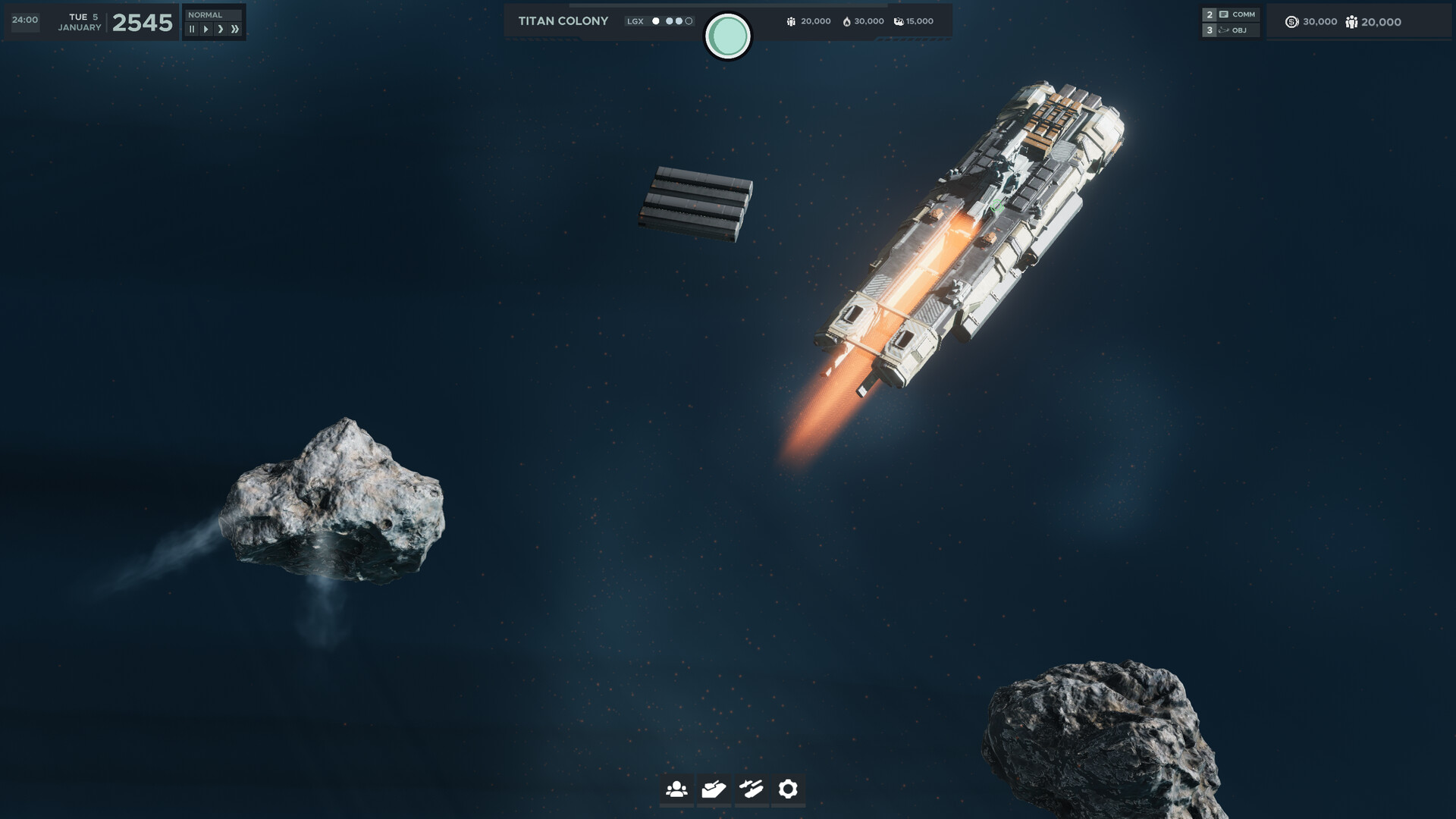
At its simplest the economy runs on two raw resources, ore and fuel, with further manufactured resource types produced from them. Both ore and fuel are mined from particular asteroids, which occur either in asteroid fields or inside a nebula. Asteroids carrying a resource are marked with an identification graphic so that valid targets and their resource type can be read at a glance.
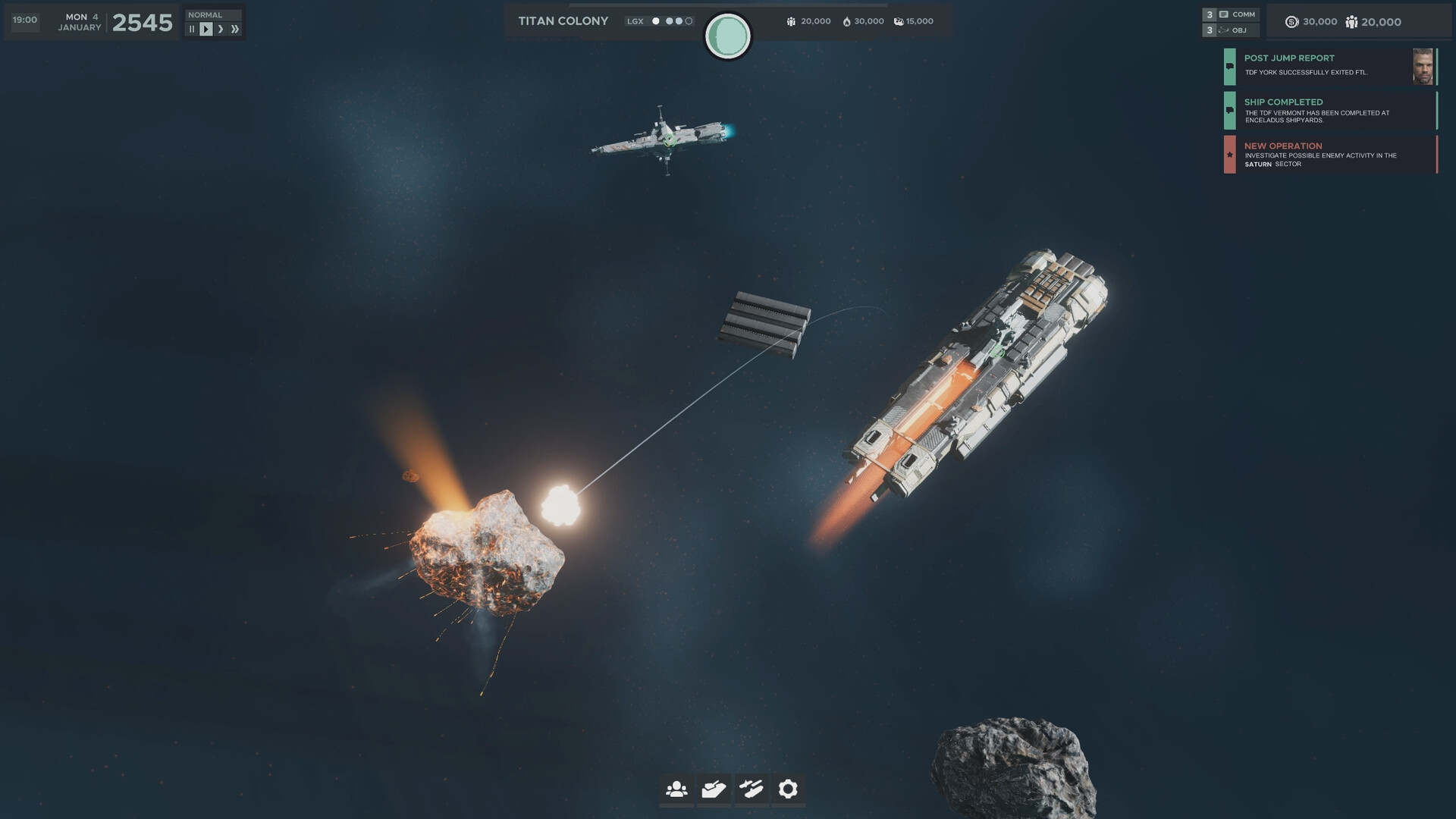
Asteroids are physical objects rather than scenery. Some can be collided with and broken apart, either by a ship flying through them or by weapons fire striking them during a battle, which makes an asteroid field a shifting piece of terrain rather than a fixed one.
Repair and Recovery
Damaged ships are repaired rather than replaced, which matters because warships are expensive and slow to build. A ship requesting repair has to dock at a shipyard large enough to accommodate its size, so a fleet operating far from a suitable yard cannot simply patch itself up in the field. Damage is readable on the hull itself: plumes of fire and smoke indicate how badly a ship has been hit, and they subside as the repair progresses.
Ships can also be disabled rather than destroyed outright, and escape pods launch depending on how much of the crew is still alive. Search and rescue operations are a named part of the game, and they connect directly to the officer system, since a pod adrift in the battlespace may hold a commander worth recovering or worth capturing.
Bases and Installations
Alongside its fleet, a faction establishes and upgrades a network of stations and structures: shipyards, supply depots, refineries, and recon stations. These installations are what turn a raw star system into supply, production, and vision, and because everything in the system is physical, they are also the points an opponent will try to break.
Research and Development
Technology is developed through a research tree covering combat, logistical, and civilian capability. Research unlocks new facilities, weapons, ship hulls, upgrades, and colonization options, so both the fleet a faction can field and the structures it can build widen over the course of a match.
Reconnaissance and Intelligence
Accurate intelligence is essential. Players construct recon stations that scan defined angles of space, with a configurable tradeoff between scan width and scan range. Passive scans yield limited information without revealing the player's position, while active scans provide more detailed data at the risk of being detected.
Probes and scout ships can be deployed deep into enemy territory. Ships may conceal themselves behind planets and moons, though a ship tucked behind a celestial body gives up much of its own scanning ability while it hides. A ship can also mask its heat signature by sitting near a hot body such as a gas giant, at the risk of the hull melting if it lingers. Asteroid fields and nebulae provide cover for ambushes.
Probes are configured rather than simply launched. A stellar probe is set up with an explicit tradeoff between accuracy and detection, so a probe tuned for a sharper reading is also easier for an opponent to notice. Its destination is plotted through a set-path step that can target a celestial body or an orbit, and the scan itself is issued at one of three range settings.
Officer Management
Command crews are named individuals with portraits, ranks, and unique traits. Officers affect the performance of ships and flotillas, making crew selection a strategic consideration. Enemy officers who survive a battle may be captured and interrogated for intelligence on enemy capabilities and positions. Alternatively, they can be left in escape pods, with their food supply dwindling, as bait for an ambush on any rescue ships that respond.
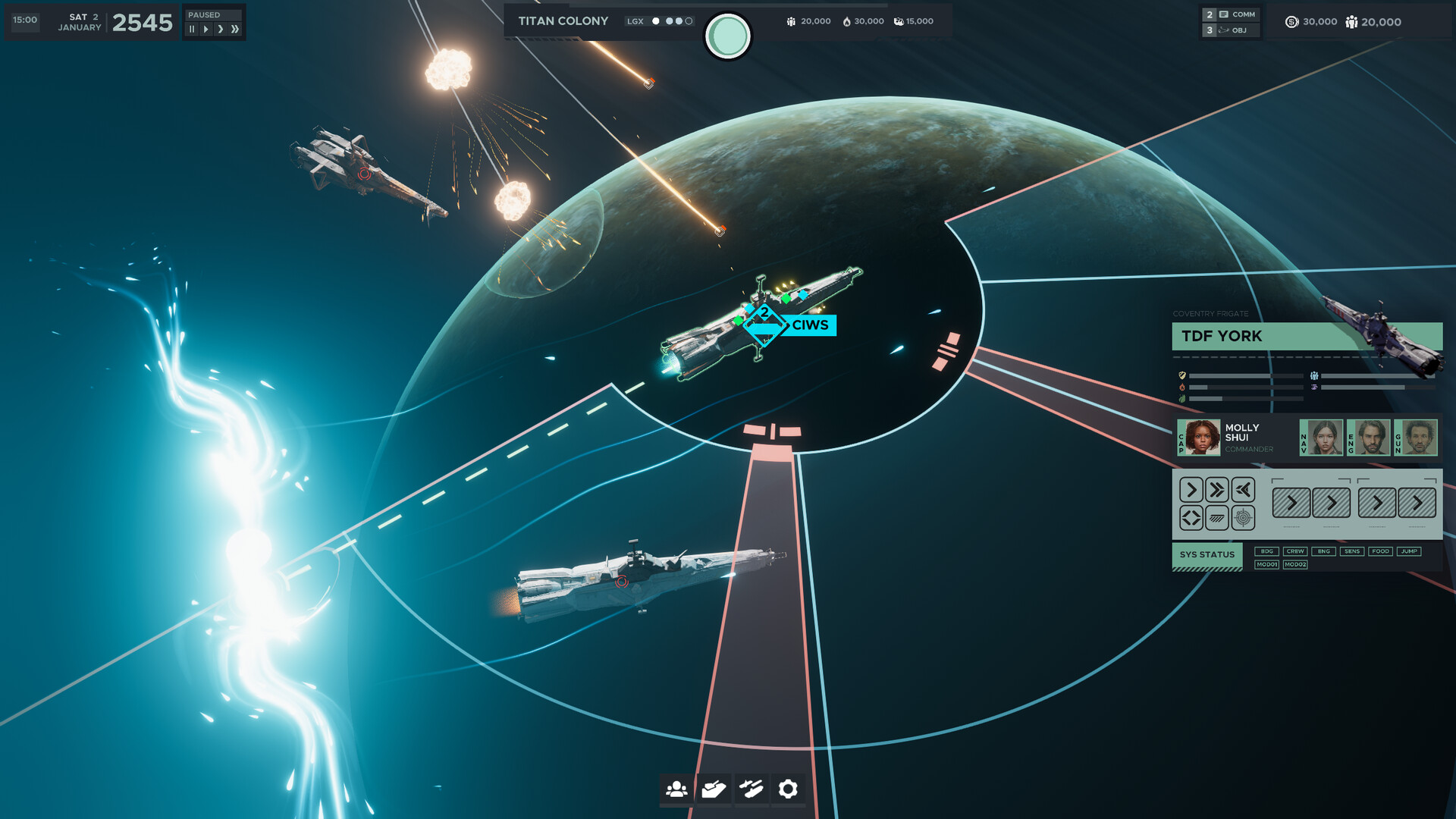
A selected ship shows its command crew as a row of portraits, each tied to a station aboard the vessel rather than to a generic bonus slot. The stations seen in official material cover the captain, navigation, engineering, and gunnery, with the commanding officer named and titled alongside them. The same panel carries a system status readout listing the ship's individual subsystems, which is how the damage described below becomes readable at a glance: bridge, crew, engines, sensors, food stores, and the jump drive each report separately, alongside the fitted modules.
Command stations, traits, the subsystem status readout, capture and interrogation, and search and rescue are covered in full on the Officers and Crew page.
Combat
Combat in Falling Frontier is fully physicalized. Weapons fire thousands of rounds per minute and each shot follows realistic ballistic trajectories. Shots that miss a target can strike unintended ships or ricochet off hulls. Each ship has subsystems that can be individually damaged or destroyed, and a hit to a munitions storage area can trigger a chain reaction that destroys the ship instantly.
When ships are destroyed or break apart, the individual internal decks are visible within the wreckage. Ships can be customized before deployment by selecting weapons, utility modules, and other components suited to each tactical role. Drone squadrons operate alongside the gun and missile armament in the current build. Missiles do not always reach their targets either: they can be pulled off course by decoys or lost among asteroids in the area of operations.
Fleet Composition
Engagements are not built around large numbers of interchangeable ships. Battles are described as being fought by carefully composed flotillas of four to five significant warships, each with its own history and role. A stronger force is not meant to merge everything into a single unstoppable fleet either: ships are expected to be split into smaller flotillas distributed across a faction's territory, so that there is something able to answer an attack wherever it lands.
Combat Phases
Combat in Falling Frontier plays out across four distinct phases that run in real time. Which phase a battle is in depends on a mix of information, distance, and armament. Each phase rewards different ship loadouts and tactics, and chance plays a role in every calculation, so the same engagement fought twice will not unfold identically.
Phase | Range | What Happens |
|---|---|---|
Information Acquisition | Longest range | No enemies are within visual range, but they may still be active in the area of operations. Contacts appear as LiDAR returns that sharpen as they close on visual range. The goal is to understand the battlespace through ship composition and sensor modules before the enemy understands yours. |
The Long War | Long range | The missile phase: long-range missiles, rockets, and vertical launched systems are lobbed to overwhelm close-in weapons systems. A strong opening salvo can knock vital systems or defenses offline and cripple an enemy ship before it can close. |
Mid-Range Warfare | Mid range | Fleets maneuver based on their read of the battlespace, a second salvo of launched systems may fire, and main battle guns come online (only railguns are accurate at this range). Sticking near asteroid clusters helps, as enemy missiles are easily confused by them, and electronic warfare can disrupt missiles and targeting solutions. |
Looking Death in the Eye | Shortest range | The gloves-off phase of broadsides and maneuvering into an opponent's blind spot, while remembering that a second enemy ship may have moved into yours. Reaching this range is dangerous even for the winner. |
Loadout choices carry across phases rather than mattering only in one. A ship fitted for electronic warfare changes what the long-range missile exchange looks like for both sides, and a targeting module that lets long-range cruise missiles find a target from behind an asteroid changes how the mid-range phase can be approached at all.
Orbital Bombardment
Warships in orbit are not limited to fighting other ships. A vessel positioned over a world can bombard the surface, and the bombardment controls let a commander select the world being targeted and then choose between firing at a single target or firing at multiple targets across it. Official material shows a destroyer conducting a bombardment with impacts blooming across the surface below.
Operations and Reporting
Events across the system are reported through a running operations feed rather than left for the player to notice. Reports seen in official material include post-jump confirmations that a named ship has exited faster-than-light travel, completion notices naming both the finished vessel and the shipyard that built it, and new operations that set an objective in a named sector.
Modes
Mode | Description | Status at Early Access Launch |
|---|---|---|
Titan Rising Campaign | A three-act narrative campaign following Titan's struggle for independence. Act 1 launches with Early Access (approximately ten hours of content); Acts 2 and 3 follow during Early Access. | Act 1 available at launch |
Skirmish | A 1v1 single-player battle against a main AI opponent with smaller sub-factions active across the system. | Planned for later in Early Access |
Scenario Editor | An in-game tool allowing players to design and share custom star systems, missions, and storyline campaigns. | Planned for later in Early Access |