

Travel between eras is the structural backbone of Eternal Anima and the third of its three pillars, alongside the growth and battle systems. Nintendo's storefront listing gives it a heading of its own, 【過去改変】 in Japanese and 【改變過去】 in Traditional Chinese, meaning past alteration, subtitled as connecting the histories of two eras. That heading appears on the storefront listings rather than on the official site.
Two Eras, Not an Open Timeline
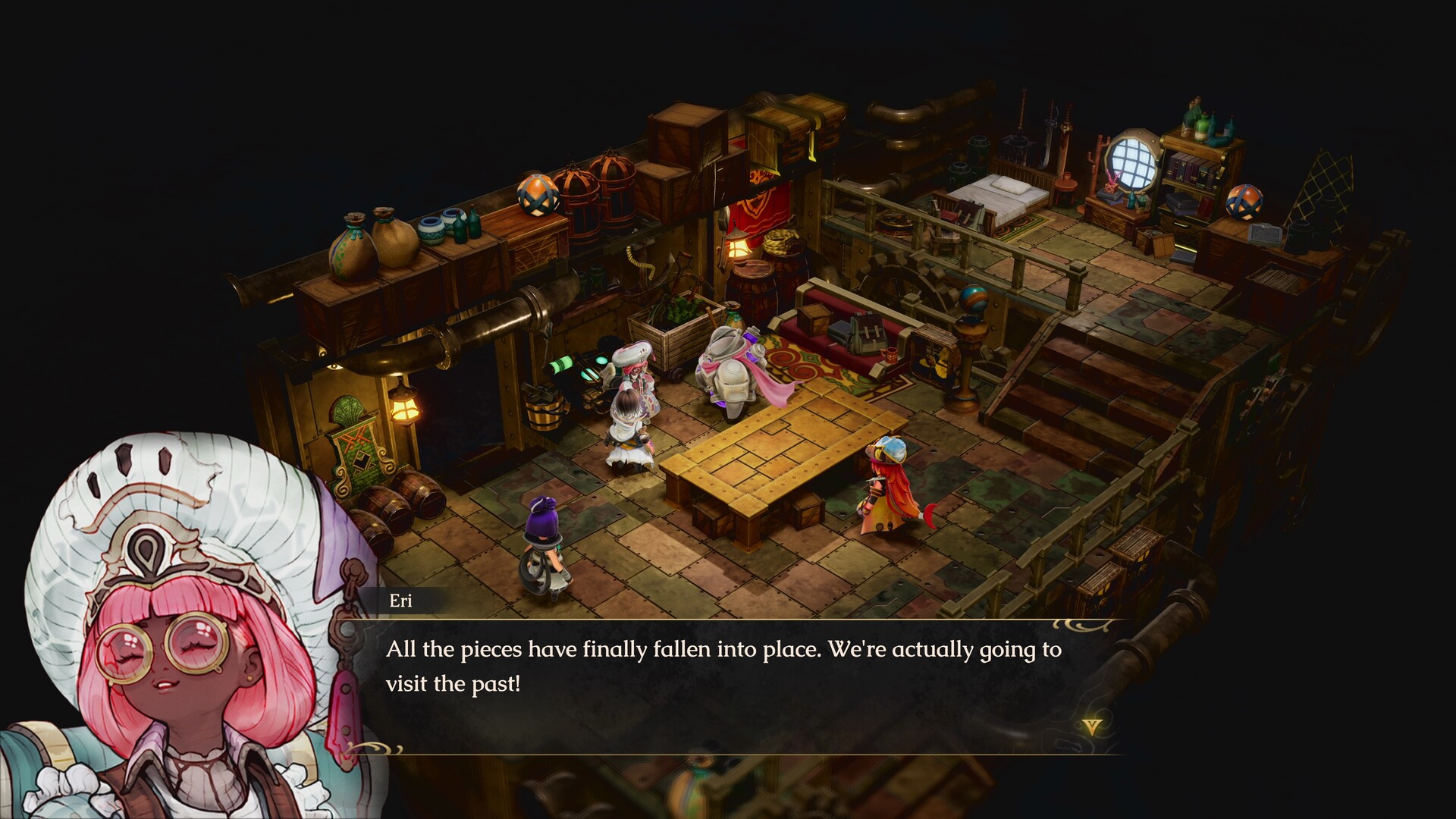
Official Japanese copy is specific that the scope is 過去と現代の2つの時代, the two eras of past and present. This is not a freely roamed timeline with many destinations. Wade and his allies move between a past and a present, and the game's interest is in what carries across the gap between them.
Official English feature copy describes the payoff in party terms: the player teams up with ancestors and descendants across time, discovers how actions in the past affect the present, and empowers allies with the abilities of their ancestors. That last clause connects the era structure directly to Classes and Skills, where inheritance is also the growth mechanic.
The One-Directional Design
The most substantial design disclosure about the system comes from the official developer conversation video, in which the game's director talks with an invited guest developer. It is worth being clear about what that source is: the guest is a guest, commenting on someone else's game, and he holds no credit on Eternal Anima. See Development Team for the full credit list.
In that video the director describes the flow as deliberately one-directional: go to the past, solve the problem there, and return to the present. His stated reason is that letting past actions branch the present without limit produces an unbounded number of permutations along the lines of because I did this here, the present became that, which cannot be processed exhaustively. Fixing the flow keeps the design tractable. The intended player experience survives the constraint: a place visited in the past may still be standing in the present, or may be gone, so the reach of the player's actions across the centuries stays legible.
The Guest on Time Travel as a Mechanic
The exchange in that video about time travel being a risky thing to build a whole game on is the part most worth recording, because it is the only place anyone has talked about the difficulty of the design. The guest, a JRPG developer who has shipped a time-travel game at scale, called the approach an unexpectedly forbidden move and noted that if you are not careful you end up having to rewrite the maps as well. His framing was that handling time travel inside one self-contained scenario is manageable, but adopting it as the structural backbone of an entire game is genuinely hard, and the hardest part is making past events propagate into the present.
The Japanese lines below are transcribed from that video; the English renderings are ours. They are second-hand renderings of on-camera speech rather than published copy.
「意外と禁じ手かな」 (our translation: "It is unexpectedly a forbidden move, I would say.") · 「下手するとマップも書き換えなきゃいけない」 (our translation: "If you are not careful, you even have to rewrite the maps.")
The same speaker had played a build before filming and said the combat in particular looked interesting. He is credited in no role on this game, and nothing from his own games belongs to this one.
Eras and the Cast
The official site applies an era label to exactly one of its three revealed regions. Ambulis splits its cast into a past group and a present group, while Urvis Ael and Port Azurea carry no era label at all. This wiki therefore does not assert an era for those two.
Ambulis group | Characters (site URL spellings) | Note |
|---|---|---|
Past | Martii, Rose, Rubin | All three live in Tarini Village (タリニ村). Rubin is the village chief and holds the hereditary role of Guardian of the Forest. |
Present | Mayaca, Capuron | Mayaca has inherited the Guardian of the Forest role. Capuron leads the village youth corps. |
No era label | The casts of Urvis Ael and Port Azurea | Neither region carries an era label on the official site, so this wiki does not place either of them in a specific era. |
The ancestor and descendant link between the two groups is explicit: Mayaca is described as the descendant of Martii, and she has inherited the mission he is connected to. The same Japanese voice actor performs both roles, which is a deliberate production choice rather than a coincidence. Note that English spellings for both names, and for the rest of the cast, are taken from the official site's own URL slugs; official English names exist for only a handful of characters as of September 2026.
What Has Not Been Published
As of 15 September 2026 no official source has explained how travel between eras is triggered, whether the player controls when it happens, how many past destinations exist, or whether the past can be revisited after a problem there is solved. Nothing has been said about how Psychometry and Anima relates mechanically to the travel itself, as opposed to reading the knowledge of an era out of an object. See Story for the narrative frame.