
Loading...
Loading...
City Building
August 17, 2026 at 02:56 AM
Replaced the preview-era worker tiers and building types with the roles and structures the release build uses
City building in Corsair Cove is the core loop the rest of the game hangs off. The haven climbs across cliff faces, hilltops, slopes, and uneven terrain, with vertical movement infrastructure stitching the layers together. The economy underneath runs on more than 50 goods organized into layered production chains, framed by the closing years of the Golden Age of Piracy. For wider context see the Overview and Getting Started articles.
Corsair Cove's vertical building philosophy and dense layered production chains place it in the lineage of strategy city-builders that Limbic's founders worked on at Sunflowers Interactive before founding the studio: the Anno series. Early hands-on coverage has made the comparison explicit. Where Anno organises chains on flat land with shipping lanes between islands, Corsair Cove compresses the same idea onto a single archipelago and adds the vertical layer covered in Vertical Construction. The structural fingerprint, however, is the same: more than 50 goods, multi-stage chains, and intermediate buildings that bridge raw materials to finished products.
Most city builders treat elevation as something to flatten before placement begins. Corsair Cove starts from the opposite assumption. Cliffs, hilltops, slopes, and uneven coastline are the intended canvas, and placement tools let production buildings, housing, and movement infrastructure stack on top of each other rather than sprawl across a flat plain. A workshop on a cliff can sit directly above the gatherers feeding it. Two havens on different islands rarely look alike, and early site choice sets the shape of every later expansion.
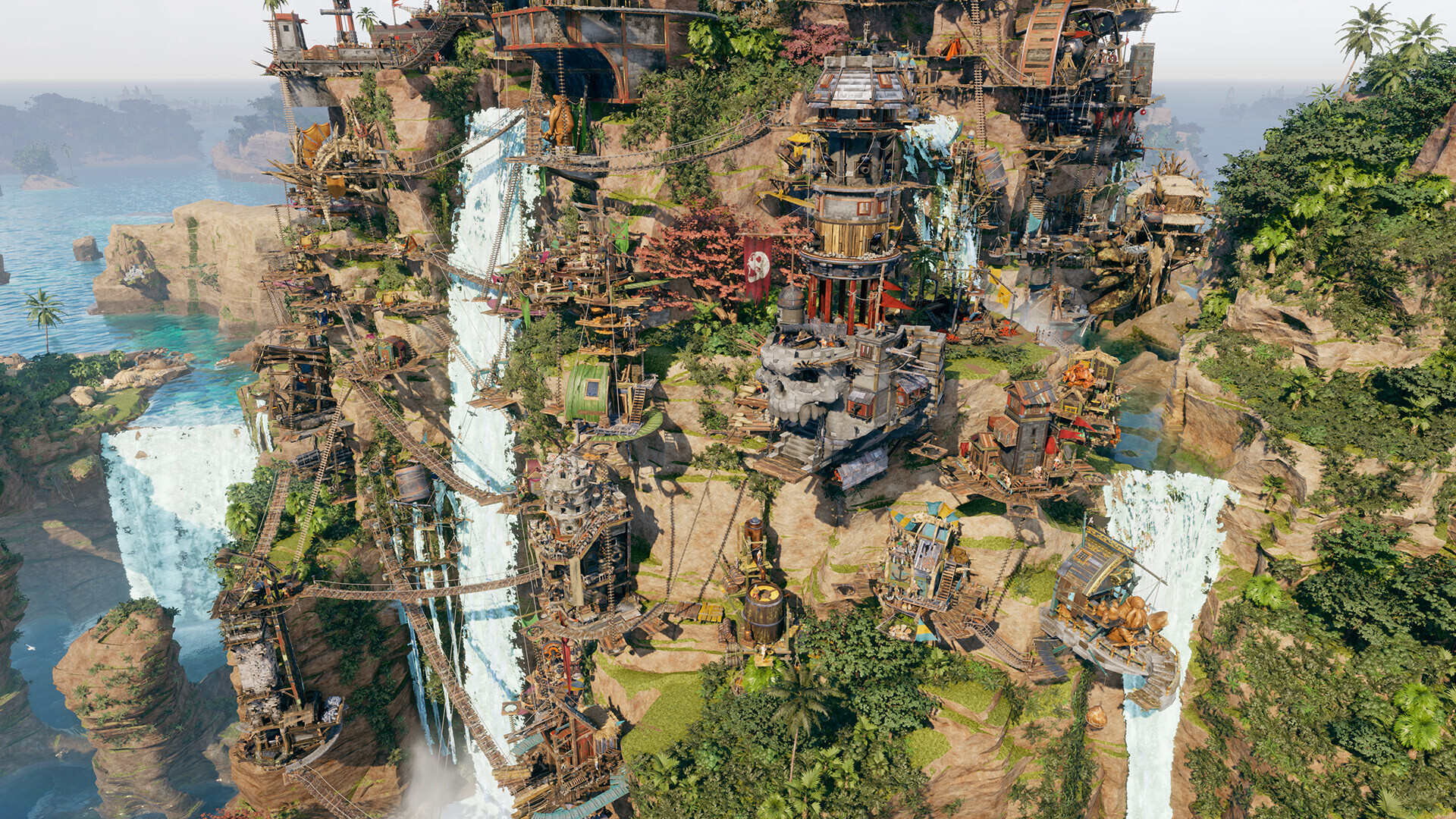
Vertical placement only works if goods and workers can move between tiers. The game ships a dedicated set of logistics structures for the layered transit web.
Infrastructure | Role |
|---|---|
Bridges | Standard spans tying platforms or building clusters at similar elevation. |
Rope Bridges | Lighter, flexible spans for hard-to-reach perches or gaps where a standard bridge is impractical. |
Ziplines | Fast one-way descents from a high point to a lower one. |
Elevators | Two-way vertical lifts that connect tiers without routing around terrain. |
Perches | Small platforms attached to cliff faces, acting as footprints where ordinary ground does not exist. |
Pulley Systems | Mechanical hoists for heavy goods when production has to climb against gravity. |
The haven economy runs on more than 50 goods in layered production chains. Raw materials are gathered, worked through intermediate stages, then assembled into finished goods. Because each stage can sit on a different elevation, planning a chain is partly layout and partly logistics. A slice of the catalogue appears below.
Raw Materials | Manufactured Goods |
|---|---|
Iron | Cannons |
Copper | Spyglasses |
Lumber | Sabers |
Ale | |
Clothing | |
Eye-patches |
Structures fall into four groups in the release build.
Group | Purpose | Examples |
|---|---|---|
Community | The core of the haven, feeding and equipping its people | Pirate Camp, Galley, Tavern, Warehouse, piers, gun towers |
Housing | Beds, one line per progression path | Tent, Salty Cabin, Bloody House, Fancy House |
Production | Gathering and refining goods | Woodcutter, Sawmill, Quarry, Brewery, Powdermill |
Principal | Compass unlocks with distinctive effects | Gambling Den, Cartographer, Grand Market, Military Fortress |
The Galley and Tavern are the two that shape early layout most, because a pirate has to eat and drink in their own Pirate Camp rather than anywhere on the island. See Buildings for the full roster with worker counts and costs.
Population does not grow through passive birth ticks. New residents arrive through active recruitment: survivors pulled from shipwrecks, recruits taken on raids, and crew fished out of the open sea all feed the same pool. Because most recruitment happens at sea, the builder loop is tightly coupled to naval combat, with recruitment missions often doubling as the ones earning resources along one of the four progression paths.
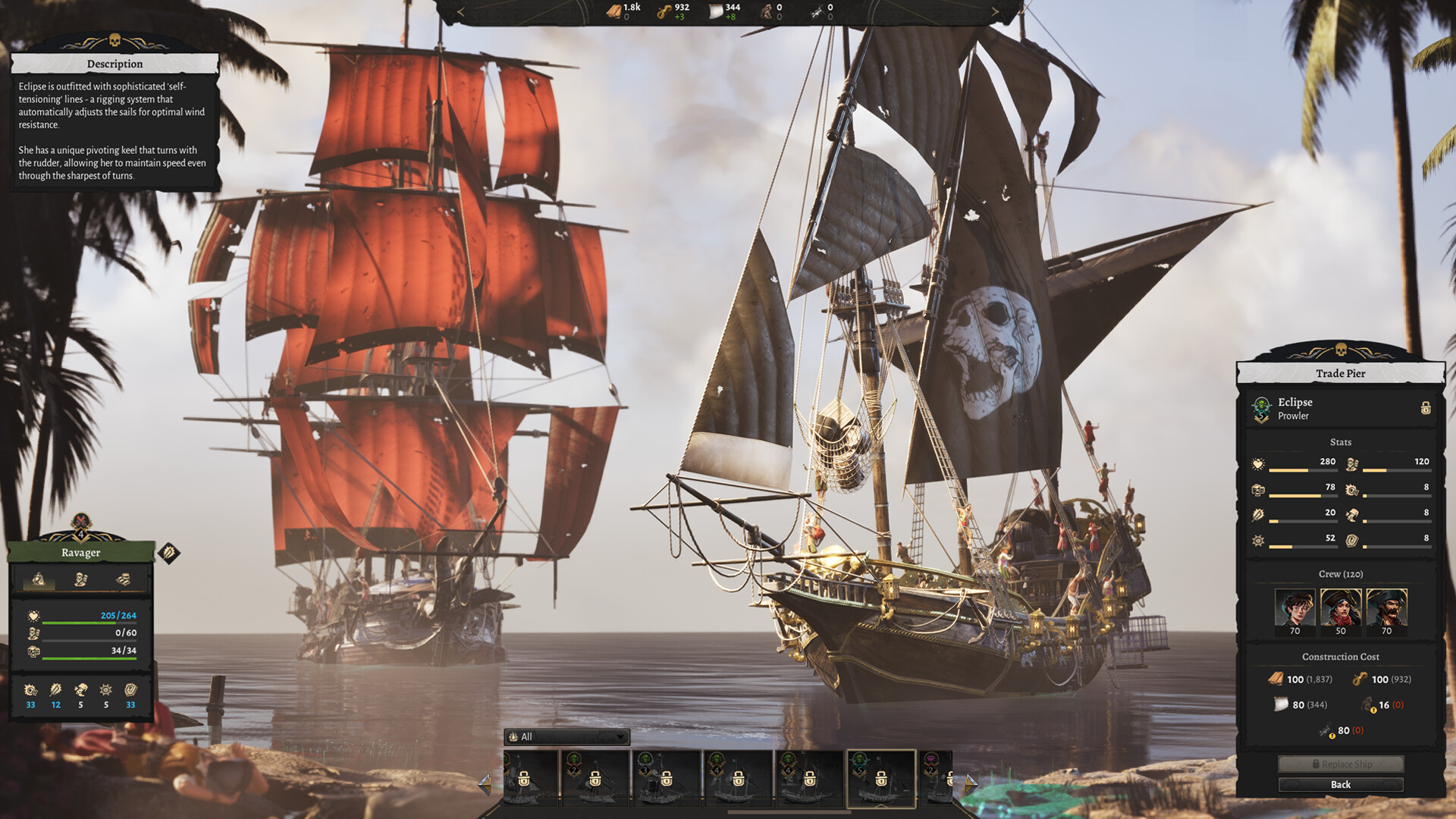
The island workforce splits into five roles. Drifters are the unassigned pool that everything else is drawn from, and they take open jobs automatically.
Role | Work | Upkeep |
|---|---|---|
Drifters | Take whatever jobs are open | Housing |
Builders | Construct production buildings | Housing |
Fetchers | Carry goods between buildings | Housing |
Greenhands | Staff simple production buildings | Housing and Stew |
Masterhands | Staff advanced production buildings | Housing, Roast Bird, and Booze |
The upper roles cost more than beds. Masterhands want cooked food and drink rather than plain stew, so committing to advanced industry means building the chains that feed it first. Full detail sits on Crew and Population.
A cohesion meter, sometimes called morale, measures how well the haven holds together. It responds to basic needs, how the crew is treated, and the broader political situation. If cohesion falls to zero, the run is effectively over. Stockpiling cannons does nothing if the crew has stopped showing up to work, so taverns and consumables like ale matter alongside housing, defense, and employment. Specific thresholds and recovery rates have not been published.
Early hands-on coverage names mutiny as the consequence of letting cohesion collapse. When supply chains stall and the crew is left under-provisioned, workers stop showing up to assigned buildings and the haven loses its grip on itself. The exact threshold and recovery mechanic for mutiny have not been disclosed publicly. The mechanic is present in the shipped game. Full coverage on the Cohesion and Morale page.
Placement is permanent, but not costly to undo. A building cannot be picked up and moved once it is built. Demolishing it refunds the full build cost, which makes rebuilding elsewhere cheap in materials but not in time. Empty a building before demolishing it: any stock still inside with nowhere to go is destroyed.
The haven is not safe by default. Crown navies and pirate hunters operate in the same waters, and a successful pirate base is a target. Defensive fortifications are part of the build set, and cannon foundries feed both fleet armament and shore guns out of the same iron supply. Elevation gives shore positions natural firing arcs.
A haven is not one settlement but a cluster of pirate camps. Every building has to sit within reach of a camp, and that camp houses and supplies the building's workers. Goods can be carried in from anywhere on the island, but a pirate eats from the Galley in their own camp, so a second camp needs its own food and drink rather than drawing on the first.
Buildings also need a physical connection before construction starts, and they stop working if they lose it. Roads, rope bridges, cliff paths, and ladders all count, and only a handful of structures need no connection at all. On steep ground that requirement is what forces the traversal unlocks from the Compass into the layout early.
Buildings can be reassigned to a different camp in range, and piers can too. That reassignment is the standard tool for rebalancing a sprawling haven: it moves the upkeep demand rather than duplicating the industry that satisfies it. See Crew and Population for the upkeep each role draws.
Exact production rates, costs, and worker requirements for any building.
The complete 50-plus goods catalog beyond the named examples.
Specific cohesion thresholds, decay rates, and the precise inputs that move the meter.
Total counts for each building category and any tiered upgrade paths.
Named structures beyond living quarters, taverns, piers, and cannon foundries.
