

Chronicles: Medieval is a sandbox RPG in which players create a character and pursue their own path through a dynamic medieval world. The game emphasizes player-driven storytelling, tactical combat at multiple scales, and long-term character and faction development. A single playthrough spans up to 35 in-game years within one historical chapter, with characters aging over time and a legacy summary provided at retirement.
Battle Structure
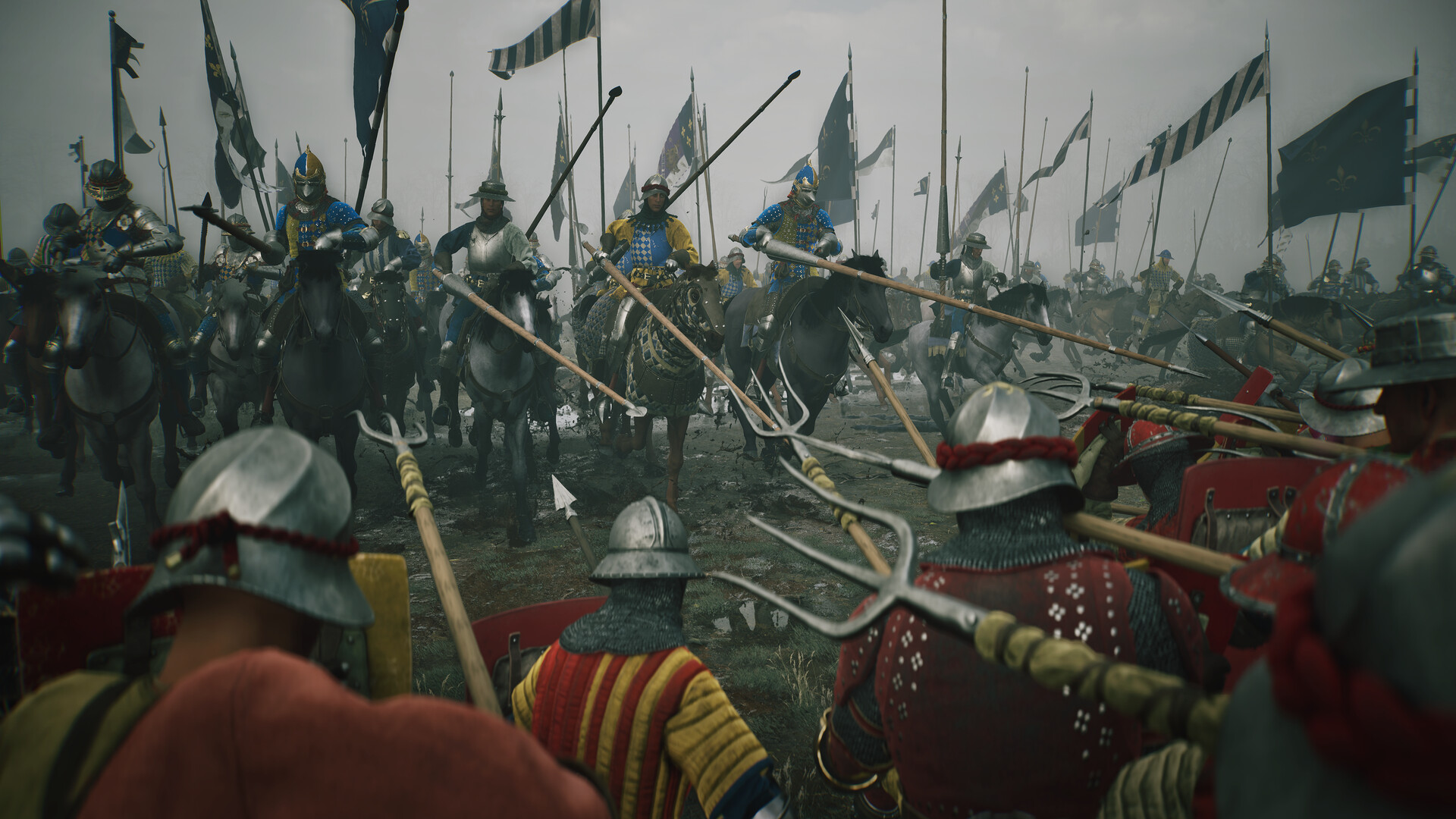
Combat in Chronicles: Medieval operates across three integrated layers that players can move between during an engagement.
Layer | Description |
|---|---|
General | Pre-battle strategy phase where players plan positioning, unit composition, and tactical approach before engagement begins. |
Captain | Real-time command layer where players issue orders to their units, managing troop formations and directing forces across the battlefield. |
Direct engagement layer where players control their character in third-person melee combat alongside their troops. |
Players can switch between the Captain and Combat layers seamlessly during a battle. An auto-resolve option is available for players who prefer to focus on diplomacy or trade rather than direct battlefield participation, though manual command generally produces better outcomes.
Battle Planning and Formations
Battle Planning is built around three layers that the player sets before the fighting begins: battle lines, standing orders, and initial orders. Most battles open with the player standing inside a deployment zone, their army arrayed in front and the enemy doing the same across the field. Smaller skirmishes of only a handful of troops skip the planning step. Battles run the full spectrum, from a few dozen combatants fighting over scraps of land to large clashes that can decide the fate of a kingdom. The studio has stated an ambition of around 1,000 versus 1,000 combatants and is working toward it, while being open that the figure is not yet committed and may not be reached by Early Access; a consistent, solid experience takes priority over a headline number.
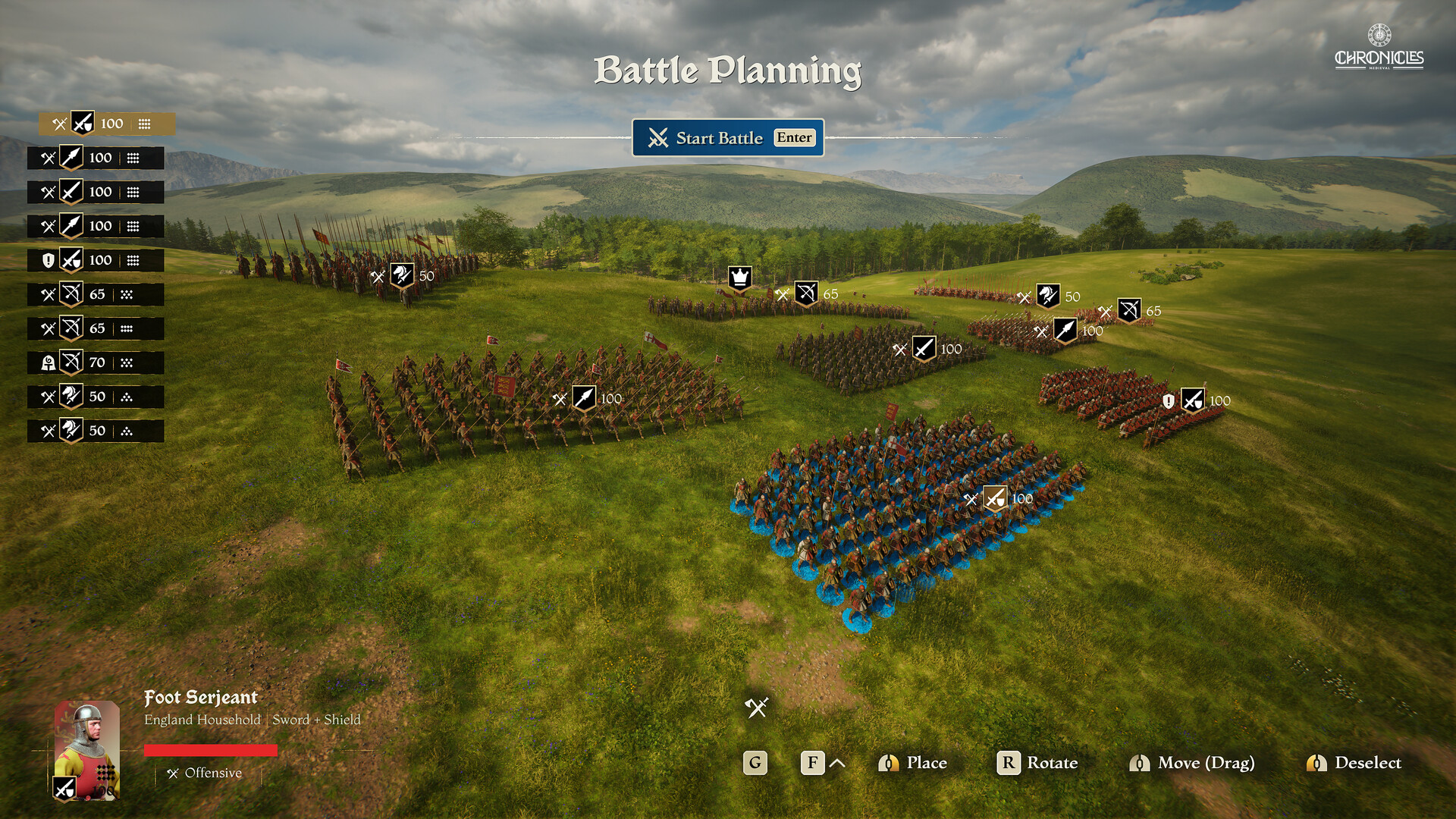
The battle planning screen itself is a discrete stage before the fighting starts, ending in a Start Battle prompt. The army sits as a roster down the left of the screen, each entry showing a unit's weapon type and its current strength, and units are positioned on the terrain with place, rotate, drag-to-move and deselect controls. Every deployed block carries its own strength counter, with values such as 100, 70, 65 and 50 appearing side by side on the same field, so army composition is read as a set of differently sized blocks rather than a single troop total. A crown marker picks out the commanding lord's block.
Battle Lines
An army deploys into battle lines, the broad zones that define its shape on the field: the Vanguard at the front, the Middle Guard in the centre, the Rearguard behind, and the Flanks on either side. There is no single prescribed shape an army must take. Each unit carries placement preferences based on its type and culture, and the deployment system reads those preferences to position each group where it fits best. French heavy cavalry gravitate to the Vanguard to lead the charge, English longbowmen prefer the Flanks for clear lines of sight, and the forces of the Holy Roman Empire favour a dense Vanguard and Middle Guard. Lines can be shifted around during deployment to react to the enemy. Setting these arrangements as saved defaults from an army-management screen is something the studio is aiming to add after Early Access.
Formations.
Formation | Type | Notes |
|---|---|---|
Line | Base | Default ordered rank for general engagements. |
Block | Base | Compact body of troops for holding ground. |
Loose | Base | Spread-out spacing that reduces vulnerability to certain attacks. |
Shield Wall | Advanced | Defensive front built to absorb a charge. |
Spear Wall | Advanced | Braced polearms that punish oncoming cavalry and infantry. |
Square | Advanced | All-round defensive box for resisting attacks from multiple sides. |
Wedge | Advanced | Pointed formation for driving into and breaking an enemy line. |
Skein | Advanced | Loose arrowhead-style arrangement used for aggressive pushes. |
Standing orders.
Each group can be set to one of three standing orders that govern how it acts without fresh input: Aggressive (the unit seeks out and attacks any enemy that comes within range), Defensive (the unit holds its ground and waits, stopping to hold the line the moment it spots an enemy), and Versatile (the unit uses its own judgement, for example a cavalry unit charging a shield wall may switch to a Wedge on its own to punch through). Standing orders combine with initial orders, the commands set during planning that define what a unit does the instant battle begins, such as sweeping a flank or advancing on a ridge. Once an initial order is completed, the unit reverts to its standing order.
Morale.
Battles are decided as much by morale as by casualties, because units break before they are wiped out. Every unit has its own morale value moving through five states: Inspired (fighting above its baseline), Confident (the normal state), Concerned (the first warning), Wavering (the second warning, a window to act), and Broken (which triggers a rout). Two units side by side can sit in different states. Taking casualties, being charged (especially in the flank), and watching a friendly unit break nearby all drag morale down. The player commands their army’s leader directly, and only the commander’s own kills and executions, performed where the troops can see them, can lift a unit into the Inspired state; no standing order or horn call will do it.
Commanding the Battle
Once the horns sound, the player has two ways of being in the fight and can swap between them freely. Fighting in the line puts the player’s character among the troops on foot or horseback, one warrior among many, gaining experience but sharing the danger. Command Mode (a press of left control) pedestals the camera up and slows time so the player can direct the army rather than fight personally. In Command Mode there are two kinds of order. Global Commands are army-wide statements of intent issued as horn calls, with no single unit selected: Advance, Hold, Fallback, Engage, Charge, and Retreat. The AI works out how each unit best carries them out. Local Commands are precise: the player selects a unit and takes direct control to move it, send it at a target, change its facing, or switch its standing order, with a command banner under the cursor showing exactly where the order resolves.
A unit that breaks is said to rout: it flees and is counted as lost regardless of how many men survive, and currently it cannot be reformed mid-battle. A retreat is different, an ordered withdrawal that the player can call deliberately or that the game triggers automatically when the army’s overall strength drops below a threshold; retreating units stay with the army. The single biggest morale hit of all is the player-character falling, which applies a one-time penalty across the entire army.
Battlefield Generation
Each battlefield is procedurally generated during development with the studio’s in-house tool, Ymir, rather than at runtime, so loading into a battle stays fast. When the player chooses to engage, the game reads their position on the exploration map and loads a battle arena scaled and shaped to suit the fight, from the rolling hills of Burgundy to a muddy field facing a royal army. The studio has committed to putting Ymir in the hands of the modding community once the game reaches version 1.0.
Military Units
Players recruit, train, and command historical military units. Confirmed units include English Longbowmen and French cavalry. No Imperial unit has been named publicly. Beyond the culture-specific units, four broad unit roles have been named: longbowmen, men-at-arms, crossbowmen, and cavalry, each with its own job on the field and each taking orders in real time. Units gain experience from fighting and are promoted through power tiers that raise their stats and can upgrade their equipment and formations. Three factions are fully playable at the Early Access reveal: England, France, and the Holy Roman Empire, each fielding its own historical units and tied to a region of the map spanning the British Isles, France, and the Empire. Armies are built from units in three categories, Levy, Household, and Mercenary, each with per-faction progression trees and power tiers running from 1 to 10. New units and replacement troops are recruited from quartermasters in settlements and castles across the exploration map, and a skilled commander can eventually field up to ten units of roughly a hundred men each. Unit morale also persists outside battle, where unpaid or unfed troops lose heart and begin to desert. See Armies and Units for recruitment, replenishment, unit progression, and upkeep in full.
Character Progression
Chronicles: Medieval uses a use-based skill development system. Weapon proficiency improves through repeated use, with each weapon category following its own progression path. As characters level up, they earn perk points to spend on weapon specialization trees, unlocking techniques from Apprentice and Journeyman moves up to advanced chains. Broader perks also improve overall power, efficiency, or performance with higher-tier equipment.
World Exploration
Players explore the world through a top-down overworld map that transitions contextually to third-person instances when entering settlements and battlefields. The overworld map is open in structure, allowing players to explore any accessible region. Points of interest include settlements, castles, battlefields, and camps. A fog of war system features three visibility states: unexplored regions (fully hidden), previously visited regions (showing outdated information), and areas within current scouting range (live tactical data).
Work picked up in a settlement is tracked as a short checklist rather than a single goal. One task shown in official material, a bandit-clearing job called Pest Extermination, lists travelling to the bandit camp, dealing with the threat, and reporting back to the quartermaster who set it, with an extra optional objective attached. That optional objective is tied to a date on the in-game calendar and shows the days remaining, so the same passing time that drives the rest of the simulation also puts a clock on side work.
Sandbox and Roles
The game offers multiple roles including bandit, trader, knight, mercenary, and captain, among others. Players can interact with and navigate rival factions, rising through ranks via diplomacy, reputation, or force. The army commander path is the most developed content at Early Access launch. Players can ultimately rise to rule kingdoms, controlling territory and managing vassals through direct character interaction.
Not every walk of medieval life is a playable path. The studio has said there are currently no plans to let players become priests: religion is present as a theme in the world and in its architecture, but it is not a role a character can take up.
Lords, Power, and War
Above the battlefield, the world runs on a layer of feudal politics. Factions are modelled as networks of individual lords linked by titles rather than as monolithic blocs. Each title carries a rank and a type, characters build or lose legitimacy and personal relationships on scales from -100 to 100, and lords can declare war, occupy settlements, raid trade caravans, and force peace through an accumulating warscore. The army commander path threads directly through these systems as the player climbs from a nobody to a ruler of kingdoms. See Lords, Power, and War for the full breakdown of titles, vassals, diplomacy, and war.
Simulation Systems
The world features interconnected economic, diplomatic, social, and environmental simulation systems. Events such as plagues and famines affect the world dynamically. Player decisions create rippling consequences both locally and globally. The design emphasizes a world that operates with its own logic and momentum, rather than centering all activity on the player character.
Historical Chapters
Each playthrough begins with the player selecting a historical chapter, each covering a distinct era between the 14th and 15th centuries with its own context and events, such as the Black Plague or the Hundred Years' War. Additional historical chapters are planned as part of the Early Access development roadmap.
Multiplayer and Co-op
Chronicles: Medieval is primarily a single-player sandbox, but it also supports online co-op. At the Early Access reveal the studio confirmed co-op custom battles for up to four players, where a group sets up a battle and commands its armies together against an enemy force. The single-player campaign is the focus of Early Access, and full co-op campaign play, where friends progress through the campaign together, is a stated ambition for the 1.0 release. Dedicated servers, matchmaking, and large-scale competitive battles are not planned.