

Lords, Power, and War is the set of political, economic, and diplomatic systems that govern the living world of Chronicles: Medieval. These systems provide the context for the battles and activities that the player and every other character undertake. They model feudal society as a network of personal relationships between individual lords rather than as monolithic factions, so the world reacts to who holds power, who owes loyalty to whom, and who is willing to fight for a cause. The systems below were detailed by the developers during Early Access development, and their exact scope and values remain in active development and subject to rebalancing.
Titles and Factions
Rather than classic factions, the game uses the concept of titles. Each title has a rank and a type that together place a character within medieval society. The higher the rank of a character's highest title, the closer they sit to the top of the social hierarchy, ranging from a common knight up to an emperor. A single faction can encompass the full range of nobility, from the lowliest knight to the most renowned emperor, all linked through the title system.
Type determines which social hierarchy a title belongs to. Types include the feudal nobility and the clergy, as well as merchants, artisans, and mercenary bands. The focus of the Early Access experience is centred on the feudal nobility.
Title Aspect | Description |
|---|---|
Rank | Position in the social hierarchy, from a common knight up to an almighty emperor. The highest-ranked title a character holds determines their standing. |
Type | The hierarchy a title belongs to: feudal nobility, clergy, merchants, artisans, or mercenary bands. Early Access centres on the feudal nobility. |
Heraldry | Each title is visually represented by heraldry. The arms of a character's highest-ranking title fly on the banners and standards of the armies and castles they own. |
Linked holdings | Titles tied to settlements or regions grant ownership over villages, castles, cities, and regions. These become a source of income through taxation, alongside duties paid by vassals and revenue from trade. |
Liege Lords and Vassals
A title can have one liege lord or none, and many vassals or none. These links, constrained by a title's rank, are what bring factions to life. The world is vast, and one character can only rule so much of it directly, so feudal rule is decentralised and local lords can hold considerable power. The game captures this through two soft caps:
Limit | Effect |
|---|---|
Domain limit | A soft cap on the number of points of interest (settlements) ruled directly by a character. Exceeding it brings penalties to income and to standing with vassals, who come to view the character as hoarding land that should be granted out. |
Vassal limit | A soft cap encouraging a character to consolidate the number of direct vassals beneath them. Exceeding it incurs penalties similar to the domain limit, since an organisation can only run so smoothly once it grows beyond a certain size. |
Vassals are expected to join their liege lord's wars, though they are not always immediately compelled to do so and will weigh the risk of supporting a disliked liege now against facing their wrath later. They may also start wars of their own. Liege lords, by contrast, are more constrained: they have a vested interest in protecting their vassals' lands, which are the lands of their realm, in exchange for the taxes those vassals pay.
Legitimacy
Ownership of a title can be seen as more or less legitimate on a scale from -100 to 100, from illegitimate to rightful. A character seen as legitimate finds it easier to retain titles and to rally vassals to their aid, while an illegitimate character is more vulnerable because allies and vassals are reluctant to defend them. Legitimacy can also be measured against titles a character does not currently hold, marking them as a claimant and influencing the support they can expect if they press that claim by force. Factors affecting legitimacy include how long a character has held a title and how complete their ownership of the linked areas is.
Some titles begin the game unheld, either because no one held them at that historical point or because they allow alternative-history developments. Examples include creating the Kingdom of Wales or the Duchy of York. When a character meets the requirements, such as holding some of the points of interest that make up a region, they can claim the title and become a force capable of unifying previously disparate groups. Title creation is therefore also a tool for consolidating vassals within a realm and projecting strength outward.
Diplomacy
Diplomacy is character-to-character. When dealing with a faction, the player is dealing with individual characters, each pursuing their own ambitions, so befriending one noble within a faction does not automatically make the player a friend to others within it. A character's opinion of another is measured on a relationship value scale from -100 to 100, from absolute hatred to absolute love. This value is swayed by the personal traits of the characters involved, for example a brave character tends to despise a cowardly one, and by the specific actions a character takes for or against another. Sending gifts improves a relationship value, while fighting someone lowers it.
Allies are characters who have struck a deal for mutual protection. They generally need to like each other and have comparable military strength to consider an alliance, which is formed to deter threats by combining forces. Allies may still fail to appear when war becomes reality, damaging how others view them, though they have less at stake than a vassal would.
War, Warscore, and Peace
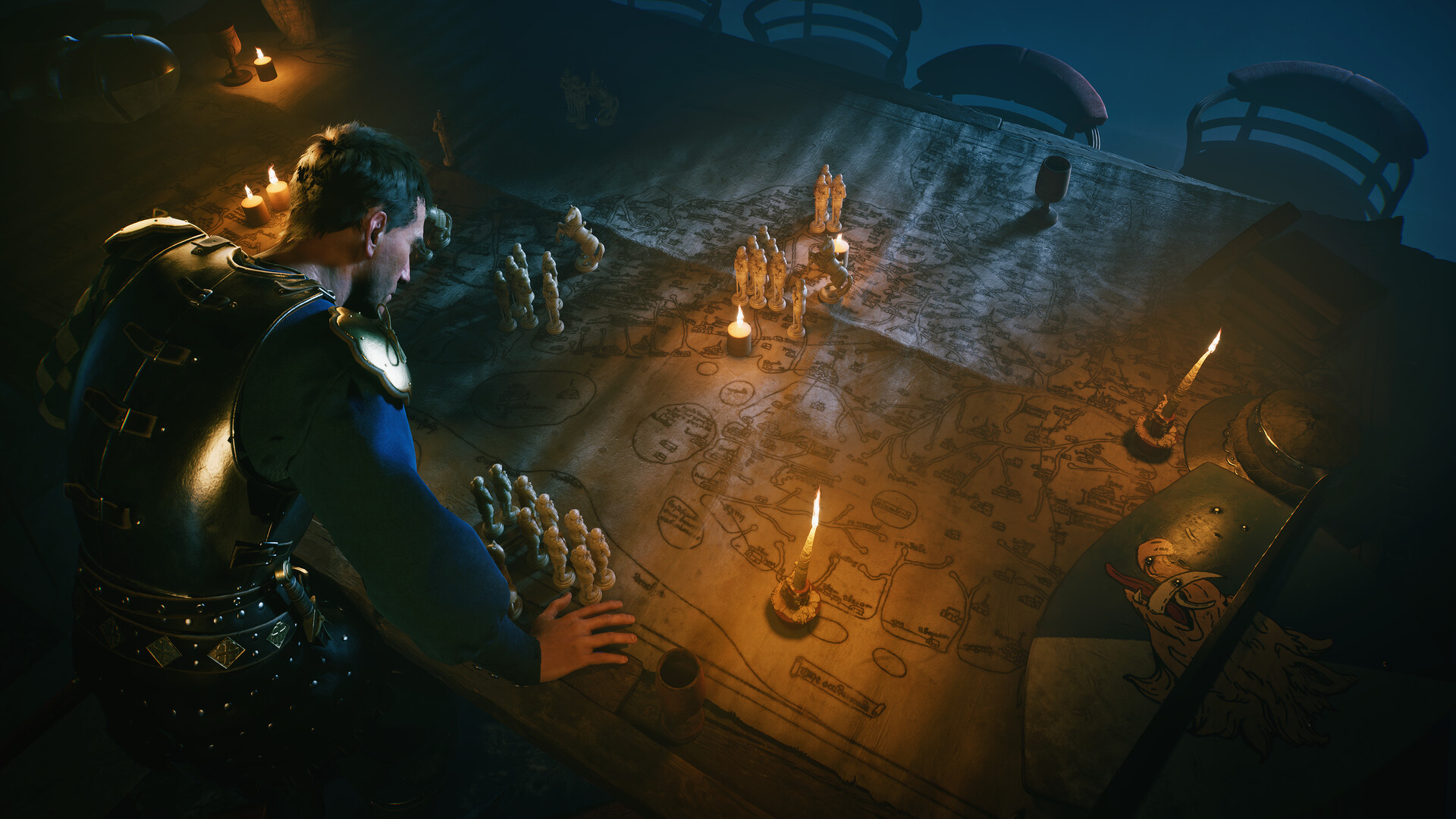
When a character deems it appropriate, they can declare war on another, rallying their vassals and allies against the enemy's armies. Wars are waged between two sides, each seeking to bring down the other. During a war, a character can occupy the enemy's cities and castles and disrupt their trade by attacking caravans carrying resources.
These actions accumulate a warscore that reflects how well the war is going for each side. Raiding enemy trade caravans, the casualties inflicted and sustained relative to the size of standing armies, and the occupied settlements each side controls all feed into it. Warscore is then used in peace negotiation to enforce demands against the loser.
Either side can compose a peace deal at any point and send it to the enemy for consideration. The enemy weighs whether the deal is agreeable and accepts or rejects it. Once a certain warscore threshold is reached, the winning side can enforce a deal on the losing side if their offers keep being rejected. Demands take the form of titles and their associated lands, or coin. Once peace is agreed, the losing side is protected by a period of truce that gives them time to rebuild. Truces cannot be broken without consequence: those who break them incur severe diplomatic penalties as their neighbours come to view them as an unreliable threat. The developers have said the scope of peace treaties is expected to expand beyond Early Access to cover outcomes such as independence and trade.
The Player's Path
The player starts at the bottom of the medieval social ladder and must become one of the rare figures who eke out a name for themselves on the field of battle and in the realm of politics. The developers cite historical figures such as Bertrand du Guesclin, a minor noble's son who rose to Constable of France, and William Marshal, a landless young knight who turned tournament glory into the regency of England, as the kind of exceptional climb the game models. Befriending the right people, helping them, outmaneuvering rivals for a patron's favour, and achieving glory in battle are the ways to climb the ranks and accumulate titles and vassals.
For the battlefield side of these conflicts, see Combat and Gameplay. For holding territory once it is won, see Castle Building. For raising, paying, and promoting the troops that fight these wars, see Armies and Units.