

Three factions are confirmed as fully playable in Chronicles: Medieval at the Early Access gameplay reveal: England, France, and the Holy Roman Empire. Each is tied to a region of the playable map spanning the British Isles, France, and the Empire, and each fields its own historical units and brings distinct cultural habits to the battlefield. The Holy Roman Empire was the last of the three to be shown publicly, debuting alongside the June 2026 gameplay reveal.
In Chronicles: Medieval, a faction is not a single monolithic bloc. The world models feudal society as a network of individual lords linked by titles, so a faction can span the full range of nobility from a common knight up to an emperor. The detail below covers the three cultures playable at Early Access; their political machinery is described under Lords, Power, and War.
Playable Cultures
Faction | Battlefield Identity | Confirmed Units |
|---|---|---|
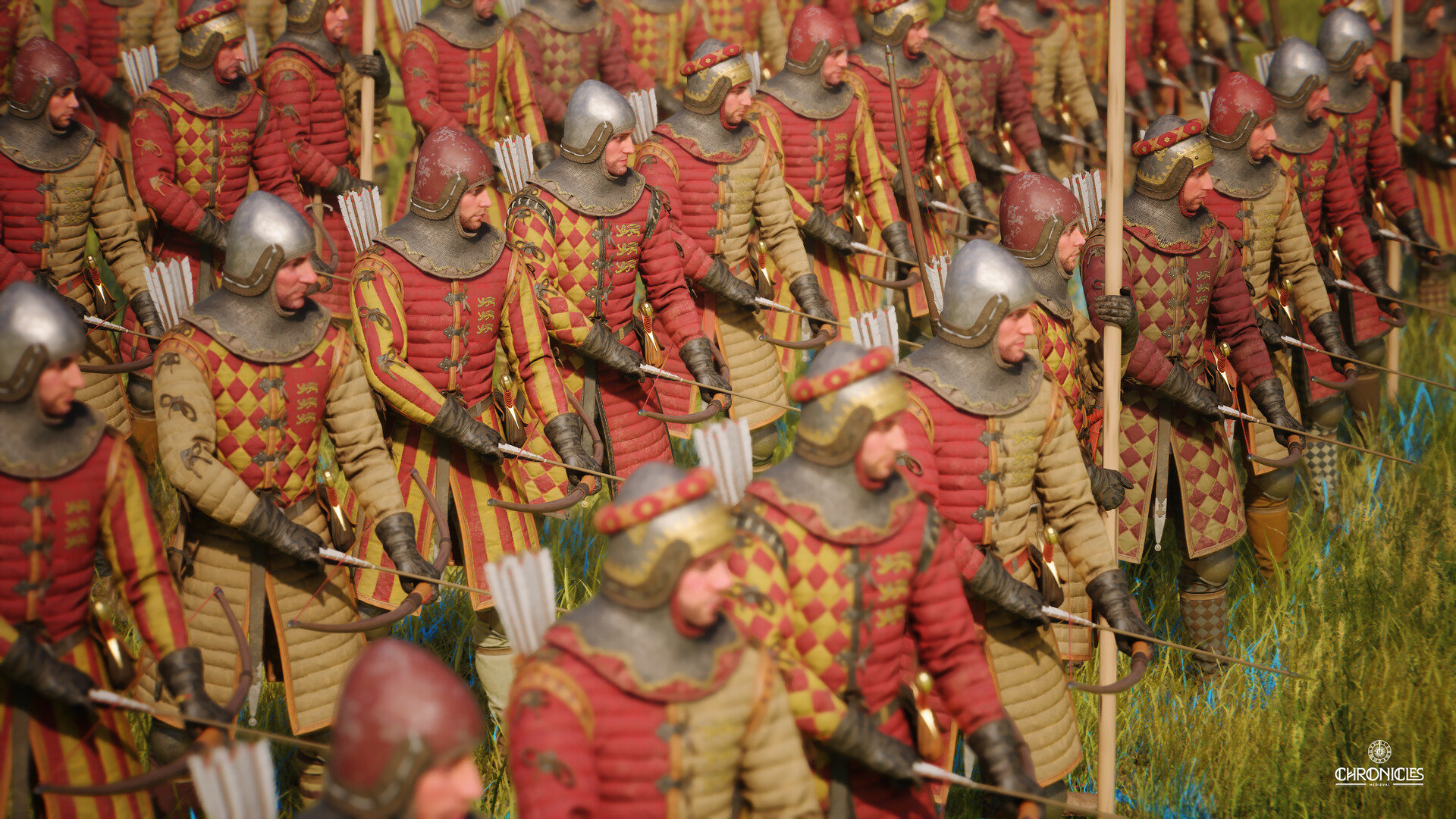
England | English longbowmen prefer the Flanks, where they have clear lines of sight and room to bring their longbows to bear. | English Longbowmen, Foot Serjeant, Sword Serjeant, Bill Serjeant |
France | French heavy cavalry gravitate to the Vanguard, eager to lead the charge, reflecting the culture's cavalry dominance. | French cavalry |
Holy Roman Empire | Imperial forces favour a dense Vanguard and Middle Guard, presenting a wall of well-drilled armoured men to break against. | Not yet named publicly |
Each culture carries its own placement preferences, and the deployment system reads those preferences to position each unit where it fits best. The result is that an army's battle lines take on a distinct shape depending on which culture fields it, scaling to any size of army.
Cultural Units and Veterancy
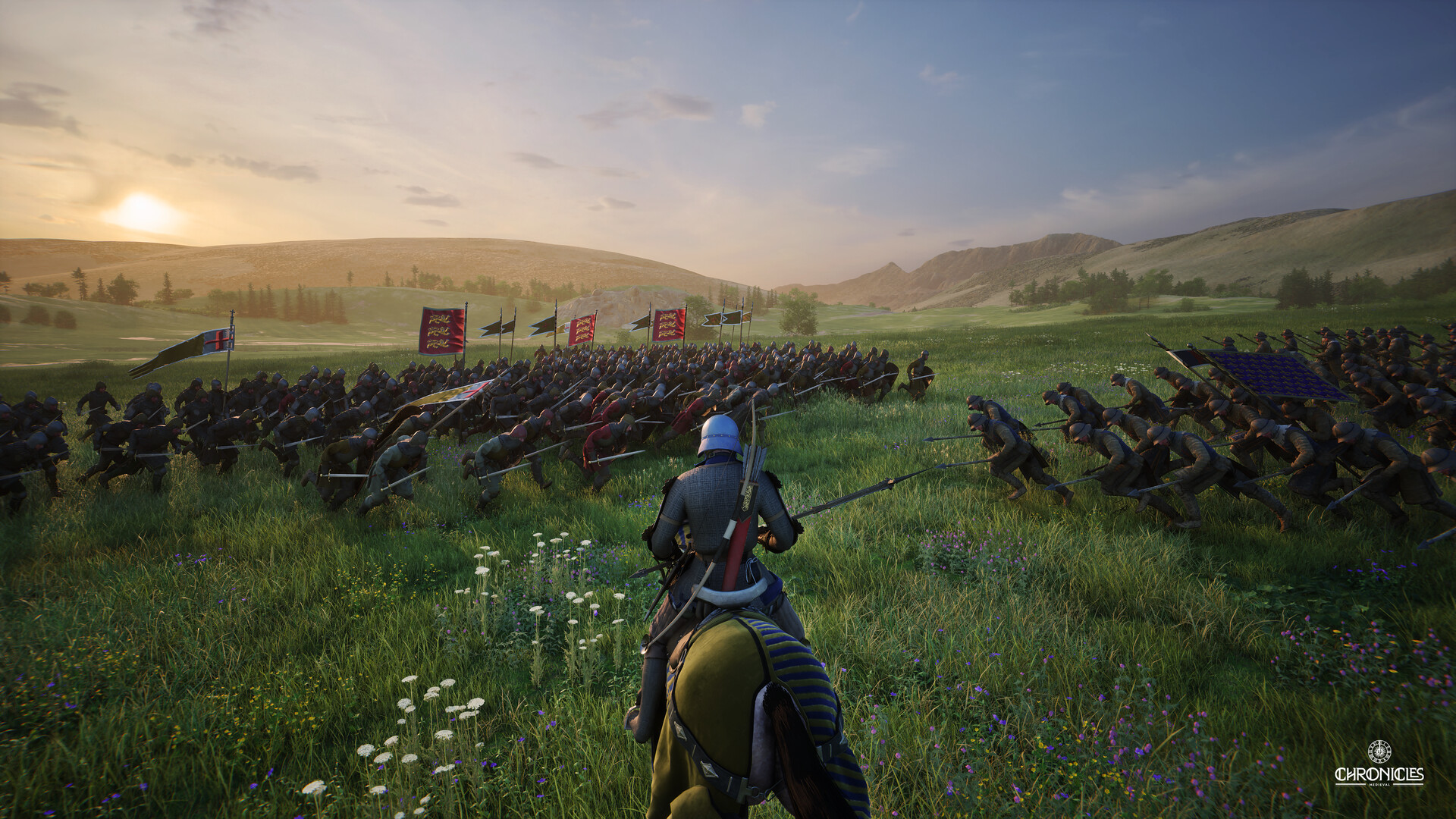
Players recruit, train, and command historical military units drawn from their culture. Confirmed units include English Longbowmen and French cavalry. No Imperial unit has been named publicly, and the Holy Roman Empire has so far been described only by how its forces behave on the field rather than by the troops it fields. Units gain veterancy over time and unlock advanced techniques as they progress, in the same way a player's character advances through Apprentice, Journeyman, and Master tiers in combat. The studio has said a wider selection of units and additional factions are planned for development during the Early Access period.
Every main faction fields its own dedicated Levy, Household, and Mercenary units, each with a unique progression tree covering melee and ranged troops, infantry and cavalry. Each tree is tailored toward the historical strengths of its culture: the English have exceptionally skilled bowmen, the French are known for their fearsome cavalry, and the Holy Roman Empire for its tough melee infantry. Unit names are somewhat anachronistic, and French and Holy Roman Empire units carry names in their native languages. In the English Household tree, the tier 5 Foot Serjeant can be promoted into either the Sword Serjeant or the Bill Serjeant, a heavier troop that carries a bill polearm suited to dealing with cavalry. See Armies and Units for recruitment, unit stats, and progression in full.
Alongside the culture-specific units, the roster is described in broader battlefield roles. Longbowmen, men-at-arms, crossbowmen, and cavalry have each been named as distinct unit roles, with the studio indicating more to come. Each role has its own job in a battle line and responds to the player's orders in real time rather than acting on its own script.
Official material showing the battle planning screen gives a sense of how a unit is described in game. Selecting a block brings up a card naming the unit, the culture and category it belongs to, and the weapons it carries. One card reads Foot Serjeant, England Household, sword and shield, set to an offensive standing order, which places Household alongside the culture as a way units are grouped.
Factions as Networks of Lords
Because factions are built from individual lords rather than fixed teams, diplomacy is character-to-character. Befriending one noble within a faction does not automatically make a player a friend to the others within it. A single faction can encompass the full range of nobility, from the lowliest knight to the most renowned emperor, all linked through the title system. Rising through a faction, claiming titles, and gathering vassals is the core of the army commander path. See Lords, Power, and War for titles, legitimacy, vassals, and war, and Castle Building for holding the territory a faction controls.
Historical Grounding
The factions and their conflicts draw on the era of the Hundred Years' War, the long struggle between England and France, with the Holy Roman Empire as a major third power in the medieval Europe the game depicts. The studio has been clear that the game is a sandbox inspired by the politics, warfare, and tensions of the period rather than a strict historical recreation or a direct simulation of that conflict. Real historical settings and figures appear depending on the chosen historical chapter, with creative liberties taken to keep the experience engaging.