

This article is incomplete
Some sections are missing or need additional details. Help improve it by contributing.
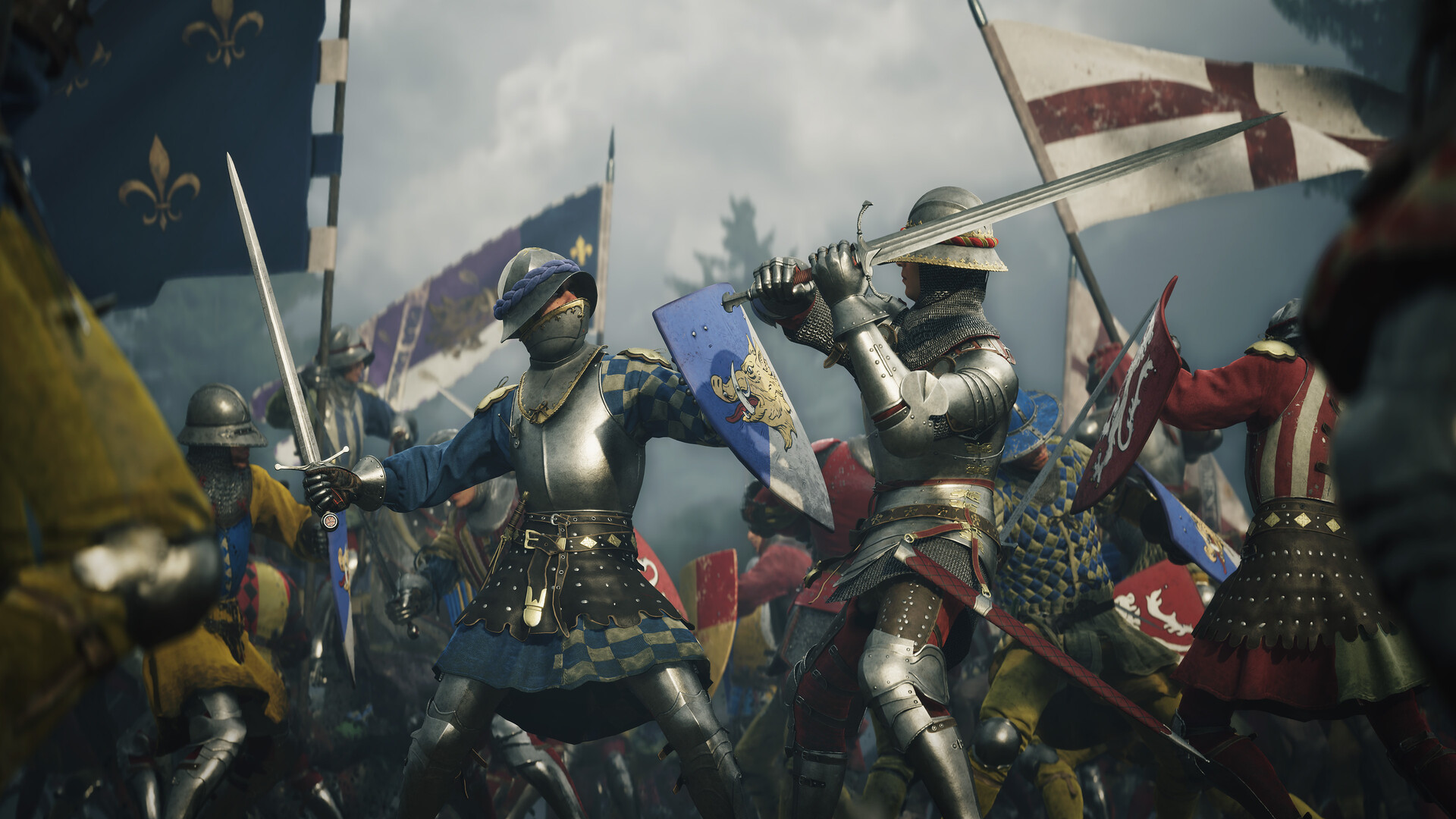
Combat in Chronicles: Medieval is a skill-based melee system designed to function consistently across all scenarios, from one-on-one duels to large-scale battles with hundreds of participants. The system was developed in collaboration with Historical European Martial Arts (HEMA) expert Björn Rüther, whose input shaped weapon handling, guard positions, blade contact, and the overall weight and rhythm of engagements.
Core Mechanics
Two primary variables govern each combat engagement: Energy and Posture. Both names are subject to change during Early Access development.
Variable | Description | Effect When Depleted |
|---|---|---|
Energy | Represents endurance. Drains with each heavy attack, parry, or dodge. | Attacks become weaker, slower, and easier to counter. Players are vulnerable in extended skirmishes or when facing multiple opponents. |
Posture | Represents balance and defensive stability. Reduced by taking hits, being parried, or attacking into a block. | When critically low, the player is left open to devastating finishers or disarms by the opponent. |
Design Philosophy
Raw Power Games chose to reject directional combat systems in favor of a design built on clarity, control, and consequence. Every swing is intended to be readable, every hit communicates why it landed, and every decision carries weight. The system uses motion-warping technology for fluid positioning and includes an optional lock-on targeting mode.
Weapon Progression
Each weapon category has its own dedicated progression path. Proficiency improves through use, with players advancing through Apprentice, Journeyman, and Master tiers. Each tier unlocks additional techniques and abilities specific to that weapon type. Role-specific advantages are built into the system: spears dominate open ground, maces perform well against armored opponents, and longswords offer broader versatility.
Players can carry up to four weapons simultaneously and swap between them freely during combat, allowing for strategic loadout decisions before and during engagements.
Progression replaces a character's basic moves with more advanced versions rather than only adding new ones, so a weapon feels more fluent and chains more attacks as proficiency grows. Non-player characters advance through the same Apprentice, Journeyman, and Master stages, which means fighting an untrained levy and dueling a seasoned knight with the same weapon play very differently. The studio emphasizes polearms alongside swords: a knightly pollaxe was historically far more effective than a sword against heavily armoured opponents, and weapon choice can even depend on whether a player is assaulting or defending during a siege.
Mounted Combat
Mounted combat merges the strength of the horse with the skill of the rider. Lance behavior varies by equipment quality, and character proficiency affects readiness speed, stability, and aim adjustment when mounted. Each horse has individual characteristics including top speed, turning rate, health, and trampling damage. Players can charge enemies on horseback or participate in full-scale cavalry clashes.
Morale and Battle Scale
The same melee system scales from a duel up to a full battle. The studio has stated an ambition of around 1,000 versus 1,000 combatants and is working toward it, while being open that the figure is not yet committed and may not be reached by Early Access. At that scale, battles are won and lost on morale rather than raw numbers: a unit’s spirit breaks before its bodies do, and a broken unit routs and is counted as lost regardless of how many men survive. The player fights as the commander of their army rather than directing it from a safe distance, and that battlefield presence matters. Standing with the front line bolsters nearby troops, and only the commander’s own kills and executions, performed where the soldiers can see them, lift a unit into the Inspired morale state. The flip side is that the commander falling is the single biggest morale hit of all, applying a one-time penalty across the entire army, so wading alone into a large group remains dangerous regardless of skill or armor. Picking when to charge in and when to hold the line is part of the tactical layer. A unit that breaks is said to rout and currently cannot be reformed mid-battle; a retreat, by contrast, is an ordered withdrawal that keeps a unit with the army, called deliberately or triggered automatically when the army’s strength drops below a threshold. See Gameplay for the battle planning, battle lines, formation, command, and morale systems that sit around this combat. The units themselves carry their own combat statistics, including attack and block chances, weapon penetration values, and a Cohesion rating that reflects training, organization, and leadership; see Armies and Units for the full unit stat model.
HEMA Partnership
Raw Power Games partnered with Björn Rüther, a recognized figure in Historical European Martial Arts, to ensure the combat system reflects the precision and weight of authentic historical swordsmanship. The collaboration informed blade-to-blade contact simulation, guard positions, realistic parrying, and the overall feel of weapons in combat.