

Armies and units are the military backbone of Chronicles: Medieval. A unit is a permanent body of men who are similarly equipped and fight together under the same banner. In the army overview a unit appears as a single entry with a name and a current troop count, while on the battlefield its members appear as individual troops. The developers detailed these systems in August 2026, and their scope and values remain in active development and subject to change and rebalancing.
Unit Categories
Every main faction fields its own dedicated Levy, Household, and Mercenary units, each with a completely unique progression tree. All trees include melee and ranged troops, infantry and cavalry, and each is tailored toward the historical strengths of the culture it belongs to: the English have exceptionally skilled bowmen, the French are known for their fearsome cavalry, and the Holy Roman Empire for its tough melee infantry.
Category | Power Tiers | Recruited At | Notes |
|---|---|---|---|
Levy | 1 to 5 | Settlements | The cheap backbone of an early army. Typically recruited at tier 1, with the size of a settlement affecting which tiers appear. |
Mercenary | 3 to 7 | Regions of a foreign culture | Hired to patch weaknesses in a lineup. Expensive, and their morale is more easily shaken than that of Household troops. |
Household | 4 to 8 or 9 | Professional troops with training and better equipment. The functional buildings present, such as barracks, stables, and a blacksmith, influence which roles and tiers appear. |
Mercenaries let a commander compensate for the weaknesses of a faction lineup. Adding English Mercenary archers to a French army improves its ranged potency, while French Mercenary cavalry can reinforce a Holy Roman Empire force built around melee infantry. Tiers overlap deliberately: a fully upgraded Levy unit at tier 5 has a fighting chance against a low-tier Household unit. Unit names are somewhat anachronistic, and French and Holy Roman Empire units are named in their native languages.
Unit Stats
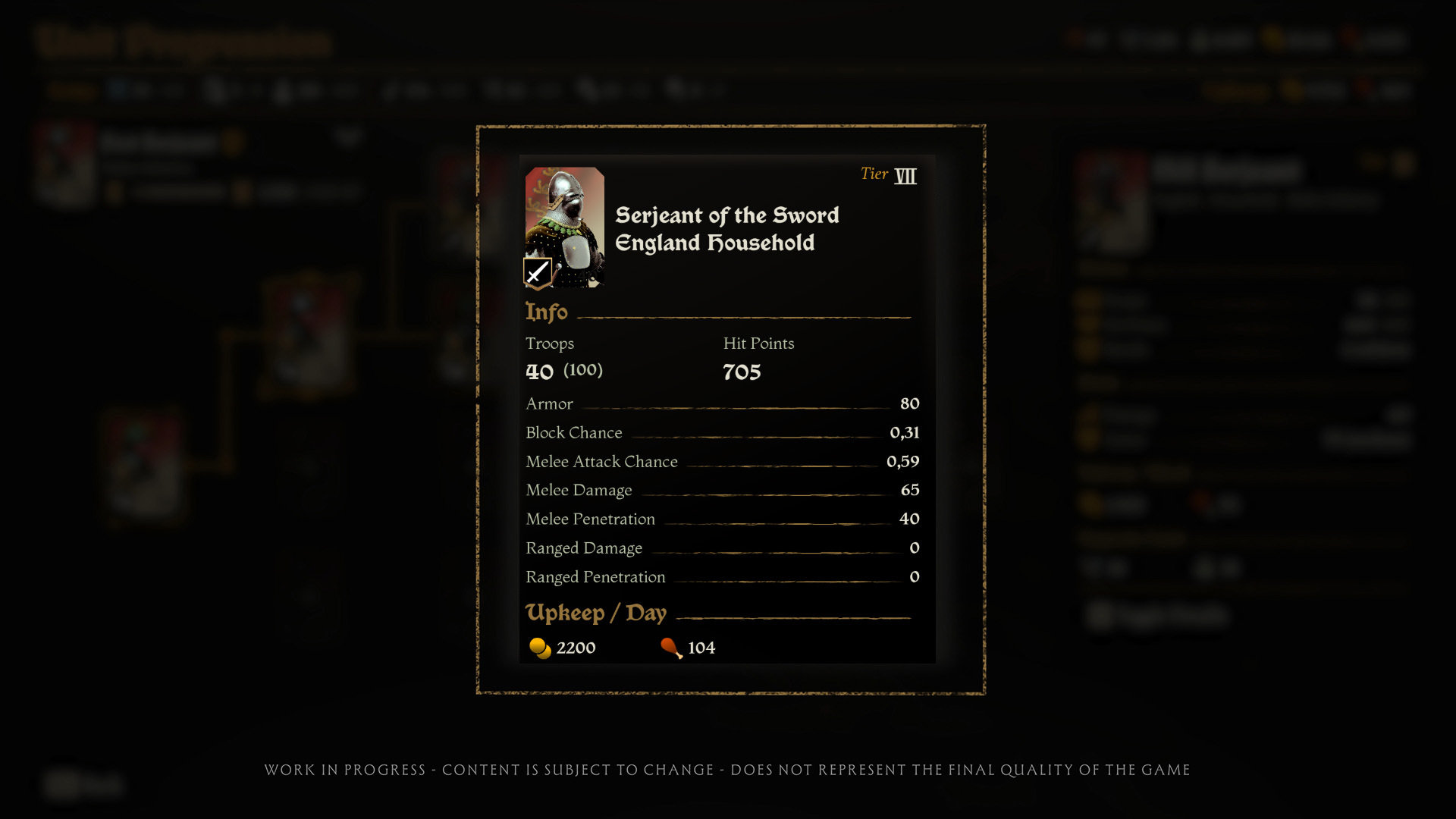
Each unit carries a card that details its stats, tier, general equipment, and category.
Stat | Description |
|---|---|
Troops | The current number of active troops in the unit, shown alongside the maximum possible troop count. |
Hit Points | Total damage a single troop can absorb before dying. Melee troops are durable, ranged troops are fragile. |
Melee and Ranged Damage | Base weapon damage dealt. Units without a primary melee weapon automatically use a sidearm in close combat. |
Armor | Damage reduction. Higher armor raises the penetration an incoming attack needs to do damage. |
Melee and Ranged Penetration | The ability of the unit’s weapons to bypass enemy armor. |
Attack Chance | The probability that a troop’s next action is an offensive swing. |
Block Chance | The probability that a troop’s next action is a defensive block. |
Cohesion | The trust, loyalty, and mutual support between soldiers that makes them fight as a team instead of individually. |
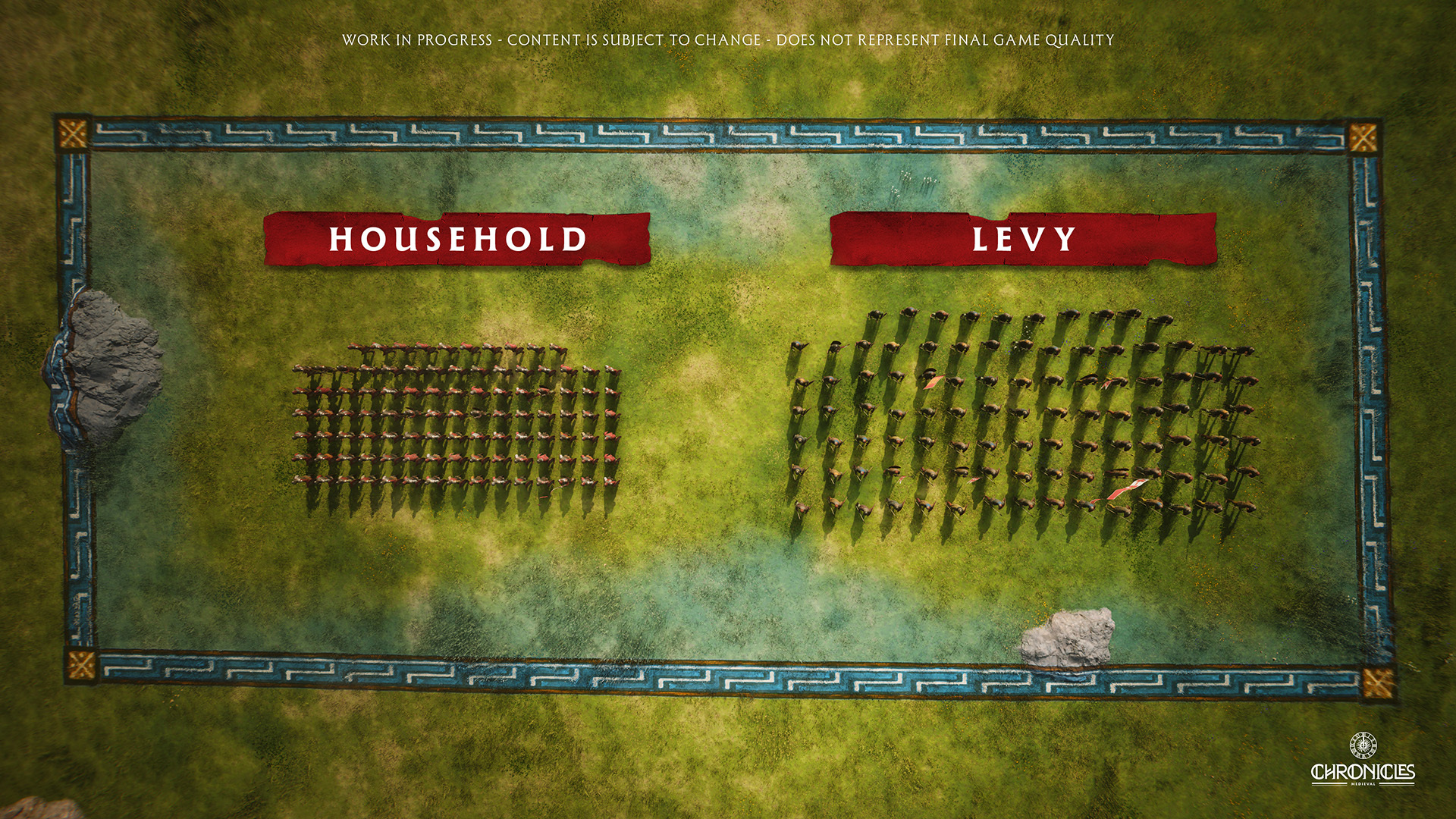
Cohesion reflects a unit’s training, organization, and leadership. A high-Cohesion unit maintains a tighter formation, responds more quickly to commands, and holds its ground more effectively against cavalry charges and opposing infantry. A hundred Levy soldiers and a hundred Household soldiers ordered into the same formation look visibly different on the field for exactly this reason.
Recruitment
New units and replacement troops are found by talking to quartermasters at locations across the exploration map, primarily in settlements and castles. Quartermasters show which units and troops are available for recruitment and replenishment. Recruitable Levy and Household units match the culture of the region they are found in, while Mercenaries do the opposite: English regions offer English Levy and Household units alongside French or Holy Roman Empire Mercenaries, and English Mercenaries only offer their services abroad.
Not every category is available to a fresh commander, either because the units are too costly or because they refuse to follow an unknown name. A typical campaign leans on Levy units in the early game, brings in Mercenaries toward the mid-game, and fields Household units from the mid-game onward. Recruitment and upkeep costs vary by category, troop type, and tier, and fielding a large army too early without solid finances is a quick way to ruin a campaign. The developers are balancing costs so that a maximum-size army made up entirely of Household units is very expensive, but not impossible.
Replenishing Troops
Newly acquired units usually arrive below their maximum size, and battle losses deplete them further. Each unit category has a matching replenishment troop resource, available at the same kinds of locations as the units themselves. These troop resources are added instantly and are type-agnostic within their category, so they can top up any category-matching unit regardless of culture, role, or tier. The per-troop cost matches what a new unit of that type would cost per soldier, paid in arms, armor, and horse resources.
Availability
Each location holds a limited pool of troops and units, and rival army commanders draw from the same pool, so heavy recruitment by others can leave little behind. Offers reset globally every in-game week, which means an army that takes heavy losses may not be able to recruit back to full strength right away, forcing the commander to pass the time or travel to other locations. Renown, the prosperity of a location, and its functional buildings all modify unit spawn chances, initial unit sizes, troop tiers, and replenishment pools.
At Early Access launch, functional buildings can only be constructed and upgraded in castles, with settlements planned to follow later in development. Seasonal changes will have limited gameplay impact at launch and mostly affect recruitment availability, reflecting how medieval armies were less likely to fight through winter; the developers intend to expand the role of seasons during Early Access.
Progression
Units improve by earning experience, primarily by participating in battle. Experience is awarded for performance: units that inflict losses and take casualties earn more than units that stay passive. Once a unit has earned enough experience it qualifies for promotion to the next tier. Levy, Household, and Mercenary units each have different experience requirements, reflecting their training and capacity to improve, and the requirement rises after every promotion.
Promotion costs resources that scale with the number of troops in the unit. Melee and ranged infantry need different amounts of arms and armor, cavalry also needs horses, and Household units cost more to upgrade than Levy or Mercenary units. More powerful units demand more upkeep as well. A promoted unit becomes something new entirely: its stats increase, it may gain better equipment and learn new formations, and its troops undergo a visual transformation that reflects their new role, strength, and standing. At certain forks in a progression tree, a choice appears between developing the current role further, specializing in a particular weapon type such as sword or polearm, or changing role entirely, such as infantry to cavalry or melee to ranged.
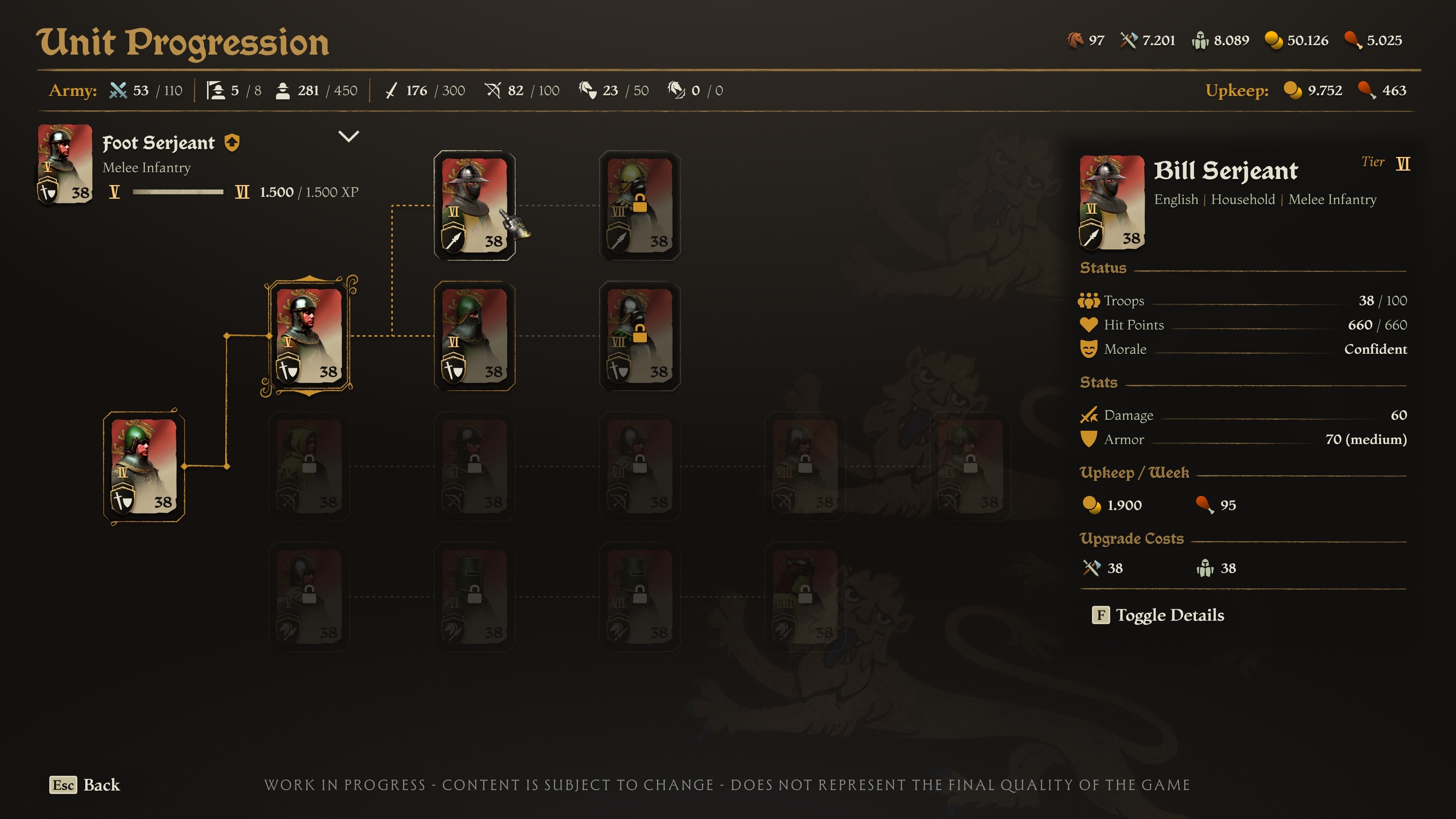
The Foot Serjeant, a tier 5 melee infantry troop type in the English Household tree, illustrates such a fork. Promoted to tier 6, it becomes either the Sword Serjeant, which fights much like its predecessor with better equipment and stats, or the Bill Serjeant, which takes on heavier armor and a bill polearm better suited to dealing with cavalry.
Army Size
A new commander controls only a few units, and growing beyond that is part of character progression. Raising a character’s skill as a commander unlocks up to ten unit slots, along with the ability to field larger units by increasing their maximum troop count to roughly double its starting value. An army that begins as two Levy units of fifty troops each can grow into a mixed force of ten units with a hundred troops apiece, letting a player eventually lead a thousand men into battle, provided they can pay and feed them all.
Morale
Morale matters both on and off the battlefield, and the same brackets apply in both places, with one exception: the Inspired state can only be reached during a fight. A unit’s morale status is carried into battle, fluctuates with how the fight unfolds, and persists once the fighting ends.
Morale State | Behavior |
|---|---|
Inspired | Fighting above baseline. Only achievable in battle, when the commander’s own kills and executions are performed where the troops can see them. |
Confident | The normal state. No desertion occurs. |
Concerned | The first warning. Desertion begins, and troops flee sooner in battle. |
Wavering | The second warning. Desertion grows worse. |
Broken | Triggers a rout in battle. Outside battle, desertion is at its worst. |
Outside battle, troops stay content when they are fed and paid. Failing to provide upkeep lowers morale, and low morale leads to desertion, with more troops leaving the army periodically the unhappier they become. The remedy is consistent full upkeep and decisive victories under an inspiring commander.
Armies raised here fight through the battle systems described under Gameplay and Combat, serve the political ambitions covered in Lords, Power, and War, and garrison the strongholds covered in Castle Building.