

Overview
Black Myth: Zhong Kui is set in a world rooted in the Tang dynasty (618-907 CE), the historical period from which Zhong Kui's mythology originates. However, the game does not appear to be a straightforward historical recreation. Game Science's press release describes it as "rooted in ancient Chinese fantasy" based on "ancient Chinese myths and folk tales," suggesting a mythological interpretation of the period rather than a historically accurate simulation. The design language shown in trailers blends Tang dynasty architectural motifs with mechanical and cyberpunk-inflected elements.
Historical Grounding
Zhong Kui's mythology is deeply embedded in specific historical moments of the Tang dynasty. His origin story takes place during the Wude reign of Emperor Gaozu (618-626 CE), the founding years of the dynasty. The famous dream of Emperor Xuanzong occurs during the Kaiyuan reign (713-741 CE), the dynasty's golden age. The imperial capital of Chang'an (modern Xi'an) is referenced throughout the mythology, from the Imperial Examinations to the palace steps where Zhong Kui killed himself.
Court painter Wu Daozi, who created the canonical Zhong Kui portrait for Emperor Xuanzong, was one of the Tang dynasty's greatest masters, revered as the "Painting Saint." The cultural context of the Tang, its poetry, its Buddhism and Taoism, its artistic traditions, and its bureaucratic structures, permeates every layer of the Zhong Kui legend.
Character Design
Zhong Kui's appearance in the Gamescom 2025 trailer makes the Tang dynasty influence explicit while transforming it into something new. His armor is described as blue-black mechanized armor with shoulder guards inspired by the flying eaves (翘角) of Chang'an's Tang dynasty architecture. This is a specific design choice: the upward-curving roof corners that define Tang palatial buildings are reinterpreted as the shape of armored shoulder plates.
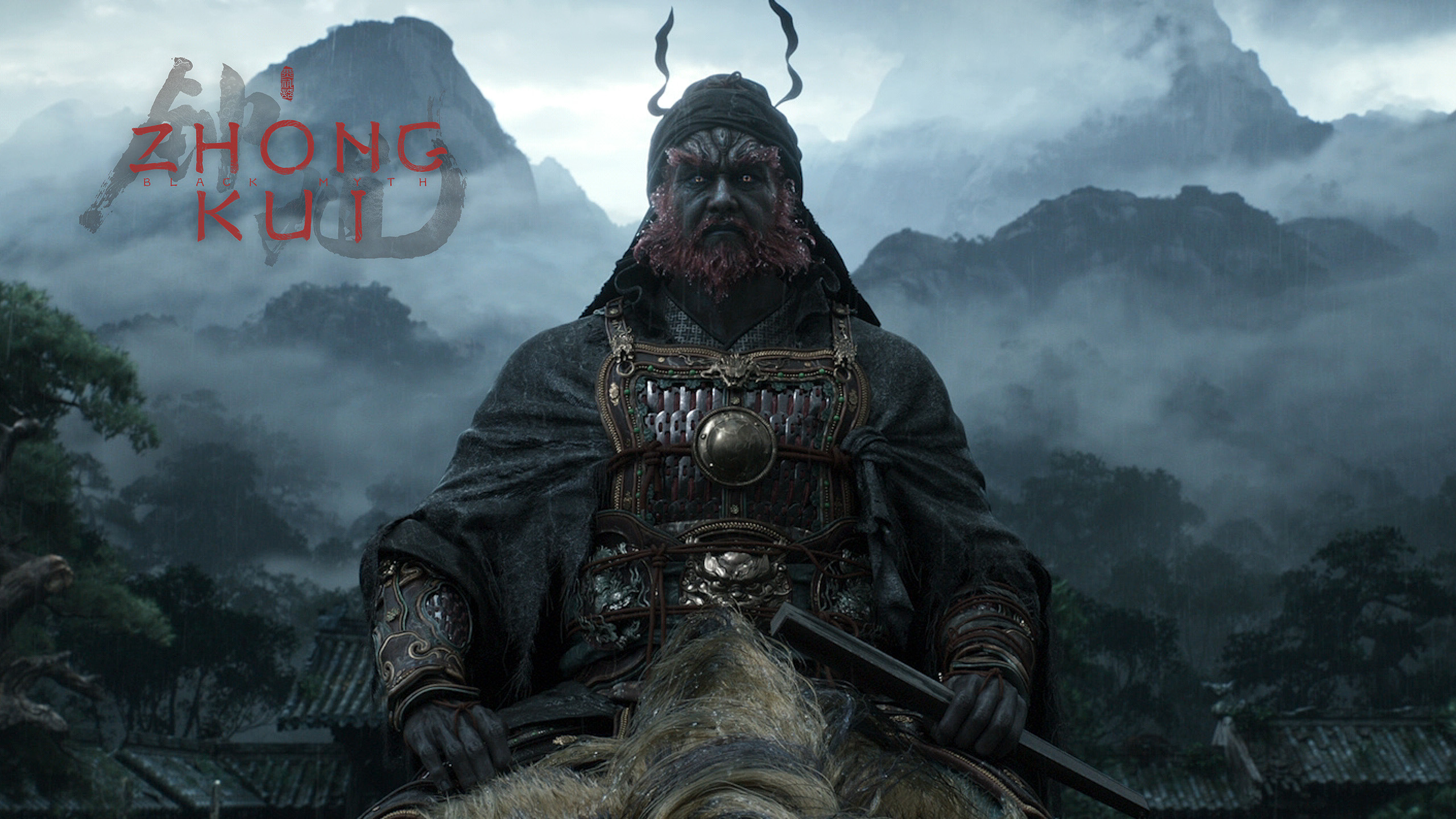
His face follows traditional descriptions closely: a black coiled beard and flaming hair, consistent with depictions rooted in Tang-era art. The overall effect is a character who looks simultaneously ancient and futuristic, grounded in a specific historical aesthetic but expressed through a science-fiction lens.
Game Science describes this fusion as "showing the clash between machine and divine." The Tang dynasty provides the "divine" half of the equation: the mythological authority, the cultural weight, the visual grandeur. The mechanical elements provide the "machine" half: something modern, aggressive, and unexpected layered on top of the historical foundation.
Weapons and companions
Zhong Kui's weapons and companions also draw from Tang dynasty iconography. His folding fan, which doubles as a razor-sharp blade, comes from traditional artistic depictions where Zhong Kui holds a folding fan while standing over a subdued ghost. The fan was an accessory associated with scholars and officials in Tang culture, reinforcing Zhong Kui's identity as a man of learning turned supernatural warrior.
His tiger mount is consistent with centuries of traditional depictions. The trailer shows him riding the massive beast into a rain-soaked town. Flanking him are goblins and ogres carrying his iconic ghost-slaying sword, a detail drawn directly from Tang dynasty folklore and from paintings like Gong Kai's Yuan dynasty handscroll showing slave-demons carrying Zhong Kui's belongings.
Environmental Design
The trailer offers only a brief glimpse of the game's environments. The rain-soaked town that Zhong Kui rides into has no clearly identifiable historical period markers visible in the short clip. It could be Tang dynasty, it could be an underworld reflection of a mortal town, or it could be something entirely fantastical.
How extensively the game world recreates actual Tang dynasty settings, such as Chang'an itself, the Zhongnan Mountains of Zhong Kui's youth, or the palaces of Emperor Xuanzong, is completely unknown. Black Myth: Wukong was celebrated for its painstaking recreation of real Chinese temples and historical sites, with Yang Qi's team surveying 36 real-world locations for digital preservation. Whether the same approach applies to Zhong Kui, or whether the game opts for a more fantastical interpretation of its setting, has not been revealed.
The Tang Dynasty as Narrative Backdrop
Beyond visual design, the Tang dynasty provides the narrative scaffolding for the game. The examination system that produced Zhong Kui's tragedy, the imperial court that rejected him, the underworld bureaucracy that rewarded him, the folk religion that venerated him: all of these are products of Tang dynasty culture and its interaction with Buddhism, Taoism, and Confucianism.
The Chinese underworld as described in the Yuli Baochao (Jade Record) reflects Tang and Song dynasty ideas about cosmic justice, with its ten courts, its paperwork, its formal sentencing procedures. Taoist Exorcism rituals that may inform the game's combat were practiced and codified during the Tang period. The game does not need to look like a Tang dynasty period drama to be steeped in Tang dynasty thought.
A Mythological Interpretation
The clearest statement from Game Science about the game's relationship to history came in the press release: the game is "rooted in ancient Chinese fantasy." The word "rooted" is key. The Tang dynasty is the root system, the source of nourishment. What grows above ground, the game itself, may look very different from a historically accurate recreation. The mechanized armor, the cyberpunk-inflected design language, the supernatural environments: these are the branches. The Tang dynasty is the soil they grow from.