

Overview
Zhong Kui has been one of the most frequently painted subjects in Chinese art for over a thousand years. From the lost original by Tang dynasty master Wu Daozi to Qing dynasty hanging scrolls to Game Science's armored reimagining, the character has been constantly reinterpreted while maintaining a core iconography: a large, bearded figure in official's robes, wielding a sword, often accompanied by demons.
Wu Daozi's Lost Original (8th Century)
The entire Zhong Kui painting tradition begins with a single commission. After Emperor Xuanzong's famous dream, he summoned court painter Wu Daozi (c. 680-760 CE) (regarded as the greatest Tang dynasty painter, known as the "Painting Saint" (画圣)) and commanded him to paint Zhong Kui exactly as the dream described. Wu's portrait was so vivid that the emperor marveled it "seemed wrought from firsthand sight."
The original painting is lost. But its composition was described in inscriptions that survived into the Song dynasty, documented by scholars including Shen Kuo. Emperor Xuanzong distributed copies of the portrait to court officials during Lunar New Year as gifts, and the tradition of hanging Zhong Kui paintings at New Year spread across China.
Surviving Masterworks
Gong Kai (1222-1307) "Zhongshan Going on Excursion" (中山出游图). Late 13th - early 14th century, Yuan dynasty. Handscroll, ink on paper, 32.8 x 169.5 cm. Held at the Freer Gallery of Art, Smithsonian Institution, Washington D.C. (Acc. F1938.4). The earliest extant painting of the Zhong Kui wedding procession. Shows Zhong Kui and his sister in sedan chairs with slave-demons carrying his sword, bundles of goods, and captured demons. Scholar Chuang-ying Liu has argued it contains political allegory about xenophobia under Mongol rule.
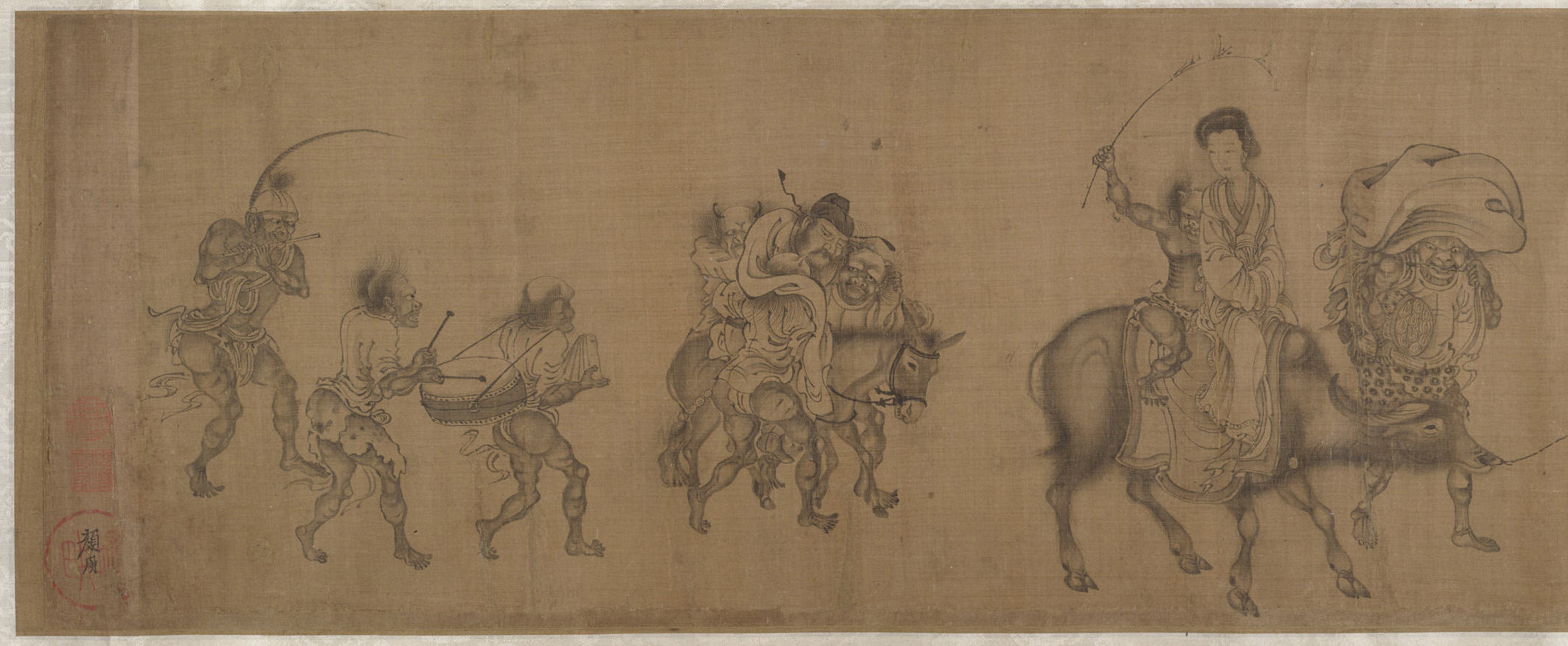
Yan Geng (active late 13th century) "The Demon Queller Zhong Kui Giving His Sister Away in Marriage." Yuan dynasty. Handscroll, ink on silk, 24.4 x 253.4 cm. Metropolitan Museum of Art, New York (Acc. 1990.134). Depicts Zhong Kui "stone drunk and propped atop a small donkey by three retainers while his sister sits helplessly astride a recalcitrant water buffalo."
Yan Hui (late 1200s - early 1300s) "The Lantern Night Excursion of Zhong Kui." Yuan dynasty. Handscroll, ink and slight color on silk, 24.8 x 240.3 cm. Cleveland Museum of Art (Acc. 1961.206). Shows Zhong Kui leading a nightly procession of street entertainers with demonic faces. One beats a drum, another lifts a large rock, one stands on his hands attempting to drink.
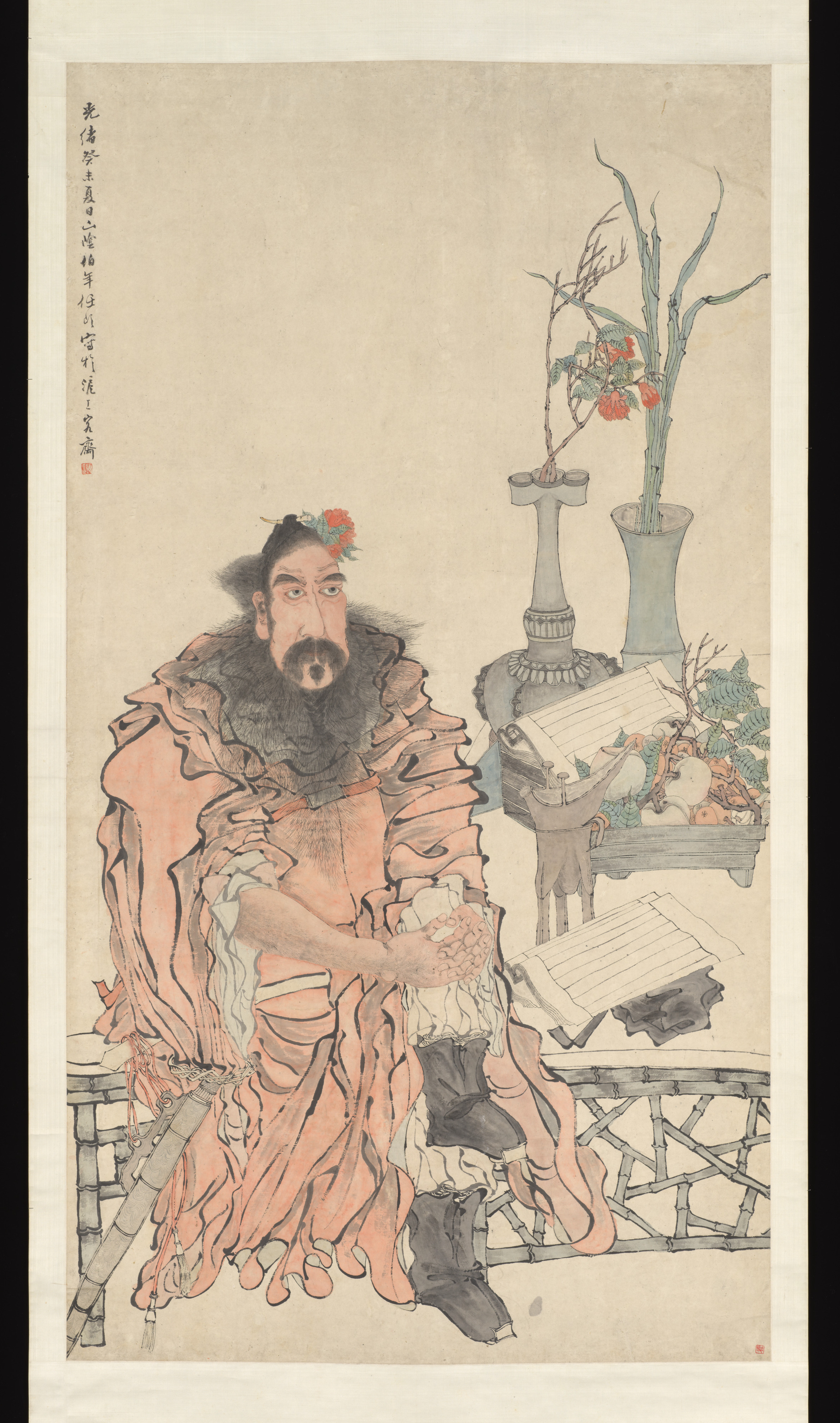
Ren Yi / Ren Bonian (1840-1896) "Zhong Kui." 1883. Hanging scroll, ink and color on paper, 171.8 x 93.3 cm. Metropolitan Museum of Art. A late Qing Shanghai school painting showing Zhong Kui as an elegant, eccentric scholar rather than a fierce warrior: "his sword sheathed and a blossom stuck in his hair, he sits reading beside a table laid out with archaic bronzes."
Spread to Japan
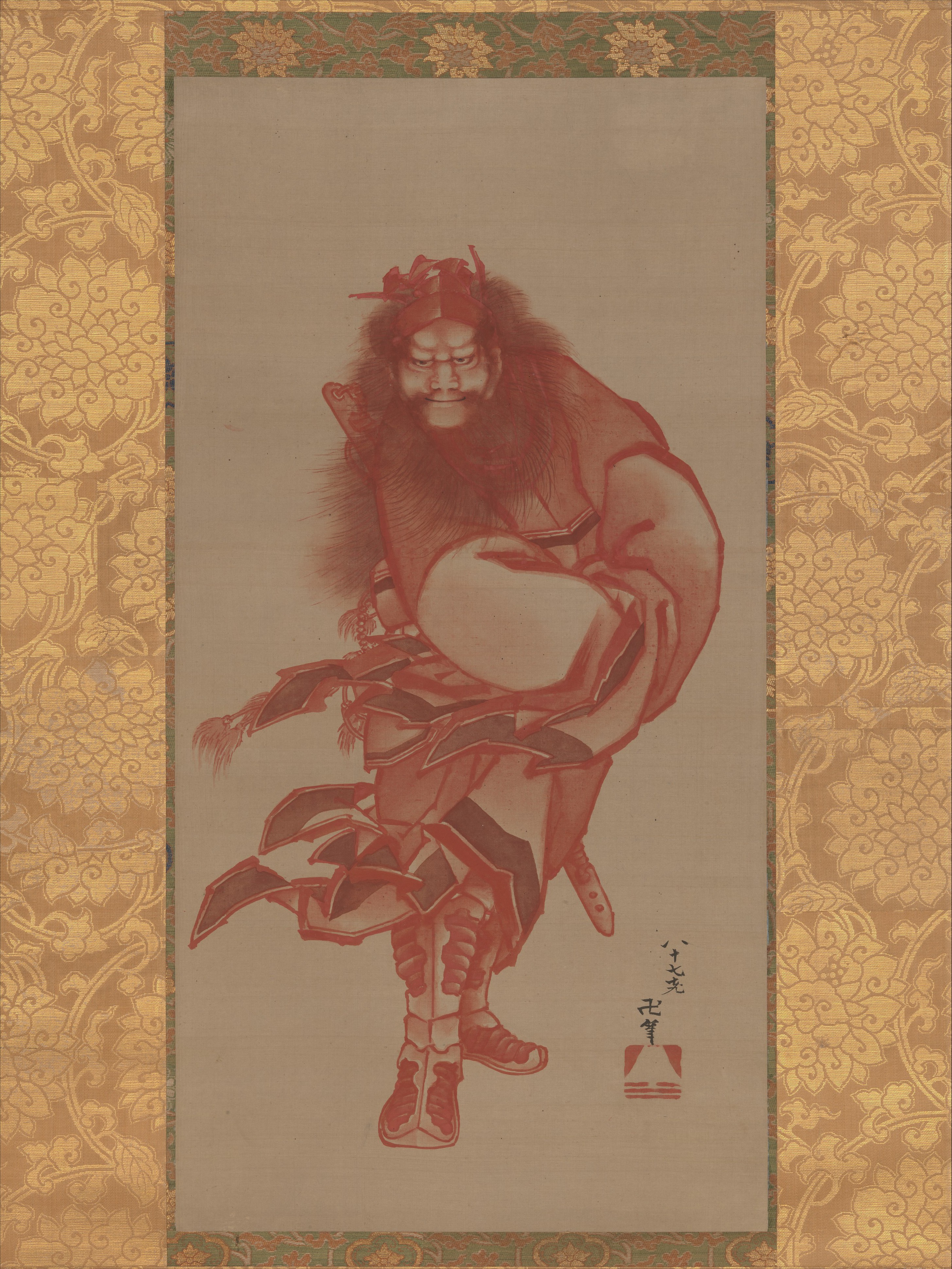
Zhong Kui's image crossed to Japan, where he is known as Shoki (鍾馗). The Metropolitan Museum holds a Muromachi period (1392-1573) painting by Kenko Shokei showing Zhong Kui with a tiger and bat. Katsukawa Shunsho's 1770s woodblock print "Shoki Vanquishing a Demon" is held at the Arthur M. Sackler Gallery, Smithsonian. Shoki statues are still placed on Japanese rooftops to ward off evil.
Game Science's reimagining
In the Gamescom 2025 trailer, Game Science's Zhong Kui maintains the core iconography (black beard, demon attendants carrying his sword, riding a tiger) while dramatically modernizing the aesthetic. The blue robe becomes blue-black mechanized armor. The official's cap becomes partially armored headgear. The flying eaves of Chang'an architecture appear as shoulder guard design motifs.
Yang Qi's dream of "a strange man with a black face and a red beard" on a balcony consciously echoes the Ming dynasty painting tradition of Zhong Kui on a tiger. The game's design is in dialogue with a thousand years of artistic interpretation.