

Overview
The origin story of Zhong Kui is one of the most enduring legends in Chinese folklore. It tells of a scholar of extraordinary talent who achieved the highest academic honor in the empire, only to be denied his reward because of his physical appearance. Driven to despair by this injustice, he took his own life, and in death was granted a power far greater than any mortal office could bestow. The story sits at the foundation of Black Myth: Zhong Kui and shapes the character's motivations, abilities, and place in the supernatural world.
The Scholar From Zhongnan
Zhong Kui was a scholar from the Zhongnan Mountains, a range south of Chang'an (modern Xi'an) that held deep significance in both Taoist and Buddhist traditions. He lived during the reign of Emperor Gaozu of Tang (618-626 CE), the founder of the Tang dynasty. From an early age, he devoted himself to study, mastering both literary and military arts.
His appearance, however, was striking for all the wrong reasons. Historical and literary sources describe him with dark skin, a protruding forehead, wild and unkempt beard, and fish-like eyes. His face was broad, his features misaligned. By every standard of physical beauty held by the Tang court, Zhong Kui was grotesque. But his intellect was without equal.
The Journey to Chang'an
Zhong Kui traveled to the imperial capital of Chang'an with his close friend Du Ping to sit for the imperial military examination. The imperial examination system was the Tang dynasty's meritocratic method for selecting government officials and military leaders. Candidates were judged on their scholarship, strategic thinking, and mastery of classical texts. The examinations were extraordinarily competitive, with success rates for the most prestigious degrees hovering around one to two percent.
Zhong Kui did not merely pass. He scored the highest marks of any candidate, earning the title of Zhuangyuan, the top-ranked scholar in the entire empire. This was the pinnacle of intellectual achievement in Tang China, a distinction that guaranteed a distinguished career in imperial service.
The Emperor's Rejection
When the time came for the emperor to personally receive the Zhuangyuan, Emperor Gaozu took one look at Zhong Kui and recoiled. The man standing before him, despite having outperformed every other candidate in the realm, was too ugly to serve at court. The emperor revoked Zhong Kui's title and dismissed him.
The cruelty of this decision is difficult to overstate. The entire purpose of the examination system was to select officials based on ability, bypassing the aristocratic favoritism of earlier dynasties. For the emperor to override the results based on a candidate's face was a betrayal of the system's core principle. Zhong Kui had done everything the system asked of him, perfectly, and was punished for something entirely outside his control.
Suicide at the Palace Gates
Devastated by the injustice, Zhong Kui dashed his head against the palace gates and died on the steps. Some versions say he used the palace stairs, others specify the stone columns flanking the entrance. In every version, the act is immediate and public. He did not withdraw quietly. He destroyed himself at the threshold of the power that had rejected him.
His friend Du Ping retrieved the body at great personal risk. Du Ping arranged a proper burial with full funeral rites, honoring his friend when the imperial court would not. This act of loyalty becomes important later in the story.
Appointment as King of Ghosts
In the afterlife, Yanluo Wang, the King of Hell, recognized what the mortal emperor had failed to see: Zhong Kui's extraordinary capability. Where the living court judged him on his face, the underworld judged him on his spirit. Yanluo Wang appointed Zhong Kui as the King of Ghosts (gui wang), tasking him with capturing and destroying evil spirits throughout the mortal and supernatural worlds.
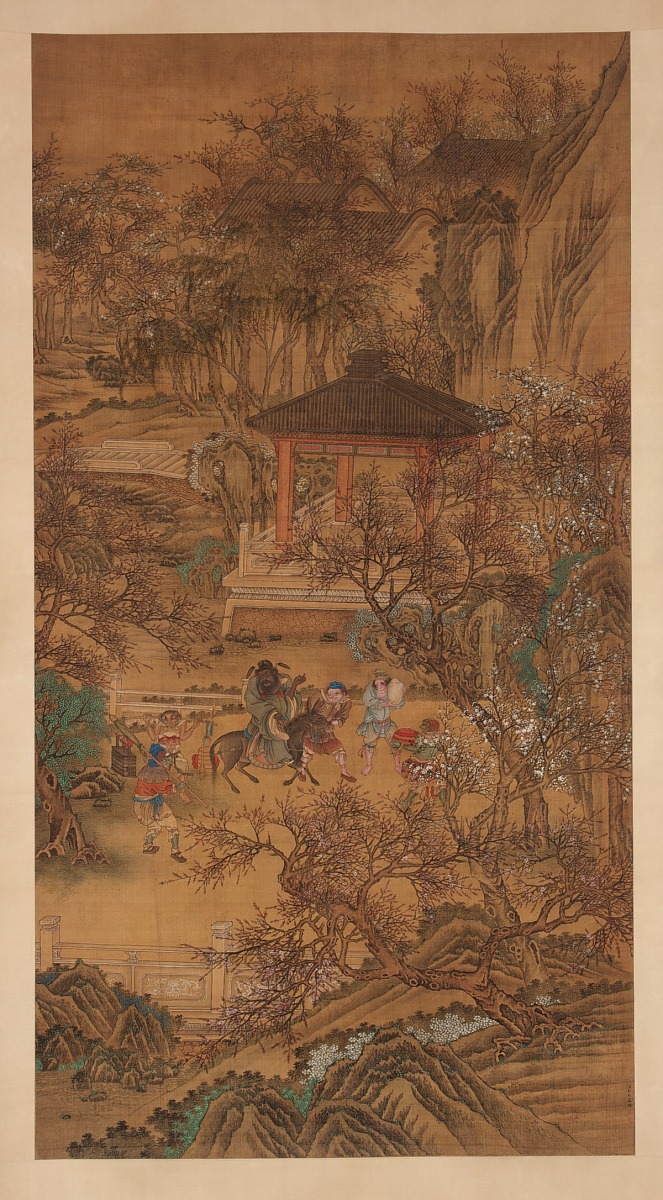
Zhong Kui accepted. He swore to "rid the Tang realm of every Xuhao ghost and harmful spectre," turning his rage and brilliance toward a purpose that no mortal office could have matched. The scholar who was denied a government post received instead dominion over 80,000 demons and the authority to hunt evil across both the living and dead worlds.
Du Ping's reward
Out of gratitude for Du Ping's loyalty, Zhong Kui arranged for his younger sister to marry his old friend. This detail appears in nearly every version of the legend and has inspired centuries of artistic depiction. The "Marriage of Zhong Kui's Sister" (嫁妹) became a major subject in Chinese painting, with famous works by Gong Kai, Yan Geng, and others showing elaborate processions of demons escorting the bride.
Themes and Significance
The origin story carries several layered meanings. it is a protest against superficial judgment: a system designed to reward merit failed because the people running it could not look past a man's face. It is also a story about justice found in unexpected places. The mortal world rejected Zhong Kui; the supernatural world gave him the recognition he deserved.
For Black Myth: Zhong Kui, this origin provides a protagonist with a built-in emotional arc. Zhong Kui is not a simple hero or a chosen one. He is someone who was wronged, who died in anguish, and who turned his pain into a cosmic purpose. That combination of righteous anger and supernatural authority is the foundation on which the game builds.