

Overview
The dream of Emperor Xuanzong is the most famous episode in Zhong Kui's mythology and the event that transformed a regional ghost story into a national institution. During the Kaiyuan reign (713-741 CE), the Tang emperor fell gravely ill after returning from military exercises. In a fever dream, he witnessed Zhong Kui capture and devour a ghost thief. Upon waking, the emperor was cured and immediately commissioned court painter Wu Daozi to capture the vision on silk. That painting, now lost, became the template for over a thousand years of Zhong Kui artwork.
Historical Setting
The story takes place during the reign of Emperor Xuanzong of Tang (r. 712-756 CE), also known as Emperor Ming. The Kaiyuan era (713-741 CE) represented the peak of Tang dynasty prosperity, a period sometimes called the "High Tang" when Chang'an was the largest and most cosmopolitan city in the world. Xuanzong was a patron of the arts, a skilled musician, and the emperor whose love for Consort Yang Guifei would later inspire some of the greatest poetry in Chinese literature.
The emperor had returned to the palace after military exercises on Mount Li (Lishan), a site near the famous Huaqing hot springs east of Chang'an. He fell gravely ill, possibly with malaria, and remained bedridden for more than a month. Court physicians could not cure him.
The Dream
While ill, Xuanzong dreamed of two ghosts. The first was a small ghost wearing red trousers with one bare foot, the other foot shod. It had snatched Consort Yang's purple embroidered sachet and the emperor's own jade flute, and it raced about the great hall, darting and capering, taunting the emperor with the stolen objects.
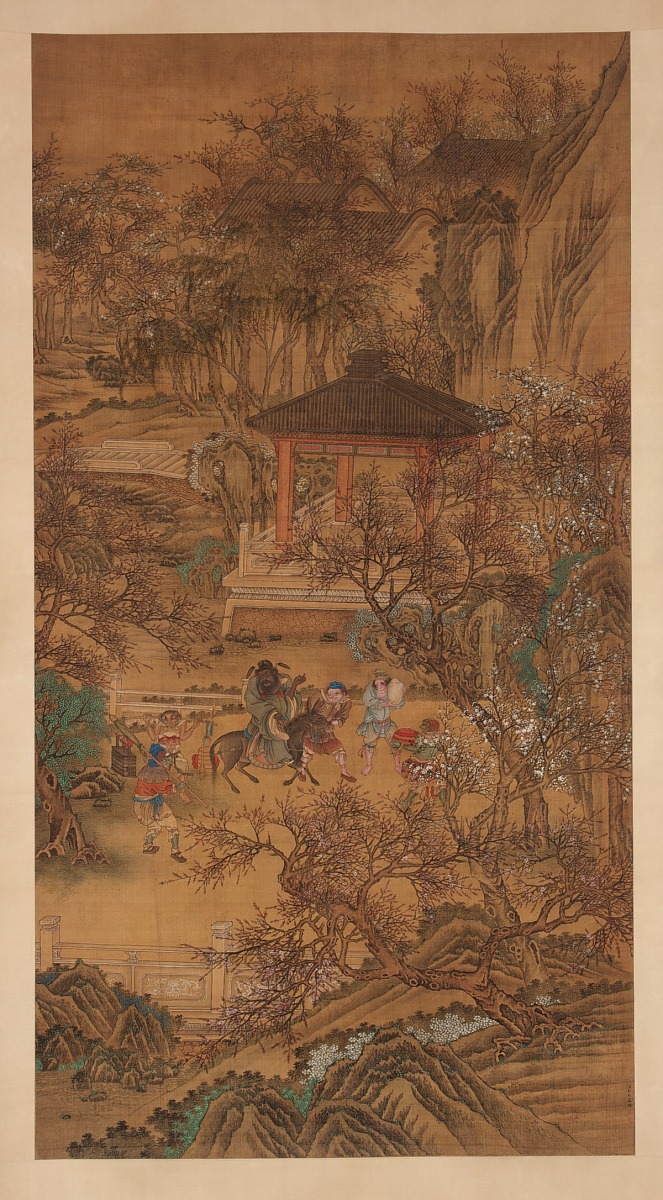
Then a larger ghost appeared. This figure was enormous, wearing a battered cap and a torn blue robe with one sleeve stripped off, both legs bound in hide wrappings. He seized the small ghost thief with his left hand, gouged out its eyes with his right index finger, and swallowed the eyes whole. The small ghost was destroyed.
The emperor, still dreaming, demanded to know the identity of this fearsome figure. The large ghost knelt and introduced himself: "My humble name is Zhong Kui. I was once a candidate in the imperial military examination during the Wude reign. Shamed by my failure" (or in some versions, by having his earned title revoked due to his appearance), "I dashed my head against the palace steps and died. Emperor Gaozu ordered me buried with honor, granting me the green robe of an official. In gratitude, I swore an oath to rid the Great Tang of every Xuhao ghost and harmful spectre."
The Miraculous Cure
Emperor Xuanzong awoke drenched in sweat. His malarial fever had broken. The illness that had resisted every physician's treatment for over a month vanished instantly upon waking from the dream. Whether understood as supernatural intervention or psychosomatic recovery, the cure was total and immediate.
The emperor took the dream as a genuine supernatural encounter. He was not a skeptic looking for rational explanations. He believed Zhong Kui had visited him, destroyed the ghost causing his illness, and identified himself by name and history.
Wu Daozi's Painting
Xuanzong summoned Wu Daozi (c. 680-760 CE), the greatest painter of the Tang dynasty, known reverentially as the "Painting Saint" (huasheng). The emperor described his dream in detail and ordered Wu Daozi to paint Zhong Kui exactly as he had appeared.
Wu Daozi produced the painting. When the emperor saw it, he marveled that it "seemed wrought from firsthand sight," as though Wu Daozi had witnessed the same dream. The composition showed a large, bearded figure in a battered cap and torn blue robe, seizing a small ghost with one hand while the other gouged out its eyes. This image became the canonical depiction of Zhong Kui.
The original painting is lost. No copy has survived. But its composition was described in inscriptions documented by Song dynasty scholars, and its influence radiates through every subsequent Zhong Kui painting, from the Yuan dynasty handscrolls of Gong Kai and Yan Hui to Qing dynasty hanging scrolls and modern interpretations.
Cultural Legacy
Emperor Xuanzong established a tradition of distributing copies of the Zhong Kui painting to court officials during the Lunar New Year as protective gifts. This practice spread from the court to the common people. Hanging Zhong Kui portraits on household doors during New Year and during the Dragon Boat Festival (fifth day of the fifth lunar month) became a folk tradition that persisted for over a millennium.
The dream narrative also established the specific visual and narrative elements that define Zhong Kui across all media: the battered cap, the torn blue robe, the physical act of ghost-eating (gouging out eyes and swallowing them), the military background, and the oath to protect humanity from evil spirits.
Connection to the Game
Game Science's press release for Black Myth: Zhong Kui directly references this legend, describing Zhong Kui as "an immortal from Chinese legend who failed the imperial military examination during the Tang dynasty." The Gamescom 2025 trailer reimagines the visual template established by Wu Daozi's painting: the beard, the demon attendants, the ghost-slaying authority. The game's Zhong Kui wears mechanized armor instead of a torn blue robe, but the lineage from Xuanzong's dream to Yang Qi's character design is unbroken.