
Loading...
Loading...
Victory Conditions
August 6, 2026 at 10:12 PM
Replaced placeholder victory thresholds with the published per-war figures for the last three wars and explained single-condition versus multiple-condition war setups
A war in Anvil Empires ends when one faction satisfies a victory condition before the others do. There are three named paths to victory, each rooted in a different style of play: military pressure on enemy strongholds, cultural dominance through faction-cultural structures, and religious sway through worship and influence. The path system was introduced alongside the war scoring framework in early 2025 and has been iterated on through every test since; specific counts can change between tests, but the three-paths framework has held steady.
Path | Core Activity | Win Trigger |
|---|---|---|
Military | Siege and capture enemy strongholds | Hold a defined number of enemy Town Centers or Keeps for the required period |
Cultural | Build and protect cultural structures | Construct and hold a required number of Temples (or equivalent cultural structures) for a sustained period |
Religious | Accumulate influence through worship and faction-aligned play | Reach the religious influence threshold across the war |
All three paths are tracked simultaneously and any one of them can end the war. A faction that is failing in pitched battle can still take a religious or cultural win, which keeps non-frontline play meaningful and prevents the war from collapsing into a single siege race.
The military path is the most visible. A faction wins militarily by capturing a defined number of enemy Town Centers or Keeps and holding them for the required period. The exact count has changed between tests:
Some early wars required capturing all enemy Keeps before the timer expired.
Recent wars have lowered the requirement to a smaller fixed number, often three Town Centers, which keeps the path achievable in the five-to-seven-day window of a single test.
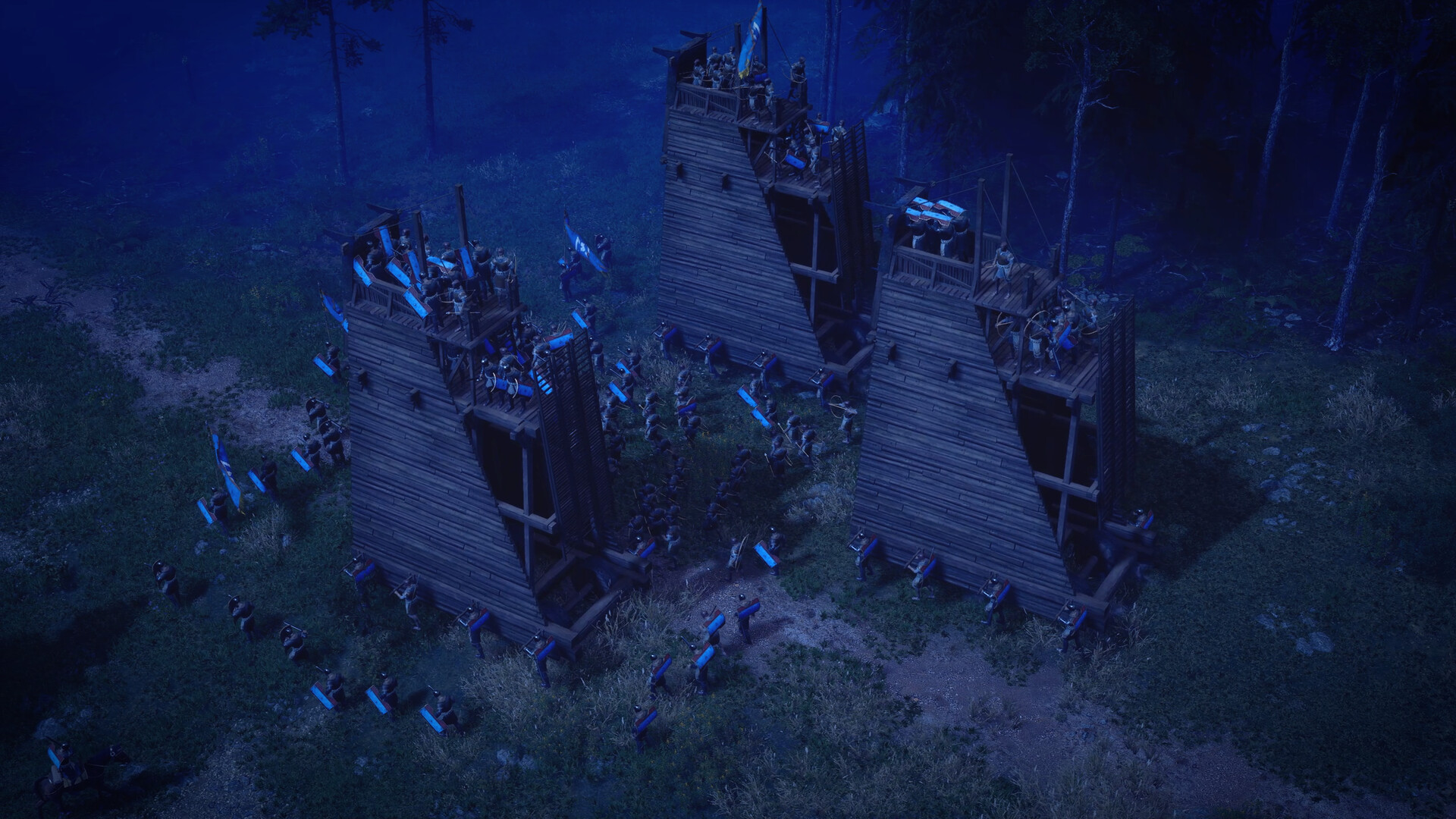
Capturing a Keep requires breaking through walls and gates with siege equipment, clearing defenders, and holding the Town Center for the required duration. Heavy battering rams and catapults are the standard answer to fortified walls; burning oil can be used by defenders to push siege engines back from the walls.
Locations under attack now always appear as available spawn points on the map, even when the option to show all avatars is switched off. That applies to towns under attack and to fortresses whose temples are under attack, and it makes reinforcing a contested keep far more responsive than hunting for a spawn manually.
The cultural path rewards a faction that can dedicate resources and territory to Temples and the surrounding cultural structures. A cultural victory requires constructing a required number of Temples and protecting them through to the win threshold. Temples are expensive in raw resources and require a guarded location; a faction pursuing this path needs to invest in homestead defenses and Logistics rather than throwing every player at the front.
Because Temple construction takes time and a Temple destroyed by an enemy raid resets the progress, cultural play often combines with a defensive layer of walls, towers, and supply lines around the Temple sites.
The religious path is the least visible but tracked the same way. In the most recent build, religious influence is gained by working Relic Sites rather than by claiming them: Relic Sites are no longer fixed on the map and instead spawn near the front line periodically. Players mine a Relic Site with Pickaxes to excavate Relics, then turn those Relics in as bounties in a Town, which raises the faction's religious influence. The exact metric is a private religious-influence score; once a faction's score crosses the war's threshold, the war ends with a religious win.
Religious wins have shown up across the recorded war history in roughly the same proportion as cultural wins; they are not a curiosity but a real third lane. A faction pinned down militarily and short on Temple-grade economy can still close out a war by sustained religious play.
The MS 67 build made temples easier to protect. Temples can now be built inside fortress areas, fortress areas themselves grew by five percent in radius, and temple health rose by fifty percent. Together these let a faction chasing the religious path shelter its temples behind existing fortifications instead of defending them in the open, which changes the counterplay from picking off isolated buildings to breaking a fortress first. Fortresses whose temples are under attack always show up as available spawn points on the map, so defenders can answer a push quickly.
If no faction reaches any victory condition before the test window expires, the war ends in a stalemate. Stalemates are recorded on the war ledger alongside victories and defeats, and they count for tuning purposes but not for a faction's win column. Stalemate weeks are still meaningful for individual players because Avatars, structures, and feedback all carry forward into the next test cycle.
Specific numbers shift between tests as the studio tunes the system. The two most recent wars were both set up the same way: a military win required capturing and holding two enemy Town Keeps, a cultural win required building and defending two Temples for forty-eight hours, and a religious win required collecting ten thousand Influence. The war before those asked for three Town Keeps, three Temples held for seventy-two hours, and the same ten thousand Influence, so the counts move but the shape of each path has been stable. The Pre-Alpha Tests article tracks the most recent observed state, and the war record on Factions lists which path each completed war was actually won under. When the studio publishes a balance change, the live build wins over anything written here.
Wars can also be configured to end on a single condition or on multiple conditions. Recent wars have run in multiple-condition mode, where each path is tracked independently and more than one can be satisfied before the war closes, which is why the same war can be recorded as won on two different paths by two different empires.
Factions
Pre-Alpha Tests
Sieges
Logistics and Supply Lines
