

Settlements are the foundation of long-term play in Anvil Empires. A settlement might begin as a single homestead built by one or two players, grow into a hamlet with workshops and a marketplace, and end the war as a fortified town with multi-level keeps and dozens of residents. Almost every productive activity in the game ties back to a settlement somewhere.
Town Centers
Each faction's spawn locations are anchored on permanent Town Centers placed across the map. A Town Center is the public face of a settlement: it provides spawn points, vendor access, and the structural anchor for surrounding workshops and walls. Capturing or defending Town Centers is one of the war's victory conditions; in recent rules, controlling a set number of enemy Town Centers triggers a military victory.
Homesteads
A homestead is a player or small-group claim placed in the world. Homesteads are bounded by a square area defined by the Homestead Keystone structure, and homesteads built inside a Town snap to the town's building grid for clean integration. Homesteads support modular building: foundations, walls, floors, roofs, corridors, and bridges connect into larger structures, and dedicated furnishings (Hearth, Oven, Pantry) turn a basic shelter into a living and working space.
Homestead ownership gained several controls in the MS 67 build. Owners set their own rent through a dedicated button in the homestead interface rather than accepting a fixed price, and homesteads claimed by a house display a unique icon on the world map so house property is easy to pick out at a glance. Homestead keystones now count toward the foundation limit, which caps how far a single plot can sprawl. A homestead built across a town border can draw on both wild and town building options, a quirk the studio has listed as a known issue rather than intended behaviour. Since the MS 68 build, homesteads, towns, fortresses, and camps also carry dedicated feeding slots for stored avatars and animals, with horses and donkeys using their own slots.
From Hamlet to Town
Stage | Typical Buildings | Population |
|---|---|---|
Solo homestead | Homestead Keystone, basic shelter, Cooking station, storage chest | 1 to 4 players |
Hamlet | Homestead cluster, Smithing forge, Farming plots, simple palisade | 5 to 20 players |
Town | Town Center, Trade and Economy Marketplace, Tavern, Industry workshops, defensive towers | Dozens to hundreds of players |
Fortress town | Multi-level Fortress Keep, full curtain walls, Sieges defensive equipment | Hundreds of players |
Homestead Specialisation
Homesteads further split into two specialised branches depending on whether the keystone is placed inside a Town's footprint or out in the open wilderness. The choice is made at placement and the keystone cannot be converted afterwards.
Branch | Where | Buildable Area | Specialised Buildings | Role |
|---|---|---|---|---|
Town homestead | Inside a Town footprint | 16 metres per side | Forge, anvil, hearth, oven, quenching station | Smithing and cooking; equips the front line with finished arms, armour, and prepared food |
Wild homestead | In the wilderness | 40 to 48 metres per side (tier dependent) | Tilled fields, stables, drying racks, heating vats for leather tanning | Farming and resource processing; feeds the raw material chain for crafting and trade |
Both branches share the same inventory model (auxiliary slot, treasury, and general storage) and the same modular building palette. The split is in what specialised production stations can be placed inside the keystone area, which makes Town homesteads the natural location for a smithy or kitchen and Wild homesteads the natural location for a farm or tannery.
Production Chains
Towns concentrate the production buildings that make a faction self-sufficient. A typical fortified town will have a Forge and Furnace for ingots, a Grain Mill turning wheat into flour and seeds into animal feed, a reworked Tavern that centralises the town’s food production and grants a Rested buff, a Pantry for player upkeep, and a Marketplace for selling barrels of bulk goods to other players. The trade economy adds three regional resources (linen from flax, lead ingots from lead, rosin from resin) that rotate annually to encourage inter-settlement trade.
Defense
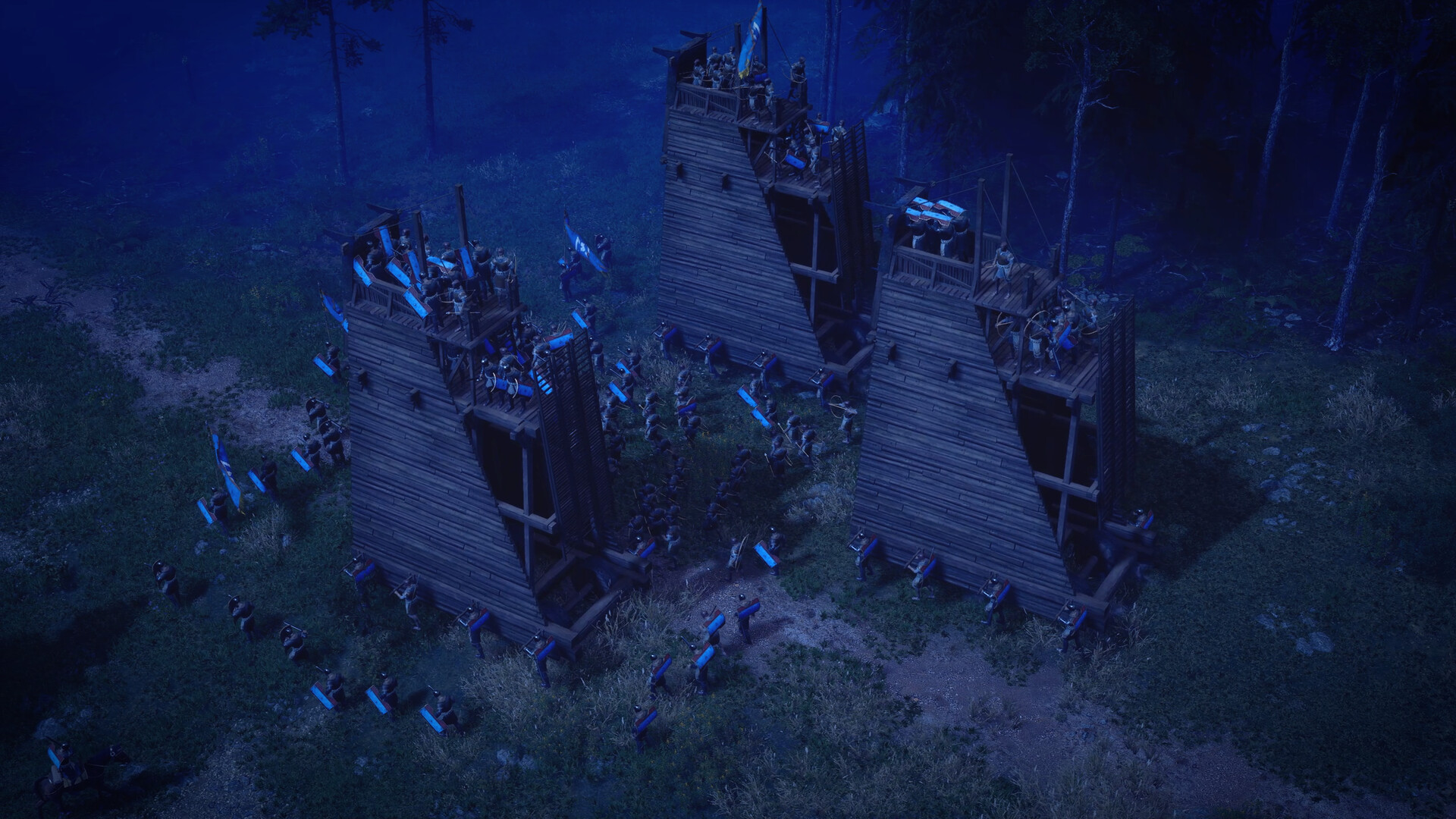
A town that cannot defend itself will not survive a serious war. Towers, stockades, and weapon stockpiles cover the perimeter; deeper inside, fortress keeps house the most valuable crafting stations and serve as the fallback in a siege. Burning Oil placed on fort walls can both damage attacking troops over time and damage approaching siege engines directly. See the Sieges article for how attackers respond.