

Combat in Anvil Empires is real-time and player-driven. Battles are not scripted: they happen wherever two factions meet, from a roadside ambush to a thousand-player melee in front of a fortress. The studio's custom r2 server technology is designed to keep that scale playable in a single shard. The fundamentals below apply to both small-scale skirmishes and large army fights.
Combat Roles
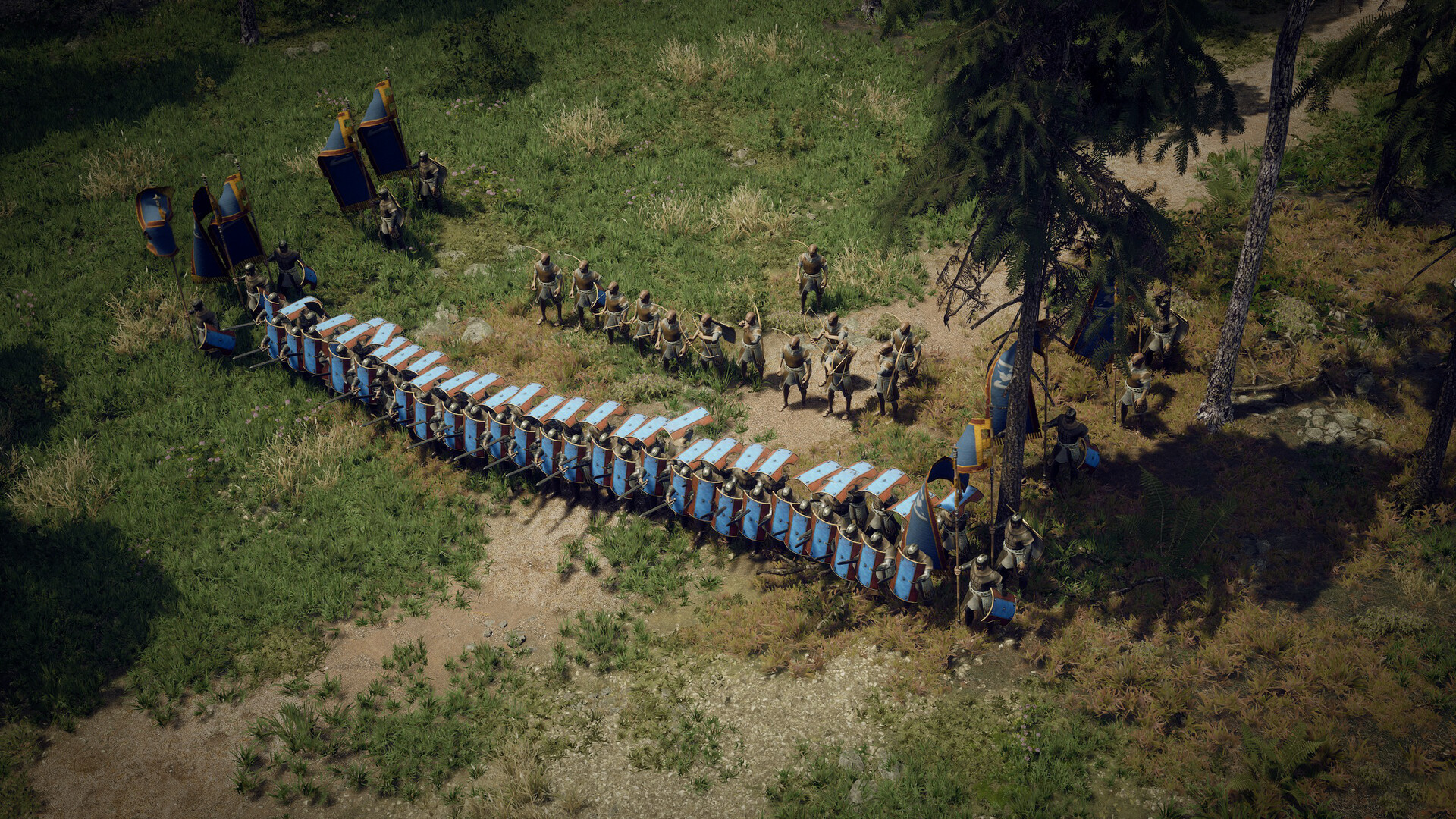
Infantry: Front-line melee. Sword and shield, spear formations, and mace teams targeting heavily armoured foes.
Skirmishers: Light troops with bows or javelins. Cannot wear Armours heavier than light because Bows and Spears cannot be armed in reinforced or heavy armour.
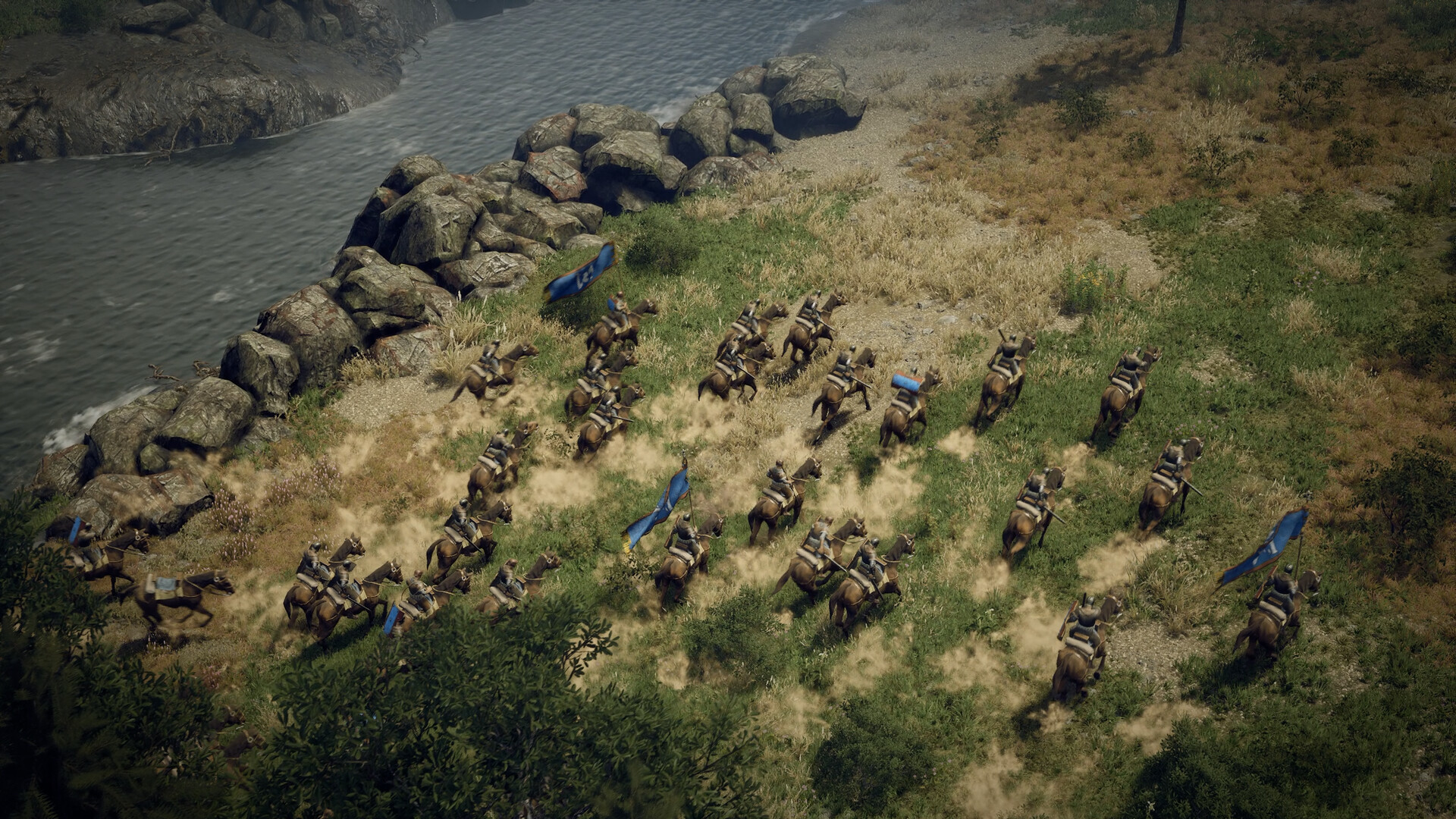
Cavalry: Mounted players using Vehicles (horses) for raiding and rapid response.
Siege engineers: Operate Sieges equipment, supply ammunition, and repair vehicles under fire.
Logisticians: Run caravans, pack carts, and keep Logistics and Supply Lines feeding the front.
Damage Types
Most weapons deal one of several damage types. Different damage types interact differently with armour and with siege engines.
Damage Type | Primary Source | Notes |
|---|---|---|
Slashing | Swords, axes | Default melee damage; standard armour mitigation applies. |
Piercing | Longswords, Spears, Javelins | Thrusting and reach damage; the two-handed Longsword family and the Spear line deal Piercing rather than Slashing. |
Crushing | Maces, Rock Slab | Damages stability and is effective against heavily armoured targets. |
Cleaving | Combat Axes | Damages siege weapons in addition to players. |
Missile | Bows | Ranged damage; weapon and bow tier roll a damage range per hit. |
Burning | Burning Oil, Oil Flask, Torch | Damage over time; Burning Oil also directly damages siege engines. |
Water | Water Bucket | Used to extinguish burning effects on structures and players. |
The Stability System
Heavy hits, particularly from crushing weapons, reduce a player's stability. A staggered or knocked-down character cannot block or attack effectively. Crushing damage is the main answer to opponents who stack heavy armour; a coordinated mace line will out-trade a sword line against the heaviest plate.
Armour Interaction
Armour mitigates incoming damage by category. Wearing heavier armour does not just reduce damage; it also restricts the weapons you can wield. Bows and spears cannot be armed in reinforced or heavy armour. This forces a real tactical choice: a heavy infantry line cannot also be a missile line, and vice versa. See the Armours article for the multiplicative mitigation formula.
Recent Combat Changes
The most recent pre-alpha tests refined several core combat behaviours. The changes below were shipped across builds MS 64 (Pre-Alpha Test 43, April 2026) and MS 66 (Pre-Alpha Test 45, June 2026). Where the MS 67 overhaul later replaced one of them, the row says so.
Change | Effect |
|---|---|
Movement penalty removed for most melee weapons | Between builds MS 64 and MS 66, players kept full mobility while armed with the standard melee families. The MS 67 overhaul reversed this: movement is slower again while a melee weapon is armed, and slower still while guard is up. |
Charging mechanic | Under builds MS 64 to MS 66, holding the guard stance while stability stayed at sixty percent or higher let the avatar charge forward. MS 67 moved the charge onto the sprint key held from a standstill, with a wind-up indicator on the stamina bar. The tactical use is unchanged: it closes distance against ranged opponents and breaks formations. |
Stagger rules | Stagger only triggers when an attack is blocked or when stability drops to a low threshold. Open-stance attacks no longer interrupt the target's swing unless the threshold is met, which rewards stance management over button mashing. |
Durability loss reduced by fifty percent | Tools and weapons consume durability at half the prior rate, which lengthens equipment lifespan and reduces the supply burden on the front line. |
Power level indicator | An at-a-glance power-level marker now sits next to each combatant's name; the marker summarises combined combat attributes from the Avatar System and helps small groups read incoming threats quickly. |
Call to Arms | Attacking a location's locked public inventory now requires three players to press the Call to Arms button at the same time. Successful activation unlocks the previously locked stockpile for raiding; failed activation leaves the inventory protected. |
Combat attributes no longer scale PvP damage | Melee and Ranged attributes no longer increase the damage an avatar deals to other players; they now determine which weapons the avatar can equip, while still scaling damage against animals and AI. Player-versus-player outcomes lean on weapon choice, armour, and positioning rather than raw attribute levels. |
Heavy armour resists light projectiles | Reinforced and Heavy body armour are no longer staggered by arrows or javelins, and Heavy armour can deflect them outright, with the deflection chance highest from the front. Heavy armour is in turn vulnerable to Piercing weapons such as the Longsword and Spear line. |
MS 67 also retuned ranged fire and the Call to Arms window. Indirect bow fire now deals the same damage as direct fire for every bow type, and the Longbow's indirect range grew by ten percent, which makes arcing volleys over a shield line a real option rather than a weak fallback. Public storage stays accessible for twenty minutes during a Call to Arms instead of ten. Camera shake has been removed.
Previewed Combat Rework
The MS 67 build that opened Pre-Alpha Test 46 on 21 July 2026 reworked combat outright. The studio advises resetting keybinds before playing the new system, because several defaults moved. The behaviour below is the current shipped state and supersedes the older guard-and-stability handling described above.
Change | Effect |
|---|---|
Secondary and tertiary attacks | Every weapon gains a secondary attack on Ctrl and left mouse and a tertiary attack on Alt and left mouse, widening each weapon's moveset beyond a single swing. Sword tertiary attacks deal extra damage to an opponent's guard. |
Combat Stamina replaces the Guard meter | Attacking and blocking both consume Combat Stamina, which sits in the centre of the heads-up display where the Guard meter used to be. It regenerates over time but pauses while sprinting, and its ceiling is set by the avatar's maximum stamina. |
Low stamina no longer weakens hits | Attack damage is no longer reduced when stamina runs low, so a tired fighter still lands full-strength blows and the penalty for a long engagement is measured in options rather than in damage. |
Guard is raised manually | Guarding is now a deliberate action on a dedicated key rather than a stance that holds itself up, and the guard drops automatically whenever an attack is thrown. Attacking and defending have to be timed against each other instead of overlapping. |
Charging returns | Holding the sprint key from a standstill builds a charge, with an indicator on the stamina bar showing the state of the wind-up. Guard cannot be held while sprinting. |
Armed movement is slower | Movement speed drops while a melee weapon is armed and again while guard is up, which puts a real cost on walking through open ground in a fighting stance. |
Facing follows the cursor | With any weapon or tool armed, the avatar always turns to face the mouse cursor, so aiming no longer depends on holding an attack button down. |
MS 68 Changes
The MS 68 build that opens Pre-Alpha Test 47 redesigns what happens when a fighter goes down. When an avatar’s health reaches zero it enters a wounded state instead of dropping immediately: the wounded avatar can crawl toward safety and be treated by a friendly player using Bandages, which are widely available. An avatar can be wounded up to three times before it becomes incapacitated, at which point the body must be retrieved and stationed. Auxiliary avatars skip the wounded state entirely, and players no longer drop their inventory when wounded, so sticking in close formation with allies is the difference between a treated wound and a lost avatar.
The same build retunes damage. Slashing, Cleaving, and Crushing damage against infantry dropped by a quarter; missile damage from bows deals half damage against a raised guard and no longer damages light structures; the Short Bow line gained ten percent damage; and Iron and Superior Spears gained fifteen percent ranged damage. Maximum stamina now depletes twenty percent more slowly, maces received unique animations for every action, and the health bar animates to show changes more clearly.
Battle Scale
A single battle can support up to one thousand simultaneous combatants on the same field. In practice, encounters of dozens to a few hundred are more common, but the network architecture is built around the larger number so that the climactic battles of a war are not capped. Battles are always organic: there is no instance, no queue, and no battlefield boundary other than the world map itself.
Related Pages
Armours
Sieges
Logistics and Supply Lines