Loading...
Loading...
Avalon
August 23, 2026 at 01:02 PM
Added the in-game glossary definitions of Folded Realms and the Fog, recorded that the first playable demo never reached Avalon or a named Folded Realm, added the official reveal framing of the two worlds and the thirty-plus boss figure, corrected Mordred to female, reworked the Niniane entry against her role in the demo, and added Sir Lamorak as the one named ally beyond London
Avalon is one of the two primary settings in Tides of Annihilation, standing in counterpoint to the fog-choked ruins of modern London. It is the mystical Arthurian otherworld, reimagined by Eclipse Glow Games as a surreal, fractured realm that exists alongside the mortal city rather than in a distant sea. Avalon is the home of the antagonist faction, the demi-gods who rule its shores, and the source of the invasion that shattered the living world. The realm was formally unveiled in the Xbox Partner Preview trailer on November 20, 2025, which showed Gwendolyn crossing into its mirrored skies to confront one of its wardens.
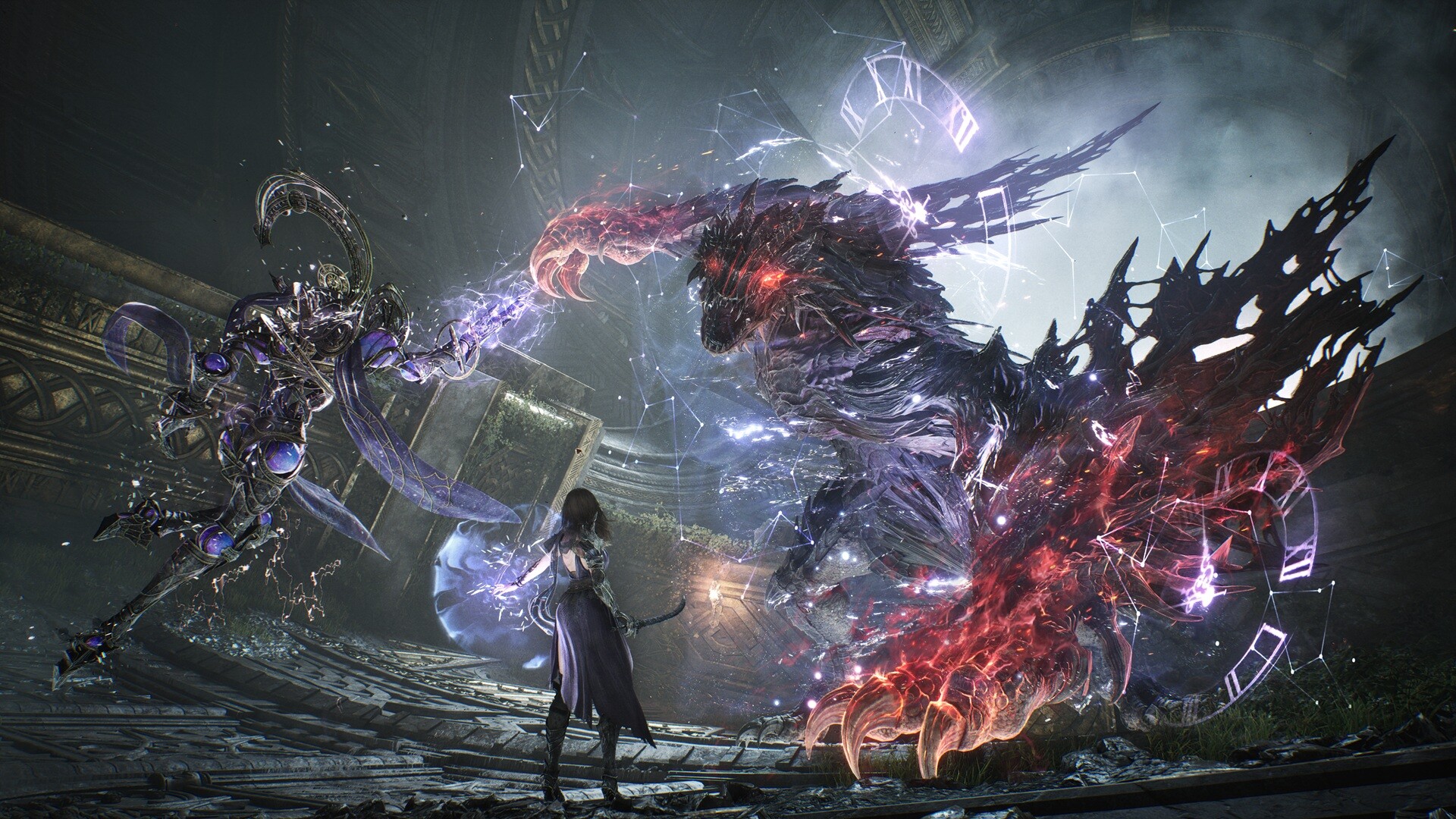
In the game, Avalon is described as part dreamscape and part nightmare: a surreal, fractured otherworld where dimensions fold back on themselves and the usual rules of geography and gravity no longer apply. Where London is defined by crumbling landmarks, Colossal Knights, and the suffocating silence that followed the invasion, Avalon answers back with shifting architecture, mirrored skies, and set pieces that read as both alien and uncomfortably familiar. The realm is presented as the seat of power for the forces that tore through the mortal city, and its surface acts as a staging ground for boss encounters against its rulers.
Avalon is not purely a backdrop. It is threaded through the Arthurian Legend in Tides of Annihilation, acting as the mythic counterweight to the modern setting and the place where the Knights of the Round Table originally rose and fell. The realm is tied to the same tides that bleed otherworldly power into London, and the Grail Shards Gwendolyn gathers across her journey are presented as the means to match Avalon's influence and confront its rulers on their own ground.
In traditional Arthurian myth, Avalon is the Isle of the Blessed, a place of healing and enchantment where King Arthur is carried after his final battle at Camlann to be tended by a company of sorceress-sisters. It is the forge where Excalibur is said to have been crafted in some tellings, the orchard of magical apples that lend the island its name, and the residence of Morgan le Fay, Arthur's half-sister and one of the most famous enchantresses of the cycle. Later medieval romances expand the court of Avalon to nine sisters under Morgan's leadership, each gifted with specific talents in magic, shape-shifting, and healing.
The game keeps the skeleton of this tradition. Avalon remains a mystical island-realm, its rulers remain sorceresses tied to Morgan le Fay, and its associations with healing waters and magical apples are preserved in the imagery of the environment. What changes is the posture. In the classical tradition, Avalon is a neutral or benevolent refuge. In Tides of Annihilation, the same sisterhood has turned outward, and the realm that once waited for a wounded king now pushes its forces across the veil into the mortal world as the primary villains of the story.
Within the game's fiction, Avalon is ruled by a council of demi-gods: Morgan le Fay and her sisters, a circle of powerful sorceresses who serve as the overarching antagonists. They are the figures responsible for the otherworldly invasion that fractured London. The passage they opened between realms is what allowed their forces to pour into the mortal city, raise the Colossal Knights above its skyline, and leave Gwendolyn as the last human able to push back. Avalon, in other words, is not just a location Gwendolyn visits. It is the home address of the enemy she is hunting.
The realm is tightly bound to the story's central mystery. The game frames the Grail Shards as the key to countering Avalon's influence and reaching its rulers, which positions the realm as a gated endgame destination rather than a background layer. Environments across Avalon are built to reflect the sisters' power and personality, so the territory Gwendolyn crosses changes depending on which demi-god holds that stretch of the realm. The sisters include Tyronoe, Niniane, and figures tied to the traitor Mordred, and each leaves a distinct mark on the stretch of Avalon that belongs to her.
The studio's own Chinese-language reveal copy sets out the same terms in plainer language: invaded modern London on one side, the fantasy otherworld of Avalon on the other, and Gwendolyn able to save her family and the real world only by defeating the otherworld's demi-gods. The same copy gives her motive as revenge together with the rescue of her younger sister, and puts the game's boss count at more than thirty, drawn from Round Table legend. That figure is the clearest indication of how much of Avalon the finished game intends to cover.
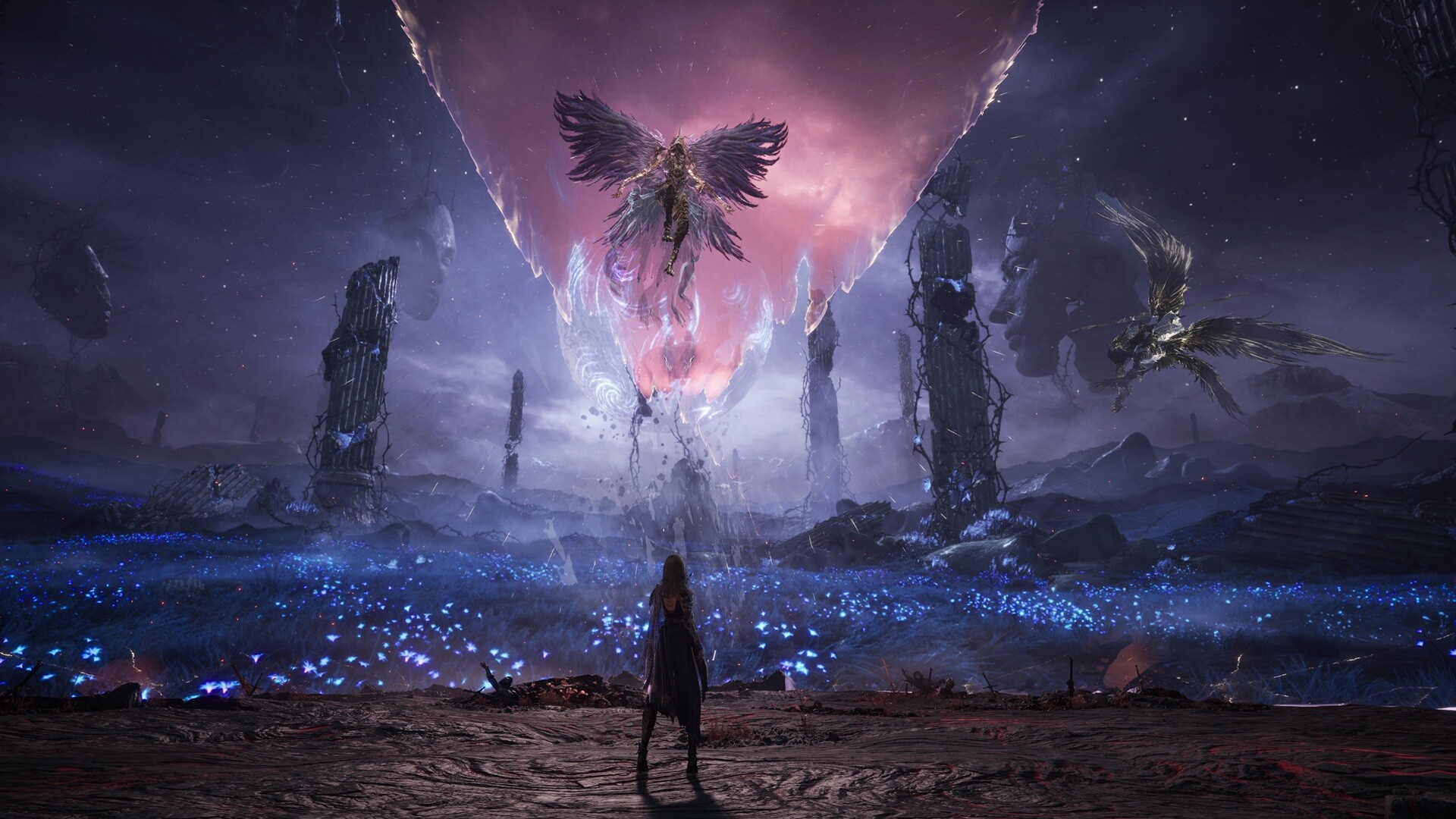
The link between Avalon and London is drawn through the Mirror Space Folded Realm. The Folded Realm is described by the developers as a recurring story element, a family of otherworldly pockets that fold mortal spaces onto mystical ones so that the two overlap. Mirror Space is the specific variant tied to reflections and shifting realities, where the environment splinters into multiple mirrored copies and combatants can be pulled from one copy to the next mid-fight. Avalon is presented as sitting on the far side of these folds, reachable only by stepping through a mirror or by being dragged across one by someone who already has the power to cross.
The reveal trailer uses this mechanic as its centerpiece. The boss encounter against Tyronoe takes place across a Mirror Space Folded Realm barrier that the sorceress raises, and Gwendolyn and the spectral knight Sir Lamorak must fight through shifting, reflected versions of the arena to reach her. The fight plays out as a dimension-shifting spectacle in which the ground, the sky, and the position of the enemy can all flip without warning. This is the clearest on-screen demonstration of what Avalon looks like when it leans on its own rules rather than borrowing the shape of London, and it frames the rest of the realm as a place where combat and traversal will repeatedly bend along these mirrored seams.
Folded Realms stopped being purely a marketing term in August 2026. Players who reached the collectible lore notes in the first playable demo found a glossary that defines them directly, alongside entries for the Fog, the Scarlet Thread, Scarlet Water and the Grail Shards. The Fog gets the most striking definition of the group: the notes call it a conscious being of material energy, which makes it a participant in the story rather than weather or a rendering effect. Since the spectral knights Gwendolyn summons are made of that same fog, the entry quietly reframes her own power as borrowed from something alive.
That demo did not take anyone to Avalon. The playable slice stayed in London, inside the Great Russell Museum, and no hands-on account from it reports stepping into a named Folded Realm. Everything the public has seen of Avalon still comes from trailers and official descriptions rather than from playable footage, so the realm remains the least directly evidenced part of the setting. The museum does show the game folding one space onto another during play, since the building itself becomes an Egyptian desert for the Mordred fight, but that is a transformation of a London interior rather than a crossing into Avalon.
Movement between the two worlds is not a casual walk. Travel across the divide is gated by who or what can open a fold in the first place, and the game treats each crossing as an event. Gwendolyn is positioned as one of the few mortals able to cross at all, a status tied to the power she awakens in the wake of the invasion. Her ability to summon spectral Knights of the Round Table is presented as part of the same pool of abilities that lets her move between London and Avalon, since the Knights themselves are echoes pulled across the veil when she calls them.
On the Avalon side, the demi-gods and their lieutenants can open folds on their own terms. Tyronoe is described as one of the few characters who can travel between the human world and the Mirror Folded Realm she creates, drawing on the magical energies of the mirror side to reshape battles in her favor. That ability is what allowed the invasion to reach London in the first place and what keeps the passage between the two realms open even after the initial breach. The practical effect during play is that Gwendolyn can be pulled into Avalon against her will during certain encounters, while later in the story she gains the agency to step across on her own, carrying her Spectral Knights with her.
Several named figures are tied to Avalon as residents, rulers, or architects of the forces that spill out of it. The three below are the ones confirmed in public material so far.
Tyronoe. A shape-shifting sorceress and one of Morgan le Fay's sisters, also called the Ferryman. She creates the Mirror Space Folded Realm barrier that Gwendolyn has to break through in the reveal trailer's boss fight, and she is associated with a region called the Whitelands whose destruction she is blamed for. Before her fall, she served as a court sorceress to the White King. Her fight is the most fully shown Avalon encounter to date.
Niniane. Drawn from the Lady of the Lake of Arthurian tradition, and the figure whose place in the story is least settled in public material. She is named alongside the demi-god sisters who hold court in Avalon. In the first playable demo, though, she is at Gwendolyn's side as a quiet red-haired girl who travels with her, and Mordred wants her badly enough to offer up a Grail Shard in trade for her. Whether she belongs to Avalon's court, has broken with it, or was never part of it has not been stated.
Mordred. The traitor of Arthurian legend, recast here as a woman and a demi-god, appears as a figure tied to Avalon, her fate woven into the realm's place in the story. She defends her standing as a Pendragon, commands spectral knights of her own, and in the demo she closes the museum level rather than waiting at the end of the game. Her presence underscores that Avalon is not simply the old mythic refuge: it has turned, and its court now includes the figures most responsible for the fall of Arthur's kingdom.
Sir Lamorak. Official material describes him as a former adversary of Gwendolyn's who now fights at her side in the otherworld beyond London, against an enemy dug into the Mirror Realm. He is the one named ally on the far side of the divide, which makes him the exception in a cast of Avalon figures who are otherwise obstacles. See Sir Lamorak for his combat role.
Other members of Morgan's circle are referenced collectively as the demi-gods of Avalon, a council of powerful sorceresses who share rule of the realm. Gwendolyn's broader campaign is framed around confronting this council in turn, with each sister presiding over her own stretch of Avalon and her own set of servants drawn from the Spectral Knights and the twisted remnants of Arthur's court.
The visual language of Avalon lands somewhere between Arthurian pastoral and surrealist nightmare. Footage shown so far leans into mirrored skies, floating architecture, and set pieces that reflect and refract themselves across the horizon. Combat arenas fold in on their own geometry. The ground tilts, palatial halls hang in empty air, and reflections of the player and the enemy march in step across distant planes. The developers have openly cited dimension-bending action scenes from films such as Inception and Dr. Strange as touchstones for the way Avalon's space behaves during fights.
Color and lighting are used to separate the realm from the fog-grey palette of London. Avalon's skies are typically washed in cool blues, deep teals, and pale golds, with pockets of warmer, more painterly light around the set pieces tied to individual sisters. Water recurs as a motif, echoing the classical image of Avalon as an island surrounded by lakes and sea, but the water here behaves unnaturally: pools stand vertical, rivers bend upward, and reflected versions of the environment sit below the surface as fully realized spaces in their own right. The overall effect is a realm that reads as beautiful at first glance and wrong on second glance, which is exactly the tone the story is after.
Architecturally, Avalon leans on Arthurian silhouettes: round towers, cathedral-like halls, and long colonnades drawn from romantic illustrations of Camelot and its sister courts. These are then broken, reassembled, and stretched through the Folded Realm's logic so that a hall might repeat three times in mirrored copies or a stair might lead back into the same chamber from the ceiling. The end result is a space that feels curated by its rulers. Each stretch of Avalon is decorated to match the sister who holds it, and each boss fight takes place in an arena built to show off her particular brand of magic.