

Combat and Gameplay
The Expanse: Osiris Reborn is a third-person action RPG built around three interlocking combat layers: cover-based shooting, skills and technology, and companion commands. The developers have cited Gears of War, Mass Effect, The Division, and Uncharted as direct influences on the combat design. Every encounter is meant to feel like a tactical puzzle where positioning, ability usage, and squad coordination all matter. The studio spent nearly a year prototyping the combat before committing to the final model, building and discarding six separate prototypes during pre-production.
Cover-Based Shooting and Time-to-Death
The foundation of combat is a cover system that lets players snap to walls, crates, barricades, and other objects scattered throughout the environment. Leaning out of cover to fire, blind-firing over obstacles, and vaulting between cover points are all standard actions. The system functions similarly to what you would expect from The Division or Gears of War, with the camera pulling in tighter when the player is behind cover and opening up when they move into the open.
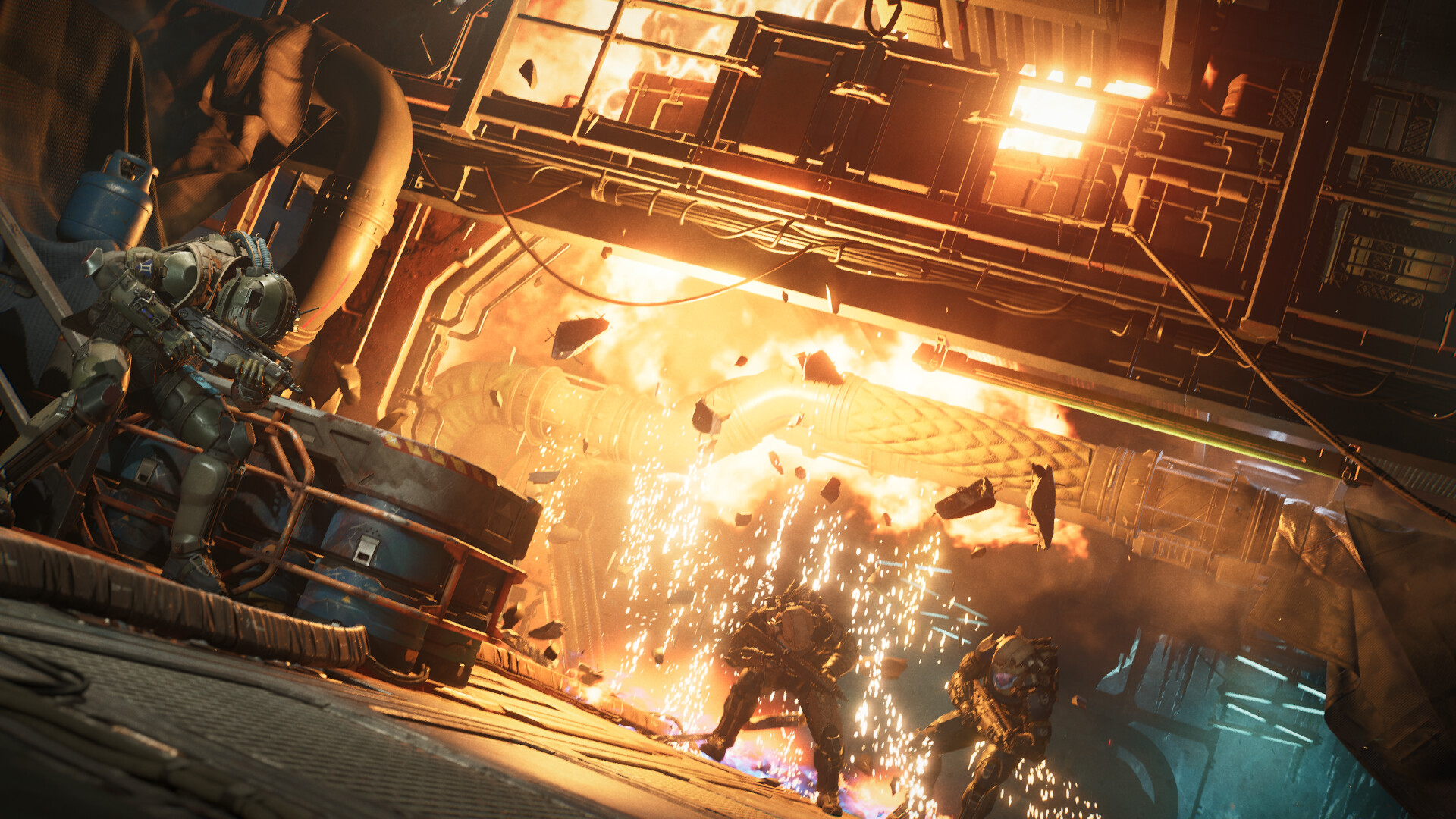
What sets Osiris Reborn's cover system apart is the time-to-death mechanic. Exposure outside of cover is lethal on a very short timer. The game is balanced so that standing in the open for more than a few seconds will kill the player on Normal difficulty or higher. Health regenerates when in cover, but this creates a tension: staying behind one piece of cover too long invites flanking, and flanking enemies will force the player out of safety. The push-and-pull between regeneration in cover and the constant threat of being outmaneuvered drives the combat rhythm.
Weapons
The game has a couple dozen weapons spread across several categories, including assault rifles, shotguns, pistols, sniper rifles, and heavy weapons. Each weapon has distinct fire rate, damage output, accuracy, and handling stats. Every weapon also has a secondary fire mode: an assault rifle might mount a grenade launcher, a pistol might switch to a charged shot, or a sniper rifle might have an armor-piercing toggle. Swapping between fire modes is instant during combat.
There are no melee-focused builds in the game. The Expanse setting dictates that close-quarters combat uses shotguns, defensive stances, and point-blank tech abilities rather than blades or fists. If enemies get too close, the player's options are a shotgun blast, a grenade at their feet, or a quick dodge to create distance. The developers wanted combat to feel grounded in the reality of a universe where people fight with guns, armor, and technology, not swords.
There are no silent takedowns either. The game does not feature stealth as a primary mechanic. While the player can sometimes approach encounters from a favorable angle or use the Tactical Visor to scout ahead, combat is the expected resolution for hostile encounters. This design choice keeps the pacing aggressive and prevents the game from turning into a stealth-action hybrid.
Confirmed Weapon Categories
The closed beta build confirmed the following weapon categories available to players. Each category handles differently in terms of range, recoil, and effectiveness in zero-gravity environments.
Category | Combat Role |
|---|---|
Shotguns | Close-range damage with wide spread; devastating in tight station corridors |
Assault Rifles | Versatile mid-range option; reliable in most combat situations |
Sniper Rifles | Long-range precision; ideal for open environments and picking off high-value targets |
Pistols | Lightweight sidearms; useful as backup weapons or for stealth-oriented approaches |
Submachine Guns | High rate of fire at close to mid range; effective for suppressing enemies behind cover |
In addition to standard firearms, vision modes and armor-piercing ammunition are confirmed as tactical resources that enhance the gunplay. Vision modes allow players to detect enemies through obstacles and in low-visibility conditions. Armor-piercing rounds provide an answer to heavily shielded enemies without requiring the player to switch to a heavier weapon class.
Skills and Technology
Beyond raw gunplay, players have access to a range of skills and tech devices that add tactical depth. These are not magic spells dressed up in sci-fi clothing. They are grounded in the technology of The Expanse universe, keeping things plausible even when the action gets intense.
Ability | Description |
|---|---|
Tactical Visor | Highlights enemies through walls, smoke, and cover for a limited time. When combined with armor-piercing (AP) ammo, the player can shoot through walls at highlighted targets. This synergy makes the Tactical Visor one of the most powerful abilities in the game for players who invest in it. |
Grenades with Thrusters | Throwable explosives equipped with small RCS thrusters. In zero-gravity, these grenades adjust trajectory mid-flight, curving around cover to reach hidden enemies. In standard gravity, the thrusters provide minor course correction. |
Protective Drones | Deployable drones that hover near the player and project an energy barrier or intercept incoming fire. Some companion builds specialize in drone usage. |
Energy Shields | Temporary defensive barriers placed on the ground as improvised cover or held as a personal shield while advancing. Absorb a set amount of damage before collapsing. |
Shoulder Cannon | A mounted weapon that fires independently of the player's main gun, auto-targeting enemies within a cone. This weapon is lootable mid-mission from certain locations or enemy types, not a permanent starting ability. |
These abilities are tied to the character progression system rather than a fixed class. Players choose which tech to invest in as they level up, and nothing stops a player from mixing shield abilities with shoulder cannons or combining drones with grenades.
Combat Opportunities and Companion Commands
The third layer of combat involves issuing orders to companions. Up to two companions accompany the player in the field at any time. Each companion has their own combat specialty, equipment, and abilities that the player can direct during fights. Ordering a companion to focus fire on a specific target, hold a position, or deploy their unique ability at a major moment can turn the tide of a difficult encounter.
Companion commands create what the developers call "combat opportunities." These are moments where companion abilities exploit structural weaknesses in the environment or enemy positioning. For example, J uses explosives to destroy sections of cover, exposing enemies who were hiding behind it. Ordering J to blow apart a barricade while lining up a shot on the enemies behind it is a basic combat opportunity. More advanced opportunities chain multiple companion abilities together with the player's own tech for devastating results.
Destructible Environments
Environments in Osiris Reborn are partially destructible. Cover can be broken by sustained fire or explosions, forcing players to constantly reposition. Panels fly off walls, ceilings collapse in targeted sections, and debris scatters across the floor. In zero-gravity sections, destruction takes on an extra dimension because loose debris floats freely and can obscure sightlines or create improvised cover. Explosive barrels and pressurized containers can be detonated to deal area damage. The Gamescom 2025 demo showed this system in action, with journalists noting how thoroughly an environment could be torn apart during an extended fight.
Skill Checks
Outside of combat, the game features skill checks during dialogue and exploration. Three skill categories govern these checks: Persuasion, Science, and Hacking. Each has multiple proficiency levels that the player invests in through the progression system. Skill checks are flat pass/fail based on proficiency level, not random dice rolls. If the player has enough points in Science, the check passes every time. If they do not, it fails every time. There is no RNG involved.
Failed skill checks do not block the main story. They close off specific dialogue options, bonus rewards, or optional paths through a scenario, but the player can always continue. This design ensures that no build is locked out of completing the game while still rewarding investment in non-combat skills.
Consumables and Crafting
Consumable items (med-kits, stims, grenades, and similar supplies) are designed to be used frequently rather than hoarded. The game economy provides enough consumables that players should not feel the need to save them for emergencies. The developers want every fight to feel like an opportunity to use the full toolkit.
A crafting system allows players to build weapons, armor, and gadgets from materials found through looting and purchased from vendors. The crafting system was described as "in progress" during the Gamescom 2025 demo, so the final scope and complexity are not fully confirmed. What is known is that materials come from two sources: looting them from environments and enemies during missions, and buying them from vendors at social hubs. The crafting system is intended to complement the loot and vendor economy, not replace it.
No Survival Mechanics
Despite being set in the hostile vacuum of space, Osiris Reborn is not a survival game. There are no oxygen meters, hunger bars, or temperature gauges to manage. The developers made this decision deliberately to keep the focus on combat, story, and exploration rather than resource management. When the player is in a vacuum environment, the danger comes from enemy fire and physics mishaps, not from slowly running out of air.
Fall Damage
Fall damage exists in gravity environments. Jumping or falling from heights in pressurized stations or planetary surfaces deals damage proportional to the distance. In zero-gravity sections, fall damage does not apply (since there is no "down"), but colliding with surfaces at high speed after a botched thrust maneuver can still hurt.
Difficulty Settings
Difficulty | Description |
|---|---|
Story | Enemy damage and health are significantly reduced. Intended for players who want to experience the narrative and setting without challenging combat. Companion AI is more aggressive and effective. |
Normal | The default experience. Enemies are dangerous enough to punish careless play, but skilled players will find a steady rhythm. Cover, abilities, and companion commands are all important. |
Hard | Enemies deal substantially more damage and have increased health. Positioning mistakes are often fatal. Players need to make full use of tech abilities, companion synergies, and environmental hazards to survive. |
Design Inspirations
The developers have been transparent about the games that influenced Osiris Reborn's combat and gameplay design. Each inspiration informed a specific aspect of the experience.
Inspiration | What It Influenced |
|---|---|
Mass Effect | Overall combat flow, squad commands, and the rhythm of moving between cover, issuing orders, and deploying abilities |
Dark Souls | Weapon discovery and build philosophy; finding a weapon in the world and building your entire playstyle around it |
Baldur's Gate 3 | Cinematic companion storytelling; companions with deep personal arcs that react to player choices |
Persona 5 | Vivid characterization; making each companion feel like a fully realized person with distinct personality |
Helldivers 2 | Loadout discovery feel; the satisfaction of experimenting with different gear combinations and finding synergies |
There are no traditional classes in the game. Players build custom playstyles through weapon discovery, ability combinations, and synergy-building with their companions. This classless approach means the game never forces players into a predetermined role. Early hours offer freedom to experiment, and over time the player naturally gravitates toward a build that suits their preferences.
Design Philosophy
Owlcat has described the overall design philosophy as wanting combat to feel like an action movie set in The Expanse universe. Every firefight should be kinetic, with the player constantly moving between cover, issuing companion orders, and deploying abilities. The combination of grounded, physics-based weapons and high-tech devices creates a push-and-pull where players need to balance aggression with caution. Rushing into the open without a plan will get you killed, but staying behind one piece of cover for too long means it will eventually get destroyed or you will get flanked.
Tactical Pause and Active Slow
The closed beta introduced a tactical pause bound to the F key on keyboard. Pressing it drops the encounter into a heavy slow-motion state rather than a full freeze, so time keeps ticking while the player lines up the next move. It is used to switch focus to a companion, queue orders, cycle through equipped gadgets, or aim at environmental targets the player wants to exploit. Everything the slow mode enables can also be executed at normal speed, so tactical pause is treated as an optional accessibility layer rather than a mandatory mechanic. Players who prefer a purely real-time run can ignore it, while players who want the CRPG feel of setting up exact timings can lean on it every fight.
The Engage Command
Engage is the core squad command. Pressing it on an enemy tells the nearest (or pause-selected) companion to focus that target, temporarily boosts their damage, and triggers their signature gadget, such as J's wrist-mounted multi-shot launcher. If the signature gadget is on cooldown, the companion fires their currently equipped second gadget instead. Engage itself has a cooldown between uses. Investing in the Leader skill tree reduces that cooldown, and heavy investment can lower it far enough that Engage becomes the spine of a commander-style playstyle built almost entirely around directing squadmates rather than shooting personally. Leader-tree nodes also raise companion damage and armor and grant a damage-reduction buff to companions while the command is active.
Destructible Cover
Every piece of cover in the beta can be shredded by sustained fire, grenade blasts, or environmental hazards. Walls, crates, barricades, pipes, and panels all break apart the longer they absorb hits, so static positioning is punished and the player has to rotate through the battlefield constantly. Enemies lean into this by throwing grenades specifically to flush campers and by chipping at cover with sustained automatic fire. Vantages also matter: characters on higher ground can shoot over low cover, and missiles aimed at a barricade can collapse it in one hit and leave the player exposed mid-fight. In vacuum sections the debris from a destroyed panel drifts in free-fall and can briefly mask sightlines, which companions and enemies both exploit.
Gadget-Driven Abilities
The four combat trees the captain invests in are Marksmanship, Gadgets, Survivalist, and Leader. Marksmanship covers weapon mastery and feeds critical damage, accuracy, and related modifiers; Gadgets raises ability damage and duration while cutting cooldowns; Survivalist handles health, armor, and armor regeneration, plus bonuses that reward fighting while exposed or in melee; Leader pushes companion weapon and ability damage, companion armor and damage reduction, and buffs the captain while crew are nearby. Which of them you lean on is a separate decision from which gadgets you equip, and the gear is what actually sets the playstyle.
Most of the player's active toolkit comes from equipped gadgets rather than a fixed class. Three gadget slots are available at any time, and each runs on its own cooldown, so rotation between them is the main offensive rhythm on the hacker-leaning builds. Each gadget can also be upgraded at a workbench to change its behavior, not just its numbers. The gremlin drone swarm, for example, can be specced into a Hunter mode that autonomously selects targets or a Bodyguard mode that prioritizes the biggest threat to the player.
Examples seen in the closed beta loadouts:
Tactical Scanner reveals enemies through cover and grants a bonus of roughly 30% damage against revealed targets. Low cooldown, so it is treated as a near-constant utility tool.
Pandemic Algorithm charges up and then releases an electric burst that stuns targets in place, especially strong against shielded enemies who try to close the distance.
Gremlin Drone Swarm deploys a lingering cloud of nanobots as a persistent damage zone, and a second press redirects the swarm to a new location so it can keep chasing enemies around cover.
Seeker Frag Grenade a self-propelled explosive with no traditional throwing arc that homes toward a marked target and detonates on impact, wired into the officer starting loadout.
Incendiary Rounds a timed ammunition buff that layers burn damage over standard gunfire, pairing naturally with the officer's more direct shooter playstyle.
Wrist-Mounted Launcher a small missile mounted to the armor that delivers a homing high-damage hit and cleanly punches through most armored targets. J uses an upgraded multi-target version as their signature gadget.
Shield, Health, and Repair Foam
Survival in combat is layered. Armor is the outer buffer that absorbs incoming hits before they start chewing into the health bar, and both pools can be topped off quickly with repair foam at the press of a single button. Repair foam restores armor and health together rather than forcing the player to juggle two separate heals, which keeps the flow of a firefight forward-moving. Armor totals are driven by equipped subsystems, and Survivalist-tree investment raises raw armor, regen speed, health, and the damage bonus that kicks in once armor hits zero.
Weapon Slots and Categories
Loadouts use two slots: one rifle-sized primary and one short hip sidearm. Weapons split across five categories: handguns, submachine guns, shotguns, assault rifles, and sniper rifles. Wrist-mounted launchers sit alongside the main weapon system as gadget-class armaments. There are no gear tiers or rarities. Every weapon is unique and can be pushed through three grades of upgrades at a workbench, so a starting rifle that feels good in the first fight can be carried the entire game. See weapons and equipment for the full category breakdown and upgrade perk list.
Weapons observed in the closed beta build include:
Weapon | Category | Notes |
|---|---|---|
Kovac M42 | Assault Rifle | Default primary for the Earther officer preset. Reliable mid-range option. |
Weber E7 | Handgun | Default sidearm for the officer preset. Pairs with any rifle-sized primary. |
Rattler SMG | Submachine Gun | J / Jay's starting weapon (see J). High rate of fire, close to mid range. |
Armal Luna | Submachine Gun | Looted in the beta. Takes the primary slot, which blocks pairing with another rifle-sized weapon. |
Archer M1 | Sniper Rifle | Long-range precision weapon. Strips enemy shields quickly. |
Undertaker | Assault Rifle | Late-beta find. Nearly double the starting rifle's damage at a slower fire rate. |
Any weapon in the player's inventory can be handed to a companion. Damage does not scale down in their hands: a companion with equal points invested in the Shooter tree deals the same damage per shot as the player with the same gun.
Skill Checks in Combat and Exploration
Skill checks are woven into both firefights and exploration rather than being confined to dialogue. Each check resolves against a combined score: the player's rank plus the ranks of any companions brought along for that mission. Focus-drug consumables raise a single non-combat skill by one point for the duration, which is enough to push marginal checks into success.
Skill Check | How It Plays Out in the Beta |
|---|---|
Engineering | Opens broken terminals and lets the player trace conduit lines behind walls. In one beta path it clears a debris-choked section in a vacuum corridor that hides a unique subsystem and a new gadget. |
Athletics | Shoves heavy obstacles out of the path to reveal side rooms and extra loot. Movement speed and melee hits also scale off the Athletics score. |
Perception | Triggers a gaze-reticle mini-check: a reticle appears on a point of interest and fills while the player holds their view on it, interrupting if they look away or step outside a radius. Used to uncover hidden context around story events and spot details companions flag. See choices and consequences for how these payoffs feed back into the story. |
Cyber Sabotage | Opens locked doors and terminals via a timed number-alignment mini-game. The player pairs columns of numbers from left to right under a 15-second timer. Success grants XP, new subsystem blueprints, and sometimes access to sealed rooms or armories. |
Perception (Passive Memory) | Door codes found on data pads stay pinned to the HUD automatically once seen. A code like 9009 discovered in a bunk room carries over when the player reaches the keypad, so there is no menu digging. |
Companion Integration in Combat
Companions are tied into the moment-to-moment fight at several layers beyond the Engage command. The player can hand off any weapon to a squadmate without a damage penalty, and a companion's non-signature gadget slot can be freely swapped around, so the player can, for instance, strip the frag grenade from their own loadout and plug it into J's free slot. Each companion also brings environmental exploits that the player can cue up through the tactical pause. For the mechanics of those exploits, see the exploit system. Companions join mid-mission conversations dynamically too: while exploring, J will sometimes break off to chat with an NPC the player walks past, and incomplete skill checks may still succeed if a companion's stacked score clears the threshold.
The beta gave the clearest look at two companions in action. J (Jay) fights at the player's side as the twin, and Zafar supports from a distance by piloting the Gemini, firing the ship's point-defense cannons into the station during one set-piece battle to shred cover and enemy formations.
Enemy Types in the Closed Beta
Standard riflemen of Protogen fire teams. They hold cover by default but rotate out aggressively when flanked, and they throw grenades to flush campers.
Shielded chargers. Use body shields to close the distance to the player. Shooting their legs bypasses the shield, and the Pandemic Algorithm stuns them through it, which is often the cleanest opener.
Mini-boss heavies. Armored and far more durable than standard troopers. They field a small support drone that heals them back up mid-fight, so the drone has to be destroyed before the player can push through the health bar.
Flanking mercenaries. Groups that break formation to circle the player. Staying in one piece of cover for long invites being looped around; the combination of flankers, grenades, and destructible cover is what keeps the beta from feeling like a lane shooter.
Beta Difficulty Options
The closed beta exposes two difficulty options: Normal and Hard. Normal is tuned so that careless exposure is lethal within a few seconds but skilled play is comfortable. Hard multiplies enemy damage and health pools to the point where positioning mistakes almost always end the run, and players need to lean on tactical pause, companion exploits, and environmental hazards rather than raw reflexes. The full game's difficulty spread is expected to be wider, but those are the only two settings enabled during the closed beta build. Character build decisions also feed into effective difficulty: see character creation and progression for the full skill-tree rundown, and zero-gravity mechanics for how combat shifts once the player steps outside the station.
Player character background also shapes the opening difficulty curve. The Earther preset's Athletics bonus makes it easier to clear obstacle checks and survive melee exchanges, while the Belter preset's Engineering bonus opens more shortcuts and bonus loot during firefights. Both backgrounds can be played through Normal or Hard on any of the four beta presets (Belter Officer, Belter Hacker, Earther Officer, Earther Hacker), and Pinkwater Security mercenary framing stays consistent regardless of which one is chosen.
Post-Beta Adjustments
Owlcat's May 2026 beta wrap-up flagged two combat-side reworks based on player feedback. Both changes are scoped at quality-of-life polish rather than systemic redesign, and the studio said the overall combat loop, cover-shooting logic, and weapon roster do not change.
Area | Planned Change |
|---|---|
Cover system | Cover interactions being adjusted to feel easier and more intuitive when snapping into and out of low and high cover, and when transitioning between cover pieces. |
Combat audio | Repetitive battle barks attributed to J are being addressed via the broader rework of the ask system, with the goal of more situational and reactive chatter rather than fixed-cooldown lines. |
Owlcat also confirmed that the broader beta numbers (more than 60 million bullets fired, approximately 2.8 million headshots, more than 380,000 enemy bodies left in space across roughly 2.5 years of aggregate playtime) reflect the existing combat build rather than the post-rework state.