

Overview
Weapons and equipment in The Expanse: Osiris Reborn form the backbone of how players define their playstyle. The game does not use a traditional class system. Instead, your character build emerges organically from the weapons, gadgets, and abilities you choose to invest in over the course of the campaign. Creative Director Alexander Mishulin has compared this approach to Soulslike games, where discovering a weapon during gameplay and then strengthening your playstyle around it is the core loop. You are never locked out of using any particular piece of gear. Early in the game you have freedom to experiment with different styles, perhaps trying the role of a sniper one mission and a hacker or engineer the next. Over time, however, you will be called to make definitive choices about which weapons and gadgets to specialize in.
The developers have confirmed that the game has a couple dozen weapons or more, each with varying parameters including damage output, accuracy, and recoil behavior. Weapons also behave differently in zero-gravity environments, where firearm ballistics and recoil work differently than they do on solid ground. This gives every weapon a second dimension of performance that players need to account for during spacewalk encounters.
Combat Approaches
The announcement trailer and Gamescom 2025 gameplay showcased three distinct combat approaches. One approach centers on traditional firearms, using cover-based tactics to engage enemies directly. A second approach leans on drone-based support, allowing the player to direct a gun drone from a distance while staying out of the line of fire. The third approach uses a ballistic shield paired with a shoulder-mounted weapon, turning the player into a mobile fortress capable of pushing forward through enemy positions. That shield loadout also includes some form of jetpack propulsion that converts the shield into a battering ram for close-quarters breaches.
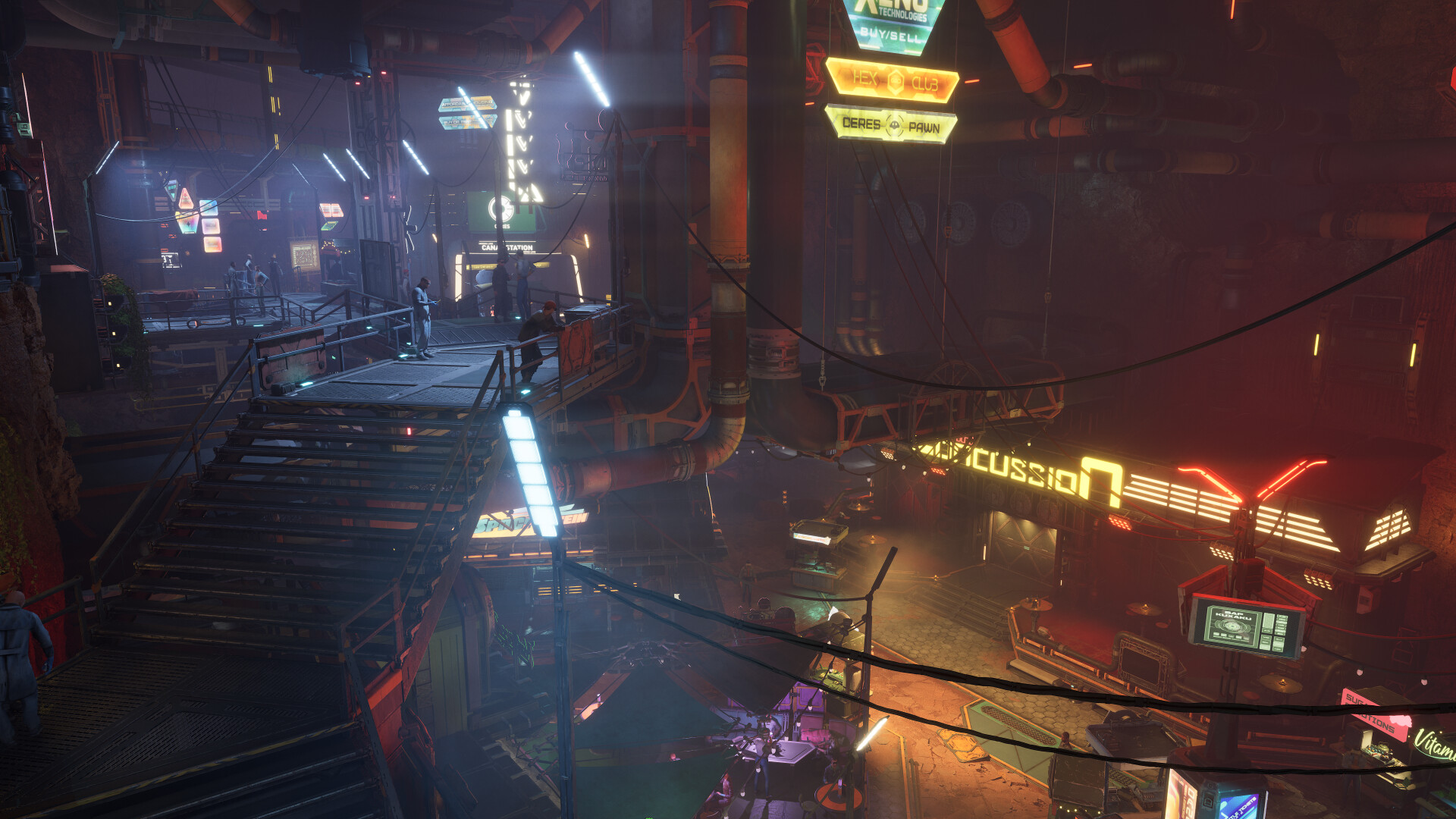
These approaches are not hard-wired classes. They represent starting points that you can mix, match, and evolve as you find new gear and unlock new skills. The combat system is built around three layers: cover-based firefights as the foundation, a second layer of skills and technological tools (gadgets), and a third layer of team tactics where companions provide combat opportunities by exploiting environmental weaknesses.
Confirmed Weapon Categories
The closed beta build confirmed five primary weapon categories. Each category has distinct handling characteristics that change depending on whether the player is fighting in a gravity environment or in zero-gravity conditions.
Category | Range | Combat Role |
|---|---|---|
Shotguns | Close | High burst damage at short range; effective in tight station corridors and breaching scenarios |
Assault Rifles | Medium | Versatile all-purpose weapons; reliable in most combat situations with balanced recoil and damage |
Sniper Rifles | Long | Precision weapons for picking off targets from distance; slower fire rate compensated by high per-shot damage |
Pistols | Short-Medium | Lightweight sidearms; useful as backup weapons or for stealth-oriented approaches |
Submachine Guns | Close-Medium | High rate of fire; effective for suppressing enemies behind cover and close-quarters engagements |
Known Gadgets and Tools
Gadgets provide the tactical variety that separates a straightforward shooter from a flexible action RPG. The following gadgets and tools have been confirmed through official sources, developer interviews, and gameplay demonstrations.
Gadget / Tool | Description |
|---|---|
Tactical Visor | A visor that highlights enemies through smoke and cover, giving the wearer a tactical awareness advantage in low-visibility situations. |
Protective Drone | A deployable combat drone that can provide covering fire or draw enemy attention. One of the three demonstrated combat approaches revolves around drone-based support. |
Ballistic Shield | A handheld energy or physical shield used in a defensive combat style. Can be combined with a shoulder-mounted weapon for simultaneous attack and defense. |
Shoulder Cannon | A powerful shoulder-mounted weapon paired with the ballistic shield loadout. Allows the player to fire while maintaining shield coverage. |
Grenades | Throwable explosives confirmed as part of the combat toolkit. In the Expanse universe, grenades can be fitted with thrusters for use in zero-gravity environments. |
Jetpack / Ram Module | Propulsion system attached to the shield loadout that converts the ballistic shield into a battering ram for aggressive forward pushes. |
Weapons and Parameters
Each weapon in the game has a distinct stat profile. The confirmed parameters that differentiate weapons from one another are damage, accuracy, and recoil. Beyond raw stats, weapons define your build identity in a way the developers compare to how weapons work in Dark Souls or Elden Ring: you find a weapon, you invest in it, and your entire approach to combat shifts around it.
Weapon types shown in trailers and gameplay include conventional firearms (rifles, pistols, shotguns), heavy weapons, and specialized tech-based armaments. The developer has not published a full weapon list, but the Gamescom demo showed the player switching between different weapon types mid-combat to adapt to changing encounter conditions.
Vision Modes and Armor-Piercing Ammunition
Two tactical resources were confirmed in the March 2026 reveal that enhance the core gunplay experience.
Vision modes allow the player to detect enemies through walls, smoke, and other visual obstructions. When activated, vision modes highlight enemy silhouettes and can reveal hidden threats before the player commits to engaging. This is particularly valuable in the game's darker environments, such as the interior corridors of abandoned stations and zero-gravity debris fields.
Armor-piercing ammunition provides an answer to heavily armored enemies and shielded targets. Rather than requiring players to switch to a heavier weapon class, armor-piercing rounds can be loaded into existing weapons as a tactical option. Managing your supply of AP rounds adds a resource management layer to combat encounters, especially on harder difficulty settings where armored enemies appear more frequently.
Armor and Protection
Armor is part of the broader equipment system that players invest in throughout the game. While the developers have not broken down individual armor sets in detail, the crafting and upgrade system (described below) applies to armor alongside weapons and gadgets. The Gamescom demo showed characters wearing varied armor configurations ranging from light tactical suits to heavier plated gear, suggesting that armor choice interacts with playstyle. Characters in the announcement trailer wore distinct armor styles that matched their combat approach, with the shield-bearer in heavier plating and the drone operator in a lighter, more mobile kit.
Crafting and Upgrades
The game includes a crafting system that uses materials gathered from vendors and looting to upgrade weapons, armor, and gadgets. During the Gamescom Q&A, the developers confirmed that crafting materials can be obtained both from purchasing at shops in social hubs like Ceres and Pinkwater Station, and from looting during missions. The crafting system was described as still in active development during that interview, but its core function is to let players strengthen the weapons and equipment that define their build.
The Pinkwater Station demo demonstrated how player choices affect equipment access. If the player asks civilians to surrender during the Protogen attack, the station armory remains stocked and the player can obtain supplies from it. If instead the player encourages resistance, groups of civilians are killed and the armory may be depleted. This is one example of how the choices and consequences system intersects directly with equipment availability.
Equipment in Zero Gravity
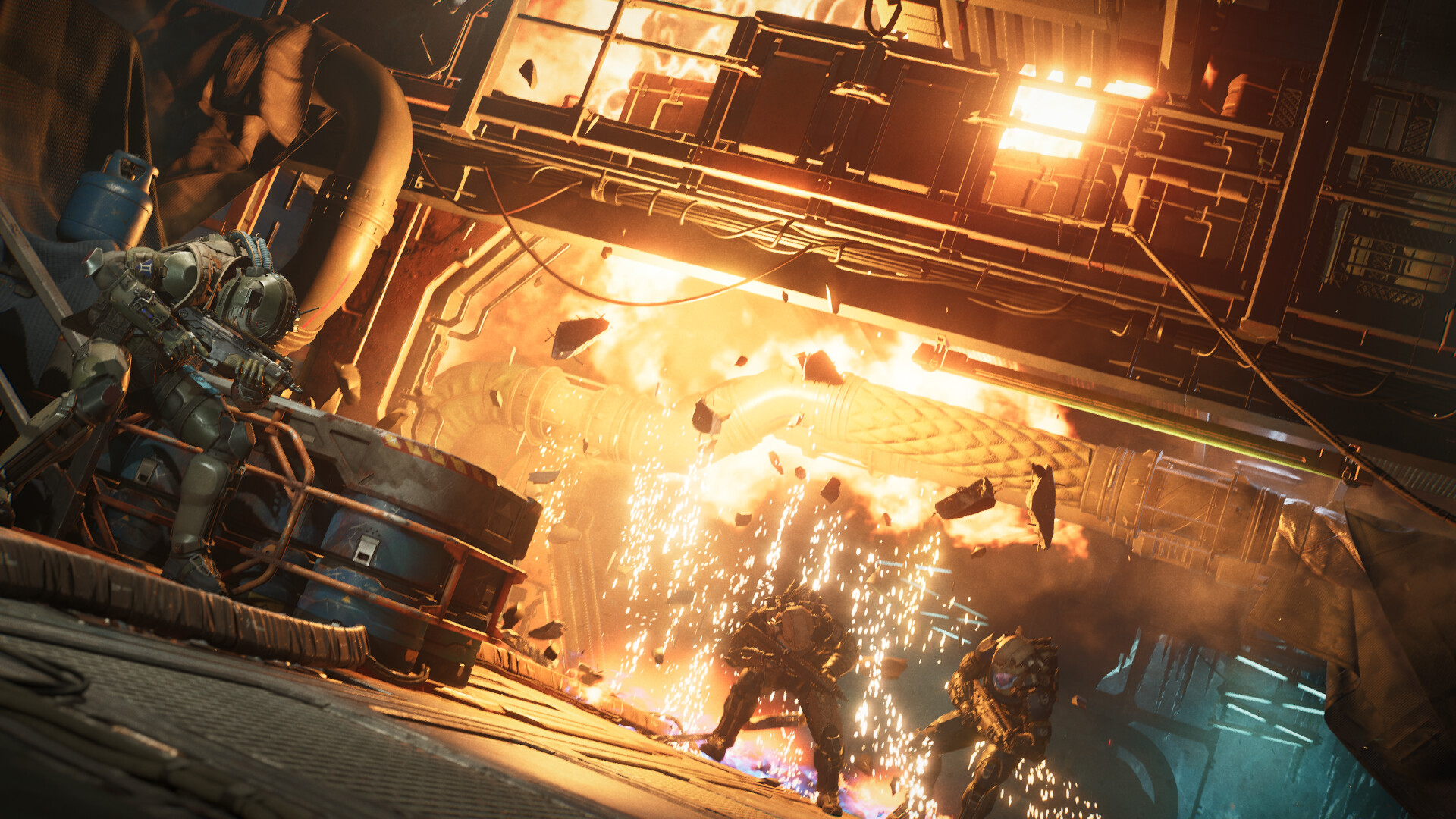
Equipment behavior changes during zero-gravity sections. Magnetic boots keep the player anchored to surfaces, but weapons experience altered recoil physics, grenades behave differently without gravity pulling them downward, and drones operate in fully three-dimensional space. The developers worked with former NASA astronaut and ISS commander Leroy Chiao to ensure that equipment interactions in vacuum and zero-G felt grounded in real physics while remaining fun to play with.
Skill Checks and Equipment
Some equipment and gadgets interact with the game's skill check system. Failed skill checks do not block story missions, but they may deny access to optional areas, bonus loot, or alternate approaches to encounters. This means that investing in certain equipment-related skills can open up routes and rewards that a purely combat-focused build might miss.
Named Pre-Order Weapons and Armor
Several named weapons and armor pieces are available as pre-order bonuses. These items are cosmetic variants with unique visual designs but follow standard item parameters for their respective categories.
Item | Type | Edition |
|---|---|---|
Miller's Revolver | Pistol (sidearm) | Miller's Pack ($79.99) and Collector's Edition ($289.00) |
UN Spec Ops Assault Rifle | Assault Rifle | Deluxe Pack ($59.99) and above |
Miller's OPA Heavy Armor | Armor set | Deluxe Pack ($59.99) and above |
Miller's Revolver is themed after Detective Joe Miller's signature weapon from the TV series. The UN Spec Ops Assault Rifle carries a United Nations military skin. Miller's OPA Heavy Armor has an Outer Planets Alliance design. All three items are available from the start of the game for players who purchase the corresponding editions.
Tips
Experiment freely in the early hours before committing to a specialization. The game gives you room to try different weapon types before asking you to invest deeply.
Pay attention to how weapons handle in zero-G. A weapon that feels comfortable on a station deck might behave very differently during a hull-walk encounter.
Companion combat opportunities can compensate for gaps in your personal loadout. If you specialize in ranged combat, bring companions who can handle close-quarters threats.
Check vendor inventories at social hubs between missions. Crafting materials purchased from shops supplement what you loot during operations.
Loadout Slots
The closed beta confirmed the exact number of equipment slots available to the player and to each companion. The player carries two weapons (one rifle-sized primary and one short hip sidearm), three gadgets, and four subsystems. Each companion equips one weapon, two gadgets (one signature gadget that cannot be removed, plus one freely swappable slot), and three subsystems (one signature plus two swappable). Because signature gadgets and signature subsystems can never be taken off a companion, upgrading those first is the most efficient way to invest in whichever companions you plan to bring into fights.
There is also a decorative armor and helmet slot that changes how your character looks without affecting stats. All actual defensive numbers flow from the subsystems you slot in.
Category | Player | Companion |
|---|---|---|
Weapons | 2 slots (1 primary rifle-sized, 1 short hip sidearm) | 1 slot |
Gadgets | 3 slots | 2 slots (1 signature + 1 swappable) |
Subsystems | 4 slots | 3 slots (1 signature + 2 swappable) |
Cosmetic | Decorative helmet and armor appearance slot (no stat effect) | Gear appearance tied to equipped items |
Five Confirmed Weapon Categories
The developer overview explicitly names five weapon categories in the game, each suited to different ranges and situations. The categories shown through the closed beta include handgun, submachine gun, shotgun, assault rifle, and sniper rifle. Wrist-mounted launchers also exist in the game but are treated as gadget-class weapons that slot into your gadget bar rather than eating a weapon slot.
The studio is firm that no weapon is labeled as a main gun or a sidearm in terms of effectiveness. Every weapon can be viable in combat, and the choice of what to carry in the rifle-sized slot versus the hip slot is a loadout decision rather than a tier ranking.
Known Weapons From the Beta
The following named weapons were confirmed during the Pinkwater Four Station mission. Some are preset starting weapons tied to character creation choices, and others are found in the environment or purchased during exploration.
Weapon | Category | Notes |
|---|---|---|
Kovac M42 | Assault rifle | Officer preset starting weapon. Reliable medium-range rifle, paired on the primary slot. |
Weber E7 | Handgun | Officer preset starting sidearm. Occupies the short hip slot. |
Rattler | SMG | Starting weapon carried by J. Close-range automatic with a high rate of fire. |
Armal Luna | SMG | Found in the beta. Takes up the primary rifle-sized slot rather than the sidearm slot, so equipping it means giving up your rifle. |
Archer M1 | Sniper rifle | Found in the beta. Extremely effective against shielded targets, tearing through shields quickly. |
Undertaker | Assault rifle | Found in the beta. Deals roughly double the damage of the starting rifle at the cost of a slower fire rate. |
One flavor note on early-game weaponry: certain starter weapons fire plastic bullets, which deal roughly 20 percent less damage than standard rounds. The game telegraphs this in the weapon stats so that finding a proper rifle or pistol with real ammunition feels like a meaningful pickup rather than an incremental swap.
No Gear Tiers or Rarities
The game explicitly avoids a common, uncommon, rare, legendary ladder. Every weapon, gadget, and subsystem is unique, and any piece of gear you find can be fully upgraded over the course of the full game. The practical effect is that gear never becomes obsolete. If you find a starter weapon you enjoy early on and sink upgrade materials into it, that weapon can remain viable throughout the campaign rather than being forced out by a higher-tier drop.
Crafting Materials
Materials for upgrading and crafting are scattered throughout the environment and can also be bought from station vendors. The closed beta surfaced several named materials, with aluminium alloy explicitly called out as the currency for weapon upgrades. Additional materials such as fabric, wire, and spare parts are found tucked into lockers, desks, and loot crates around any given level.
Aluminium Alloy: primary upgrade material used at the workbench to advance weapons through their grades.
Fabric: generic crafting resource looted from containers and worn gear.
Wire: electronics material used in subsystem fabrication and tech upgrades.
Spare Parts: general mechanical components pulled from stations and machinery.
Social and exploration skills interact with the economy. Investing in engineering, for instance, increases the yield you get when scavenging low-level crafting materials, and cyber sabotage checks can pull subsystem recipes off locked terminals.
Weapon Upgrade System
Upgrades are laid out in tiers. At each tier you make an exclusive choice between two or three upgrade paths, pushing the item toward one playstyle at the cost of the others, until you reach the final tier where a single powerful perk finishes the build. Most nodes are ordinary stat work: more damage, a wider blast radius, a shorter cooldown. Some are triggered effects instead, such as a damage bonus that stacks with every kill. A small number of rarer upgrades unlock an entirely new ability on the gear rather than tuning an existing one.
How far any single item can be pushed depends on its quality. Quality cannot be upgraded directly. If you want more upgrade depth than an item allows, you have to find a higher-quality variation of that same weapon or gadget, which reopens tiers the original could not reach.
Resetting an Item's Upgrades
Investment is not permanent. If you have poured a dozen encounters' worth of materials into a rifle and then find something better, you can reset that rifle's upgrades and rebuild around the new weapon instead. The default cost of doing so is the invested resources themselves, which are lost on reset. A limited consumable recovers them, so the number of free-of-charge pivots you get across a playthrough is capped by how many of those you have found.
Worked Example: The Kovach M46
The Kovach M46 rifle is the developer's own illustration of how far a couple of tiers can move a weapon. Upgraded, it carries a bigger magazine, lands harder headshots, fires five-round bursts instead of three, and gains a scope that reaches ranges the base version could not cover. The weapon's identity does not change, but its effective role shifts from mid-range utility to precision work.
Weapons upgrade through three grades at a workbench. Each grade requires crafting materials and presents a small branching choice: instead of every upgrade simply boosting the same stat, each tier offers a set of perks and you pick one path to specialize that weapon. Picking a particular perk at one tier does not lock you out of the alternatives at later tiers. You are specializing within that weapon, not gating the entire tree.
Perk Branch | Effect |
|---|---|
Accuracy | General accuracy improvement across all firing stances. |
Hip-Fire Accuracy | Improves accuracy while firing from the hip without aiming down sights. |
In-Cover Accuracy | Sharpens shots fired from behind cover, useful because all cover in the game is destructible. |
Magazine Size | Increases the number of rounds per clip, trimming reload downtime in extended fights. |
Crit Damage | Raises the multiplier on critical hits, rewarding precise aim for headshots and weak-point targeting. |
Reload Speed | Cuts time spent reloading so the weapon spends more of the fight actually firing. |
Damage to Destructible Objects | Scales damage dealt to breakable cover and environmental pieces, making cover-shredding strategies viable. |
The practical read on this is that two players running the same rifle can build it in very different directions. A stealth-leaning build might prioritize in-cover accuracy and crit damage, while a breach-and-clear loadout could lean into magazine size and damage to destructible objects.
Gadget Upgrades That Change Behavior
Even the plainest gadget is on the same upgrade ladder. A basic frag grenade can be taken from a simple blast-radius increase all the way to a version that emits three extra projectiles, each of which detonates for additional damage when you shoot it. That turns a throwaway consumable into a setup tool that rewards follow-up fire.
Gadget upgrades are not purely numerical. Some branches change how a gadget actually functions. The gremlin drone swarm is the clearest example from the beta: its upgrade tree can convert the swarm into a Hunter mode where the drones autonomously chase the nearest enemy, or into a Bodyguard mode where they target whichever enemy poses the biggest threat to the player. The base gadget is a persistent damage-over-time field, but the upgrade choice turns it into a very different tool depending on your tactical preference.
Other gadgets have their own quirks. Ammo-type gadgets such as incendiary rounds and electric rounds (from the pandemic algorithm) grant one magazine of specialized ammunition when activated. Holding down the gadget button lets the character eject that clip early if unspent, which shortens the cooldown at the cost of the remaining rounds. The tactical scanner highlights enemies and boosts damage against revealed targets by 30 percent while active, and an accuracy perk for the scanner can further sharpen your aim during the ability window.
Gadget Slot Categories
The beta UI labels the three gadget slots by body location: a shoulder gadget, a program gadget, and a helmet gadget. Each slot accepts only gadgets of the matching category, which steers loadout choices rather than letting the player stack three copies of the same gadget family.
Shoulder: physical devices mounted on the suit, such as wrist-launcher accessories and deployable tools.
Program: software-based gadgets that trigger effects like the pandemic algorithm or tactical scanner.
Helmet: visor and sensor-integrated gadgets that feed information or targeting data.
Subsystems
Subsystems are the passive slot of the loadout. Rather than activating abilities, they grant continuous modifiers to armor, reload speed, ability damage, ability cooldowns, ammo economy, and similar values. Subsystems come in types that include Mechanical and Digital. Each subsystem slot accepts only subsystems of a matching type, so the subsystem loadout is a balance between what the slots accept and what stats you want to push.
Subsystems can be upgraded through their own pseudo skill trees, similar in shape to the weapon upgrade trees but with their own stat choices. The workbench also has a fabrication tab: if you find a blueprint while exploring or while clearing a cyber sabotage check on a locked terminal, you can spend materials to craft that subsystem on demand.
One specific example from the beta is the Tactical Overdrive armor subsystem. Its blueprint is hidden behind a hacking check in the closed beta build. Once fabricated, Tactical Overdrive reduces the player's maximum ammo capacity but significantly increases ability damage, making it an aggressive pick for builds that rely on gadget damage to close fights.
Companion Gear Sharing
Weapons and gadgets can be shared between the player and J (or any other companion, once they are available). Handing J your frag grenade, for example, lets the companion throw frags when commanded rather than relying only on the signature multi-shot wrist launcher. Companion damage is not nerfed compared to player damage. If the companion has equal investment in the shooter tree, they deal the same damage per shot that the player would with the same weapon.
During ship support sequences, Zafar can call in the Gemini's point-defense cannons as a ship-level exploit that rains fire on a section of the station. This counts as an environmental interaction inside the exploit system rather than a gadget slot, so it does not eat a weapon or gadget slot on the player.
Manual Looting
Looting in this game is explicitly manual. There is no auto-pickup as you walk through a room, and nothing is scooped up from enemy corpses automatically. You have to walk up to each fallen enemy or container and interact with it to retrieve gear, ammunition, or crafting materials. This deliberate choice slows combat pacing between engagements and rewards players who sweep every room instead of rushing to the next objective.
Equipment Progression Philosophy
Everything above points to a single design intent: equipment defines your build identity without locking you into a class. The game ships with no rigid classes, so what separates an officer from a hacker is the starting set of gadgets and skill points, not a permanent label. Over time the player is expected to specialize, but the tools of specialization are the weapons, gadgets, and subsystems that you upgrade, not a class checkbox. Because every weapon can be fully upgraded and none are rarer than any other, the game encourages committing to the gear you actually enjoy using in combat rather than chasing higher-tier drops.