
Overview
The Blood of Dawnwalker uses three distinct skill trees that reflect Coen's dual nature as a Dawnwalker: Swordmastery for weapon arts, Witchcraft for ritual magic, and Vampirism for the night-form powers. Generic perks such as stamina, health and carry weight sit across all three rather than belonging to any single tree. Earlier pre-release materials described the same split in looser terms as human, vampire and shared abilities; the three named trees above are how the playable build presents it.
Experience and Skill Points
All three trees draw on a single pool. Coen earns one kind of experience, fills one bar, and receives one kind of skill point, which can be spent across any of the three trees in whatever proportion the player likes. Nothing is ring-fenced to a discipline, so a run can be almost entirely swordplay, almost entirely magic, almost entirely vampiric, or any blend of the three.
Experience comes from defeating enemies and powerful creatures, completing quests and objectives, discovering hidden locations and secrets, and overcoming special encounters and bosses.
Unlocking or improving an ability costs skill points and time together. The developers frame the time cost in fiction as study, or as letting the curse deepen, and the game shows the cost before the player commits, so every build decision is also a decision about the thirty day clock. Most perks cost between one and three segments to learn.
Individual perks carry a timing label of Daytime, Nighttime or Anytime, marking the phase in which their effect applies. A perk bought for the wrong half of the cycle is dead weight until that phase comes round.
Swordmastery and Witchcraft (Day)
Coen's human combat is grounded in medieval fighting styles. Rebel Wolves noted that "we studied medieval fighting styles and even have a few trained swordsmen on the team." The directional combat system is at the heart of daytime fighting, allowing players to choose the direction of each swing to target gaps in an enemy's defense.
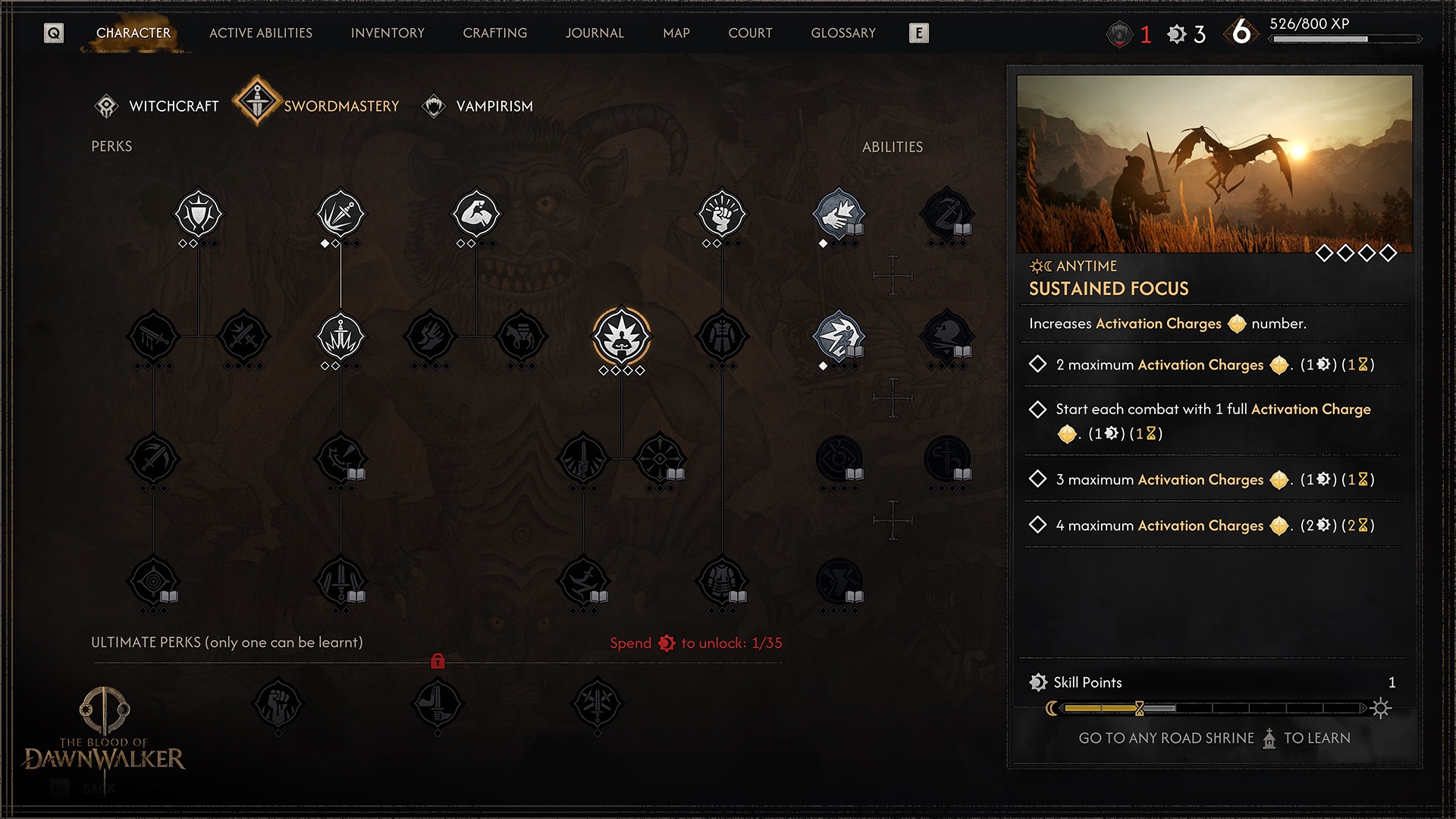
The human tree also includes access to Rune Carving and Hex magic. The shipped Witchcraft tree carries ten active abilities. Four are taught by Anca towards the end of the prologue, and the other six are gated behind manuals found or bought out in the world. No first-party roster has been published. The table below follows launch-week guide coverage, and databases compiled from the game's own text list the same ten names.
Witchcraft Ability | How It Unlocks | Effect |
|---|---|---|
Compel Soul | Taught by Anca in the prologue | Questions the dead. The investigative hex that several quests are built around |
Astral Communion | Taught by Anca in the prologue | Activates dormant magic at places of power. Each exorcised place permanently improves Witchcraft ability damage. |
Burning Blood | Taught by Anca in the prologue | Deals damage over time to a target |
Mercurial Fervour | Taught by Anca in the prologue | Grants haste in exploration by briefly slowing the world around Coen |
Ravenous Flock | Manual | Area attack that stuns a target with a flock of crows |
Cycle of Ruin | Manual | Extends the duration of active Witchcraft abilities with each landed attack, block and Perfect Block |
Soul Reaping | Manual | Drains a target over time and keeps it at a distance |
Unholy Vitality | Manual | Regenerates health after using abilities |
Soul Stigma | Manual | Raises critical chance and critical damage against the target |
Life Lock | Manual | Blocks damage and reflects it back at the attacker. Unlocked automatically during the Manumit quest Who Pulls the Strings; manuals raise its rank |
Swordmastery ships a closed roster of seven abilities. Dirty Trick is unlocked from the start; the rest arrive through quests, chests in bandit and soldier camps, or purchases from Swordmastery trainers, and duplicate manuals raise an ability past its first rank.
Swordmastery Ability | Effect |
|---|---|
Dirty Trick | Stuns and damages a target and leaves it vulnerable to active abilities. Unlocked from the start |
Charge | Deals damage and stuns the target and everyone in the way |
Broad Swing | Swings the sword in two circular arcs, damaging every enemy in the area of effect |
Swiftness | Boosts attack speed after a Perfect Block |
Adrenaline Rush | Increases attack damage after using active abilities |
Artery Strike | Critical strike with a chance of decapitating the target |
Walking Fortress | Perfect Block restores a portion of Activation Charge |
Two ability names carried on this wiki from pre-launch material need qualifying against these rosters. Acrid Dust was the dust-throwing stun shown in the June 2025 gameplay reveal. It is a Swordmastery technique rather than a hex, and guides to the shipped game list that stun as Dirty Trick, the first entry in the Swordmastery table above, so Acrid Dust is best read as its earlier name. Feral Mind is named directly as a spell in the publisher's own community bulletin question-and-answer and was shown in the same June 2025 deep dive, so the name itself is on firm ground, but it does not appear under that name in the shipped Witchcraft roster as of September 2026. Whether it was cut, renamed or folded into another ability has not been stated. Artery Strike, previously listed here as a hex, belongs to Swordmastery.
Vampirism (Night)
At night, Coen transforms and gains access to a completely different combat toolkit. He can switch between equipped weapons and vampiric claws; Swordmastery remains available. The vampire tree includes traversal abilities that open up new areas of the map:
Ability | Description |
|---|---|
Shadowstep | short-range teleportation, transforming Coen into a moving shadow |
Planeshift | walk up walls and across ceilings |
Clawride | high-speed vertical drops |
One note on naming. The wall-and-ceiling ability is Planeshift, the spelling used in the publisher's own material and in the game's own tutorial and control text. Earlier previews and one pre-launch guide called it Shadow Walk; that was a pre-launch name for the same ability rather than a separate power. Planeshift works only in the vrakhir form and is entered by Shadowstepping onto a flat wall or ceiling. Walking in it drains stamina, and if stamina runs out Coen drops from a ceiling or slides into Clawride on a wall. The Vampirism perk Dimension Reach lowers that stamina cost and removes it at its top rank. For longer distances the night form adds the Shapeshift wolf form. There is no bat transformation in the base game as of September 2026; a community mod adds one.
Vampire form also lets Coen bite enemies mid-combat for health regeneration and perform stealth takedowns. Full exploration of Svartrau is only possible using these nighttime traversal abilities.
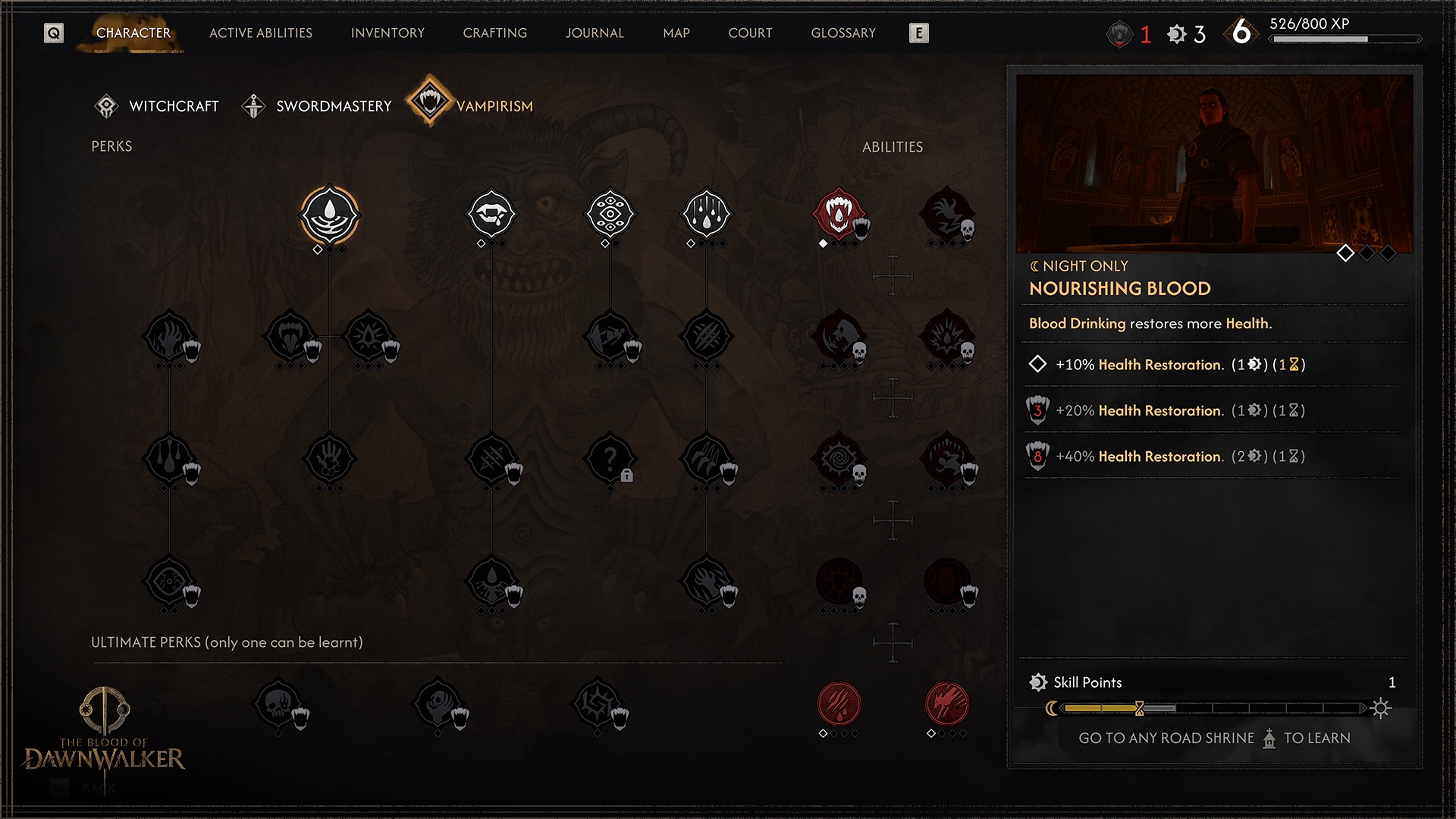
Unlike the other two trees, Vampirism has no manuals; its full perk roster is listed further down this page. Its perks and passives open as Coen's Corruption rises, while several of its active abilities are granted by drinking the blood of named vrakhiri rather than bought at all. See Vampire Combat and Night Abilities for the night-side ability list.
Shared Tree
What earlier materials called a shared tree is, in the playable build, the band of generic perks that spans all three trees: stamina, health, carry weight and similar quality-of-life upgrades. They are not gathered into a fourth tree of their own. Their purpose is the same either way, which is to make sure investment carries value regardless of whether Coen is in his day or night form.
Progression and Time
Because the game uses a 30-day time limit, players cannot max out all three trees in a single playthrough. This forces meaningful choices about which abilities to prioritize. A player who invests heavily in vampire abilities will have a very different experience from one who focuses on human swordsmanship and Hex magic. The shared tree offers a middle ground for players who want versatility across both forms.
Manuals and Shrine Perks
Skill points from leveling up are not the only source of progression. Rebel Wolves confirmed in April 2026 that perks live across two systems: shrine purchases and world manuals. Road shrines act as the main perk vendor, with each unlock costing skill points plus a slice of in-game time. Manuals are physical books hidden across Vale Sangora, and they gate which abilities can be bought at all. Finding the manual makes the ability available; skill points and time still pay for it. Swordmastery manuals turn up on soldiers and bandits or are sold by fencers and blade instructors, while witchcraft manuals sit in ancient ruins, haunted places and searchable bookcases, or are sold by practitioners of magic. The Precision perk, which raises damage for directional attacks that do not repeat the previous direction, is one example of the manual track: its manual is sold by a Swordmastery teacher. This means that combing through ruins, libraries, and quiet villages can produce real character-build progress, not only loot, and it gives daytime exploration a payoff that does not depend on the 30-day clock advancing.
In the shipped build perks are bought with perk points at road Shrines, and perk points arrive with each level. Most cost between one and three time segments to learn on top of the point price, and the cost is shown before the purchase is confirmed. Manuals are inventory items consumed on reading. They are sold by merchants, handed out as quest rewards, and turn up at random in searchable bookshelves. A few abilities sit behind quests or boss fights rather than behind manuals, so not every run will even have the option to buy every perk.
Level Cap and Mastery
Coen's level caps at 50. The achievement Glass Ceiling is awarded for reaching level 50, walkthroughs of the shipped game describe 50 as the maximum level, and the game's own experience table stops there. Reaching it normally means playing past the 30-day deadline, since side content stays available after the clock runs out. A separate achievement covers levelling a single Swordmastery, Witchcraft, or Vampiric ability to its full potential, so individual abilities have their own upgrade track on top of the tree they sit in.
Because every perk bought with those points also costs time at a shrine, measured against the 30-day clock, building toward the cap competes directly with everything else the player wants to do. Growth is framed by the developers as more than raising numbers: the point is to settle on a fighting style for Coen rather than to fill every node.
How Each Tree Unlocks
The three trees do not unlock the same way, which is one of the more unusual parts of the progression design.
Tree | How New Entries Unlock | Named Examples |
|---|---|---|
Swordmastery | Manuals found out in the world teach the technique. Levelling alone does not open them. | Stinging Blade, Omniblock |
Witchcraft | Also manual-gated: the spell must be found before points can be spent on it. | Hex Magic abilities such as Burning Blood |
Vampirism | Gated by Corruption rather than by manuals. Feeding on blood raises Coen’s Corruption, and each tier of vampiric power needs a higher level of it. | Shapeshift, Shadow Dweller, Dimension Reach |
Points are only spendable at an activated Shrine, and spending them costs in-game time on top of the point price, so building Coen stronger is itself a draw against the 30-Day Cycle. Each of the three trees ends in an Ultimate Perk, confirmed by separate achievements for unlocking one in Swordmastery, in Witchcraft, and in Vampirism. Each tree in fact holds three Ultimate Perks, nine across the game, and only one per tree can be unlocked in a playthrough, which permanently closes off the other two in that tree. Update 1.1 on Steam adds Draught of Mind Rebirth to reset abilities in all three trees and return their learning time for a different ability set. Resetting ordinary perks or Ultimate Perks remains unconfirmed. Swordmastery and Witchcraft ultimates require 35 skill points invested in the corresponding tree before the chosen perk can be bought for 4 skill points and 2 time segments. Vampirism ultimates require Corruption 15 and have the same purchase cost.
Where the Perks Sit
Beyond the ultimates, databases compiled from the game's own text list 65 perks across the three trees: 24 in Swordmastery, 21 in Witchcraft and 20 in Vampirism, counting the three Ultimate Perks at the foot of each tree. A walkthrough of the shipped game lists the same Swordmastery and Witchcraft names in the order the character menu shows them. Active abilities such as Walking Fortress, Life Lock, Shapeshift, Death From Above and Voracious Bite are separate from these perks and appear in the ability tables above and on the linked pages.
Tree | Perks | Ultimate Perks |
|---|---|---|
Swordmastery | Endless Effort, Omniblock, Stinging Blade, Strong Soldiers, Trade Law, Vigour, Fleet of Foot, Pack Mule, Perfect Block, Perfect Riposte, Fate's Favour, Second Skin I, Sustained Focus, Counterattack, Precision, Second Skin II, Master Fencer, Renewed Focus, Sharp Eye, Growing Momentum, Restless Blade | Last Stand, Sword Sage, Tactical Mastery |
Witchcraft | Bewitching Influence, Forager, Unnatural Resilience, Witchcraft Mastery, Aether Flow, Amalgam, Herbal Remedies I, Medicus I, Forbidden Sigils, Frugal Witchcraft, Lasting Malediction, Font of Life, Blasphemous Echo, Herbal Remedies II, Medicus II, Potent Blood, Unholy Fervour, Evil Eye | Aether Cascade, Entwined Torment, Runic Bulwark |
Vampirism | Endless Hunger, Nourishing Blood, Razorsharp Claws, Shadow Dweller, Clawpierce, Closing Wounds, Crimson Feast, Hastened Corruption, Wild Blood, Restless Claws, Dimension Reach, Vrakhiri Might, Endless Ferocity, Dancing Claws, Blood Theft, Lasting Blood, Mandrake Ward | Lethal Crescendo, Renounce Death, Sanguine Renewal |
Shadow Dweller is worth singling out because it does more than raise a number: its second rank extends the range of Shadowstep far enough to cross terrain that is otherwise impassable, which is how one of the game's early endings is reached.
Two perks are not bought with points at all. Mandrake Ward comes from eating the mandrake with Lacra at the end of The Night of Horrors. One walkthrough reports that once per night it lets Coen survive a lethal hit and regain three health segments, and walkthroughs tie the same meal to Lacra surviving a later attack from Brencis. Font of Life is a Witchcraft perk granted by choosing to drink from the Font of Life in Anca's quest Stronger Than Achilles, and the game's own text describes it as passive health regeneration in human form.
The nine Ultimate Perks and the effects documented for them so far are collected on Ultimate Perks.
Expanding ability slots
Each tree has a separate ability-slot limit. Forbidden Sigils expands Witchcraft slots after the Unnatural Resilience branch and a manual. Master Fencer expands Swordmastery slots after Sustained Focus and a manual. Vrakhiri Might expands Vampirism slots through Corruption rather than a manual.
Rank | Slots in the upgraded tree | Skill points | Time | Vrakhiri Might requirement |
|---|---|---|---|---|
1 | 2 | 1 | 1 segment | Corruption 4 |
2 | 3 | 1 | 1 segment | Corruption 7 |
3 | 4 | 2 | 1 segment | Corruption 11 |
Forbidden Sigils manuals can be found at St. Tyna's Grove Tower or bought from the Matriarch. Master Fencer manuals can be found in the Echoes of Silenced Bells library or bought from Ocha once her teacher service is unlocked. Ability slots determine what can be equipped; quickslots determine which equipped abilities can be activated immediately.
Builds: Compare four approaches to Coen's skill trees and choose a practical starting foundation.