

The Tadpole is a modular one-pilot submersible in Subnautica 2. It was the central topic of Dev Vlog 4 ("Crafting the Tadpole"), released December 9, 2025, where the development team walked through the vehicle's complete design process from concept art to in-game implementation.
Design and Appearance
The Tadpole has a manta ray fin chassis design, with wing-like panels extending from the vehicle's body. This gives it an organic, hydrodynamic silhouette that fits naturally within Proteus's alien underwater environments rather than looking like an industrial Earth-built machine. A large glass cockpit window provides unobstructed forward visibility for the pilot.
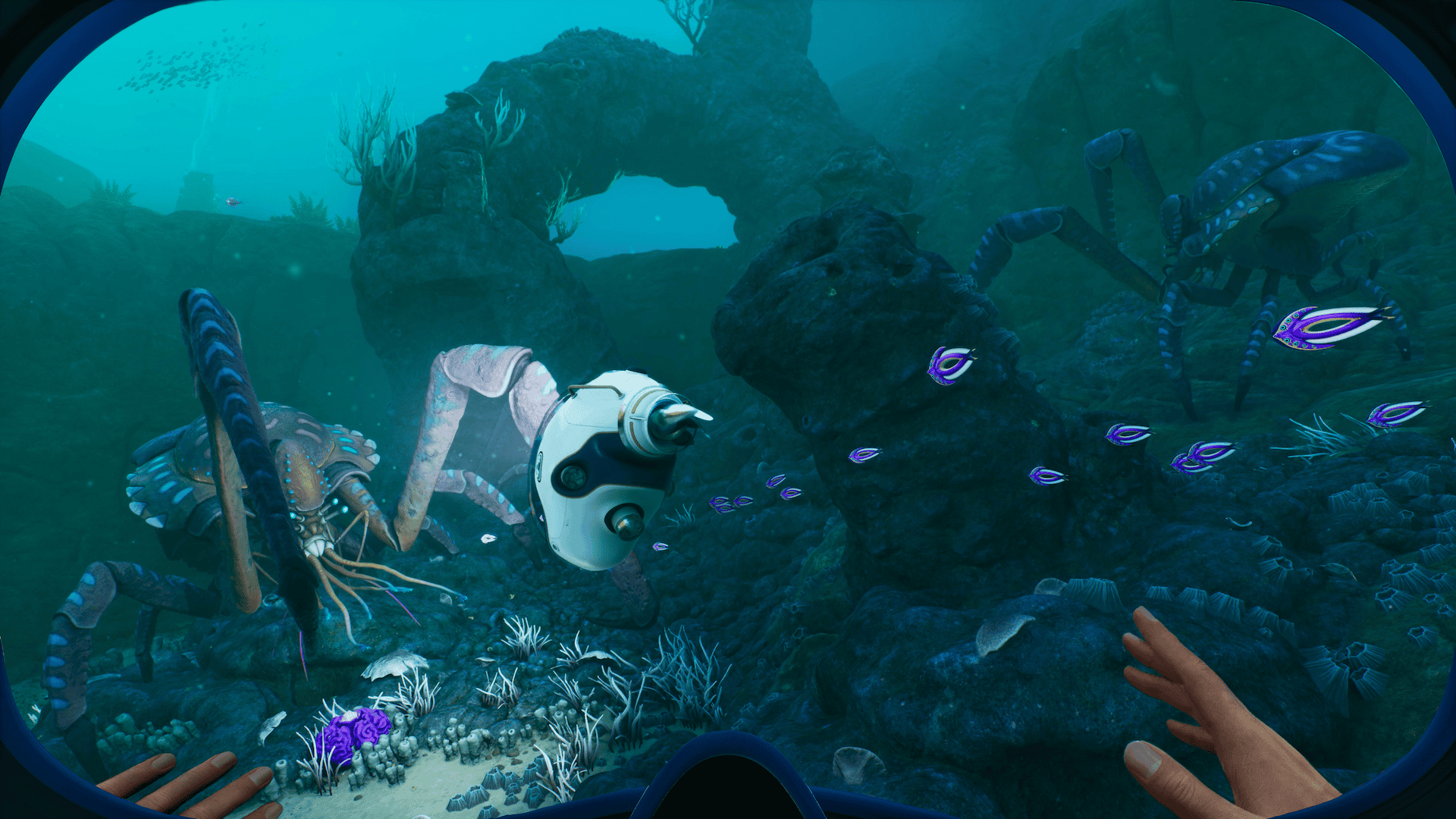
Visual Development Lead Cory Strader directed the visual design and worked alongside 3D Artist Ben Henry to translate the concept into a fully realized in-game model. The vlog showed multiple design iterations, balancing aesthetic appeal with practical gameplay needs like cockpit sightlines and animation readiness.
Chassis Variants
Dev Vlog 4 footage showed at least two distinct chassis configurations: a bare-bones variant with the core frame exposed, and a paneled variant with additional hull plating covering the chassis. In the shipped build these are chassis: swappable attachments fitted to the hull after it is built through the crafting loop, rather than upgrade tiers or cosmetic skins. The visible socket and attachment points on the rear of the chassis suggest a modular system where components can be added or swapped. Two variants carry official names: the June 1, 2026 Hotfix 3 patch notes reference the Tadpole Haul Chassis directly, and Buddy System Hotfix 1 on September 1, 2026 fixed a collision issue at the Scout Ray chassis carry point.
Specifications
Specification | Value |
|---|---|
Crew | 1 pilot (co-op passengers can ride the exterior) |
Base crush depth | 250 meters |
Upgraded crush depth | 450 meters with the Tadpole Depth Module Mk. 1 (800 meters with Mk. 2, Creative mode only at present) |
Cockpit | Large glass canopy with wide forward visibility |
Chassis | Modular with manta ray fin panels |
Damage | Can sustain hull damage; glass cockpit shows visible cracking beyond crush depth |
Repair | Repairable with the Repair Tool |
Dev Vlog 4 footage before launch showed a 200 meter hull limit with a 250 meter upgrade, but the shipped Early Access vehicle is rated to 250 meters as built. Exceeding the crush depth causes visible cracks on the glass cockpit, and continued depth will eventually destroy the vehicle. The upgrade is the Tadpole Depth Module Mk. 1, which raises the safe limit to 450 meters; a Mk. 2 module rated to 800 meters exists in the game data but, as of the launch-build guides, was only obtainable in Creative mode. Depth modules do not stack.
Building the Tadpole
The Tadpole blueprint unlocks after scanning three of its fragments, which are scattered around the starting region from the old habitat and the Cicada wreck out to and inside the Tadpole Pens. The vehicle is then built at a Vehicle Fabricator, which is a base structure rather than the handheld Fabricator, so a powered base with a dock is needed first. The figures below are the launch-build costs and no patch note through Buddy System Hotfix 1 (September 2026) has changed them.
Item | Materials | Station |
|---|---|---|
Tadpole | Titanium Ingot x2, Glass x1, System Chip x1, Power Cell x1 | Vehicle Fabricator |
Haul Chassis | Titanium Ingot x4, Strontium x3, Enameled Glass x3, Dedicated Core x1 | Vehicle Fabricator |
Tadpole Depth Module Mk. 1 | Celestine x3, Enameled Glass x2, System Chip x1 | Modification Station |
Co-Op Exterior Riding
In multiplayer sessions, other players can ride on the exterior of the Tadpole while one player pilots it from the cockpit. The vehicle includes oxygen ports on the exterior so that passengers riding outside do not drown. The oxygen port system means a group of divers can travel together on a single Tadpole, with the pilot protected inside and passengers clinging to the hull while receiving air.
Buddy System Hotfix 1 on September 1, 2026 tightened this up. Players attached to a Tadpole, or to a Haul, now reliably receive replenished oxygen rather than occasionally being left to drain. Inventory sharing is blocked while riding, the share prompt dismisses once the vehicle drives away from the other player, and dying mid-share no longer leaves the exchange in a broken state.
Design Philosophy
The development team described the Tadpole's design goal as combining modularity and utility with agile, responsive handling, drawing on lessons from prior franchise vehicles without recycling their designs. The Tadpole aims to split the difference: a single-hull vehicle with customizable chassis elements rather than detachable trailer modules.
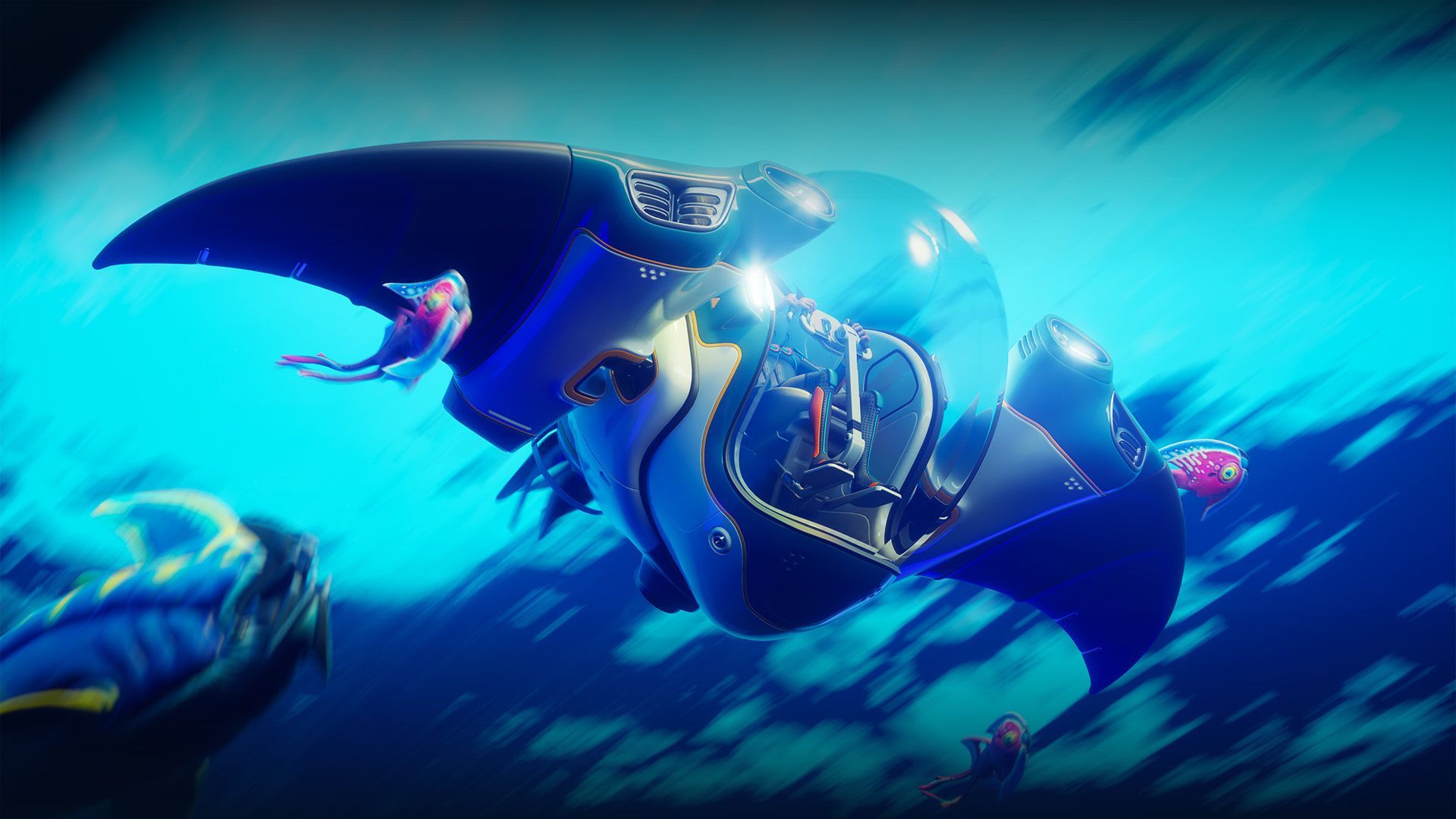
The team also noted they "wanted to make sure that it wasn't so big that it would compete with the larger vehicles," confirming that additional, larger submersibles are planned for Subnautica 2 beyond the Tadpole.
Water Physics
Dev Vlog 4 highlighted the advanced water rendering that affects the Tadpole's visual presentation. Light refracts through the moving ocean surface and plays across the manta ray wing panels, creating dynamic lighting effects. Water turbidity and color degradation at depth are rendered more realistically, meaning the Tadpole's appearance changes as it descends. These visual details were made possible by Unreal Engine 5.
Development Team
Dev Vlog 4 featured detailed commentary from five team members:
Team Member | Role | Contribution |
|---|---|---|
Design Lead | Defined the gameplay role, size class, and design requirements within the vehicle lineup. | |
Visual Development Lead | Directed the visual design, established the manta ray fin aesthetic, and oversaw the concept-to-model pipeline. | |
Pedro Perez | Gameplay Designer | Designed the vehicle's handling, interaction mechanics, and gameplay systems. |
Ben Henry | 3D Artist | Created the 3D model from blockout to high-detail, handling geometry, texturing, and detail work. |
Andi Urwalek | Gameplay Programmer | Implemented the vehicle's code, physics, controls, and integration with the game's vehicle systems. |
Role in the Vehicle Lineup
The Tadpole occupies a personal-submersible niche: a personal, maneuverable submersible for mid-depth exploration. It sits between the Wakemaker (wearable speed booster for unprotected swimming) and the Dive Elevator (platform for bulk vertical transport) in the vehicle hierarchy.
Anthony Gallegos stated that players would "be there when we first add new vehicles" during Early Access, confirming the Tadpole is part of an expanding vehicle roster. The leaked milestone documents reference a second, unnamed submersible in addition to the Tadpole.
Early Access Fixes
Since the May 14, 2026 Early Access launch, the Tadpole has been the focus of several stability and behavior fixes. The May 22, 2026 hotfix resolved two Tadpole-specific issues: a bug that could teleport players back to base while they were exploring in a Tadpole, and an infinite-oxygen exploit that occurred after dying of hunger or thirst while piloting one. The same update also tuned creature behavior around the vehicle, so that Hammerhead creatures are no longer as strongly attracted to the Tadpole’s lights. Before the change, the lights drew Hammerheads toward parked or piloted Tadpoles, making the submersible a magnet for harassment in the upper biomes.
Hotfix 3 (June 1, 2026) went further: Hammerheads no longer attack unpiloted Tadpoles at all, though they can still take an interest in a parked one, and a bug that left goggles visible in first-person view when exiting the Haul Chassis as a passenger was fixed.
Creature aggression toward the vehicle varies by species. Community documentation reports that the Needler Mango attacks even an unpiloted Tadpole, Nibblers chase Tadpoles as readily as divers, and the Marrowbreach actively dislikes the submersible and keeps its distance.
A full list of these changes and every other Early Access release is tracked on the Updates and Patch Notes page.
Dev Vlog 4
The Tadpole was the central topic of Dev Vlog 4, released December 9, 2025. The vlog provided an unusually detailed look at the vehicle creation process at Unknown Worlds, covering:
Early concept art and silhouette exploration
The decision-making process for the manta ray fin aesthetic
3D modeling workflow from blockout to high-detail model
Multiple chassis iterations (bare-bones vs. paneled)
Gameplay programming and physics implementation
In-game footage showing the Tadpole in action across different biomes
The vlog was well received by the community for its transparency about the development process and the amount of iteration shown between early concepts and the final design.
October docking and boundary fixes
Buddy System Hotfix 2 on October 6, 2026 fixed docking orientations where the Tadpole geometry blocked the docking check. It also fixed incorrect teleporting when returning from out-of-bounds areas and destroyed Tadpoles with attached chassis modules failing to return correctly. These fixes address recovery inside the existing Early Access boundary.
The hotfix improved Leviathan grab attacks on Tadpoles and corrected Scout Ray visual effects. Shiver Leviathans no longer interact with unpiloted vehicles; this species-specific change does not establish protection from every creature.