

Railborn is a first-person survival game built around constructing and managing a mobile train base. Players must scavenge resources from a dangerous alien planet, build and expand their train, and manage the systems that keep themselves and their train functional. The game blends survival mechanics, base building, resource management, and exploration.
Starting Out
Players begin with a small handcar assembled from a few squares of wood. This initial vehicle is barely large enough to stand on while traveling down the tracks. From this starting point, players scavenge the world for resources, gather food and water to stay alive, craft a working engine, and gradually expand the handcar into a proper train.
Train Construction
The train is built incrementally, piece by piece, floor by floor, and railcar by railcar. Players add new compartments and systems over time, customizing the layout to suit their needs and playstyle. The driving control panel can also be configured. Construction requires materials gathered from the world around the tracks.
Trains grow upward as well as outward. Extra height adds room for gardens and machines, and it also brings the train closer to resources that cannot be reached on foot, such as the Vesperite ore nodes that sit on the tall ceilings of tunnels. See Train Building.
Survival Systems
Beyond the train, the planet presents constant threats. Players must manage the following to stay alive:
System | Description |
|---|---|
Food | Players must gather and grow food to avoid starvation. Vegetable plots and farming cars can be constructed on the train. |
Water | Water must be captured from the environment and distributed through the train's plumbing systems. |
Air | The outside air is toxic. Players must manage breathable air supply when venturing off the train. |
Power | The train runs on a power system that must be managed and expanded as new railcars and equipment are added. |
Survival also extends to the world around the train. Players can swim on the surface and underwater to reach undersea areas, though deep water is dangerous in the early game. At night the world becomes very dark, and players can either keep working with the right tools or rest using sleeping items, from a basic sleeping bag up to better setups with added benefits. On the rails, obstacles called track blockers can obstruct the train, countered by researching and building a cowcatcher. See Survival Mechanics for these systems. Severe weather such as thunderstorms and sandstorms also sweeps the world, and the train is the main shelter from it.
Resource Management
Players direct the flow of resources through the train, managing power distribution, water supply, and material storage. Upgrading the train requires copper and other scavenged materials. A technology upgrade tree governs which new systems and railcars can be unlocked as the game progresses.
A handful of materials are visible by name in released footage. Build pieces list their costs before placement, and resource nodes in the world are named when the player looks at them:
Material | Where It Appears |
|---|---|
Raw Wood | Listed as a build cost on train pieces such as walls and solar panels. |
Quartz | Listed alongside Raw Wood as a build cost on train pieces. |
Ember Reed | Listed as a build cost on more advanced pieces such as solar panels. |
Iron Rock | A boulder-sized node in the world, named on screen when targeted with a harvesting tool. |
Vesperite | An ore whose nodes often sit on tunnel ceilings. See Atlas Bases. |
This is what has been shown rather than a complete list, and material names may change before and during Early Access.
Biome Cultivation
Rare plants found across the dying alien world can be rescued and cultivated on the train. Players recreate small biomes in dedicated farming and greenhouse railcars, providing a sustainable food source and preserving plant life from an environment in collapse.
Exploration
The world consists of a branching network of railroad tracks. Players choose routes at junctions, navigating paths that lead through mountains, into the sea, and across ruins. Exploration happens both on foot and by train. Abandoned colonist outposts and alien monoliths can be discovered and investigated, revealing the history of the planet.
Abandoned Atlas bases are a further destination. These are former corporate research hubs that run deep underground, hold the plants required to unlock technology, and are described as dangerous and challenging to clear. Their locations are not always obvious, so players find them by covering ground on foot or by reaching towers. See Atlas Bases.
Navigation and Piloting
Players pilot their train directly along the track network. The customizable driving control panel allows each player to configure their driving setup to their preference. The track system is fixed; players choose paths at branching junctions rather than laying new track.
Cooperative Play
In co-op, up to four players share a single train. Each player can take on different roles: one may pilot while others gather resources, maintain systems, or expand the train. Construction, resource gathering, and system management are all shared across the group.
Technology and Progression
Progression in Railborn runs through a technology upgrade tree fueled by a currency called motes. Motes are harvested mainly from plants grown in biomes on the train's cars, then deposited into mote vaults to unlock technology and rebuild the world's ecosystems.
The Nexus is the central upgrade structure of the train, described by the developers as its brain. Building it up expands abilities such as incline (for climbing tracks), engines (speed and base size), platforms (production and biome space), and bonus oxygen. Expanding the Nexus requires Nexus Cores gathered from the world.
Navigation Systems
The world is crossed along a branching rail network. The game currently uses two baseline track types, a well-maintained mainline shown in white and a slower off-road type shown in orange, with some routes additionally affected by weather. Information towers can be reached to reveal nearby Core locations and local track layouts on the map. Tracks that pass through a mountain run through tunnels, and some routes open up only after exploring on foot to reach track bypasses.
A mini-map appears in the bottom right of the screen when the player steps off the train. The developers originally wanted exploration to stay difficult and mysterious and have said the mini-map may prove too powerful, so they are keeping it in for now and watching how players react to it.
Heads-Up Display
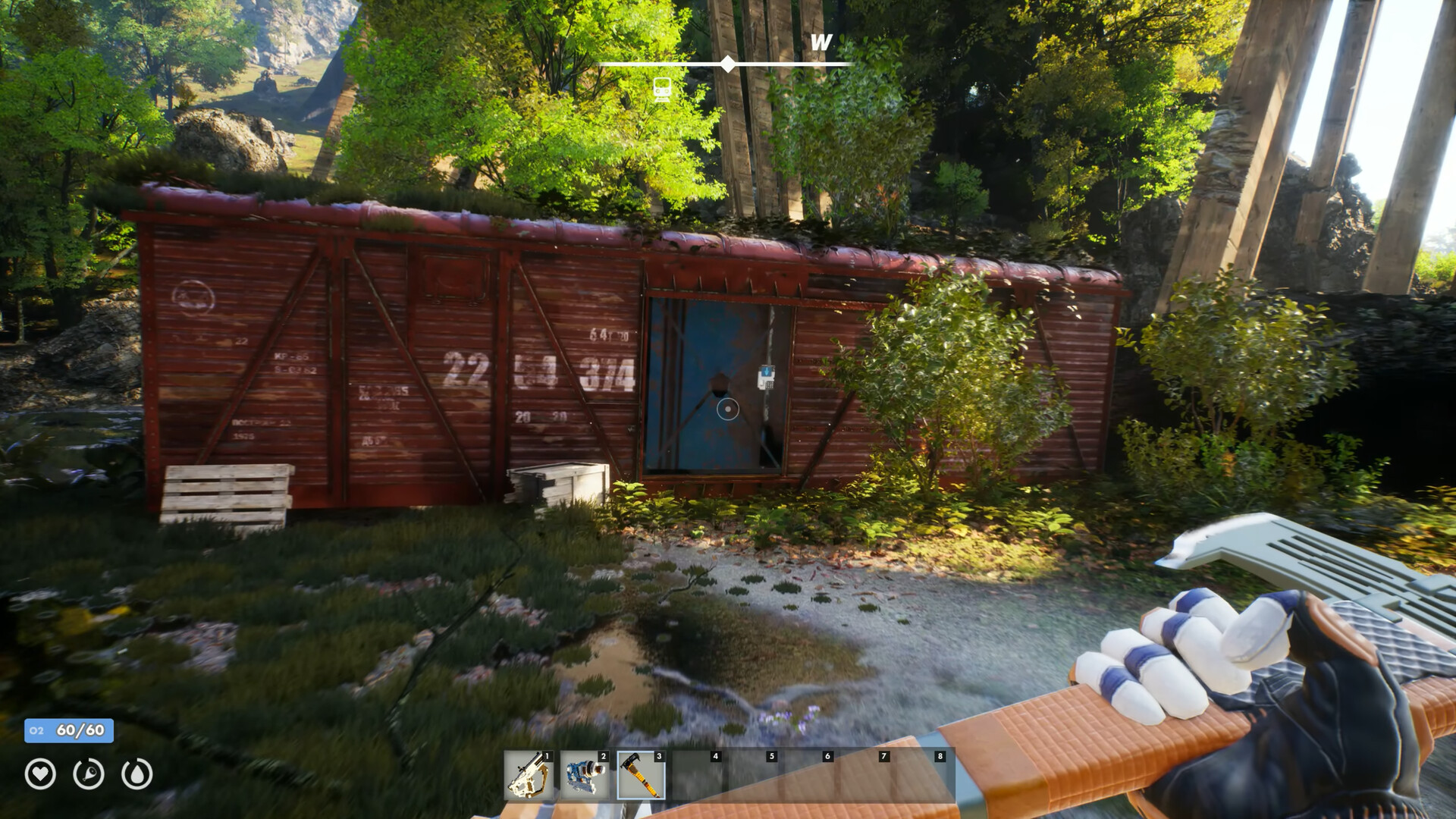
The interface shown in released footage keeps survival and train information on screen at once. An oxygen gauge sits at the bottom left above icons for the player's other vital needs, with an eight-slot hotbar across the bottom and a compass along the top. While aboard, the top right shows the train's current speed in kilometres per hour and the gradient of the track in degrees, and a power meter sits above the hotbar. Points of interest appear on the compass with their distance in metres, including Research Base and plant markers.