
Loading...
Loading...
Animals and Welfare
August 7, 2026 at 10:01 AM
Rebuilt the species roster to the 63 catalogued entries with taxonomy group, region, conservation status and wild population; corrected the Spotted Eagle Ray to the Ocellated Eagle Ray; corrected the nine Zoopedia regions to include four ocean basins rather than nine continents; added the welfare panel breakdown, the new nesting and fledging system, and the Zoopedia filter axes
Animals are the heart of Planet Zoo 2. Every species is a realistically simulated creature with its own needs, and a habitat only thrives when those needs are met. The sequel rebuilds animal behaviour around what Frontier calls an improved animal brain, producing more natural and varied actions such as herding, grazing, and reacting to the world around them. Frontier highlights a generational leap in fidelity, with detailed fur, feathers, and scales, along with authentic breathing and sounds.
Behaviour is also more expressive. Layered animations communicate an animal’s mood and emotional state at a glance, without the player needing to open a menu, and species show off newly detailed actions such as more dynamic climbing and jumping, resting on raised frames, and rubbing against their surroundings.
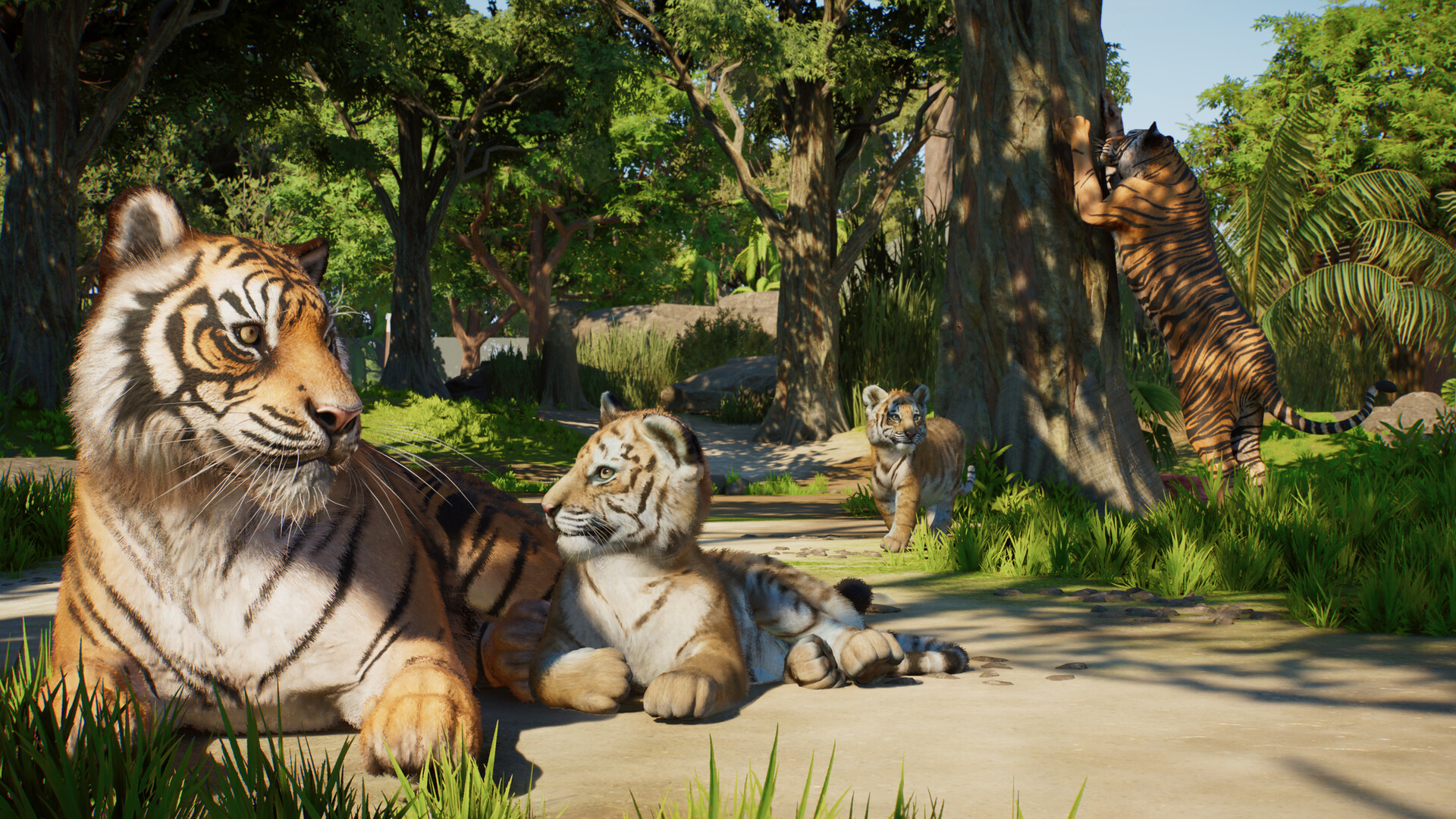
Underneath those expressions sits what Frontier calls the animal brain, the set of systems that decides how a creature behaves across its zoos and reserves. It works as a reactive brain that sorts everything an animal can do into four kinds of action and lets it shift between them smoothly as the situation around it changes.
Behaviour Type | What It Covers |
|---|---|
Routines | The animal’s default actions, such as exploring, resting, and using enrichments. |
Periodics | Reactions to changes in the environment between routines, such as finding shelter or escaping a predator. |
Distractions | Reactions that change how an action is carried out, such as joining a herd while exploring or answering a social call while resting. |
Interruptions | Reactions that stop the current action for another, such as playing with a member of the same species or waking from sleep when disturbed. |
Mood feeds into all of this. An animal that is happy, sad, angry, or scared carries out the same actions in a different manner, shown through its appearance rather than a readout, whether that is a hot lion panting or an angry tiger flattening its ears. Those moods can spread, so a scared zebra alerts the rest of its herd to danger. Animals also read their surroundings, reacting to the time of day, the weather, the seasons, and the presence of predators, and seasonal fertility shapes when they court and breed.
Flying and aquatic species use the same brain but draw on different pools of behaviours. Birds weigh the cost of flying against walking and prefer perching if they are arboreal, while fish hold a preferred position in the water column and rest by hovering. Those differences are covered under Aviaries and Aquariums.
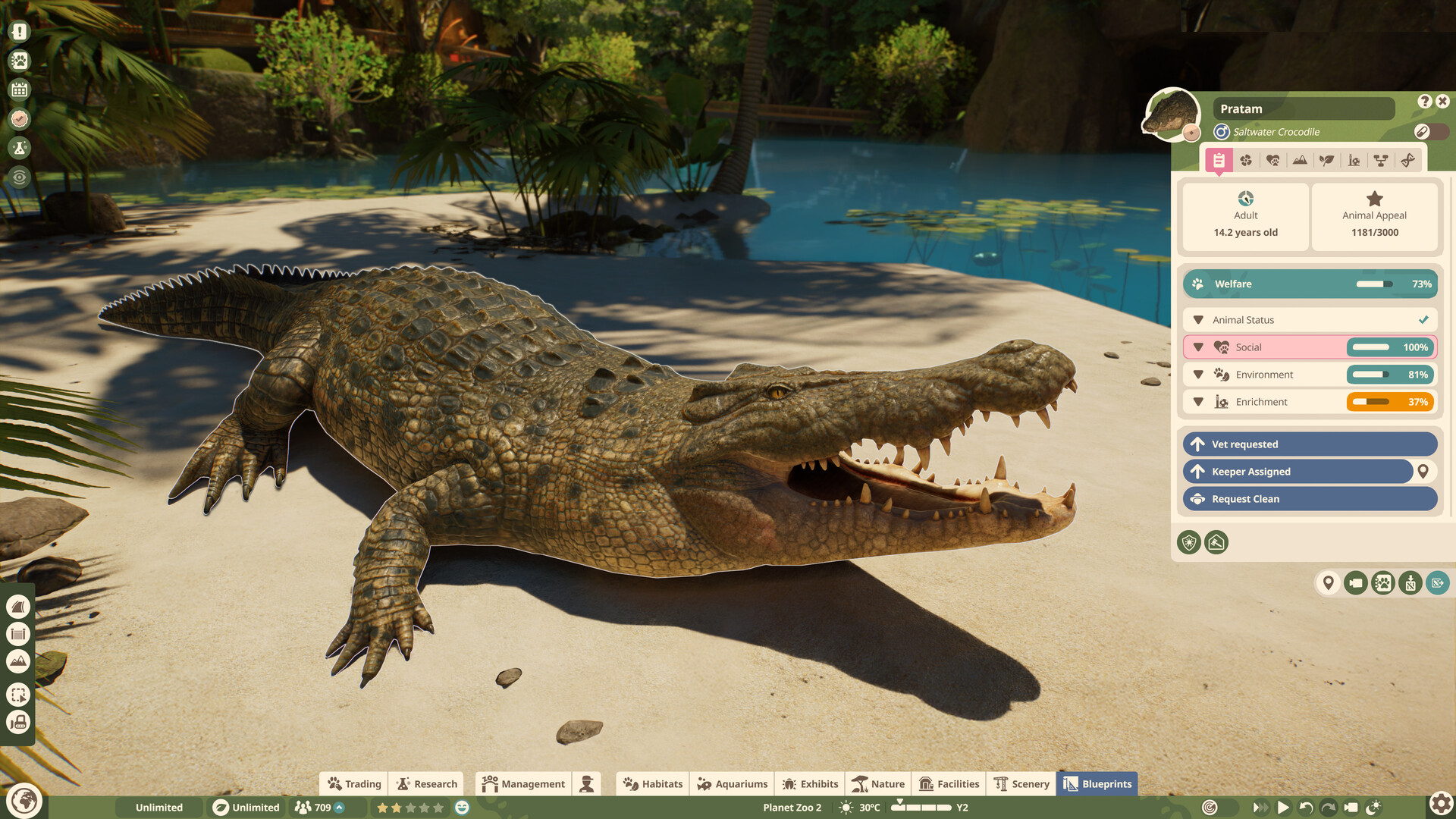
Welfare is tracked through clear on-screen indicators, and animals now show more obvious physical reactions to their surroundings and condition, making problems easier to spot. Selecting an animal opens a panel with its name, species, age, and life stage alongside an overall welfare percentage broken into components, plus an Animal Appeal score that measures how much of a draw the animal is for guests.
Welfare Component | Covers |
|---|---|
Animal Status | The animal’s own condition, including health. |
Social | Group size and company, measured against what the species needs. |
Environment | How well the habitat itself suits the animal, including space, terrain, and planting. |
Enrichment | Stimulation from enrichment items placed in the habitat. |
The same panel carries direct actions, so a keeper can be assigned, a vet requested, or a clean ordered without hunting through a menu. Aquatic animals add a salinity requirement on top of the shared needs, and every species has its own temperature tolerance.
Players raise animals from their earliest moments and can breed them across generations. Planet Zoo 2 adds nesting, which the first game did not have: flying birds, flightless birds, and reptilian egg-layers all need a suitable nesting site for each breeding pair, and a pair cannot conceive until it has claimed one. Eggs are laid in the nest and incubated by the male, the female, or both depending on species, while reptiles leave their eggs to incubate alone, though some mothers stay to guard them.
Newly hatched flying birds are nestbound and depend on their parents. At fledging age they swap their shaggy juvenile look for adult plumage, but they still count as juveniles and do not press against a habitat’s adult population limit until they reach sexual maturity. Reptiles and flightless birds hatch free to explore straight away.
Cohabitation returns from the first game and takes on a larger role in management, letting compatible species share a single habitat. Frontier has said it will detail how cohabitation works closer to launch. Aviary birds can cohabit with other animals, which the studio has shown as part of its aviary coverage.
Conservation is a central theme rather than a side objective. Animals can ultimately be released, and that effort extends beyond the zoo through the new Wildlife Reserves. Frontier says it researches every species with input from experts and from the IUCN Red List, and that its choice of aquatic species in particular was guided by real-world husbandry and ethical practice, keeping to animals that suit the habitats the game actually ships with.
The Zoopedia is the game’s in-game reference for every animal, and it is also published on the official website ahead of launch. Each entry covers the animal’s appearance, size and weight, taxonomy down to genus, wild population, conservation status, social and reproductive behaviour, and a set of real-world facts. New species are added in weekly drops, and Frontier notes the Zoopedia reflects work in progress, so text, images, and stats are not final.
Entries are filterable along four axes. Animals are sorted by where they are housed, across Habitat - Terrestrial, Habitat - Flying, Aquarium, and Exhibit; by biome, across twelve options; by region, across nine that include four ocean basins alongside the five landmasses; and by conservation status.
Axis | Values |
|---|---|
Housing | Habitat - Terrestrial, Habitat - Flying, Aquarium, Exhibit |
Biome | Desert, Estuarine, Grassland, Lakes and Rivers, Mangrove, Open Sea, Reef, Taiga, Temperate, Tropical, Tundra, Wetlands |
Region | Africa, Asia, Europe, North America, South America, Oceania, Atlantic Ocean, Indian Ocean, Pacific Ocean |
Conservation status | Least concern, Near threatened, Vulnerable, Endangered, Critically endangered, plus an unassessed placeholder |
Sixty-three species had Zoopedia entries as of early August 2026, of which fifty-seven belong to the base game and six come with the Deluxe Edition covered under Editions and Pre-Orders. Frontier has not revealed the final roster size, so this is a growing list rather than the complete lineup.
Group | Catalogued So Far |
|---|---|
Mammal | 23 |
Ray-finned fish | 15 |
Reptile | 7 |
Amphibian | 6 |
Bird | 5 |
Shark or ray | 4 |
Invertebrate | 3 |
Two further species have appeared in official gameplay footage and developer commentary without a catalogue entry yet: the White-Tailed Eagle, shown in the Scottish Highland reserve, and the Great Hornbill, named by the team when describing rainforest flight behaviour. The Eurasian Beaver was also shown in the same reserve footage.
Species | Edition | Group | Found In | Conservation Status | Wild Population |
|---|---|---|---|---|---|
Aardvark | Base | Mammal | Africa | Least concern | Unknown |
African Leopard | Base | Mammal | Africa | Vulnerable | Unknown |
African Penguin | Base | Bird | Africa | Critically endangered | 19,800 |
African Savannah Elephant | Base | Mammal | Africa | Endangered | 320,000 |
African Tigerfish | Base | Ray-finned fish | Africa | Least concern | Unknown |
American Bullfrog | Base | Amphibian | North America | Least concern | Unknown |
Axolotl | Deluxe | Amphibian | North America | Critically endangered | 50 - 1,000 |
Blackspotted Puffer | Base | Ray-finned fish | Indo-Pacific reefs and lagoons | Least concern | Unknown |
Blacktip Reef Shark | Base | Shark or ray | Indo-Pacific reefs and coasts | Vulnerable | Unknown |
Blue and Gold Fusilier | Deluxe | Ray-finned fish | Indo-Pacific reefs | Least concern | Unknown |
Blue Wildebeest | Base | Mammal | Africa | Least concern | 1,550,000 |
Blunthead Cichlid | Base | Ray-finned fish | Africa | Least concern | Unknown, abundant |
Boa Constrictor | Base | Reptile | South America, Central America | Least concern | Unknown |
Brown Trout | Base | Ray-finned fish | Europe, Western Asia, North Africa (Atlas Mountains) | Least concern | Unknown |
Cape Buffalo | Base | Mammal | Africa | Near threatened | 564,000 |
Clown Loach | Base | Ray-finned fish | Asia | Least concern | Unknown |
Common Bluetongue | Base | Reptile | Oceania | Least concern | Unknown |
Common Hippopotamus | Base | Mammal | Africa | Vulnerable | 115,000 to 130,000, in decline |
Danube Crested Newt | Base | Amphibian | Europe | Least concern | Unknown |
Diamondback Terrapin | Base | Reptile | North America | Vulnerable | Unknown |
Dolphinfish | Base | Ray-finned fish | Atlantic Ocean, Indian Ocean, Pacific Ocean | Least concern | Unknown |
Eurasian Brown Bear | Base | Mammal | Europe, Asia | Least concern | 100,000 |
European Bison | Base | Mammal | Europe | Near threatened | 2,518 |
European Peacock | Base | Invertebrate | Europe, Asia | Least concern | Unknown |
Fire Salamander | Base | Amphibian | Europe | Vulnerable | Unknown |
Gemsbok | Base | Mammal | Southwest Africa | Least concern | 373,000 |
Gharial | Base | Reptile | Asia - Indian subcontinent | Critically endangered | 650 |
Giant Malaysian Leaf Insect | Base | Invertebrate | Southeast Asia | Not stated | Unknown |
Giant Slippery Frog | Base | Amphibian | Africa | Endangered | Unknown |
Gila Monster | Base | Reptile | North America | Near threatened | Unknown |
Golden Eagle | Deluxe | Bird | North America, Europe, Northern Africa, Asia | Least concern | 85,000 - 160,000 |
Golden Lion Tamarin | Deluxe | Mammal | South America | Endangered | 4800 |
Golden Poison Frog | Base | Amphibian | South America | Endangered | Unknown |
Golden Trevally | Base | Ray-finned fish | Indo-Pacific reefs and coasts | Least concern | Unknown |
Goodfellow’s Tree-Kangaroo | Base | Mammal | Southeast Asia | Endangered | Unknown |
Great Hammerhead | Deluxe | Shark or ray | Worldwide tropical and warm temperate oceans | Critically endangered | Unknown |
Grey Wolf | Base | Mammal | Europe, Asia, North America | Least concern | 200,000 - 250,000 |
Hawksbill Turtle | Base | Reptile | Worldwide tropical and temperate oceans | Critically endangered | Unknown |
Humphead Wrasse | Base | Ray-finned fish | Indo-Pacific reefs and coasts | Endangered | Unknown |
Indo-Pacific Leopard Shark | Base | Shark or ray | Indo-Pacific reefs and lagoons | Vulnerable | Unknown |
Indo-Pacific Sergeant | Base | Ray-finned fish | Indo-Pacific reefs and coasts | Least concern | Unknown |
Lion | Base | Mammal | Africa | Vulnerable | 22,000 - 25,000 (estimate) |
Long-Eared Owl | Base | Bird | Northern hemisphere | Least concern | 2,200,000 - 3,700,000 |
Longfin Batfish | Deluxe | Ray-finned fish | Western Pacific coasts and reefs | Least concern | Unknown |
Masai Giraffe | Base | Mammal | Africa | Endangered | 35,000 |
Meerkat | Base | Mammal | Africa | Least concern | Unknown |
Ocean Sunfish | Base | Ray-finned fish | Worldwide | Vulnerable | Unknown |
Ocellated Eagle Ray | Base | Shark or ray | Indo-Pacific reefs and coasts | Endangered | Unknown |
Pacific Sardine | Base | Ray-finned fish | Pacific Ocean, Indian Ocean and Atlantic Ocean | Least concern | Unknown but prolific |
Plains Zebra | Base | Mammal | Africa | Near threatened | 150,000-250,000 |
Red Deer | Base | Mammal | Europe, Asia, Africa | Least concern | Abundant, Unknown |
Red Lionfish | Base | Ray-finned fish | Western Indo-Pacific Ocean | Least concern | Unknown |
Red Panda | Base | Mammal | Asia | Endangered | 10,000 |
Reticulated Giraffe | Base | Mammal | Africa | Endangered | 11,050 |
Saltwater Crocodile | Base | Reptile | Asia, Oceania | Least concern | 500,000 |
Schooling Bannerfish | Base | Ray-finned fish | Indo-Pacific reefs | Least concern | Abundant, Unknown |
Secretarybird | Base | Bird | Africa | Endangered | 6,700 - 67,000 |
Springbok | Base | Mammal | Southern Africa | Least concern | 2,000,000 - 2,500,000 |
Sri Lankan Rose | Base | Invertebrate | Asia | Endangered | Unknown |
Sumatran Tiger | Base | Mammal | Southeast Asia | Endangered | 400 - 600 (estimated) |
Thomson’s Gazelle | Base | Mammal | Africa | Least concern | 145,000 |
Toco Toucan | Base | Bird | South America | Least concern | Estimated more than 10,000 |
Western Chimpanzee | Base | Mammal | Africa | Critically endangered | 21,000 - 53,000 |
Wild population figures and conservation statuses are the real-world data the Zoopedia publishes for each species, not in-game statistics.
