

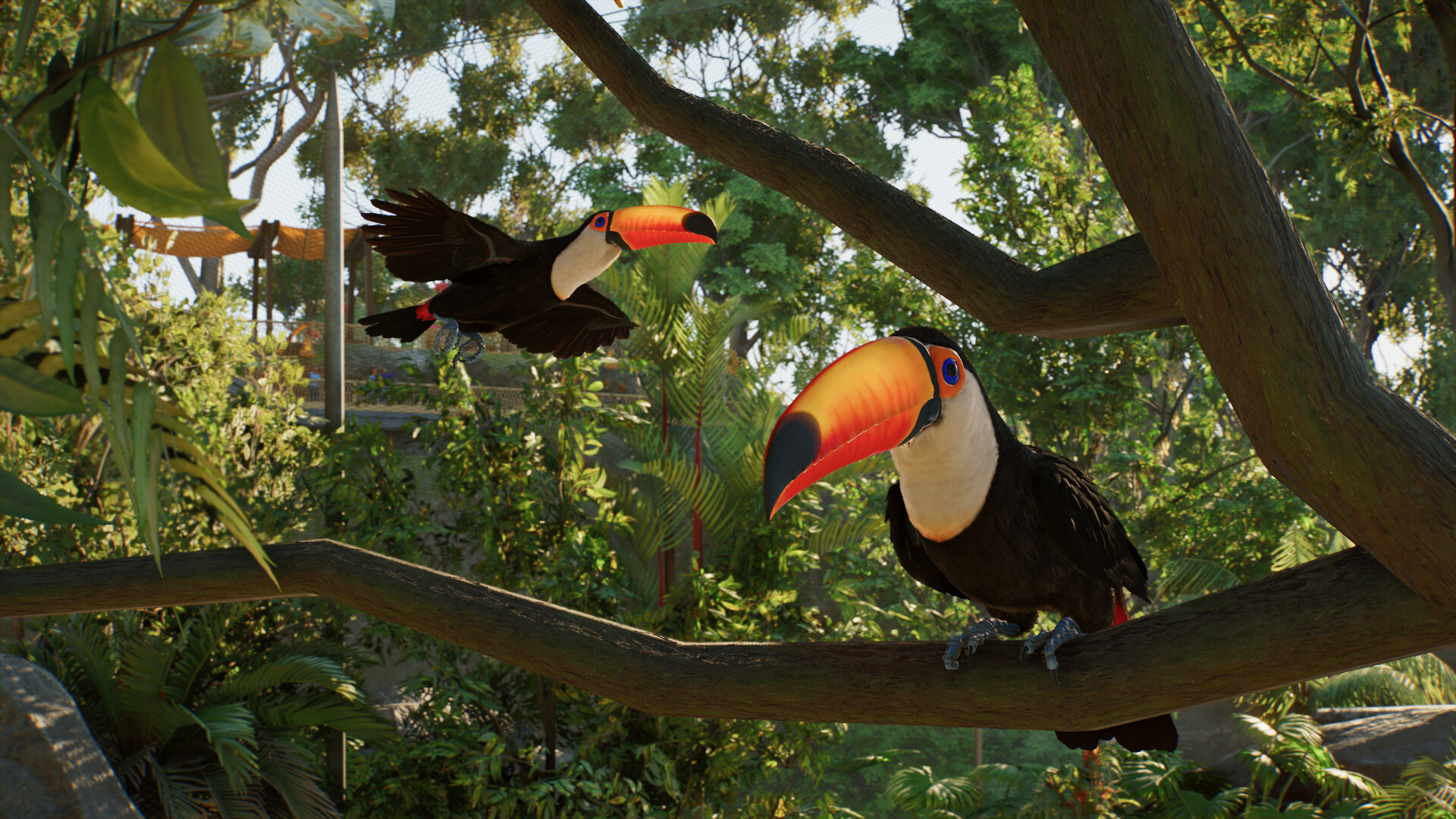
Aviaries let Planet Zoo 2 house fully flying birds for the first time in the series. Rather than being confined to the ground, birds move freely through large enclosed spaces and can be watched both perching below and soaring above. Frontier calls flying birds one of the sequel's biggest technical leaps and some of the most complex assets the studio has produced.
Building an Aviary
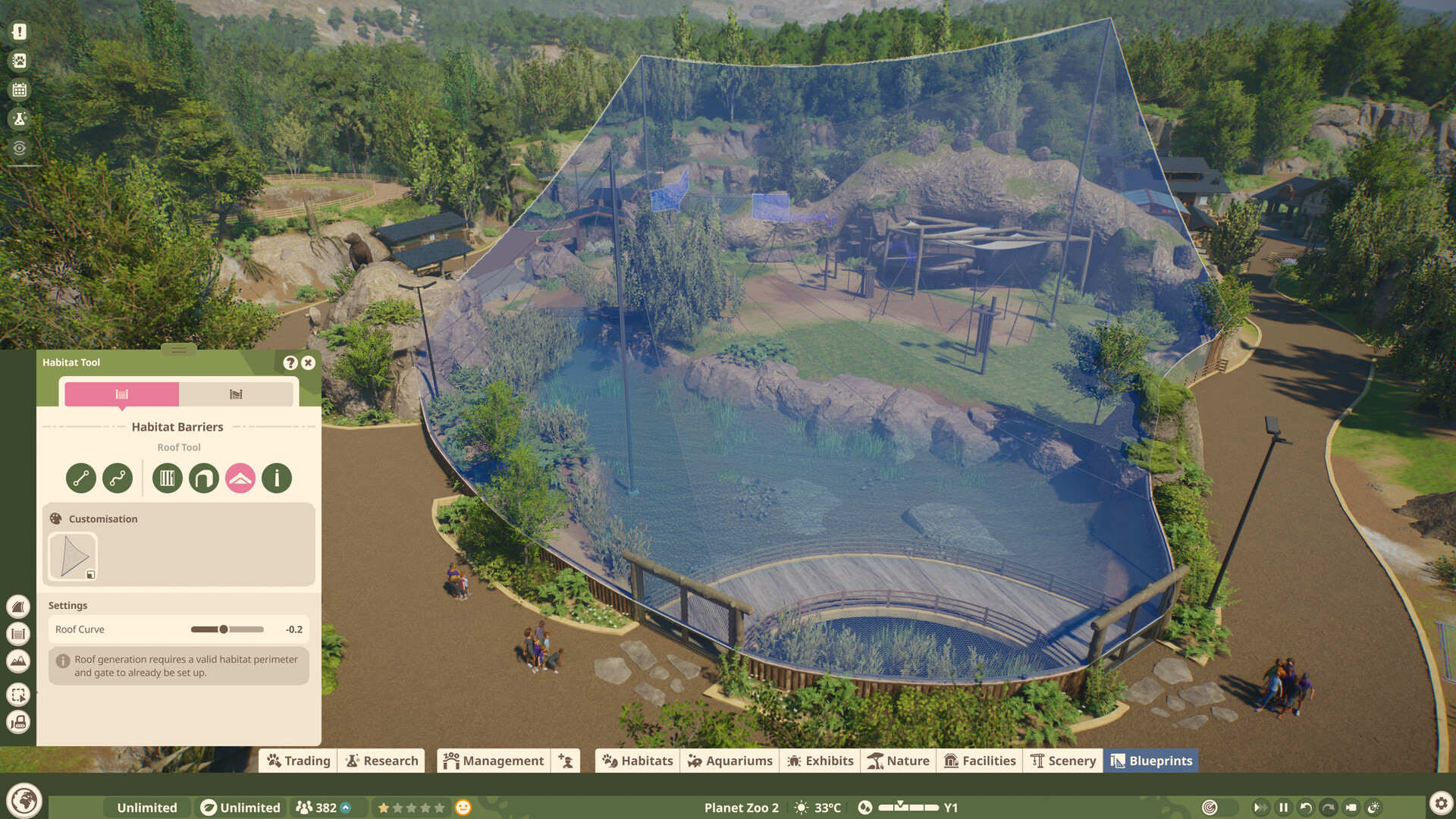
An aviary starts as an ordinary habitat and uses the same construction tools as any terrestrial enclosure, with one difference: it needs a roof. Lay a contained loop of barriers, add a staff gate, then select the habitat and choose Add Roof. A single click generates a cover from the nearby barrier posts across the whole habitat, producing a flat roof by default. The result is escape-proof air space that keeps both the birds and the guests safe.
From there the shape is yours. Pillars can be placed anywhere inside the habitat and the roof reshapes itself to connect to them, with pillar height and rotation both adjustable. The roof's own material and convexity are customised the same way habitat barriers are, and in game that convexity is exposed as a Roof Curve slider in the Roof Tool, running from a taut arch through a flat span to a slack, sagging net. Frontier's stated goal was to make roofs quick and familiar: in the original game the same effect meant manual work with scenery, terrain, and barriers.
The roofs are not limited to birds. Frontier points out that the same covers work on any habitat and are a useful tool for climbing animals or anything else with a talent for getting out.
Space and Furnishing
Every flying animal has a flyable area requirement, the aerial equivalent of the preferred water depth that aquatic species have in aquariums. Size the enclosure short and the birds will not have room to stretch their wings. Beyond raw volume, an aviary needs plenty to perch on, enrichment items, feeders, and nests if the birds are to breed.
Keeping track of that requirement is straightforward. The Zoopedia lists each species' flying-space needs, and an aviary reports its own Flyable Area through the Info Panel. If a bird's welfare shows it is short of room, the remedy is to raise the roof or widen the habitat footprint.
Because birds spend so much of their time in the air or high in the trees, guests usually have to look up to see them. Frontier expects elevated walkways, both inside and outside aviaries, to become a common sight in players' zoos as a result.
Sharing an Aviary
Many birds are social enough to live alongside other bird species and even terrestrial animals, and Planet Zoo 2 enables cohabitation between some of them. Not every species suits company, so the Zoopedia is the reference for who tolerates whom before an aviary is stocked. The wider cohabitation system is covered under Animals and Welfare.
Tolerance of visitors varies just as much. Some birds are shy and want plenty of space to themselves, while others are gregarious enough to accept a crowd: adding a guest gate and running a path through the enclosure turns it into a walkthrough aviary where guests move among the birds rather than watching from outside.
Flight and Behaviour
Flying birds run on the same decision-making framework as every other animal, described under Animals and Welfare, but they draw on a different pool of behaviours. Flight itself is tuned per species rather than shared.
System | What It Does |
|---|---|
Wing power | Wing-flap intensity changes with the phase of flight, so a bird climbing steeply beats harder than one holding altitude. |
Air noise | A noise system simulates how moving air pushes at a bird's body and feathers in flight. |
Altitude preference | Species have a desired flying height, and can be set to follow either true altitude above sea level or absolute altitude above the terrain, which changes whether they dip through a valley or soar across it. |
Landing | Landing distance and speed are authored per species, so some come in on a long glide and others drop in short and fast. |
Perching | Arboreal species prefer to perch on trees and certain habitat objects, and will stretch or sunbathe once settled. Some perches are physics-enabled, so the bird has to react to a perch that moves under it. |
Cost of flight | Each species weighs flying against walking. An arboreal bird crossing to a feeder will fly; a wading bird will usually walk there, on land or through shallow water. |
Frontier's own example of the range involved is an eagle soaring over a canyon against a Great Hornbill threading through a rainforest canopy: the same systems, tuned to very different birds.
Nesting
Aviaries brought nesting into the series. Flying birds, flightless birds, and reptilian egg-layers all need an appropriate nesting site per breeding pair before they can conceive, and a pair must claim a nest before any eggs appear. Incubation is handled by the male, the female, or both depending on the species; reptiles instead leave their eggs to incubate alone, though some mothers guard the nest.
The nests themselves are placed around the habitat, and the options are matched to how different birds actually breed. Arboreal species take cavity nests and cup nests, while waders and more ground-based birds use water platforms and mud nests. Cavity nests carry a dedicated camera, so a keeper can look in on the eggs and fledglings inside at any point.
Hatchlings differ by group. Reptiles and flightless birds emerge free to explore, but flying birds are nestbound at first and stay under their parents' care. At fledging age they trade their shaggy juvenile plumage for adult feathers, and they remain juveniles that do not count against a habitat's adult population limit until they reach sexual maturity.
How the Birds Were Built
Frontier built a bespoke pipeline for its avians around paired open and closed wing meshes that animators can swap between as a bird moves. Each wing is sculpted attached to a symmetrical body, optimised, then split and mirrored so the open and closed versions line up like interlocking pieces and the swap stays invisible in play.
The feathers are layered by hand from bespoke feather cards, hand-painted textures, and a custom fur shader, sometimes running to hundreds of cards on a single bird. A wing is assembled from a mesh forming its bulk, individually animated flight feathers slotted into it, and tertiary feathers layered above and below to blend the two. Some species add capelets over the upper body and wing to stand in for back feathers, and pockets over the chest and lower wing so a closed wing can tuck into a fold of feathers the way a real bird's does.
Confirmed Birds
Nine of the species catalogued in the Zoopedia as of 13 September 2026 are housed in a flying habitat. The African Penguin is catalogued as a bird but is kept in an ordinary terrestrial habitat rather than an aviary, because it does not fly.
Species | Found In | Conservation Status |
|---|---|---|
Eurasian Bittern | Europe, Asia, Africa | Least concern |
Golden Eagle | North America, Europe, Northern Africa, Asia | Least concern, included with the Deluxe Edition |
Great Hornbill | Southeast Asia | Vulnerable |
Long-Eared Owl | Northern hemisphere | Least concern |
Secretarybird | Africa | Endangered |
Shoebill | Africa | Vulnerable |
Toco Toucan | South America | Least concern |
White-Backed Vulture | Africa | Critically endangered |
White-Tailed Sea-Eagle | Temperate and boreal Eurasia | Least concern |
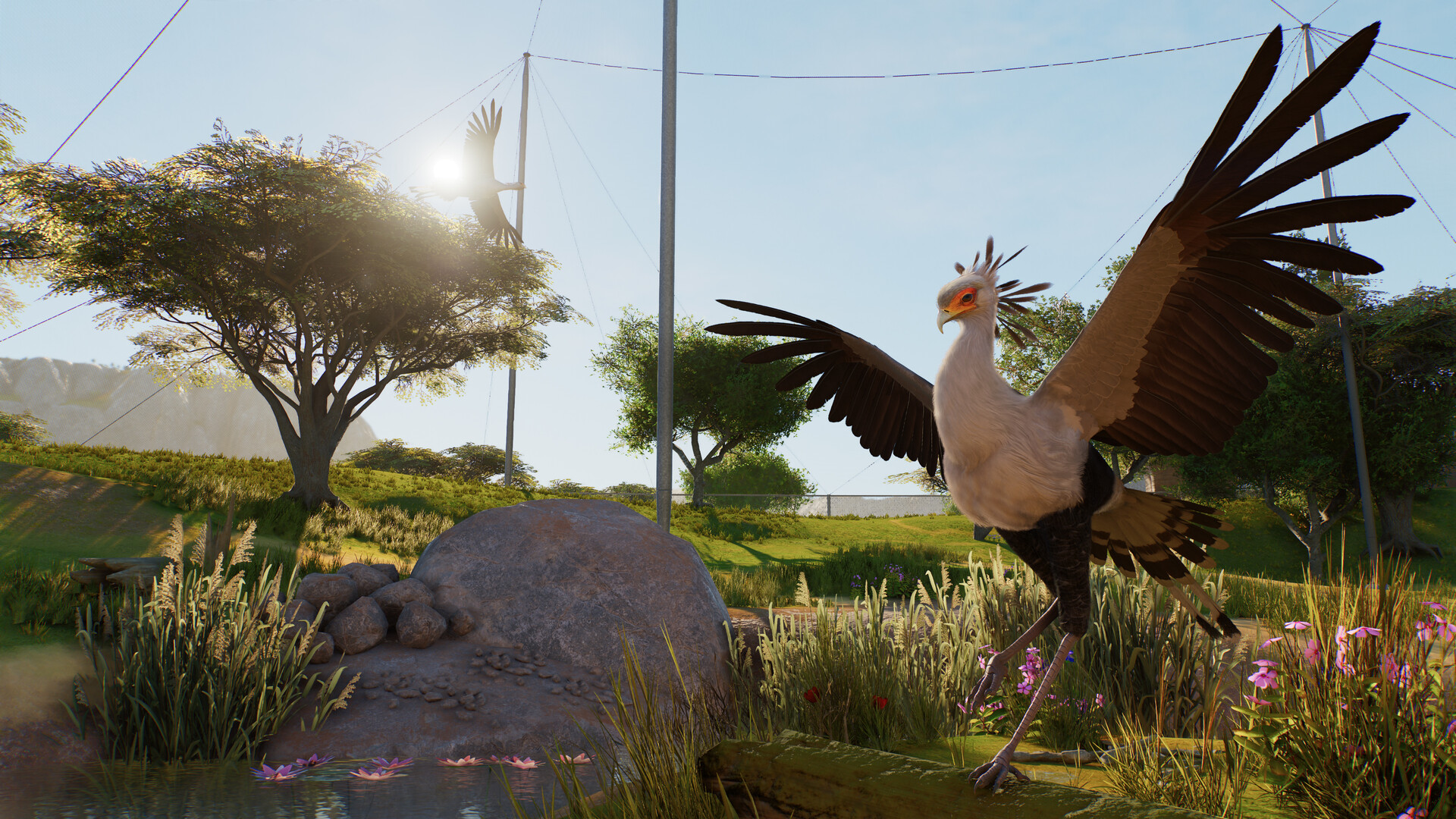
Every bird listed above has its own Zoopedia entry. Purchase details for the Deluxe bird are covered under Editions and Pre-Orders, and the nesting system aviaries introduced is detailed under Breeding and Nesting.