

Kingdom Building
Comprehensive guide to Kingmakers' kingdom building system, covering resource gathering, time travel economics, settlement construction, unit upgrades, officer experience, skill trees, supply logistics, the prisoner system, and balancing medieval and modern investments.
On This Page
Overview
Kingdom building is the long-term strategic layer of Kingmakers that sits alongside the real-time strategy mode and third-person combat. While battles determine the immediate outcome of conflicts, kingdom building determines the player's ability to fight those battles in the first place. Without a functioning economy, a steady supply of resources, and the infrastructure to produce and upgrade military units, the player's modern weapons will eventually run dry and their medieval armies will lack the numbers and quality to hold territory.
The kingdom building system operates through strategy mode's overhead view, where the player places buildings, assigns workers, and manages the production chains that keep the war effort running. It is not a separate game mode; it is integrated into the same map and the same session as the combat. Between battles (and sometimes during them), the player invests time and resources into growing their kingdom's capabilities. The choices made in kingdom building ripple forward into every battle the player fights, determining what troops are available, how well they are equipped, and whether there is enough ammunition and arrows to sustain a prolonged engagement.
Resources
Three primary resource types drive the kingdom economy:
Resource | Source | Primary Use |
|---|---|---|
Copper | Mining operations, resource nodes | Basic construction, economy buildings, unit equipment |
Gold | Mining, trade, captured territory | Advanced construction, military upgrades, premium units |
Hidden Treasures | Exploration, battlefield loot, hidden caches | Special upgrades, rare equipment, unique unlocks |
Resources are gathered through the infrastructure the player builds: mines extract copper and gold from deposits on the map, economy buildings process and distribute those resources, and exploration of the game world reveals hidden caches of treasure. Defeated enemies also drop resources, and capturing enemy territory grants access to their resource nodes. The player who controls more territory controls more resource production, which creates a snowball effect that rewards aggressive expansion.
Hidden treasures are the most interesting of the three. Unlike copper and gold, which come from established production chains, treasures must be found. They are scattered throughout the game world in places that require the player to leave the safety of the strategy map and explore on foot in shooter mode. Dungeons, ruins, battlefield wreckage, and hard-to-reach locations all contain treasures that cannot be collected any other way. This creates a gameplay loop that pulls the player between the macro-level management of kingdom building and the micro-level exploration of the world on foot.
Economy Redesign
The store and resource economy were overhauled during 2026 development builds after extensive playtesting with more than a thousand players. Testers tended to hoard currency and stockpiled it instead of spending, which meant most of the weapon arsenal went unused. In response the store moved to rolling offerings governed by scarcity and tied to village progression, so the player is encouraged to keep buying and fielding new equipment rather than saving indefinitely. As part of the same pass, stone quarries were removed from the economy, and silver became obtainable by killing enemy soldiers rather than through its earlier acquisition method. These are in-development changes to an unreleased build and may be tuned further.
Sending Resources to the Future
In a mechanic that ties directly into the time travel narrative, resources gathered in 1400 AD medieval England can be sent forward to the future. The lore explanation is straightforward: the future is in rough shape, suffering from low resources, so requesting new guns is not simple. The player cannot just call in unlimited modern equipment. Every weapon, upgrade, and piece of modern technology has to be purchased with resources that the player physically collected in the past and transmitted forward.
Once sent, these resources are converted into a currency that the player uses to unlock modern equipment upgrades, new weapons, vehicle improvements, and advanced military technology. This creates a resource allocation tension: every unit of copper or gold sent to the future is a unit that cannot be spent on medieval infrastructure in the present. The player faces a constant decision about where to invest.
The weapon upgrade system is particularly important. A basic version of a weapon may start weak against high-tier armor, but fully upgrading it through future-currency investments can allow it to match elite opponents. Upgrades improve stats like magazine capacity, armor penetration, and accuracy at range. This means that even a pistol, given enough investment, can become effective against enemies who would shrug off its base-level rounds.
Construction
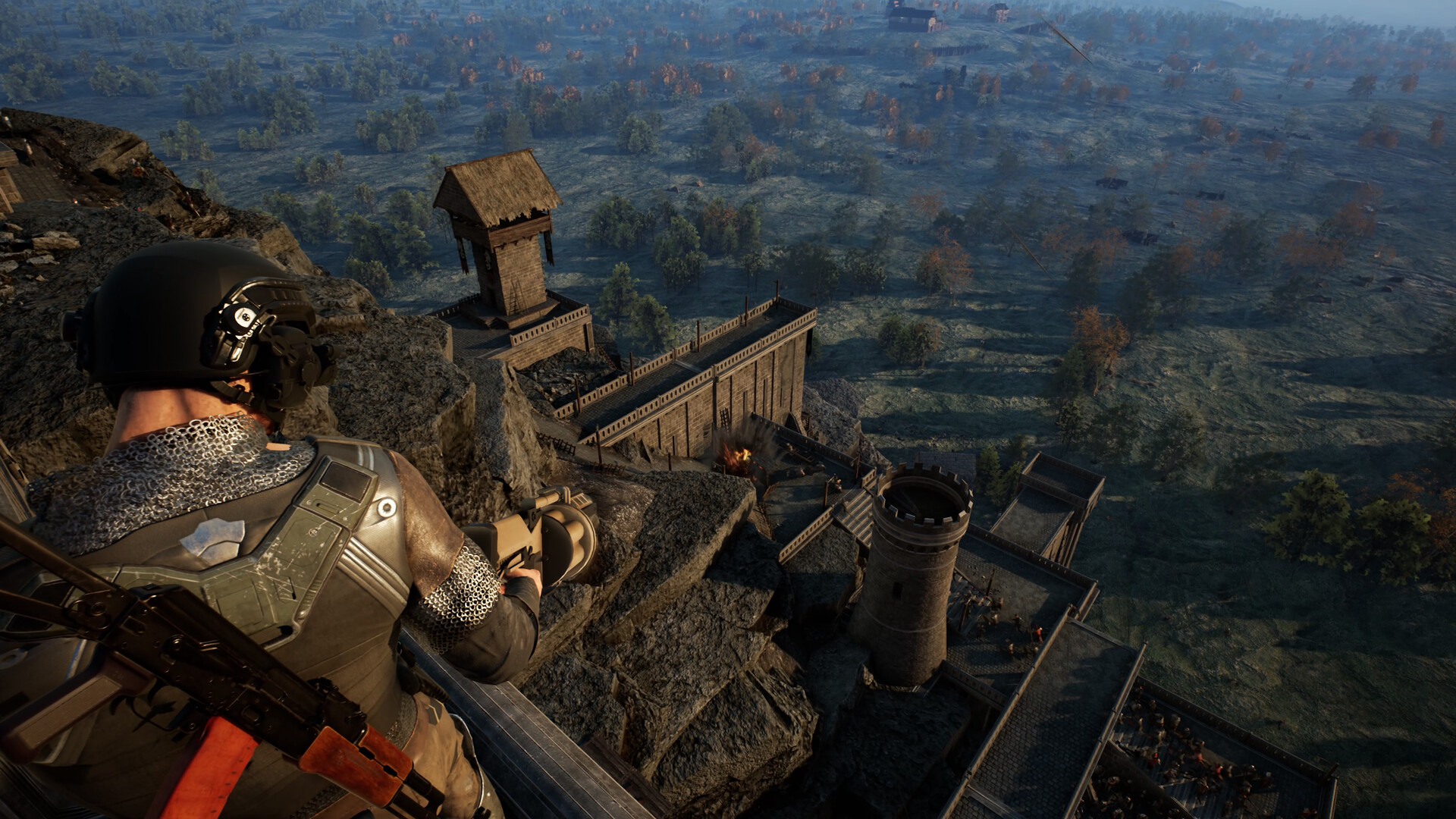
The player can construct a variety of building types, each serving a different function in the kingdom's economy and military machine.
Category | Examples | Purpose |
|---|---|---|
Settlements | Villages, towns, population centers | Generate workers and serve as hubs for other buildings; population growth |
Economy | Markets, trade posts, warehouses | Process and distribute resources; generate passive income |
Production | Smithies, armories, workshops | Manufacture equipment, weapons, and supplies for the army |
Research | Libraries, observatories, academies | Unlock new technologies, unit upgrades, and building types |
Military | Barracks, stables, training grounds | Recruit and upgrade military units |
Fortifications | Walls, gates, towers, guard posts | Defend territory and control chokepoints |
Construction requires resources and time. Buildings can be placed during strategy mode and will be built by workers over a period that depends on the building's complexity and the number of workers assigned. The player can prioritize certain buildings by assigning more workers, though this comes at the cost of slower progress on other projects. Deciding what to build and in what order is one of the first major strategic decisions in any playthrough.
The population management aspect adds another layer. Different segments of the player's population have different levels of technological understanding. Medieval peasants can operate farms, mines, and basic workshops, but they cannot maintain modern equipment without training. Managing populations across these different technological capability levels is part of the kingdom building challenge. The player needs enough technologically literate workers to keep the modern equipment running while maintaining a large enough peasant base to support the medieval economy.
Buildable roads were added to the village layer in 2026 development builds. Roads are a placeable construction the player lays out across the settlement alongside the other structures, giving the kingdom layout an additional planning element. As with the rest of the in-progress economy work, the exact role and benefits of roads may change before launch.
A July 2026 update went further on fortifications. It confirmed that in the current build the player can raise defensive walls around a base, and that attacking enemies can break through those walls to force their way in. This ties the fortification layer directly into the game's destructible environments, so a wall is a physical barrier that has to be held rather than a fixed edge of the map. As with the rest of the in-progress construction work, the exact costs and rules for walls may still change before launch.
The July 2026 expo build did not expose the construction layer, but the publisher described how it is meant to fit together. Resources pay for building, building raises how efficiently further resources come in, and that in turn opens access to stronger soldiers and better weapons. That loop is why the strategy layer still matters to players who would rather spend their time fighting on foot.
Unit Upgrades and Training
Soldiers are recruited directly into one of the six unit types: Swordsmen, Spearmen, Cavalry, Archers, Berserkers, and Men-at-Arms.
Upgrade Path | Starting Unit | Tiers | Key Improvements |
|---|---|---|---|
Swordsmen | Base tier | 2-3 tiers | Increased health, damage, and armor; better swords and shields |
Spearmen | Base tier | 2-3 tiers | Anti-cavalry effectiveness; longer reach; formation bonuses |
Cavalry | Base tier (requires a Stable) | 2-3 tiers | Speed, charge damage, and mounted combat effectiveness |
Archers | Base tier | 2-3 tiers | Range, accuracy, and arrow damage; upgraded bow types |
Berserkers | Base tier | 2-3 tiers | Massive damage output; low armor but high aggression |
Men-at-Arms | Base tier | 2-3 tiers | Best all-around stats; heavy armor; expensive to maintain |
Each upgrade tier improves a unit's stats (health, damage, armor, and movement speed) and changes its equipment visually. Higher-tier units are significantly more effective than their lower-tier counterparts, but they cost more resources to produce and maintain. A small army of fully upgraded Men-at-Arms might hold a chokepoint more effectively than a much larger force of base-tier troops, but the investment required to reach that point is substantial.
The infirmary, which handles healing and respawn for the player's forces, was reworked during 2026 development builds, and cavalry training was accelerated so mounted units reach the field faster. These adjustments are part of ongoing balance work and are not final.
Officer Experience
Officers are individual named characters who lead squads of soldiers. Unlike the soldiers they command, officers gain individual XP from each battle they participate in. A veteran officer who has survived multiple engagements becomes progressively more effective, improving the performance of the troops under their command. Losing a veteran officer is a much bigger setback than losing the same number of regular soldiers, because the experience and leadership bonuses they provide cannot be quickly replaced.
Officer XP accumulates naturally through combat. Officers who lead charges, hold defensive positions, or participate in successful engagements gain more experience than those who sit in the rear. This encourages the player to put their best officers where the fighting is heaviest, which also puts them at the greatest risk of being killed or captured. The tension between maximizing an officer's growth and protecting them from danger is a constant consideration in both strategy mode planning and real-time battle execution.
The Prisoner System
Kingmakers includes a prisoner capture mechanic that adds a layer of non-lethal tactical options to combat. The player has access to a stun gun (specifically, the TASER Pulse) that can incapacitate enemy officers without killing them. Striking an officer in combat takes them out of the fight and makes them available for capture. Regular soldiers can also be taken prisoner through other means, but officers are the high-value targets because of their leadership bonuses and the intel they carry.
Once a prisoner is captured, the player has three options:
Option | Effect | Strategic Value |
|---|---|---|
Ransom | Returns the prisoner for currency | Generates immediate resources; especially valuable for high-ranking officers who command high ransoms |
Torture | Extracts intelligence information | Reveals enemy positions, supply routes, or hidden treasure locations; damages morale of the prisoner's former allies |
Execute | Permanently removes the officer | Sends a message to the enemy faction; can demoralize their troops but may harden others' resolve |
The choice between these options depends on the player's immediate needs and long-term strategy. A player short on resources might ransom every prisoner for quick cash. A player trying to locate hidden treasures might torture prisoners for intel. A player fighting a war of attrition might execute captured officers to permanently remove experienced leaders from the enemy's command structure. Each choice has consequences, and the system adds a layer of decision-making that extends beyond the battlefield itself.
Explosion and Combat Effects by Armor Tier
The kingdom building system's investment in unit upgrades directly affects how troops respond to combat. Explosion effects vary depending on the armor tier of the soldiers caught in the blast. Elite officers wearing the highest tier armor (Gold Titanium Alloy) will stagger from explosions but remain standing. Regular soldiers in basic armor, on the other hand, go flying or have their bodies blown apart entirely. The visual and mechanical difference between armored and unarmored soldiers under explosive fire is stark, and it provides immediate visual feedback about the value of the unit upgrade investments the player has made.
This tiered response to explosions is not just cosmetic. Officers who stagger but survive can rally their troops and continue fighting, while soldiers who are ragdolled or dismembered are permanently out of the fight. Investing in better armor through the kingdom building system directly improves a squad's survivability under fire, which makes the resource allocation decisions more meaningful. Every unit of gold spent on armor upgrades is gold that could have been spent on more troops, but those upgraded troops survive engagements that would wipe out cheaper alternatives.
Skill Tree and Holy Relics
Kingmakers has a full skill tree that provides upgrades and new abilities for the player's forces. The skill tree is powered by collectible holy relics scattered throughout the game world. These relics are rare items found through exploration, hidden in dungeons, rewarded for completing specific challenges, or recovered from defeated enemies. Each relic unlocks or upgrades a node on the skill tree, providing benefits that range from passive stat bonuses for units to entirely new abilities for the player character.
The relic-based skill tree adds an exploration incentive to a game that could otherwise be played entirely from the strategy map. Going out into the world on foot to find hidden relics is a very different activity from commanding armies from overhead, and it adds variety to the gameplay loop. Players who invest time in exploration will have a tangible power advantage over those who focus exclusively on military operations.
The skill tree is not purely a combat tool. Some nodes improve economic output, reducing construction time or increasing resource gathering rates. Others improve unit training speed or unlock new building types. The breadth of the skill tree means that the relics the player finds shape their overall strategy. A player who finds relics that boost economic nodes early will have a resource advantage. One who finds combat nodes first will have a military edge. This randomization in relic discovery ensures that no two playthroughs follow the exact same progression path.
Supply Lines
Armies need supplies to fight. Archers need a steady flow of arrows, and the player's modern weapons need ammunition. The supply system requires the player to maintain production infrastructure that keeps these consumables flowing to the front lines. An army that outpaces its supply lines will run low on arrows and ammunition, reducing its effectiveness until resupply arrives.
In practice, this means the player needs to think about logistics, not just tactics. Building production facilities near the front line reduces supply distance but exposes them to enemy attack. Building them in the rear is safer but creates longer supply routes that are vulnerable to raiding. Ammunition for modern weapons is more difficult to produce than arrows, creating a natural scarcity that forces the player to use modern firepower judiciously rather than as a crutch.
In co-op, one player can specialize in logistics and supply management, keeping the other players' armies fed and armed while they focus on combat. This division of labor turns supply management from a chore into a cooperative strategic role. The supply system adds a layer of realistic military planning that complements the more immediate excitement of battlefield command and personal combat.
Balancing Medieval and Modern
The central strategic tension in kingdom building is the balance between medieval infrastructure and modern technology. The medieval side (settlements, economy, military buildings, fortifications) provides the army and the resources. The modern side (weapons, vehicles, air support) provides the player's personal power and the ability to intervene decisively in specific situations. Neither side is sufficient on its own.
A player with a powerful modern arsenal but no army will be overwhelmed by numbers. A player with a massive army but no modern equipment will lack the ability to break through heavily fortified positions or respond to unexpected threats quickly. The best approach involves building both sides in parallel: investing in the medieval economy early to establish a resource base, then gradually ramping up modern technology spending as the campaign progresses and the challenges become more demanding.
The exact balance shifts depending on the player's co-op partners and the specific challenges of each campaign mission. In co-op, players can specialize: one might focus on building the medieval economy and army while another invests heavily in modern technology. This specialization makes the co-op experience feel genuinely different from solo play, where the player must handle both sides of the equation themselves.