

Strategy Mode
In-depth guide to Kingmakers' real-time strategy mode, covering army command, seamless mode switching, kingdom building, resource management and supply lines, the morale system, the prisoner system, fortification construction, and how strategy integrates with co-op multiplayer.
On This Page
Overview
Strategy mode is one of the two core gameplay modes in Kingmakers, and it is where the game's ambitions as a hybrid title become most clear. At any point during gameplay, the player can pull the camera up from the third-person shooter perspective into an overhead, top-down view. From this vantage point, the game functions as a real-time strategy title in the vein of Total War or StarCraft: the player commands armies of AI soldiers, issues formation orders, assigns attack targets, and manages the flow of battle involving thousands of individual combatants. In official screenshots of this view, friendly troops are drawn as clusters of small green markers arranged in formation blocks over the terrain, so the player reads unit positions and spacing from the marker layout rather than from the soldier models themselves.
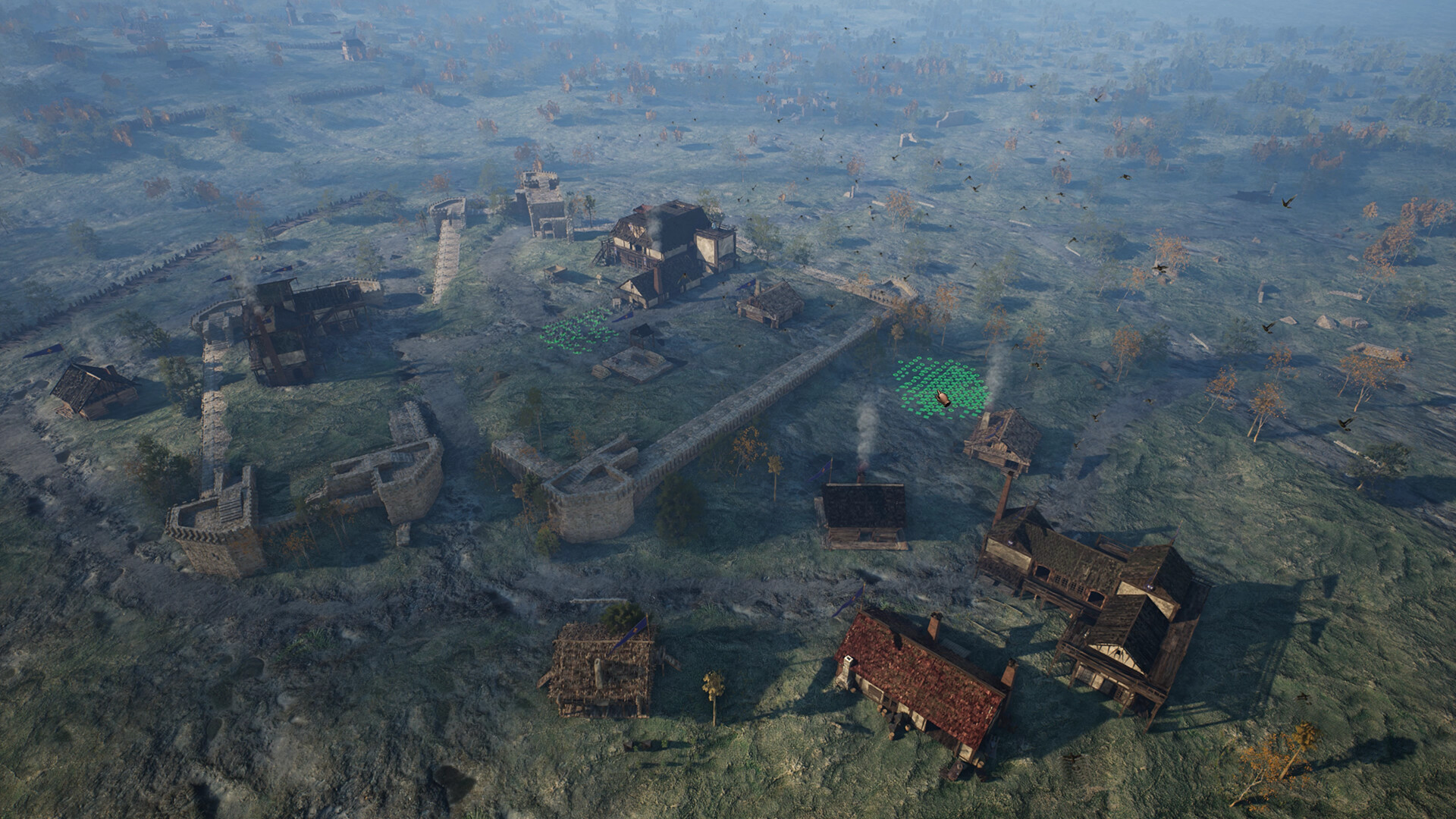
The developers have been careful to emphasize that the strategy side is not a simplified add-on stapled to a shooter. The AI governing each soldier is described as "more robust than Total War," using UE4 navmesh combined with custom solutions. Loyalty is tracked as an individual AI attribute alongside decision-making and pathfinding. Every soldier exists as part of a fully real-time simulation from the moment a mission starts; they are not spawned when the camera looks at them or triggered by proximity. The scale of these battles, with up to roughly 4,000 soldiers on the field (potentially 8,000 under optimal conditions), gives strategy mode a weight and complexity that stands on its own.
Seamless Mode Switching
The transition between strategy mode and shooter combat is seamless. There is no loading screen, no menu transition, and no pause. The player can be firing an assault rifle at ground level one second and directing a cavalry charge from the sky the next. This fluidity is one of the game's signature features and what sets it apart from other titles that attempt to combine shooter and strategy elements but keep them in separate phases.
A typical engagement might unfold like this: the player opens in strategy mode, positioning their army in a defensive formation along a river crossing. As the enemy approaches, the player drops into shooter mode to personally snipe the enemy officers leading the charge. After eliminating the officers and disrupting the enemy's momentum, the player pulls back to strategy mode to send Cavalry around the enemy's exposed flank. Then back to shooter mode to break through a fortified gate with an RPG. Then back to strategy to redirect Archers to cover a new firing lane. This constant back-and-forth is the core rhythm of Kingmakers and what makes it feel different from either a pure shooter or a pure RTS.
Army Command
From the overhead view, the player selects individual units or groups and issues standard RTS commands: move, attack, hold position, retreat, and form up. The six medieval unit types (Swordsmen, Spearmen, Cavalry, Archers, Berserkers, and Men-at-Arms) each have different movement speeds, engagement ranges, and tactical roles, so managing them effectively requires understanding their strengths and positioning them where they perform best.
The battlefield can support up to roughly 4,000 NPC soldiers simultaneously, with the engine capable of pushing toward 8,000. At this scale, individual unit commands matter less than broad strategic decisions: where to commit the main force, when to send in reserves, where to position ranged units for maximum coverage, and when to pull back a unit that is taking unsustainable casualties. The sheer number of soldiers on the field creates a level of chaos that rewards planning but also forces adaptation when plans break down under contact with the enemy.
The developers compare unit behavior to Mount and Blade rather than Total War. Soldiers are "fully individual and AI-driven" rather than moving in preset formation blocks. Each soldier makes independent decisions within the parameters set by their AI, which means formations are organic rather than rigid. A line of Swordsmen ordered to hold a position will adjust individually to incoming threats, closing gaps and shifting to face attackers, rather than standing rigidly until they die. This gives battles a more naturalistic feel but also means the player cannot rely on pixel-perfect formation placement the way they might in a traditional RTS.
The July 2026 demo build showed why commanding troops is not optional. Its mission was built around taking strongholds, the forts and villages held by enemy forces, and the player character can be killed by ordinary medieval weapons like anyone else on the field. Walking into a mass of infantry alone ends badly regardless of firepower, so the workable approach is to let allied soldiers absorb the charge and hold the line while the player picks targets from a safer angle.
Command Interface
The way commands are issued from the overhead view has been reworked during 2026 development builds. Earlier builds had the player click on individual buildings to queue production and research. That model was replaced with a single command tray that rolls out from the right side of the screen, a layout the team compares to classic base-management real-time strategy games. Production, training, and research are consolidated into this one tray rather than spread across the structures themselves, so the player manages the whole kingdom from a single interface without hunting for the right building on the map.
Two further command-layer systems are in development and may change before release. A wave timer that governs the cadence of incoming enemy attacks is being tuned through repeated internal playtesting. The team is also building a temporal troop transport mechanic that lets the player move allied soldiers across the battlefield by way of the game's time travel conceit, rather than only marching them on foot. Both are works in progress shown in development updates rather than finished, shipping features.
Kingdom Building
Strategy mode extends well beyond battlefield command. Between engagements, the player manages a growing kingdom that provides the resources and infrastructure to sustain the war effort. This colony-management system allows players to build, maintain, and organize various structures that directly support their military campaigns.
Building Category | Function | Examples |
|---|---|---|
Settlements | Population centers; generate workers and serve as hubs | Towns, villages, population growth structures |
Economy Buildings | Generate income and manage resource flow | Copper mines, gold mines, trading posts |
Production Facilities | Create equipment, weapons, and supplies | Blacksmiths, stables, armories |
Research Buildings | Unlock new technologies and upgrades | Laboratories, workshops |
Fortifications | Protect territory and anchor defensive lines | Walls, gates, guard positions, archer towers |
The kingdom building system gives strategy mode a layer of long-term planning that extends beyond individual battles. A player who invests early in economy buildings will have more resources later but fewer soldiers in the short term. A player who rushes military production will field a larger army sooner but may struggle to sustain it without the economic infrastructure to replace losses and fund upgrades. Every building decision trades present capability against future potential.
Settlement development involves balancing traditional medieval needs with the requirements of maintaining modern equipment. Peasants understand blacksmithing and farming; they do not understand how to service an assault rifle. The game includes population management across different levels of technological understanding, creating a simulation where the player must bridge the gap between a medieval workforce and a modern military machine.
Resource Management and Supply Lines
The primary resources in Kingmakers are copper, gold, and hidden treasures. These are gathered through kingdom building infrastructure, from looting defeated enemies, by capturing resource nodes on the map, and from discovering hidden caches during exploration. In a twist that ties directly into the time travel narrative, resources gathered in 1400 AD are sent forward to the future, where they serve as currency for unlocking upgrades, new equipment, and advanced military hardware.
This creates a compelling dynamic where the player's medieval kingdom functions as a resource-extraction operation funding their modern military capabilities. Investing in copper mining and gold production in the past directly improves access to assault rifles, vehicles, and air support from the future. But the future is described as being "in rough shape suffering from low resources," so requesting new guns is not simple. Every piece of modern equipment has a real cost in medieval resources, and the player must decide how to allocate between upgrading their modern arsenal and expanding their medieval infrastructure.
Supply lines are a concrete gameplay mechanic, not just a narrative concept. Archers need a steady supply of arrows, and the player must ensure that production keeps pace with consumption during prolonged campaigns. Ammunition for modern weapons follows the same logic. Running out of bullets in the middle of a siege because production could not keep up with expenditure is a real possibility that punishes players who neglect their logistics. Maintaining these supply lines while also defending territory and pushing offensives is one of the core challenges of mid-to-late game strategy.
Morale System
Medieval armies in Kingmakers operate under a morale system that affects their willingness to fight. Troops that are winning, well-supplied, and led by experienced officers fight harder and hold ground longer. Troops that are surrounded, taking heavy casualties, watching their officers die, or seeing allied units rout may break and retreat from the battlefield regardless of orders.
Several factors influence morale. Killing enemy officers drops the morale of nearby enemy troops significantly. Berserkers in rage mode have a morale-breaking effect on enemies they engage. Successful Cavalry charges, especially into already-wavering units, can trigger a complete rout. On the defensive side, keeping units near Swordsmen (who have formation-based morale bonuses) helps maintain cohesion under pressure. The morale system adds a psychological dimension to battles that goes beyond damage calculations. Sometimes the most effective tactic is not to kill every enemy soldier, but to break their will to fight through targeted strikes against leadership and momentum-shifting flanking attacks.
The presence of civilians on the battlefield adds another morale-related consideration. How the player's forces interact with non-combatants can affect the morale and loyalty of their own troops as well as the perception of the player's faction among allied and enemy populations. The moral dimension of warfare is woven into the strategy layer rather than being limited to cutscene choices.
Prisoner System
When enemy officers are captured during battle (using the taser/stun gun or through surrender after morale breaks), the player faces a choice with three options, each carrying different strategic and narrative consequences.
Option | Immediate Effect | Long-Term Consequence |
|---|---|---|
Ransom | Returns the officer to the enemy in exchange for resources | Maintains diplomatic standing; the officer may return to fight again later |
Torture | Extracts intelligence on enemy positions, troop compositions, or hidden resource caches | Damages diplomatic standing; may make future negotiations harder |
Execute | Eliminates the officer permanently from the war | May demoralize or enrage enemy forces; sends a strong message to other potential opponents |
The prisoner system ties into the game's broader faction and narrative systems. How the player treats prisoners affects their reputation with all factions and influences story direction. A player who consistently ransoms prisoners maintains more diplomatic options and a reputation for honorable conduct but gains fewer intelligence advantages and allows enemy officers to return to the field. A player who tortures prisoners gains tactical information but burns diplomatic bridges. A player who executes prisoners removes threats permanently but builds a reputation for brutality that closes off certain alliance paths.
Over the course of a full campaign, these choices accumulate. The prisoner system is not a one-time decision; it is a pattern of behavior that shapes how the world reacts to the player. Combined with the faction choice and other narrative decisions, it feeds into the calculation that determines which of the game's multiple endings the player receives.
Fortification and Defense
Building defensive structures is a significant part of strategy mode, especially in the mid-to-late game when the player controls enough territory that defending it all simultaneously becomes impractical. Guard positions allow stationing troops at specific locations where they automatically engage enemies entering their range. Archer towers provide elevated, protected firing positions. Walls and gates create physical barriers that enemy forces must breach or bypass. Trebuchets and ballistae can be positioned behind walls to engage enemies at long range while remaining protected.
Defensive construction becomes particularly important in co-op, where multiple players may expand in different directions and need to protect their borders while their armies are committed to offensive operations elsewhere. A well-built line of fortifications can hold a position with minimal troop investment, freeing up soldiers for attacks on other fronts. The interplay between fixed defenses and mobile armies is one of the deeper strategic considerations in Kingmakers, and players who master both will hold a significant advantage over those who rely on offensive power alone.
Fortifications also serve a role in the destruction system. Enemy siege equipment, or even the player's own vehicles, can destroy walls, gates, and towers. This means defensive positions are not permanent; they can be breached by concentrated attack, requiring the player to repair, reinforce, or abandon compromised positions. The back-and-forth of building, defending, breaching, and rebuilding adds a layer of dynamism to what could otherwise be a static defensive game.
Strategy in Co-Op
Strategy mode gains additional depth in cooperative multiplayer. In a four-player session, players can divide strategic responsibilities in ways that are impossible solo. One player might remain in strategy mode full-time, directing the overall battle and managing the army. Two others might operate on the ground in shooter mode, acting as special forces that handle high-value targets like officers and siege equipment. The fourth might manage kingdom building, resource gathering, and supply lines while the others focus on combat.
Alternatively, all four players might each control their own sector of the battlefield, managing their own armies and territories independently while coordinating on broader strategic goals. The flexibility of who uses strategy mode and who uses shooter mode at any given moment, combined with the scale of the battles and the complexity of the kingdom management, means that co-op Kingmakers plays very differently from solo Kingmakers. Communication and coordination between players become their own layer of strategy on top of the in-game systems.