

Overview
The armor and penetration system in Kingmakers governs how every weapon in the game interacts with enemy soldiers and the environment. Not all bullets have an easy time taking down all enemy types, because every caliber comes with realistic penetration values. Where the player aims matters too. A headshot with a low-caliber weapon might drop an unarmored soldier instantly, while the same round pinging off heavy plate armor does nothing. The system creates a layer of tactical depth that prevents modern weapons from being an automatic win button against medieval opponents.
The developers at Redemption Road Games tested real firearms to inform the penetration model. They looked into how real armor holds up against different types of ammunition, and those findings shaped the in-game values. The result is a system where weapon choice genuinely matters. A player who brings a 9mm pistol to a fight against heavily armored knights is going to have a bad time, not because the game is unfair, but because a 9mm round cannot punch through that much steel in real life either.
Armor Tiers
Enemy soldiers in Kingmakers wear one of three armor tiers, each offering progressively more protection against incoming fire. The armor tier determines how much punishment a soldier can absorb and which weapon calibers are effective against them.
Armor Tier | Protection Level | Typical Wearer | Effective Against |
|---|---|---|---|
Steel | Basic | Regular rank-and-file soldiers | Resistant to arrows and light melee; vulnerable to most firearms |
Hardened Steel | Intermediate | Veteran soldiers, squad leaders | Resists light caliber firearms (9mm); requires mid-caliber or better to penetrate |
Gold Titanium Alloy | Elite | Elite officers, high-ranking commanders | Resists light and mid-caliber firearms; requires heavy caliber or explosives to penetrate |
The naming of the tiers reflects a progression in material quality. Basic steel armor is historical and realistic for the 1400 AD setting. Hardened steel represents the best that medieval metallurgy can produce. Gold titanium alloy is the top tier, worn only by the most important enemy officers. The alloy name suggests a level of material science beyond normal medieval capabilities, fitting for the enemies the player faces in later stages of the game when the difficulty ramps up.
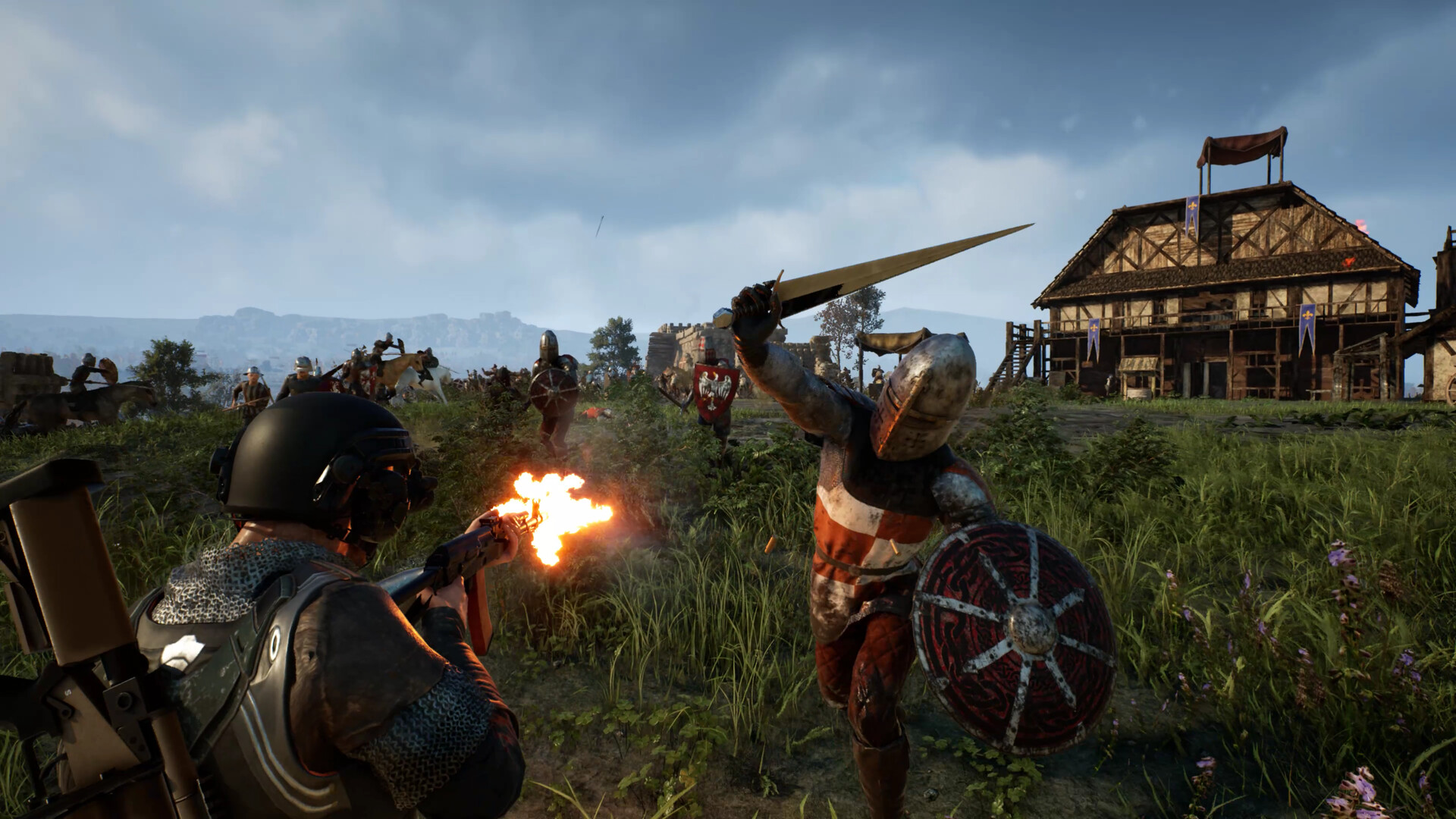
Each tier is visually distinct. Players can identify an enemy's armor level by looking at them, which is important in the heat of combat when there is no time to check stats. Steel armor looks like standard medieval plate. Hardened steel has a darker, more polished appearance. Gold titanium alloy has a distinctive golden sheen that makes elite officers stand out on the battlefield. This visual clarity lets experienced players make instant weapon selection decisions based on what they see. The player character is armoured on the same battlefield terms: across the official screenshots the operator is shown wearing a mail coif and sleeves underneath a modern plate carrier and combat helmet, mixing period protection with modern kit.
Weapon Caliber Effectiveness
Every weapon in the game has a penetration rating that determines which armor tiers it can defeat. Light calibers struggle against even basic armor, while mid-to-heavy calibers can pierce hardened or titanium alloy. The specific interactions between calibers and armor tiers follow a consistent logic rooted in the real-world physics of ballistic penetration.
Model names such as the Desert Eagle, the AR-15 variant and the Benelli M3 are used below only as shorthand. The developers have stated that they cannot use real-world trademarks, so the in-game hardware is modelled to closely resemble real counterparts rather than being licensed from them. Treat these designations as community identifications of what a weapon resembles on screen, not as the names the game itself uses.
Weapon / Caliber | vs. Steel Armor | vs. Hardened Steel | vs. Gold Titanium Alloy | Environmental Penetration |
|---|---|---|---|---|
9mm Pistol | Penetrates | Blocked | Blocked | Goes through plaster and wooden shields |
.50 cal Desert Eagle | Penetrates | Penetrates | Partial (weakened) | Goes through wood and thin stone |
5.56mm Assault Rifle (e.g., AR-15 variant) | Penetrates | Penetrates at close range | Blocked without upgrades | Goes through plaster and wood |
7.62mm Battle Rifle | Penetrates | Penetrates | Partial | Goes through wood; damages stone |
High-caliber LMG (e.g., Norma) | Penetrates | Penetrates | Penetrates | Goes through multiple walls; hits soldiers behind cover |
Shotgun (Benelli M3) | Penetrates at close range | Partial at point blank | Blocked | Destroys plaster walls; limited vs. wood |
Explosives (grenades, RPGs) | Penetrates | Penetrates | Penetrates | Destroys all material types |
Medieval bow | Blocked by full plate | Blocked | Blocked | Does not penetrate structures |
The table above illustrates a key design principle: no single weapon is universally effective. A 9mm pistol can go through wooden shields and basic steel armor, making it useful against lightly armored troops. But to punch through hardened steel, the player needs something with more stopping power, like the .50 caliber Desert Eagle. Against gold titanium alloy, only the heaviest weapons, explosives, or high-caliber light machine guns are reliably effective.
The medieval bow deserves special mention. Bows cannot get through a full plate of armor, which means that archer units are only effective against unarmored or lightly armored targets. Against heavily armored knights, archers serve more as a suppression tool (forcing enemies to keep their shields up and move slowly) than as a damage dealer. This limitation is historically accurate; medieval plate armor was designed specifically to defeat arrow fire, and the game reflects that reality.
Environmental Material Penetration
The penetration system applies to destructible environments just as it applies to armor. Weapons interact differently with plaster, wood, and stone, and these interactions follow the same logic as armor penetration.
Material | Light Caliber (9mm) | Mid Caliber (5.56mm, 7.62mm) | Heavy Caliber (.50 cal, LMG) | Explosives |
|---|---|---|---|---|
Plaster | Full penetration | Full penetration | Full penetration (exits opposite side) | Destroys entirely |
Wood | Partial (loses energy) | Penetrates | Full penetration | Destroys entirely |
Stone | Blocked | Blocked (chips surface) | Partial (cracks, weakens) | Destroys or breaches |
The practical consequence of environmental penetration is that cover in Kingmakers is not binary. Standing behind a plaster wall provides almost no protection from gunfire, because most weapons will shoot straight through it. A wooden palisade is better but still vulnerable to mid-caliber and heavier weapons. Only stone offers reliable protection, and even stone can be destroyed by explosives or weakened by sustained heavy fire.
High-caliber light machine guns like the Norma are particularly dangerous in the environmental penetration context. These weapons can shoot through multiple walls and take out several soldiers standing behind cover with a single burst. In castle sieges, an LMG positioned with a line of sight through plaster interior walls can sweep entire rooms without the gunner ever entering the building. This makes LMGs one of the most powerful weapons for castle assaults, second only to explosives in their ability to neutralize defenders behind cover.
Weapon Upgrades and Penetration
Weapon upgrades, purchased through the kingdom building system's resource-to-future economy, directly affect penetration values. A basic version of a weapon may start weak against high-tier armor, but fully upgrading it can allow it to match elite opponents. The upgrade paths for each weapon typically include improvements to magazine capacity, armor penetration, accuracy at range, and reload speed.
Penetration upgrades are the most tactically significant. An un-upgraded assault rifle might bounce off hardened steel armor at anything but point-blank range. Fully upgraded, the same rifle can punch through hardened steel reliably and even chip away at gold titanium alloy. This upgrade progression means that the player's weapon loadout grows in effectiveness alongside the enemy's armor progression. Early in the game, when enemies mostly wear basic steel, even base-level weapons are effective. As the campaign progresses and enemies start wearing better armor, the player must invest in weapon upgrades to keep pace.
The upgrade system creates an interesting decision tree. The player can choose to upgrade a single weapon to maximum effectiveness, making it powerful against all armor tiers, or spread upgrades across multiple weapons to maintain versatility. A fully upgraded Desert Eagle can handle nearly any armor type, but the player has only invested in one weapon. Alternatively, upgrading a pistol, a rifle, and an LMG to moderate levels provides options for different engagement ranges but may leave the player without a reliable counter for elite officers at long range.
Explosion Effects by Armor Tier
The armor and penetration system extends to how soldiers respond to explosions. The game differentiates between armored and unarmored responses to explosive damage, and the visual and mechanical results are dramatically different.
Armor Tier | Explosion Response | Visual Effect |
|---|---|---|
No armor / Light armor | Soldiers go flying or are dismembered | Bodies ragdoll through the air; limbs can be blown off entirely |
Steel armor | Soldiers are knocked down and heavily damaged | Bodies tumble and fall; significant but not always fatal |
Hardened Steel | Soldiers stagger and take moderate damage | Noticeable impact but soldiers may stay on their feet |
Gold Titanium Alloy | Elite officers stagger but remain combat-effective | Officers brace against the blast; minimal visible knockback |
The difference is not just visual. An explosion in a group of basic soldiers might kill or incapacitate a dozen of them, sending bodies flying and clearing the area. The same explosion hitting a group of elite officers will stagger them, interrupt their current actions, and deal some damage, but they will recover and continue fighting within seconds. This means that tactics which work against regular troops (such as softening a position with a grenade before charging in) may not work against elite defenders, who shrug off the blast and are ready to fight when the attacker arrives.
For the player, understanding these differential responses is essential for planning assaults. Against regular soldiers, a grenade into a chokepoint followed by an immediate push is effective. Against elite officers, the player might need to follow the grenade with sustained heavy fire to finish off the staggered targets before they recover. In co-op multiplayer, one player can throw the grenade while another is already positioned to fire on the staggered officers, turning the explosion into a setup for a coordinated kill rather than a standalone attack.
Shield Interactions
Medieval soldiers in Kingmakers carry shields that interact with the penetration system. A wooden shield blocks arrows and slows light-caliber rounds, but a 9mm round will punch through a wooden shield and the steel armor behind it. Higher-caliber weapons destroy shields outright. The .50 cal Desert Eagle, for example, does not just penetrate a wooden shield; it shatters it, leaving the soldier behind it completely exposed.
Shield-equipped unit types (primarily Swordsmen and Men-at-Arms) are among the most durable enemies when the player is using low-caliber weapons. Their shields absorb multiple rounds before breaking, and the soldier's armor provides a second layer of protection behind the shield. Against these enemies, the player has several options: use a higher-caliber weapon to punch through both shield and armor, aim for exposed body parts around the shield, use explosives to bypass the shield entirely, or command medieval troops to engage in melee and strip the shield away through conventional combat.
The shield breakage system also feeds into the game's performance optimization. Rather than simulating complex multi-hit physics on shields indefinitely, the game uses a health-based system where each shield has a durability threshold. Once that threshold is crossed, the shield breaks in a physically convincing way and becomes debris. This approach produces visually satisfying shield destruction without the performance cost of per-frame physics simulation on every shield on the battlefield.
Practical Weapon Selection
Understanding the armor and penetration system allows the player to select the right weapon for each engagement. The general principle is straightforward: match the caliber to the armor. But the specifics matter. Here are practical guidelines for different combat situations.
Situation | Recommended Weapon | Reason |
|---|---|---|
Open field against lightly armored troops | Assault rifle (5.56mm) | Good range, penetrates steel, conserves heavy ammo |
Castle breach against mixed armor types | Shotgun + explosives | Shotgun for close quarters, explosives for fortifications and groups |
Elite officer defense point | .50 cal Desert Eagle or LMG | Only heavy calibers reliably penetrate gold titanium alloy at range |
Shooting through walls at defenders | High-caliber LMG (Norma) | Penetrates multiple walls; can clear rooms without entering |
Stealth approach to a lightly defended position | 9mm pistol + sledgehammer | Quiet entry; pistol handles basic armor, sledgehammer breaches walls |
Large-scale siege with multiple entry points | RPG / grenade launcher + rifle | Explosives breach walls and scatter defenders; rifle picks off survivors |
Ammunition scarcity is a factor the player must always consider. Heavy caliber rounds and explosives are expensive to produce through the kingdom building supply chain, so using them on every encounter is not sustainable. The most efficient approach is to use the lightest weapon that gets the job done: 9mm for unarmored targets, assault rifle for basic and mid-tier armor, and save the heavy weapons for elite officers and fortified positions. Running out of .50 cal rounds in the middle of a fight against gold titanium alloy officers because the player wasted them on rank-and-file infantry is a mistake that the kingdom building system does not forgive quickly.