

Medieval Units
Complete guide to the six medieval unit types in Kingmakers at Early Access launch, including detailed breakdowns of strengths, weaknesses, upgrade tiers, the holy relics skill tree, siege equipment, the morale system, officer mechanics, and army composition strategy.
On This Page
Overview
The medieval armies in Kingmakers are not background decoration. They are the backbone of the player's fighting force and the primary challenge on the enemy side. At Early Access launch, six distinct unit types are available. Each fills a specific battlefield role and interacts with other unit types through a rock-paper-scissors balance system. Understanding these matchups is essential for winning large-scale engagements, because even the best personal combat skills cannot compensate for a poorly composed army. Every soldier on the battlefield is controlled by a next-gen multi-threaded AI that governs decision-making, pathfinding, and loyalty as individual attributes.
All six unit types can be commanded from strategy mode, where the player issues formation orders, attack commands, and movement directives from an overhead view. The developers have compared unit behavior to Mount and Blade rather than Total War: soldiers are "fully individual and AI-driven" rather than moving as preset formation blocks. Characters fight from the moment a mission starts as part of a fully real-time simulation; they are not spawned on demand when the camera looks their way. This means that engagements happening across the map resolve according to the same rules whether or not the player is watching.
Unit Types
Unit | Role | Strengths | Weaknesses |
|---|---|---|---|
Swordsmen | Frontline infantry | Defensive bonuses near other units, especially Archers; solid in formation | Weaker against Spearmen; average damage output |
Spearmen | Anti-cavalry specialist | Counter Cavalry; long reach slows and knocks riders off horses | Vulnerable to Archers and flanking; no formation bonuses |
Cavalry | Fast flanking, shock attacks | High speed; devastating charges that smash through lines | Countered hard by Spearmen; struggles in tight spaces |
Archers | Ranged support | Counter light armor (Spearmen, Berserkers); effective at range before melee | Extremely vulnerable in close combat; lowest armor |
Berserkers | Burst damage, aggression | Rage mode for massive burst damage; break enemy morale | Fragile outside rage window; no formation bonuses |
Men-at-Arms | Heavy tank | Heaviest armor; macemen who absorb enormous punishment; temporary defense boost | Slowest unit; vulnerable to flanking and sustained ranged fire |
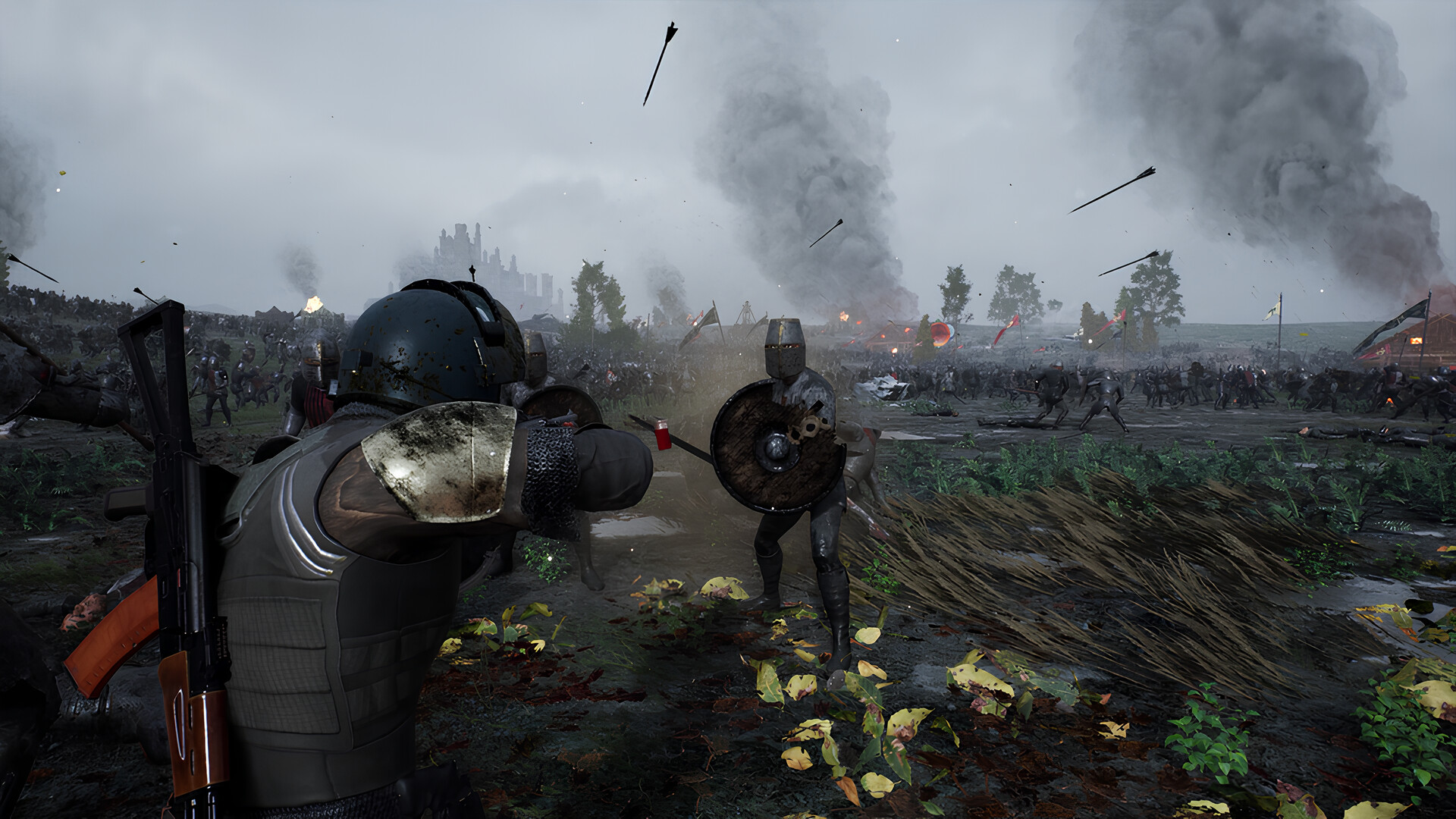
Swordsmen
Swordsmen are the most versatile infantry unit and typically form the core of any army composition. They carry swords and shields, providing a balanced mix of offense and defense. Their defining feature is a proximity bonus: when positioned near other friendly units (particularly Archers), they receive a defensive boost that makes them significantly harder to kill. This encourages players to keep Swordsmen in tight formations alongside support units rather than sending them out alone.
In practice, Swordsmen are the unit you build when you need a reliable front line. They will not counter any specific enemy type with dramatic effectiveness, but they will not fold to any single counter either, with the exception of Spearmen who hold the advantage in direct engagements. They are the bread and butter of most army compositions, and new players will likely lean on them heavily before learning the subtleties of the other five types. Their shield-based defense also provides passive protection against arrow fire, making them natural partners for Archers who benefit from the proximity bonus while the Swordsmen absorb incoming volleys.
Spearmen
Spearmen exist primarily as the answer to Cavalry. Their long-reaching spears allow them to strike mounted units before those units can close to melee range. The bonus damage they deal to Cavalry is severe enough to make them the hardest possible counter; a line of Spearmen can slow, unhorse, and destroy an entire Cavalry charge if positioned correctly. A defensive screen of Spearmen in front of your Archers or siege equipment creates a wall that enemy Cavalry simply cannot punch through.
The trade-off is that Spearmen are less effective against other infantry types and are particularly vulnerable to Archers, who can thin their ranks from a distance long before melee contact. Spearmen also lack the formation bonuses that make Swordsmen durable when grouped. They are specialists, and deploying them requires reading where enemy Cavalry is likely to appear. Placing Spearmen on a flank where no Cavalry exists wastes a position that could have been filled by a more versatile unit. Placing none at all when the enemy has Cavalry will cost you dearly.
Cavalry
Cavalry are the fastest units on the battlefield. Their primary role is flanking: swinging around the edges of an engagement to hit enemy Archers, siege crews, or the rear of an infantry formation. A well-timed Cavalry charge into unprotected ranged units can eliminate them almost instantly, and the speed of Cavalry allows them to disengage and reposition before the enemy can pin them down. Charges can smash through entire lines of lighter units.
Cavalry that charge directly into a Spearmen formation will be torn apart. The spears negate the charge bonus, knock riders off their horses, and Cavalry lack the armor to survive a prolonged melee on foot. Smart use of Cavalry means identifying the right moment and the right angle of attack, striking fast, and pulling out before the enemy can bring Spearmen to bear. In co-op multiplayer, having one player manage Cavalry flanks while another holds the front line with infantry creates a natural division of labor that the game is designed around.
Archers
Archers are the primary ranged unit, and their effectiveness depends almost entirely on positioning. Placed on high ground or behind a screen of Swordsmen, Archers thin enemy ranks well before the two sides meet in melee. They are particularly effective against lightly armored units like Spearmen and Berserkers, and they can soften heavy infantry enough to give your melee troops an advantage when the lines collide. Archer towers, part of the siege equipment roster, provide elevated and protected firing positions that further amplify their output.
The obvious weakness of Archers is close combat. Once an enemy reaches them, they have almost no defensive capability. Cavalry, which can close the distance quickly, are their natural predator. Protecting Archers is one of the core challenges of army composition. A player who leaves their Archers exposed will watch their ranged damage output disappear the moment enemy Cavalry swings around a flank. The Swordsmen proximity bonus is partly designed to address this: keeping Swordsmen near Archers gives the ranged units a defensive buffer while the Swordsmen benefit from the bonus.
Berserkers
Berserkers are high-risk, high-reward axe-wielding units that operate on a different rhythm than the other five types. Their defining feature is a rage mode that, once triggered, dramatically increases their damage output for a limited time. During rage, Berserkers tear through enemy formations with burst damage that exceeds any other infantry unit by a wide margin. They also have a morale-breaking effect on nearby enemies, which can cause wavering troops to rout entirely.
Outside of their rage window, Berserkers are fragile compared to Swordsmen or Men-at-Arms. They wear lighter armor, do not benefit from formation bonuses, and can be picked off by Archers before they ever reach the enemy line. Using Berserkers effectively is all about timing. Sending them in too early wastes the rage window on scattered skirmishing. Sending them in too late means they arrive after the battle's outcome is already decided. They are a specialist unit for players who favor aggressive, timing-dependent tactics, and they reward precise deployment with results that no other unit can match.
Men-at-Arms
Men-at-Arms are the heavy tanks of Kingmakers' medieval roster. They wield maces and wear the heaviest armor available, allowing them to absorb enormous amounts of damage before going down. In a straight fight, they outlast every other infantry type simply by not dying. Their role is to hold a position: a chokepoint, a gate, a bridge, or any location where the enemy has to come to them. They also have a temporary ability that boosts the defense of themselves and nearby allies, making them even harder to dislodge when activated.
The cost of all that armor is speed. Men-at-Arms are the slowest unit in the game, and they can be flanked by faster units if left unsupported. Cavalry charges against an exposed flank will deal significant damage, and sustained Archer fire can whittle them down from a safe distance over time. They work best when anchored in a defensive position with supporting units covering their flanks and rear. Trying to use Men-at-Arms in an offensive push requires patience and careful management of their movement to prevent faster enemies from simply running around them.
Upgrade System and Holy Relics
Each of the six unit types can be upgraded through two to three tiers. Upgrades improve stats, change equipment visually, and in some cases unlock new abilities or passive bonuses. The upgrade path is tied to the player's kingdom building progression: constructing specific buildings, gathering resources, and investing in military infrastructure are prerequisites for unlocking higher-tier units.
Beyond the tier system, a full skill tree powered by collectible holy relics provides additional enhancement. Holy relics are gathered during gameplay and spent on skill tree branches that enhance various troop types and unlock new abilities. For example, the Berserkers' rage mode and the Men-at-Arms' defense boost are enhanced through the relic skill tree. The skill tree is not tied to individual soldiers but instead applies globally to each unit type, meaning that investing in the Cavalry branch improves all Cavalry units across the army.
Each troop type is recruited at its base tier and upgraded from there, so a unit's line is fixed at recruitment and only its rank improves. Officers, who lead squads of soldiers, gain individual XP that tracks separately from the units they command. A veteran officer leading upgraded troops performs significantly better than a fresh recruit leading base-tier soldiers, creating an incentive to protect experienced leaders and keep successful units alive across multiple engagements.
Unit balance and clarity saw continued work during 2026 development builds. Cavalry training was sped up so mounted units reach the field faster, the infirmary that handles healing and respawn was reworked, and the relative strength of the army's heavier formations was rebalanced. The team has also put ongoing effort into making soldiers more visually identifiable on a crowded battlefield, so the player can tell allies from enemies at a glance. These are in-progress adjustments to an unreleased build and may change before launch.
Armor Tiers
Medieval troops wear three tiers of armor that interact directly with the weapon penetration system. Standard steel armor can be penetrated by most modern firearms, including 9mm handguns. Hardened steel resists lighter calibers and requires something on the order of a .50 caliber round to punch through. Gold titanium alloy, the highest tier, is both stronger and lighter than steel and is reserved for elite officers. This system means that the player's weapon choices matter differently depending on what they are fighting. A pistol that handles regular infantry just fine will bounce off an elite officer's gold titanium armor.
Armor Tier | Worn By | Weapon Required to Penetrate |
|---|---|---|
Steel | Regular infantry | 9mm and above |
Hardened Steel | Veteran units, mid-tier officers | .50 cal and above (heavy pistols and vehicle-mounted guns) |
Gold Titanium Alloy | Elite officers | Heavy weapons, explosives, or vehicle-mounted guns |
Officer Units
Officer units are distinct from regular soldiers in several important ways. They wear the best tier armor available, they lead and influence surrounding troops, and their deaths have an outsized impact on the battle. When an officer falls, the morale of nearby enemy troops drops significantly, potentially causing a cascade of breaks and routs. Multiple types of officers exist, each with their own troop type and fighting style. Shielded Pikemen officers march forward with raised shields and throw spears. Warhammer brutes hit wide areas with massive swings that can stagger multiple targets.
Targeting officers with modern weapons is one of the most efficient ways to break an enemy formation. An officer killed by a sniper round from across the field can cause an entire wing of the enemy army to waver, opening opportunities for a Cavalry charge or Berserker assault to finish the job. This creates a natural priority system in combat: identify the officers, deal with them first, and watch the rest of the formation crumble.
The studio has also described work on a personal honor guard that the player directs individually, alongside changes to how a player draws the attention of nearby enemy soldiers, which touches the battlefield AI layer. Both were listed as in-progress engineering work in mid-2026 rather than finished features, so how they behave in a released build is not settled yet.
Morale System
Medieval armies fight with a morale system that determines their willingness to continue the battle. Troops that are winning, well-supplied, and led by experienced officers fight harder and hold their ground longer. Troops that are surrounded, taking heavy casualties, or watching their officers die may break and rout, retreating regardless of orders. Morale can be influenced by many factors: killing officers, Berserker rage effects, successful Cavalry charges, and the general flow of battle.
When enemy morale breaks, soldiers may surrender or retreat from the field entirely. This is significant because it means that not every battle requires killing every enemy soldier. A well-executed strike that destroys enemy leadership and triggers a morale cascade can end an engagement far more quickly than a grinding attrition fight. The morale system rewards smart tactics over brute force and makes psychological warfare a valid strategy alongside physical combat.
Siege Equipment
Siege Weapon | Function | Best Used Against |
|---|---|---|
Trebuchets | Long-range stone throwing; high structural damage | Castle walls, fortifications, grouped infantry |
Ballistae | Large bolt launchers; high single-target damage | High-value targets, armored officers, gates |
Archer Towers | Elevated archer positions with protection | Advancing infantry, area denial, chokepoint defense |
Siege equipment cannot be commanded like mobile units. Trebuchets and ballistae need to be positioned before or during the battle, and archer towers are static defensive structures. They are part of the broader fortification system that includes guard positions, walls, gates, and other defensive constructions. The combination of medieval siege craft with the player's modern explosives and air support means that no castle is truly impregnable, but taking one efficiently requires choosing the right tools for the situation.
Army Composition Strategy
Building an effective army in Kingmakers requires balancing the six unit types against expected threats. A standard balanced composition might include a core of Swordsmen backed by Archers, with Spearmen protecting the flanks against Cavalry and a reserve of Berserkers or Cavalry for counter-attacks. Men-at-Arms anchor defensive positions while the player uses their modern weapons to handle specific high-value threats.
In co-op, army composition can be specialized between players. One player might focus entirely on ranged units and siege equipment while another builds a mobile strike force of Cavalry and Berserkers. A third might handle the defensive line with Swordsmen and Men-at-Arms while the fourth stays in shooter mode full-time, acting as a special forces unit that eliminates officers and siege equipment with modern firepower. The six-unit system is simple enough to learn quickly but deep enough that optimizing compositions for specific scenarios rewards experience and experimentation.