

Overview
Every building and fortification in Kingmakers is fully destructible. This is not a gimmick limited to specific scripted moments or reserved for cutscenes. Every wall, tower, gate, roof, and floor in the game can be damaged, broken, or completely demolished through player actions. The destruction is dynamic and physics-driven, meaning the way a structure falls depends on where and how it was hit, not on a predetermined animation. Two players hitting the same building from different angles with the same weapon will see entirely different results. Debris scatters realistically, floors buckle under damage, and towers topple based on where their structural supports fail.
This system is one of the primary reasons the development team at Redemption Road Games chose Unreal Engine 4.27 as their engine. While Unreal Engine 5 introduced features like Nanite and Lumen, none of the newer engine versions could match the processing speed required for the physics simulation that drives Kingmakers' destruction system. The team spent roughly five years developing the technology behind this feature, iterating on how structures break, how debris interacts with soldiers and terrain, and how all of it runs at acceptable frame rates on mid-range hardware.
How Destruction Works
The destruction system is physics-based from start to finish. When a structure takes damage, the game calculates which parts are affected based on the point of impact, the force of the hit, and the material the structure is made from. A wall hit in the center by a tank shell will collapse differently from one hit at the base by an explosive. A wooden house struck by a vehicle will splinter and fold in the direction of impact. A stone tower hit by a trebuchet stone will crack and crumble from the impact point outward.
Because the system is not scripted, it produces emergent results the developers did not specifically design. A partially collapsed building might leave a ramp of debris that troops can climb. A wall might fall outward and crush soldiers standing on the other side. A floor weakened by an explosion on the level below might give way under the weight of defenders. These emergent interactions are what separate Kingmakers' destruction from the pre-baked destruction in most other games, where buildings always fall the same way regardless of how they are hit.
The unpredictability extends to the tactical layer. Players quickly learn that destroying a wall does not just open a hole; it changes the flow of a battle. Rubble blocks pathways, collapsed towers eliminate elevated firing positions, and breached walls create flanking routes that did not exist moments ago. Every act of destruction reshapes the battlefield in ways that force both the player and the AI to adapt on the fly.
Material Types
Structures in Kingmakers are made from three material types, each with different durability and interaction properties. These materials determine not just how much punishment a building can absorb, but also how weapons interact with them from a penetration standpoint.
Material | Durability | Penetration Resistance | Common Structures |
|---|---|---|---|
Plaster | Low | Low (most weapons penetrate) | Interior walls, civilian buildings, peasant housing |
Wood | Medium | Medium (heavier weapons penetrate) | Barricades, palisades, rural structures, outer buildings |
Stone | High | High (only explosives and heavy weapons penetrate) | Castle walls, towers, keeps, fortified positions |
The material type creates a tactical layer during sieges and field battles alike. A sniper round that easily punches through a plaster wall might be stopped by wood. Stone blocks nearly everything except explosives and heavy vehicle-mounted weapons. Before deciding whether to shoot through a wall or go around it, the player needs to identify what it is made of. A plaster wall offers almost no protection, while a stone wall is effectively a fortress until heavy ordnance is brought to bear.
The armor and penetration system that governs how bullets interact with enemy soldiers uses the same underlying logic. A 9mm round that passes through plaster and wooden shields will be stopped cold by stone, just as it struggles against hardened steel armor on elite officers. The consistency between environmental penetration and soldier armor penetration means that players who understand one system already understand the other.
Methods of Destruction
Multiple tools are available for tearing down structures, each suited to different situations. The variety ensures that no defensive structure is truly impenetrable; it is only more or less difficult to break through depending on what the player has available.
Method | Best Against | Notes |
|---|---|---|
Explosives (grenades, RPGs, grenade launchers) | All material types | Most versatile option; effective against everything from wooden shacks to stone walls; area-of-effect damage can catch soldiers inside |
Sledgehammers | Plaster and wood | Close-range manual destruction; useful for breaching when explosives are scarce; quiet approach for stealth entries |
Vehicles (tank, armored SUV, motorcycle) | All material types | Driving through a structure; effectiveness depends on vehicle mass and speed; tanks plow through stone, lighter vehicles handle wood and plaster |
Siege weapons (trebuchets, ballistae) | Stone and wood fortifications | Long-range destruction of defensive structures; operated by medieval units under player command |
Renown abilities | Varies | Special abilities tied to player progression; can cause large-scale destruction over wide areas |
Air support (attack helicopter, airstrikes) | All material types | Devastating against any structure; limited availability makes them a strategic resource |
If explosives are scarce, a tank can ram through a wall. If vehicles are not available, medieval siege equipment can batter down stone defenses over time. Even a sledgehammer will get the job done against lighter construction, given enough time and patience. The game ensures that every obstacle has at least one counter, and usually several.
Sledgehammers deserve special mention because they represent the lowest-tech destruction option. They are always available, cost nothing, and work against any non-stone surface. A player who has burned through their explosive supply and lost their vehicles can still breach a wooden palisade by swinging a sledgehammer. It is slow and exposes the player to enemy fire, but it works. This design choice means the player is never truly stuck behind a wall with no way through.
Castle Sieges
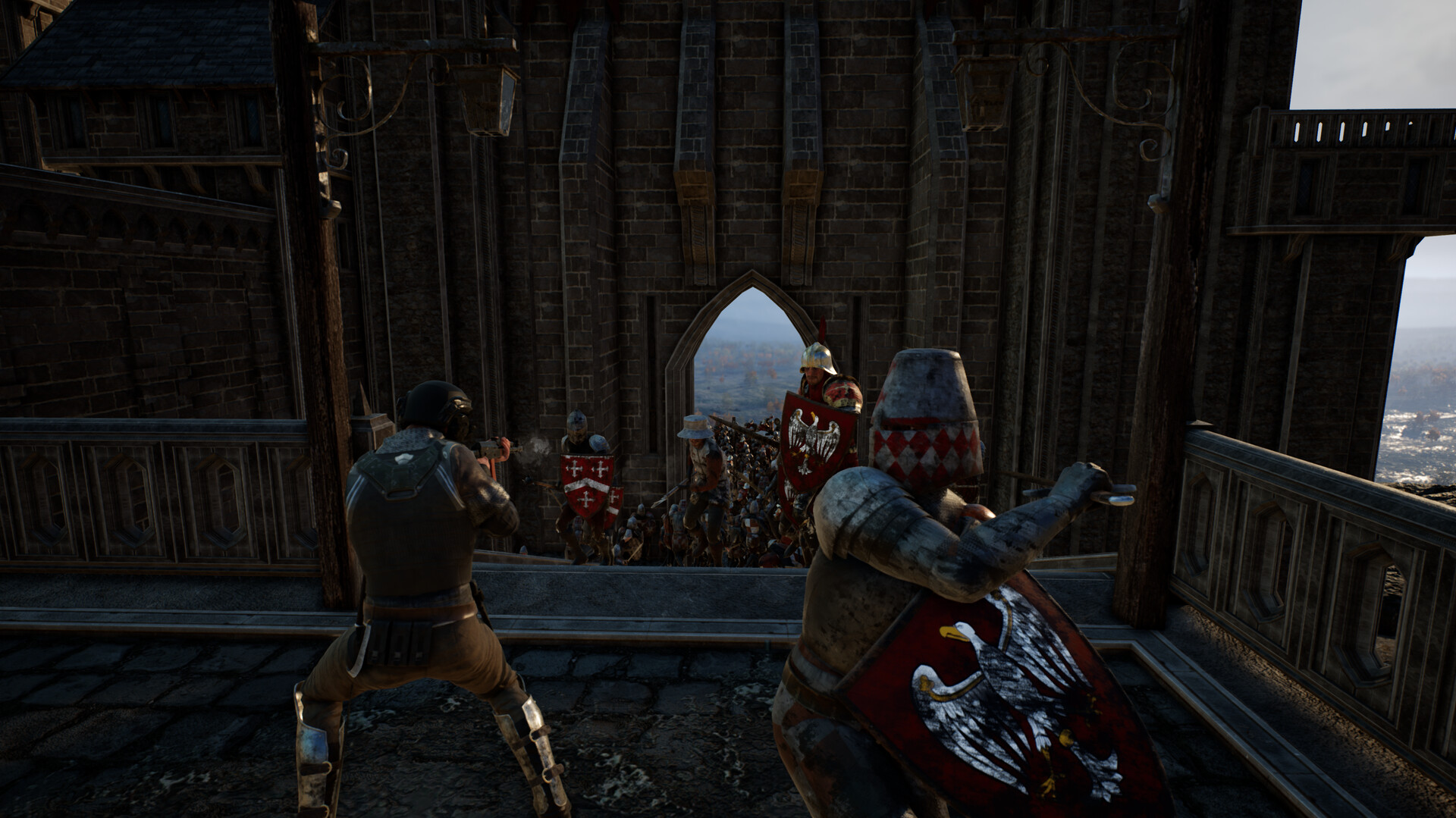
The destructible environment system reaches its most complex expression during castle sieges. Medieval castles in Kingmakers are multi-story structures with outer walls, inner walls, towers, gates, courtyards, and keeps. Every floor is fully navigable, and soldiers can fight room-to-room through the interior. The player can assault a castle by breaching the outer wall with explosives, smashing through a gate with a vehicle, or pounding it into rubble from a distance with trebuchets.
Once the outer defenses are breached, the fighting moves inside. Hallways, staircases, and rooms create close-quarters combat environments where SMGs and shotguns replace rifles. The player's medieval troops storm in alongside them, fighting hand-to-hand with defenders while the player clears rooms with modern firearms. Defenders can barricade doors and hold chokepoints, but the attacker can always find another way in by knocking down a wall. The interplay between destruction and interior combat creates a fluid, unpredictable siege experience that plays out differently every time.
Interior floors can collapse, dropping soldiers from upper levels to lower ones. Towers can be toppled entirely if their bases take enough structural damage. The cumulative destruction of a prolonged siege can reduce a once-imposing castle to a field of rubble, and the game's physics system handles every step of that transformation in real time. A six-story castle that looks impregnable at the start of a siege might be a pile of broken stone and timber by the end, with the battle having moved through every floor along the way.
Interior destructibility was extended during 2026 development builds to include furniture inside structures, so the objects that fill a room react to gunfire, explosions, and collisions rather than only the walls and floors around them. This is in-progress work on the unreleased build that deepens the close-quarters fighting once a siege moves indoors.
A July 2026 development update also confirmed work on an additional castle environment, alongside improvements to interior set dressing, furniture placement, and lighting inside existing castles. This is separate from the interior-destructibility furniture pass above; it covers how the spaces look and feel rather than how objects react to combat, and like the rest of the in-progress work described here, the exact scope may change before launch.
Tactical Implications
Destructible environments have genuine tactical consequences that go well beyond spectacle. Knocking a hole in a castle wall creates a new entry point that bypasses the gate, which may be heavily defended. Collapsing a tower eliminates an elevated archer position. Destroying a bridge cuts off an enemy's retreat or reinforcement route. Using a vehicle to punch through a building can open a shortcut for medieval units to pour through, turning a lengthy flanking maneuver into a straight charge.
On the defensive side, the player can use destruction to their advantage as well. Collapsing a building in the path of an advancing army creates an obstacle that slows their approach. Destroying a bridge forces the enemy to find an alternate crossing, buying time for reinforcements to arrive. Dropping a tower into a narrow pass can block it entirely. The environment is an active part of the tactical equation in Kingmakers, and players who learn to use destruction creatively will find solutions to problems that brute force alone cannot solve.
In co-op multiplayer, coordinated destruction becomes even more powerful. One player can breach a wall with explosives while another drives a tank through the front gate, creating simultaneous entry points that overwhelm defenders. A third player might call in an airstrike on a tower to eliminate crossbow fire before the breach team moves in. The combination of four players with different destruction tools operating simultaneously creates siege scenarios that are chaotic, unpredictable, and very difficult for the AI to defend against.
Optimization and Performance
Running a fully dynamic destruction system alongside thousands of AI soldiers, physics-driven debris, and modern and medieval weapons effects is an enormous technical challenge. The development team has said that roughly half of their development time goes toward optimization. Every feature that adds complexity to the destruction (new material types, more detailed debris, larger structures) also adds performance cost, and the team must constantly balance visual fidelity and physical accuracy against the 60fps target on mid-range hardware.
One of the key optimization techniques is the shield breakage system. Rather than simulating the physics of every individual piece of debris from a destroyed structure in perpetuity, the game uses a smart culling approach. Once debris has settled and is no longer interacting with soldiers or other objects, it transitions to a static state that costs almost nothing to render. Shields and armor fragments from destroyed fortifications follow the same pattern: they break in a physically convincing way during the moment of impact, then settle into optimized static geometry within seconds. This approach lets the game produce spectacular destruction without the debris pile from a demolished castle tanking the frame rate.
The engine choice ties directly into this optimization story. Unreal Engine 4.27 was selected over UE5 specifically because its physics pipeline handles the volume of simultaneous calculations more efficiently for Kingmakers' specific needs. The custom GPU shader-based animation system, which handles NPC animations on the GPU while the CPU sees them in T-pose, is another part of this optimization strategy. Together, these technical decisions allow Kingmakers to run at its target frame rate while maintaining the scale and physical fidelity that define its gameplay.
Five Years of Tech Development
The destruction system in Kingmakers is not something that was bolted on late in development. It has been a core pillar of the project since the beginning, and the team spent approximately five years iterating on the technology. Early prototypes focused on getting basic structural collapse working correctly: making walls fall in the right direction, making floors buckle under damage, and making debris scatter in a physically plausible way. Later iterations added material-specific behavior, environmental penetration for weapons, and the performance optimizations needed to run everything at scale.
The announcement trailer in February 2024 was the first time the public saw the destruction system in action, and it immediately became the game's most talked-about feature. The tinyBuild Connect show in May 2024 expanded on the destruction with extended gameplay showing tanks driving through buildings, explosives collapsing towers, and medieval siege weapons battering down castle walls. Each subsequent trailer has demonstrated incremental improvements to the system. This reflects the ongoing development work that continues even as the game approaches its Early Access launch.