

HUNGER's gameplay is structured around a recurring extraction loop: players leave the safety of The Chateau, venture into one of three large Expedition maps, complete quests, scavenge resources, fight hostile creatures and rival Living, and attempt to escape with their spoils. Dying during an Expedition means forfeiting any loot gathered on that run, but character levels and experience are never lost. Getting out is a procedure of its own: a survivor has to reach an active extraction point, wait out its timer, and interact with the balloon before the run's final countdown expires.
The Extraction Loop
Each Expedition is a high-stakes session in which players pursue objectives ranging from multi-stage quests to opportunistic looting. Every action in an Expedition earns experience, including killing enemies, looting containers, and completing quest stages. Quests are described by the developers as one of the most efficient routes to character advancement. Players can enter Expeditions solo, in pairs, or in trios.
Sound plays a critical role: firing a gun is audible to every player present on the map, making silence a tactical resource. Melee weapons allow for quiet traversal, while ranged firearms offer greater stopping power at the cost of revealing position.
Reaching an extraction is a readable process rather than a hidden one. Balloons descend into the region in full view and their smoke is visible from a long way off, while Deadsmoke, the red smoke that signals a contested extraction, appears only once two or more separate parties are inside the zone, so the warning means something when it shows. Standing in the zone is not enough on its own: the 30-second zone timer makes a player eligible to leave, and leaving still requires reaching the balloon and interacting with it. Certain items, maps among them, are flagged as protected so they cannot be carried into an Expedition and lost by accident.
Combat
Combat in HUNGER blends ranged and melee fighting in a first-person perspective. The arsenal at Early Access launch includes over 30 weapons, among them rifles, pistols, experimental hand mortars, axes, and maces. Archaic black-powder firearms are designed to handle responsively despite their period-accurate design. Many firearms use multi-step reload processes, and early flintlock and ramrod weapons can be specialized into through the Mastery tree to remain effective into the late game.
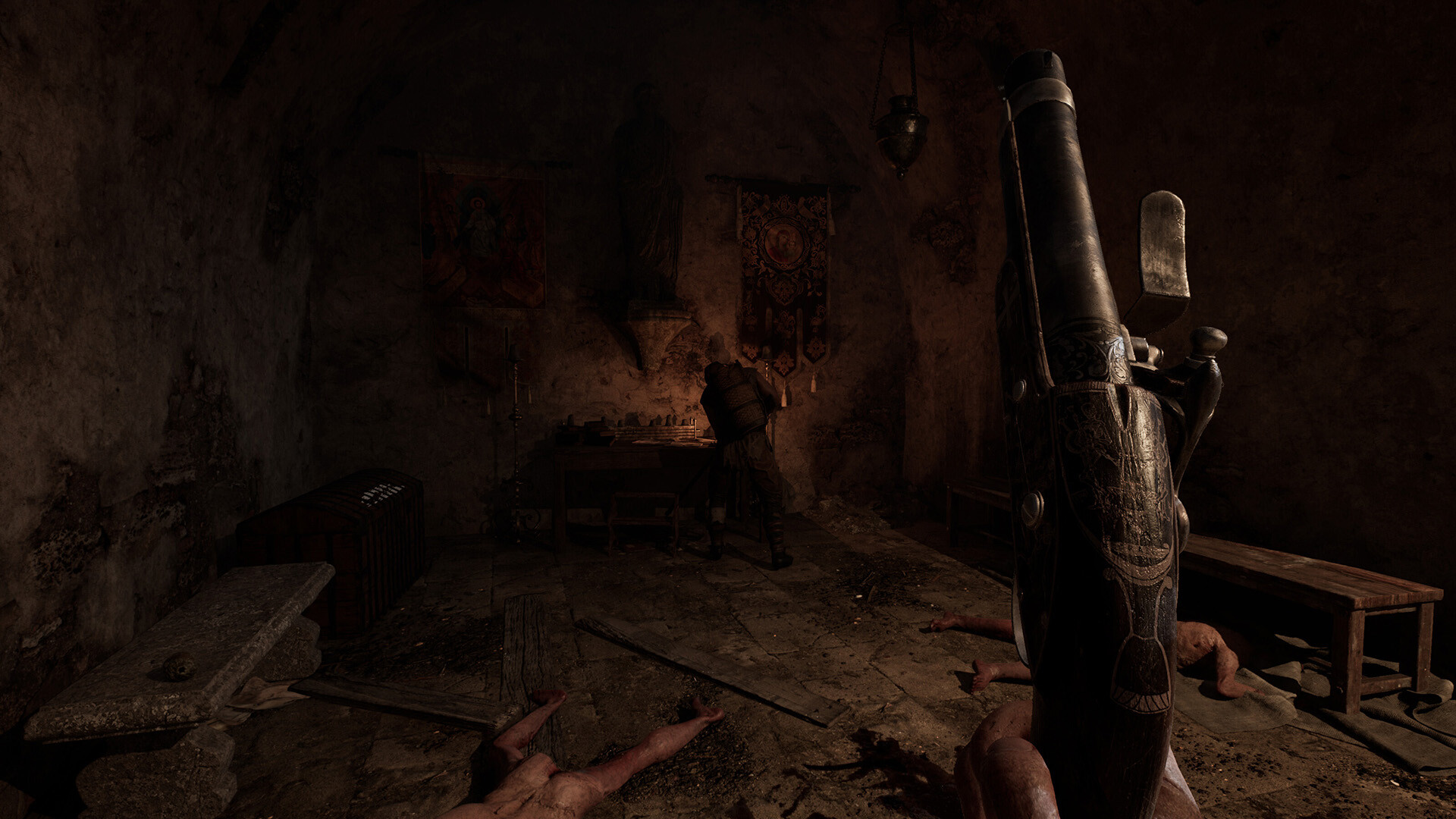
Armor in HUNGER provides limited, though meaningful, protection. Even the best available armor grants only one or two additional shots of survivability, ensuring that every player remains dangerous regardless of gear level. See Armor for the full repair and durability system. This design keeps encounters tense and discourages passive, armor-dependent play styles. Close-quarters combat also features a dismemberment system that adds extra impact and clearer visual feedback to melee encounters.
A Parry mechanic rewards well-timed defensive play, giving close-quarters fights another layer of skill on top of blocking and feinting, and the studio has kept expanding and refining it so that melee reads consistently across the full range of weapons and situations. Lunges, which close distance into melee, have been reworked so that they no longer inherit momentum from a dodge or a jump, making the move more predictable and readable for both the attacker and the defender. Melee weapon damage has also been rebalanced to reduce how often a single hit kills, opening a little more room for an exchange to develop without giving up the high lethality the game is built around.
Movement and Weight
Base movement speed has been raised slightly so traversal feels more responsive while keeping the deliberate pace the combat is built around. Heavier armour now carries a modest movement penalty, so protection and mobility trade against one another rather than stacking. Movement speed also runs into diminishing returns past a certain point, which narrows the gap between the slowest and fastest builds while still leaving room to specialise into a highly mobile character through gear and masteries.
Health and Healing
Every player begins each life with a default of 100 health, a standardized value shared across all players so that weapon time-to-kill stays balanced and no veteran starts with a vast health advantage. Health is restored only through Medicine items equipped to a dedicated Medicine slot. Repeated-use Bloodbags heal gradually over time while leaving the user exposed, and single-use Ampoules restore health quickly but can be interrupted by taking damage. The Health and Healing page covers these items in detail.
Stamina and Energy
Two resources govern movement and close combat. Stamina is consumed by sprinting, jumping, and vaulting, and it regenerates when the player is grounded and stable, rewarding deliberate movement over constant motion. A vault indicator on the heads-up display shows when an object can actually be vaulted, which removes the guesswork that used to leave players spending stamina on a jump into an obstacle they expected to clear. Energy is drawn from by every melee attack and block; depleting it leaves the player Exhausted, slowing attacks and weakening blocks. Energy only recovers when pressure is released, so fighting continuously through exhaustion prevents recovery.
Melee weapons can strike from eight directions plus a weapon-unique charged heavy attack, and attacking from an appropriate angle (such as an overhead swing with an axe) maximizes damage. Players can feint by canceling an attack early at no Energy cost, and a brief, well-timed block costs only a small fixed amount of Energy while sustained blocking drains it rapidly. Larger weapons offer broader block coverage, while smaller weapons demand tighter timing. A stamina-based dodge, performed with Left Alt together with a movement direction, gives players a defensive movement option in close combat, spending stamina to evade rather than relying on blocking alone, which keeps movement and stamina management part of every fight.
Beyond armor and weapons, players ready themselves for an Expedition with several equippable item categories. Shields can be carried for additional defensive coverage, and Trinkets are equippable items that modify how a character performs, including their Stamina and Energy gain, consumption, and efficiency. Medicines, bags, and food round out a loadout. The type of weapon a player fights with also shapes how much Energy each attack and block costs, so weapon choice and Trinket choice both feed into close-combat endurance.
See Stamina and Energy for the full breakdown of both pools, the committing-versus-holding principle, the feint and block cost rules, the named attack directions, and what happens once a Living is Exhausted.
Looting
Looting is the primary way players read the world. Containers such as crates, chests, cupboards, and barrels hold items suited to their environment, and contents are determined by container type, size, and chance. Some containers are disguised as piles of earth, sacks of grain, toolboxes, or even birds' nests. Loose loot also sits out in the open on tables, walls, and barrels. Opening a container takes time to rummage and identify its contents, leaving the player vulnerable while searching, and identification speed can be improved through food or scavenger-focused masteries. Both fallen players and slain creatures can be searched for loot.
Bags expand carrying capacity and let players extract more per run. Some containers are locked and require keys; a slower, riskier lockpicking option is planned to arrive after Early Access launch.
Food and Drink
Food and Drink are optional tools that reward planning. Food grants long-lasting bonuses that support a playstyle, such as Stewed Apple increasing container loot identification speed by 20 percent for 10 minutes. Effects from the same food category do not stack, so only the stronger of two similar dishes applies. Drink delivers stronger but shorter boosts, such as Boiled Water granting 10 percent faster movement for 40 seconds, suited to escapes or sudden bursts. Food and Drink can be purchased from NPCs, crafted, looted, or earned as quest rewards.
Map Traps
Maps contain environmental traps built into the level design and hidden in ruins, beneath bridges, and in dark corners. Some explode, some release poison, and others leave the victim bleeding. A given trap always occupies the same location, but its chance of being active varies from Expedition to Expedition, so a remembered trap can later be used against a pursuing player or creature.
Players who invest in the Survival mastery tree can learn to detect and disarm traps, and the Turncoat Mechanism talent lets a survivor assume ownership of traps placed by others, or built into the world, once they have spotted and avoided them, turning a hazard into a weapon against its original owner. Deployable, player-placed traps are planned for a later update rather than the Early Access launch. When they arrive they will be craftable through the right profession, cannot be triggered by the owner or their allies, and will feed the trapper’s down and kill counts, contributing to the experience they earn.
Character Progression
Each Living progresses from level 1 to 100. Leveling unlocks access to deep, customizable Mastery trees containing over 100 talents. Players can specialize toward a preferred style: stealth-focused builds can emphasize quietened movement and lockpicking; ranged specialists can prioritize reload speed and weapon handling; support-oriented builds can invest in armor repair and team healing. Multiple character slots unlock at progression milestones, allowing players to explore different builds simultaneously.
The game does not impose season resets or forced wipes. Progression is permanent and cumulative. The optional Prestige mechanic allows a player to voluntarily reset a character to level 1 and clear their Mastery trees; doing so removes their current build but unlocks exclusive legendary cosmetics unavailable by other means.
Professions
Players can choose a unique crafting or gathering profession alongside their combat role. Professions range from armor repair to medicine production and allow players to create goods for personal use, support their companions, or sell within the player-driven Marketplace at the Chateau. The ability to advance a profession unlocks in the Cauldron, the second district of the Chateau. Professions add an economic and cooperative layer to the game, rewarding specialization and community interdependence.
Endgame
Beyond standard Expeditions, HUNGER includes endgame content such as dungeons and boss encounters. One named dungeon, the Pit, has been confirmed by the developers. Dedicated PvP scenarios are also part of the game's confirmed scope, with additional endgame content planned for the Early Access period.