

This article is incomplete
Some sections are missing or need additional details. Help improve it by contributing.
Expeditions are the core activity in HUNGER. Players leave The Chateau, enter one of three large maps, and pursue objectives before extracting with whatever they have gathered. Death during an Expedition results in losing any loot carried at the time, though character experience and levels are never reset. Each run is high-stakes precisely because the reward depends on surviving to reach the extraction point.
Selecting an Expedition
Every run begins at the Expedition Map, reached through Reynauld's map inside the Chateau. The party leader picks the destination and commits the group, after which matchmaking runs in the background while everyone else keeps preparing. Once a route is found a ten-second countdown starts, and at zero the party leaves together. Destinations rotate on the hour across twelve-hour, three-hour and one-hour windows, and each run carries its own time of day and weather, so the same map can be entered at sunrise under clear skies or in fog after dark.
Objective Types
Expeditions support multiple types of objectives. Quests are multi-stage missions available from NPC quest givers at the Chateau. They require players to explore maps, find specific items, or reach particular locations. Quests are confirmed as one of the most efficient sources of experience, and many of them leave the approach open so a player can fight through, sneak past, or simply avoid danger. Players can also pursue opportunistic looting, hunting enemies for their drops, or targeting rival Living for their gathered spoils.
Party Size
Players can enter Expeditions alone, as a duo, or as a trio. Party coordination provides advantages in combat and quest completion, but also increases visibility and the potential for other players to identify and engage the group. Proximity voice communication lets nearby players speak to one another in the field, whether they are allies or strangers.
Maps
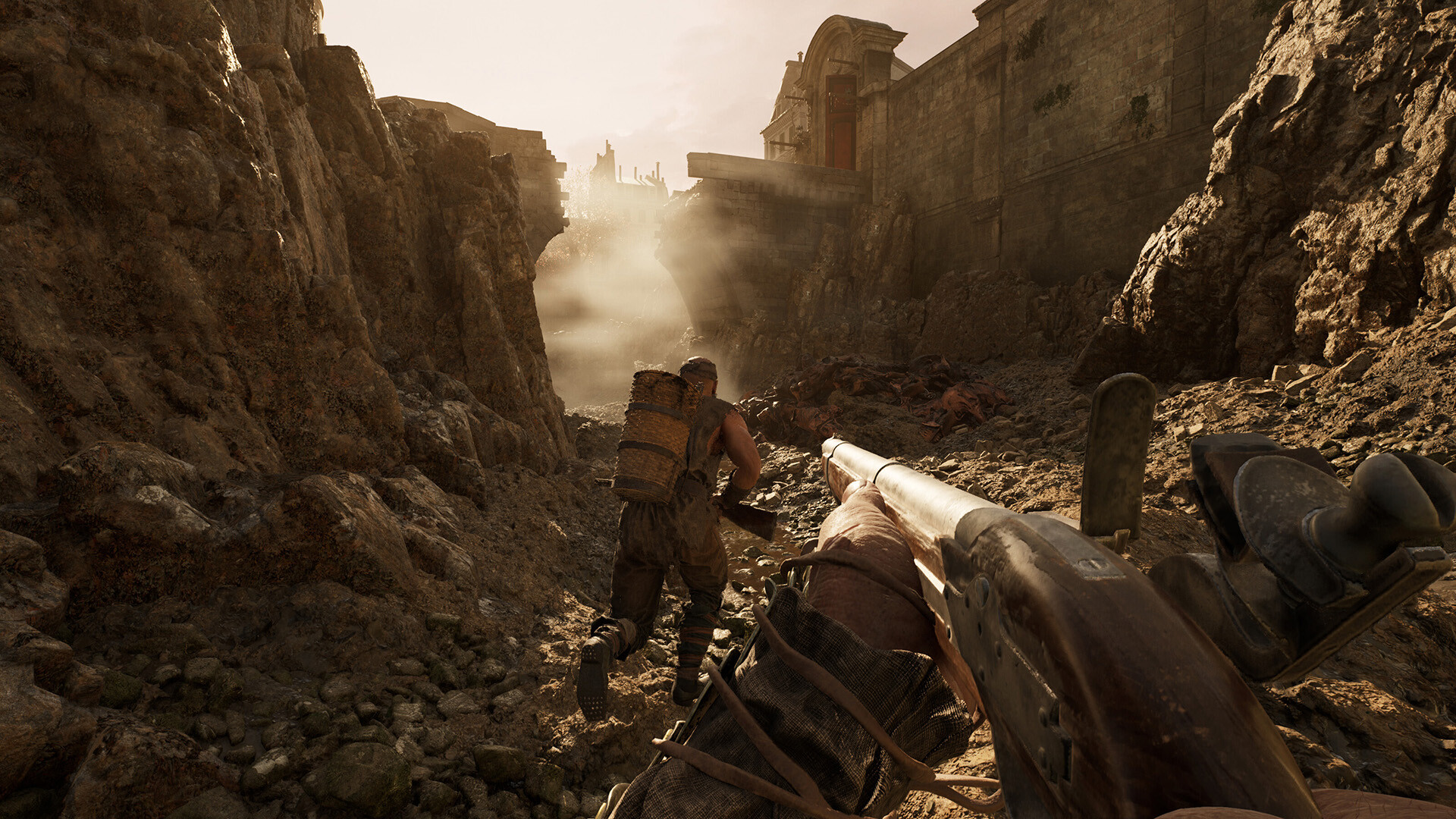
Three large and distinct maps are available at Early Access launch, with additional locations planned for post-launch updates during the Early Access period; the studio's published plans commit to two further Expedition locations over that time, and a new map is among the things it has said it is looking at for the first major content update. The confirmed launch maps are Sombre Forest, shown in official gameplay footage, along with Jacques Bridge and Sarlat Farm. Each map covers roughly one square kilometer of explorable terrain with an extensive dungeon beneath it. Across these environments players move through forests, villages, monasteries, citadels, and mines, each offering a different character and challenge.
Looting and Hazards
Every run is also an exercise in scavenging. Containers and loose loot are scattered through each map, with contents shaped by the environment, and both fallen players and slain creatures can be searched. Maps also hide environmental traps that can explode, poison, or cause bleeding; a trap always sits in the same spot but may or may not be active on a given run, so survivors learn to read the terrain and remember where danger lies.
Risk and Reward
The balance of risk against reward shapes every decision in an Expedition. Rare gear, advanced weapons, crafting ingredients, cosmetics, and other resources are obtained through successful runs. The further a player pushes into a session and the more they gather, the greater the potential loss if they do not make it out. This tension is central to the extraction loop. Currency carried out of a successful run is transferred automatically to the player's Stash back at the Chateau, while gear and other items must be deposited there to be kept safe between Expeditions. A studied map marks the active extraction points for a run and shows the player's own position and facing, and the compass displays the distance to extraction. Reaching an extraction zone starts a 30-second timer that makes a player eligible to leave, but the departure itself still requires walking up to the balloon and interacting with it. Some extractions are reached aboard dirigibles, which carry their own interaction prompt.
Extraction itself is signposted. Balloons descend into the region before a zone opens, so their smoke carries a long distance, and Deadsmoke, the red smoke that marks a contested extraction, appears only once two or more separate parties are inside the zone, so it reads as a genuine warning rather than background noise. Items flagged as protected, such as maps, cannot be taken into a run by mistake. Extraction points open progressively rather than all at once, and when the final balloon arrives a ten-minute countdown closes the run out; anyone who has not extracted by then is lost.