

HUNGER arrives in Early Access with more than 30 weapons that blend ranged firearms and melee arms in a first-person perspective. The roster includes rifles, pistols, experimental hand mortars, axes, and maces, and more weapons are planned to expand it during Early Access. Weapon choice shapes nearly every fight, from the noise a player makes to how quickly their Energy drains in close combat.
Ranged Weapons
Firearms in HUNGER are archaic black-powder arms true to the Napoleonic setting, but they are designed to handle responsively rather than feeling sluggish. Many use multi-step reload processes that take time and leave a player committed, so reloading at the wrong moment can be fatal. Early flintlock and ramrod weapons are not left behind as a character grows: they can be specialized into through the Mastery tree to stay effective into the late game. Ranged weapons offer greater stopping power and the ability to engage at distance, at the cost of revealing a player’s position.
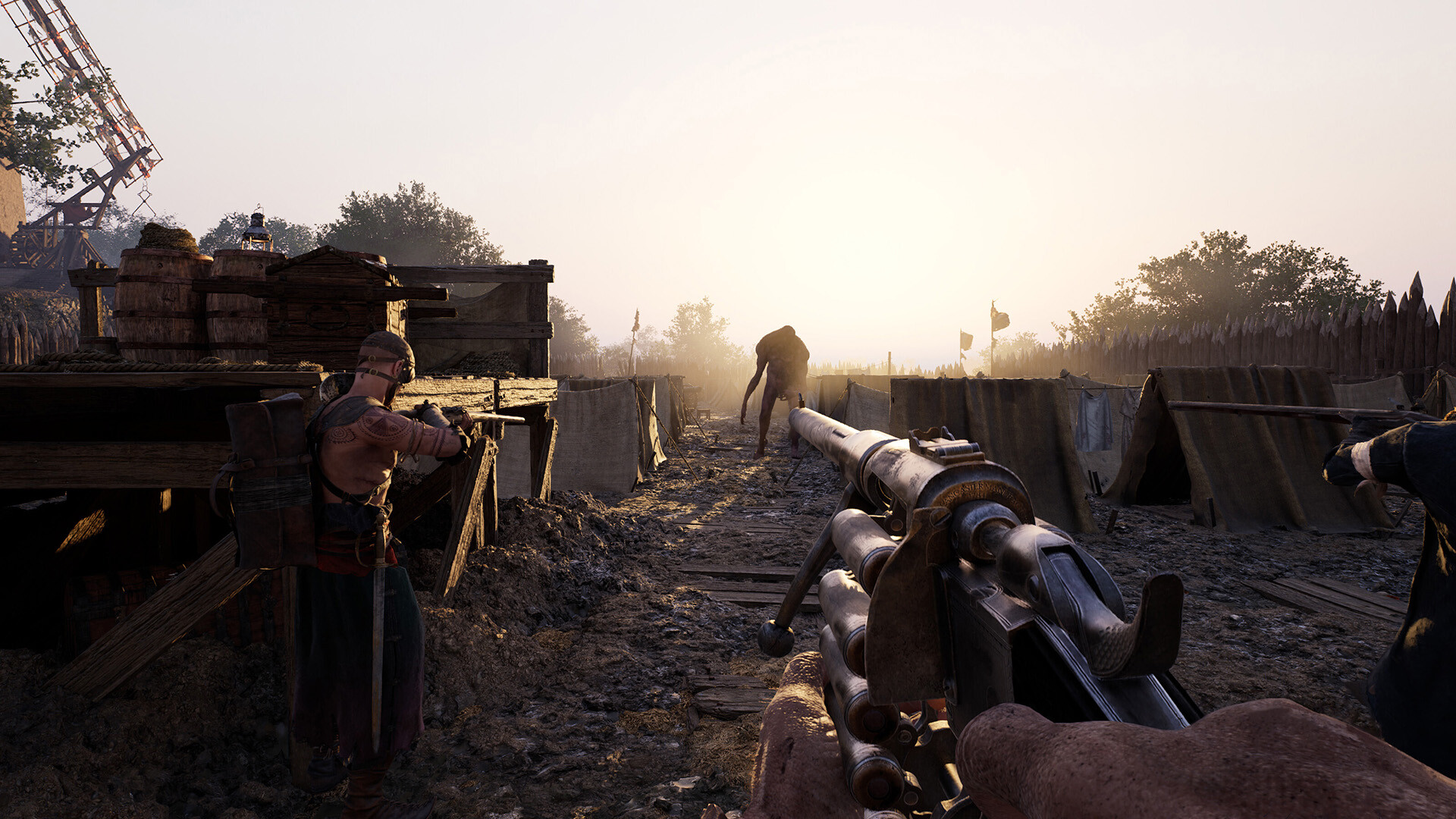
Sound is central to ranged combat. Firing a gun is audible to every player on the map, which turns silence into a tactical resource and makes the decision to shoot a meaningful one.
Thrown weapons sit alongside the firearms. The experimental hand mortar lobs explosive glass grenades, and official art covers ceramic grenades, magnesium grenades, a poison grenade and a smoke grenade, so the category reaches past simple explosives into utility.
Melee Weapons
Melee weapons allow for quiet traversal and close-quarters fighting without giving away position. They can strike from eight directions, plus a weapon-unique charged heavy attack, and attacking from an appropriate angle, such as an overhead swing with an axe, maximizes damage. Players can feint by canceling an attack early at no Energy cost, while a brief, well-timed block costs only a small fixed amount of Energy and sustained blocking drains it rapidly. Larger weapons provide broader block coverage, whereas smaller weapons demand tighter timing.
Close-quarters fighting is governed by the Energy resource and features a dismemberment system that adds extra impact and clearer visual feedback to melee encounters. The type of weapon a player wields directly affects how much Energy their attacks and blocks cost, so weapon choice is part of managing endurance in a fight.
A Parry was added on top of blocking, rewarding a defence timed to the incoming swing rather than one held up in advance, and the studio has continued expanding and refining it so that it behaves consistently across the full range of weapons and situations. Lunging into melee was also reworked: a lunge no longer carries momentum over from a dodge or a jump, so closing distance is consistent instead of being amplified by whatever the attacker did immediately beforehand. The studio has described the earlier version as too dominant, closing distance so reliably that fights ended before any real exchange developed. Melee weapon damage has since been rebalanced to reduce the frequency of one-shot kills, leaving more room for an exchange to play out while keeping the high lethality the game is built around.
The costs behind all of this are covered in Stamina and Energy, which sets out how much each attack and block draws, how the eight directions differ, and why holding a block is worse than timing one.
Shields and Trinkets
Alongside offensive arms, players can equip Shields for additional defensive coverage and Trinkets that modify their performance, including Stamina and Energy efficiency. These sit in a loadout next to armor, bags, and medicine, and together they let a player tune how aggressive or defensive their kit is before heading into an Expedition.
Equipping and Drawing
The studio draws a firm line between drawing a weapon and equipping one. Drawing is what happens when a Living pulls out a weapon they already hold in an active slot: swapping from the primary to the secondary and back again plays a draw animation each time. Equipping is the slower act of taking a weapon out of one of the stowed positions in a bag and moving it into the primary or secondary slot.
Equipping used to be effectively instantaneous. A player could open the inventory, double-click a stowed weapon and have it active at once, which let anyone carrying several high-capacity weapons cycle through them mid-fight and sidestep the limits the two active slots are meant to impose. A dedicated equip animation and equip time now cover that transfer, built on the same principle as putting on chest armour: the character spends a moment physically taking the weapon out of their bags before it can be drawn normally. Carrying spares is still worthwhile, but changing an active loadout now means making the time and space to do it rather than swapping mid-exchange. See Inventory and Loadout for how the stowed and active slots are laid out.
Weapons and Survivability
HUNGER deliberately keeps the gap between weapons narrow enough that gear never guarantees a win. Better weapons may shorten the time-to-kill, but the standardized 100 health pool and the narrow armor range mean skill, positioning, and decision-making remain the deciding factors. Even a player with top-tier equipment can be beaten by a more skilled opponent, which keeps every encounter tense and discourages passive, gear-dependent play. Weapons can be acquired through combat, looting, crafting, and the player Marketplace, and their appearance can be permanently altered with weapon cosmetics.
Named Weapons in Official Art
The studio has not published a weapon list, but it names individual weapons in the filenames of the art it distributes to press. Those names confirm the weapon exists as official HUNGER art. They do not confirm which weapons ship in the current build, what their stats are, or how they are classified, so the table below records what has been named rather than a launch roster.
Group | Names Appearing in Official Art |
|---|---|
Swords and polearms | Long Sword, Short Sword, Rapier, Zweihander, Halberd |
Axes and blunt | War Axe, Mace, and two further axe designs, one of them styled as a hermit's axe |
Daggers | A base dagger set plus variants named Emperors Talon, Golgotha, Harrow, Kraken, Misericorde, Sindle, Stag and Tenebris |
Firearms | Auster, Barking Iron, Borodino, Cavalier, Ceinture, Drak, Jager, Kompas, Lionne, Snub, Swan, Vepr and Voir, plus a rifle named Louisville and a pistol named Deux |
Thrown | Ceramic grenades, magnesium grenades, a poison grenade and a smoke grenade |
The dagger variants are most likely appearance options rather than separate weapons. One of them, Misericorde, is named in the studio's own writing on Cosmetics as a dagger cosmetic, and a War Axe finish called Sacrament is named in the same place. Those two are the strongest evidence in the group, because they are described in prose rather than inferred from a filename.